
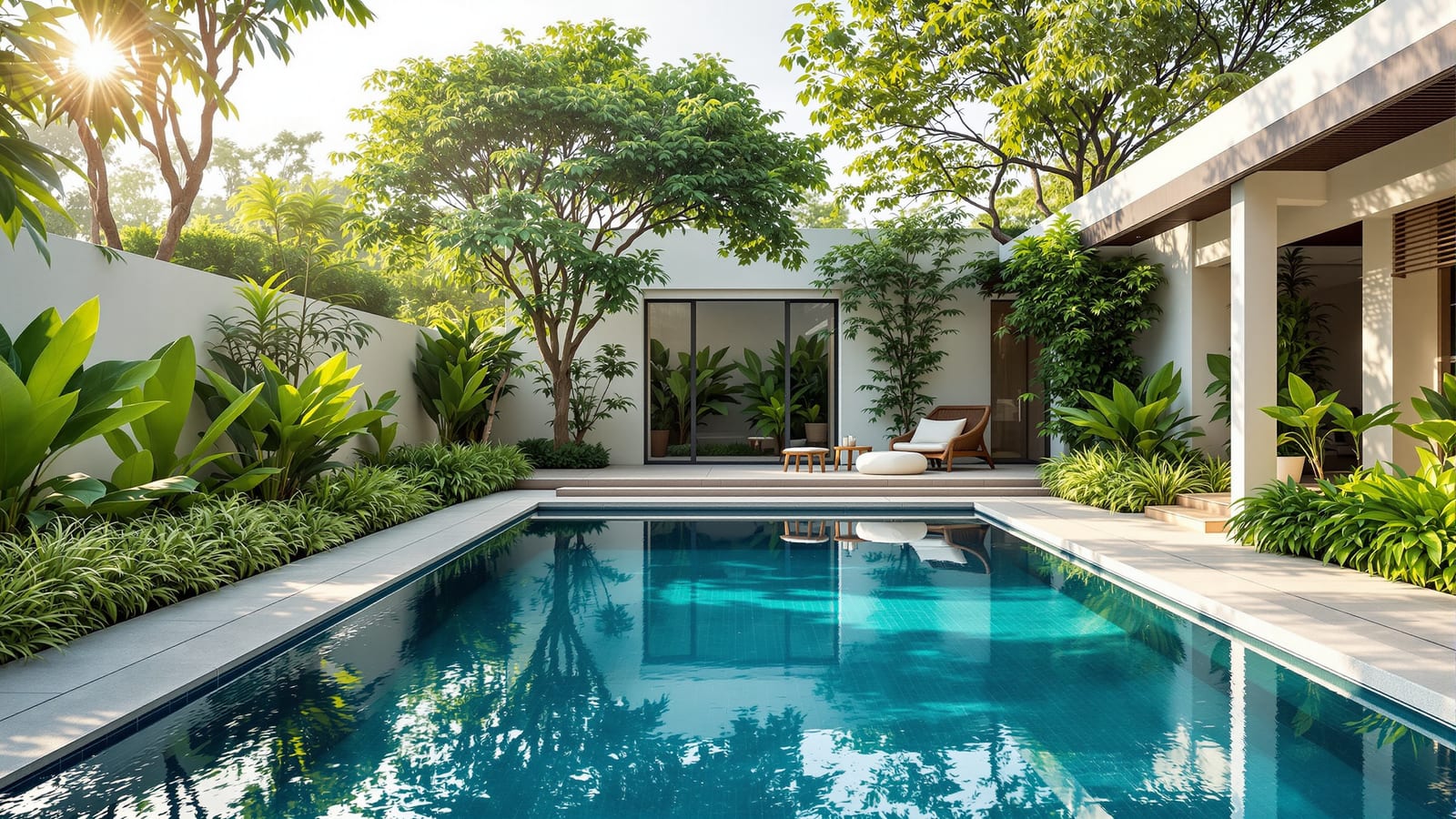
Vastu for Swimming Pools: Direction, Placement and Shape
What Vastu Shastra traditionally says about a pool's direction, placement, shape and slope — held honestly against the engineering, safety and site realities that come first.
Few elements in a home carry as much symbolic weight as water. In Vastu Shastra, the ancient Indian tradition of placement and orientation, water is associated with flow, prosperity and calm — and a swimming pool is one of the largest bodies of water most families will ever bring into their property. So it is natural that homeowners planning a pool want to know what Vastu has to say about its direction, shape and position.
This guide gathers the most commonly cited Vastu positions on swimming pools and presents them honestly. That honesty matters. Vastu is a traditional belief system, not a branch of engineering, and even its own authorities disagree on the specifics. Our aim is to help you treat Vastu as one input among several, weighed sensibly against site reality, sunlight, drainage, structural safety and your budget. If you would like the full technical picture of building a pool in India, read the complete home pool guide alongside this one.
A note before you start
It is worth being clear from the outset. Vastu Shastra is a cultural and spiritual tradition with deep roots in Indian life. It is not a building code, it carries no engineering or safety basis, and following it confers no structural, legal or financial benefit that can be measured. For many families it brings comfort, continuity and a sense of harmony, and that is a perfectly good reason to consider it. But it should never override the things that genuinely keep people safe.
Three things always come first, no matter what any Vastu consultant advises. First, structural safety: a pool is a heavy, water-filled load that must be designed by a qualified structural engineer, especially on a terrace or sloping plot. Second, waterproofing and drainage: a poorly sealed or badly drained pool will damage your home far more reliably than any direction ever could. Third, local rules: municipal bye-laws, setback requirements, water-supply norms and pollution-board guidance are legally binding, and a pool placed in a Vastu-preferred corner that violates a setback is still illegal.
You should also know that Vastu authorities do not speak with one voice. On almost every point below — direction, shape, slope, even rooftop versus ground — you will find respected practitioners who disagree. This is not a settled science with a single correct answer. Treat what follows as widely repeated belief, not as fact, and feel free to weigh it against common sense and your architect's advice.
Direction: where Vastu favours a pool
The most frequently cited "auspicious" direction for water features, and for a swimming pool, is the North-East, known in Vastu as Ishanya. This corner is traditionally linked with water and with positive energy, and many consultants name it as the ideal zone for a pool, a fountain or any standing water. The North and the East are the next most commonly recommended directions, again associated with prosperity and well-being in the tradition.
That said, the disagreement starts almost immediately. Some sources broaden the favoured set to include the North-West or the West, and a few advise the North-East specifically for fountains while steering large pools elsewhere. So while North-East, North and East represent the mainstream Vastu preference, you will not find perfect consensus even among well-known authorities. The figure below summarises the directions most often described as favourable and those most often discouraged.
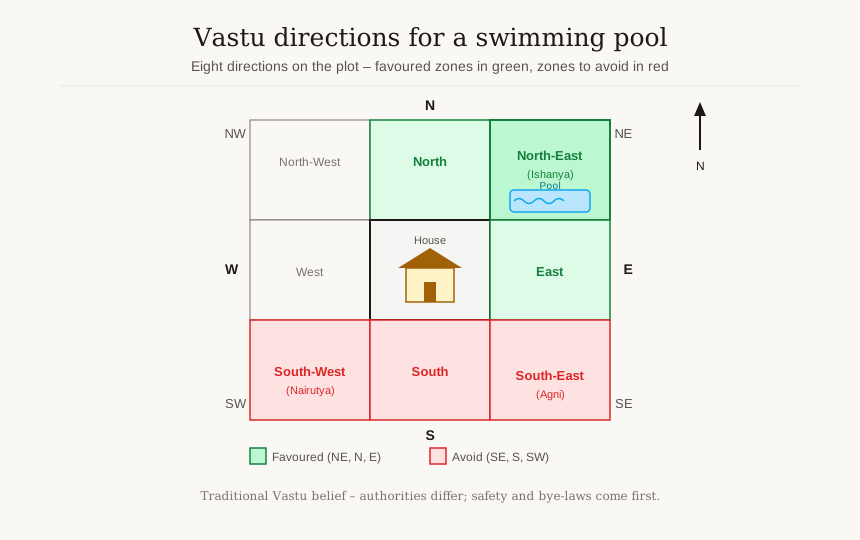
The practical takeaway is gentle. If your site naturally allows a pool in the north-east, north or east — and if that placement also makes sense for sunlight, access and drainage — then a Vastu-minded family can feel reassured. But the direction of a compass needle is rarely the most important factor in whether a pool works well.
Directions Vastu advises avoiding
The directions Vastu most consistently advises against for a pool are easier to summarise, because the tradition is more united here.
The South-East is the most cautioned-against corner. In Vastu this is the Agni, or fire, corner, governed symbolically by fire and energy. Placing water — the element opposed to fire — in the fire corner is considered an elemental clash, and the South-East is therefore widely discouraged for pools.
The South-West, called Nairutya, is the second direction Vastu typically warns against for water. This corner is associated with stability, earth and the weight of the household, and standing water here is traditionally believed to undermine that grounding quality. Many consultants regard a heavy water body in the South-West as among the least desirable placements.
The South generally rounds out the cautioned zones. As with all of the above, remember this is belief rather than measurement, and a small number of sources will dissent. But South-East, South-West and South are the directions most Vastu practitioners would prefer you avoid for a pool.
Shape, slope and flow
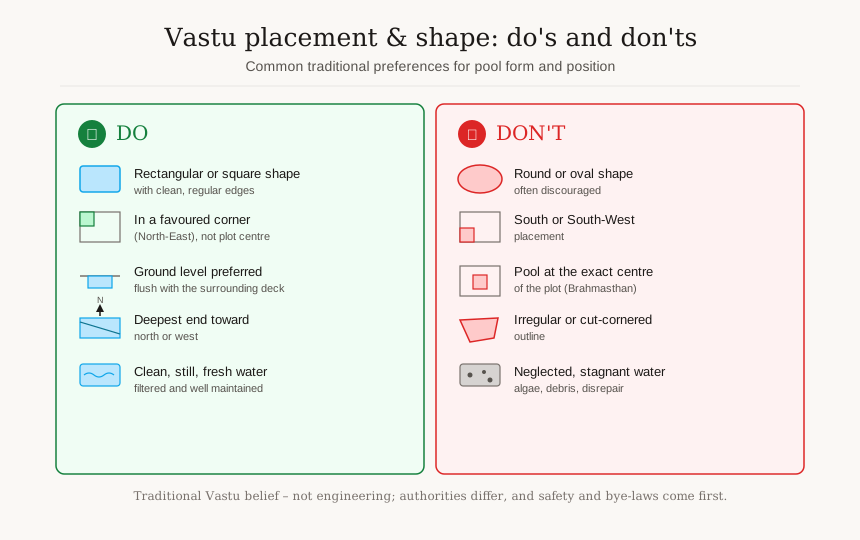
On shape, the mainstream Vastu view favours regular geometry. A rectangular or square pool is considered auspicious, its clean lines associated with order and balance. Round, oval, curved or irregular "freeform" shapes are often discouraged in traditional Vastu, even though they may be exactly what a contemporary designer would recommend for a relaxed, organic garden. If you love a curved pool and Vastu is only a soft preference for you, this is an easy place to follow your own taste — and our pool design ideas gallery shows how striking both geometric and freeform pools can be.
On slope and flow, one commonly cited authority offers fairly specific guidance: the deepest end of the pool should sit toward the north or the west, the shallow end toward the south or east, and the water should be designed to flow from west to east. The reasoning is symbolic rather than hydraulic. Treat this as one school of thought; other practitioners describe it differently, and your engineer's drainage design will, and should, take precedence over any of it.
It is worth pausing on that last point. The real-world slope of a pool floor exists to drain it safely and to position the deep end sensibly for swimmers. If a Vastu prescription about slope direction happens to align with good drainage, wonderful. If it conflicts, the drainage wins every time.
Placement, level and surroundings
Beyond compass direction, Vastu offers some general placement preferences. A pool is usually advised to sit in a favoured corner of the plot rather than at the dead centre — the centre of a plot, known as the Brahmasthan, is traditionally kept open and uncluttered in Vastu, so a large water body there is discouraged.
Many practitioners also prefer a ground-floor or in-ground pool over a rooftop or upper-level one, partly on symbolic grounds about water belonging close to the earth. Here, happily, Vastu and engineering often agree: a rooftop pool is a serious structural undertaking, and the instinct to keep heavy water low is sound for entirely practical reasons too.
For the surroundings, the tradition leans toward keeping the pool clean, well-maintained and pleasant — stagnant or murky water is considered inauspicious, which is hardly controversial. Thoughtful planting, lighting and edging around the pool support both the Vastu ideal of calm, flowing positivity and the simple reality that a well-landscaped pool is a joy to use. Our pool landscaping guide covers this in depth.
When Vastu and site reality conflict
Sooner or later, many homeowners find that the Vastu-preferred placement collides with the practical realities of their site. The north-east corner might be where the sun never reaches, leaving a cold, leaf-strewn pool. The "wrong" corner might be the only one with proper fall for drainage, safe access for children, or room to meet setback rules.
When this happens, the answer is straightforward: site reality wins. Choose the placement that gives you safe structure, reliable drainage, good sunlight for warmth and algae control, easy supervision of children, and full compliance with local bye-laws. A pool that is warm, clean, safe and legal will serve your family far better than one placed by the compass but plagued by cold water, poor drainage or a structural worry.
This is not a rejection of Vastu. It is simply putting it in its proper place — as a cultural and aesthetic preference to honour where you reasonably can, and to set aside where it would compromise safety or usability.
A balanced checklist
If you would like to keep Vastu in mind without letting it run the project, here is a sensible order of priorities. Start with structural safety and a qualified engineer's sign-off, particularly for any raised or rooftop pool. Confirm municipal bye-laws, setbacks and water norms before anything else is fixed. Get the waterproofing and drainage design right. Choose a position with enough sunlight to keep the water warm and clear, and with safe, supervised access. Then, within whatever options remain, lean toward a north-east, north or east placement and a clean rectangular or square shape if Vastu matters to you. And if a genuine conflict appears, let safety, drainage, sunlight and budget make the final call.
Above all, remember that the disagreements among Vastu authorities mean there is rarely a single "correct" answer to chase. Comfort and harmony, not anxiety, are the point. If you want to read more broadly about the tradition, our Vastu library collects guidance for rooms, plots and homes across the property.
Design it well, whatever your view on Vastu
A pool is a long-term investment and a source of years of pleasure. Whether you follow Vastu closely, loosely or not at all, what truly determines your satisfaction is good design and sound construction: the right size for your plot, safe and sensible placement, reliable engineering, smart landscaping and a look you love.
If you want help balancing tradition, site constraints and great design, find an architect through Studio Matrx. A good professional can hear your Vastu preferences, respect them where they fit, and gently steer you when safety or practicality should lead — so you end up with a pool that feels right in every sense.
Export this guide
Related Guides — Deep-dive reading
Vastu for Compound Wall and Gate in India: Directions, Height and Entrance (2026)
A respectful, practical guide to the Vastu principles many Indian homeowners follow for the boundary wall and main gate — main-gate direction, a lighter open north-east, a heavier taller south-west, gate placement within a wall side, and a continuous well-kept wall — with the everyday rationale where one exists, and an honest reminder that municipal bye-laws, structure and your budget come first.
Compound WallsThe Best Trees for Indian Homes
A research-grade guide to choosing and placing trees around an Indian home — the real cooling and clean-air numbers, the right species for shade, flowers, fragrance and fruit, and the placement science that keeps roots out of your walls and drains.
LandscapeWater Features in Landscape Design — A Complete Guide for Indian Homes
Why water, the full family of features (fountains, ponds, waterfalls, reflecting pools, rills), how to choose, site, cost and maintain one — with safety and mosquito control
LandscapeRelated Tools — Try Free
Vastu Compass — Direction Detector
Use your phone compass to detect room directions and get instant Vaastu Shastra recommendations.
Compass + VastuCross-Ventilation Analyzer
Estimate airflow and air changes per hour (ACH) from room size, window areas, layout, and local wind — with NBC 2016 Part 8 compliance check.
Ventilation CalculatorMonsoon-Readiness Checklist
Pre-rain home audit across 9 categories — terrace, drains, waterproofing, electrical, HVAC, pest, vehicles, documents.
Seasonal Audit