
Geoffrey Bawa's Façade Signature: How Tropical Modernism Dissolves the Wall for Humid India
How Geoffrey Bawa, the father of tropical modernism, replaced the sealed façade with a layered, breathing threshold — verandah, deep eave, courtyard and water — that merges the building with its garden, and why it is the most directly transferable lesson for hot-humid coastal India.
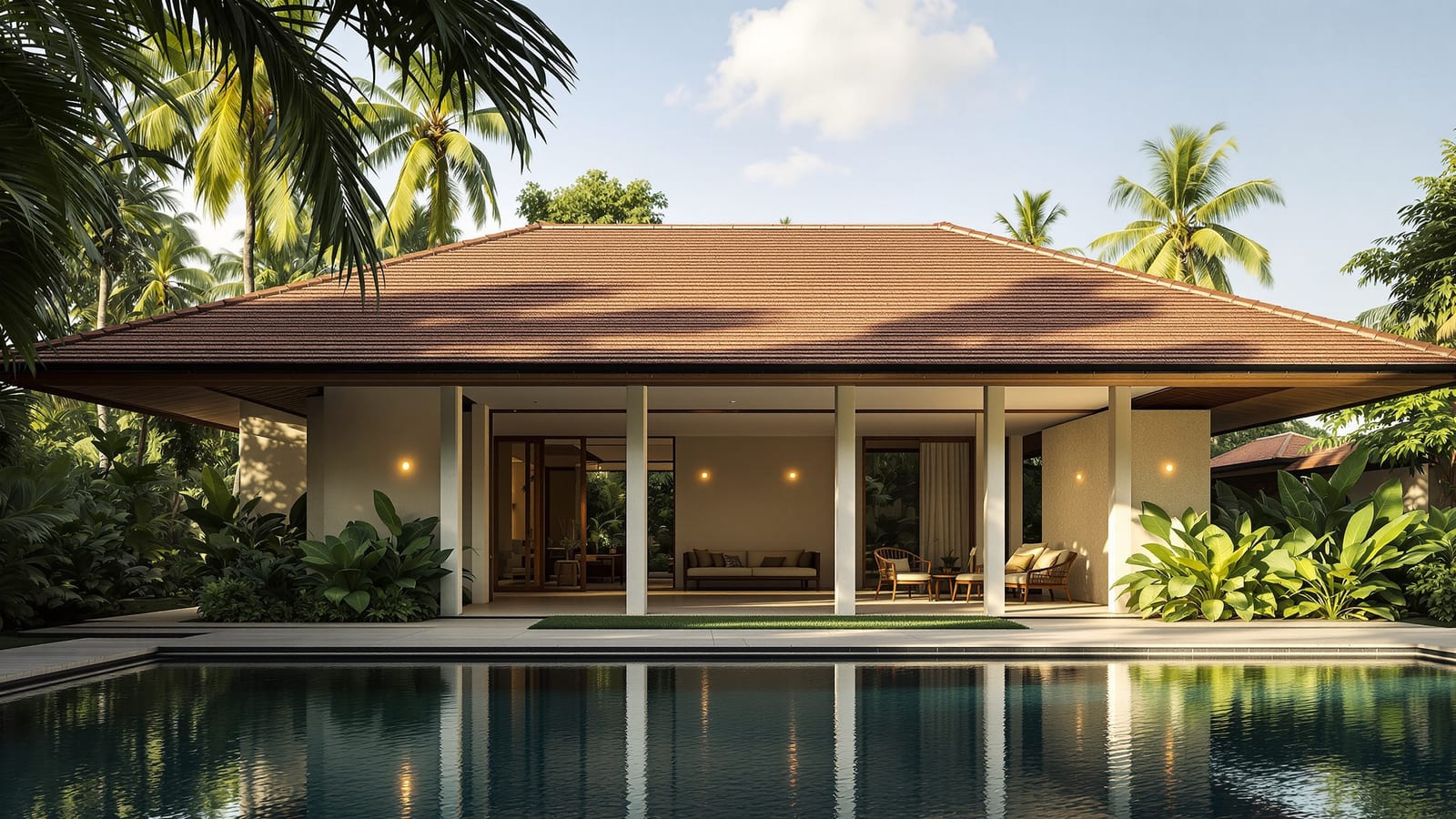
Walk up to a Geoffrey Bawa building and you go looking for the front — and you cannot quite find it. There is no flat wall presenting itself to you, no proud entrance elevation to photograph. Instead there is a deep, dark band of shade under a wide tiled roof; behind it, an open verandah of slender columns; behind that, a courtyard with water and a tree open straight to the sky; and somewhere in there, almost incidentally, the line where "outside" becomes "inside" — except you crossed it three thresholds ago without noticing. The building has no face. It has a depth you move through.
This is the great paradox of Bawa's façades, and it is the most useful idea in this entire series for one half of India. Bawa (1919–2003), the Sri Lankan architect universally called the father of tropical modernism — a way of building that fuses modern open planning with the shade, breeze and craft of the wet tropics — spent his life dissolving the wall. He decided that in a hot, humid, monsoon climate the worst thing a building can do is seal itself behind a single sealed face and then chill the air behind it. The best thing it can do is open up, layer shade in front of openness, and breathe.
This is part of our Building Façades series — specifically our Masters of the Façade set, where we study how one great architect handled the building's skin. We already tell Bawa's life story in our Geoffrey Bawa biography, so this guide stays narrowly on his façade language. Read it alongside our climate-responsive façades guide, the timber and natural façades guide and the jaali and traditional Indian façades guide for the screens — and against his fellow tropical-climate masters, the Charles Correa façade signature and the B. V. Doshi façade signature. Because where Correa, Doshi and Rewal answered hot-dry India with thermal mass, Bawa answers hot-humid India — and that is a different climate with a different right answer.
1. Tropical modernism — the climate decides, the wall opens
Tropical modernism is the idea that modern architecture in the wet tropics should not look or behave like modern architecture in cold Europe. A sealed glazed box works in Stockholm because the problem there is keeping heat in. In Colombo, Kandy, Kochi or Goa the problem is the opposite — keeping heat and glare out while letting air through — and a sealed box does exactly the wrong thing, trapping heat and humidity until you fight it with permanent air-conditioning.
Bawa's response was to let the climate, not the imported style, decide the form. The first job of a Bawa wall is to manage sun, rain and air; everything else — how it looks, what it is made of — follows from doing that job honestly. This is the same instinct Correa called "form follows climate," and the two men are the great tropical pair of the subcontinent. But where Correa worked the dry heat of Ahmedabad and Mumbai with heavy thermal mass, Bawa worked the dripping humidity of Sri Lanka, where mass matters far less and shade plus cross-ventilation matter most. The humid answer is not a thick wall that stores coolness; it is an open building that never lets the air go still.
2. The dissolved façade — there is barely a "front"
Bawa's single most radical move is the dissolved, permeable façade: the deliberate refusal of a single sealed face. Most architects design a building and then design its elevations — the front, the sides, the wall you look at. Bawa designed buildings that have, in any conventional sense, almost no elevation at all. The boundary between inside and outside is blurred on purpose, so the building merges with garden, courtyard, sky and water rather than presenting a surface to the street.
You see this most dramatically at the Kandalama hotel, which famously seems to vanish into the jungle behind a curtain of planting, and at his own garden estate, Lunuganga, where it is genuinely hard to say where the building stops and the garden begins. The "wall" is not a barrier; it is a threshold — a zone you pass through, made of shaded in-between spaces. Define this clearly: in a Bawa building the façade is not a plane, it is a layered edge, several metres deep, built from verandahs, screens, courts and overhangs stacked one behind another.
3. The verandah and loggia — the real façade is a space you move through
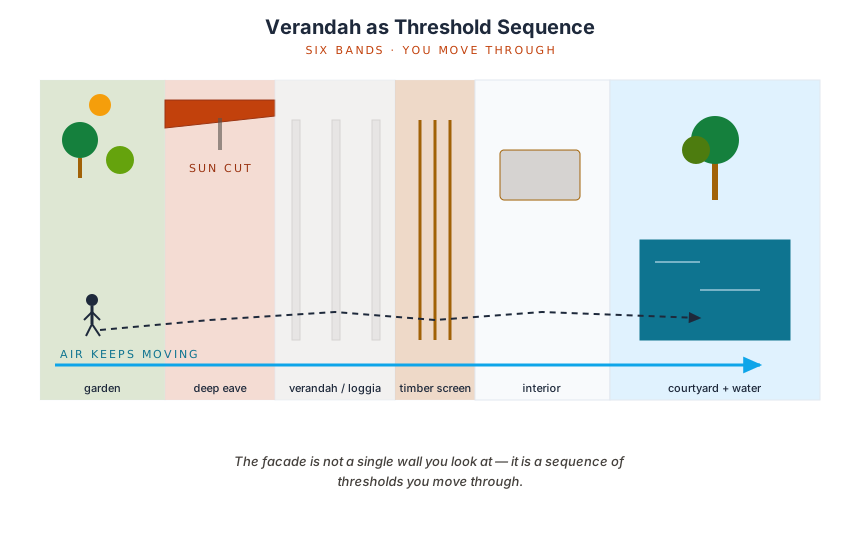
If Bawa abolishes the sealed wall, what takes its place? The verandah (and its grander cousin, the loggia — a roofed, open-sided gallery of columns). In a Bawa building the verandah is the façade. It is a deep, shaded, open-sided room that wraps the building, sits between the garden and the interior, and does all the work a wall would do — except by shading and filtering rather than sealing.
This is the in-between or transitional space: not quite outside, not quite inside, roofed against sun and rain but open to the breeze. You sit in it, you walk along it, you cross it to enter — and as you do, the harsh tropical glare is cut, the air keeps moving over you, and the rain stays off. Because the verandah takes the sun and the weather, the actual wall behind it can be light, low, openable, even absent — replaced by timber screens, louvres or simply columns. The climate work is done by the layer in front of the wall, which frees the wall itself to dissolve.
4. The courtyard, the water and the borrowed landscape
Bawa pulls the outside into the building as aggressively as he opens the building outward. His plans turn around courtyards — internal courts open to the sky — and around water: pools, tanks and reflecting sheets that cool the air, bounce light up onto ceilings and draw the eye outward. An open-to-sky court in the middle of the plan means light and air reach deep into the building from above, not just through the outer wall, so even inner rooms breathe.
And the façade frames views rather than blocking them. This is borrowed landscape — the old idea (the Japanese call it shakkei) of composing the building so that a distant hill, a lake or a tree becomes part of the architecture, captured in a deliberate opening. Bawa was a master of it: at Kandalama the sequence of arrival is choreographed so that the great rock of Sigiriya is revealed, framed, only once you reach the lobby. The opening in the wall is not a window punched for light; it is a frame aimed at a view. The façade composes the landscape instead of shutting it out.
5. The deep overhanging roof — the one element that does the climate work
Look at any Bawa building and the dominant element is the roof: a big pitched, clay-tiled roof with deep overhanging eaves. This is the workhorse of the whole system and the reason everything beneath it can be open. In the wet tropics the two enemies are the high sun and the driving monsoon rain, and a wide overhanging eave defeats both at once — it throws the wall into deep shade and it sheds the rain well clear of the openings, so the verandahs and screens beneath stay usable through a downpour.
The pitched roof is also a climate machine in section: it lets hot air rise and escape high, and its mass of handmade Sri Lankan clay tile holds and re-radiates far less heat than a flat concrete slab baking in the sun. Bawa used the local half-round tile not as nostalgia but as the correct tropical roof — and made it the defining silhouette of his architecture. The roof is the parasol; the walls below are merely the things in its shade. (At the Parliament, the move scales up into great copper-and-tile roofs over the pavilions; the principle is identical.)
6. Local craft, timber and the journey
Bawa rejected the imported glass-and-steel kit and built with what the island made well: handmade clay tile, timber, lime plaster, local stone, and timber and reed screens. These are local materials and craft — buildable by local hands, at home in the humidity, and able to age gracefully into the green damp instead of staining and corroding. Timber columns, carved doors and louvred shutters do the filtering that, in a colder country, glass would do.
And he composed the whole thing as a journey — a spatial sequence. A Bawa façade is never a single image taken in at a glance; it is an unfolding of framed thresholds. You arrive, you are funnelled through a dark low entrance, you emerge into a bright court, you cross a verandah, a view opens, the light changes. The building is experienced as a procession, not a photograph. The "front," such as it is, is the first of many edges, not the whole story.
The dissolved façade: the verandah, the roof and the court
Here is the technical heart of Bawa's façade language, and the core Indian lesson.
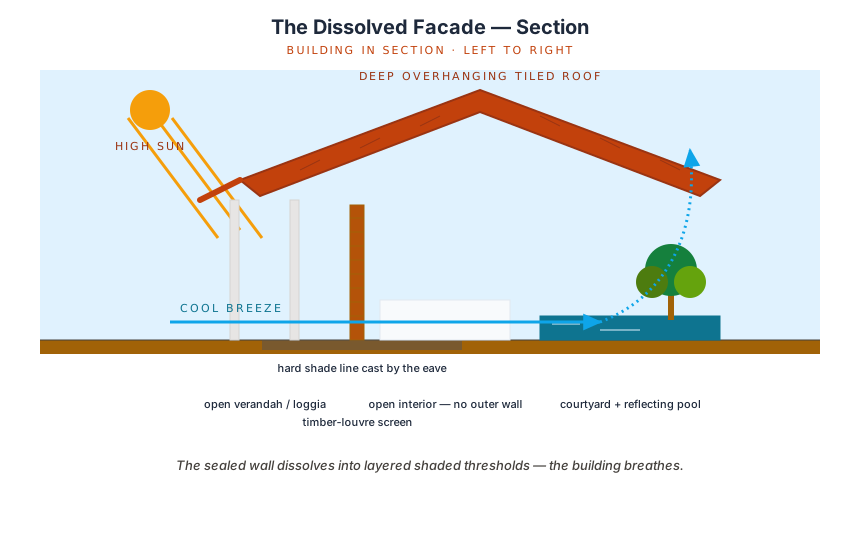
A conventional modern wall is a single sealed plane: glass or masonry, sun striking it directly, heat and the AC bill behind it. Bawa erases that plane and replaces it with a stack of shaded, permeable layers — so that by the time you reach the interior, the sun has been blocked, the air is still moving, and the garden has come halfway indoors to meet you. Read the section like this, from the garden inward:
- A deep overhanging pitched tiled roof caps everything, throwing a band of deep shade and shedding the monsoon clear of the openings. This is the parasol that does the climate work and frees everything below to open up.
- A verandah or loggia — the open-sided, columned, roofed threshold — sits in front of the rooms, so direct sun and driving rain land there, not on any glass.
- A screen layer — timber louvres, reed blinds, jaali-like perforated screens — filters what light and air remain, giving privacy and shade without sealing.
- The interior behind it is low, light and openable, often with no real outer wall at all.
- And on the far side, a courtyard with water and planting open to the sky, pulling a cross-breeze right through the building and bouncing cool, reflected light back in.
The result is a building that breathes: air enters low and shaded, crosses the rooms, and rises out through the court and the high roof, while the sun never reaches a heated surface. This is passive cooling for the wet tropics — shade plus cross-ventilation, the building kept permanently aired rather than sealed and chilled. It is exactly Correa's layered, porous wall (see the Charles Correa façade signature and our climate-responsive façades guide), but pushed to the point of dissolution — where the wall does not just open, it disappears into the garden.
Signature façade strategies
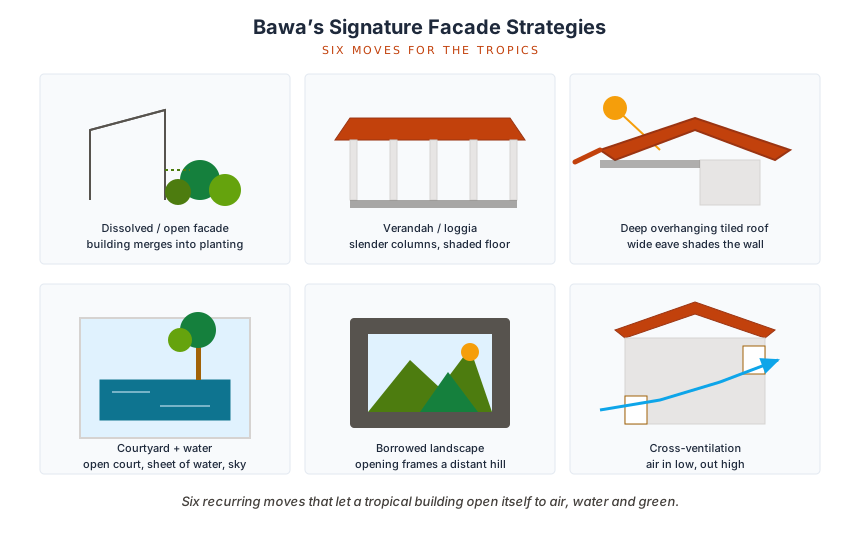
| Strategy | What it is | Where Bawa shows it | Why it works in the wet tropics | India lesson (humid coast) |
|---|---|---|---|---|
| The dissolved / open façade | No single sealed front; the building merges with garden, court and water | Kandalama (vanishes into jungle); Lunuganga (building into garden) | Stops the heat-trapping sealed box; ties building to its setting | On the humid coast, stop thinking of the façade as a sealed wall at all — layer shade and openness instead |
| The verandah / loggia as façade | A deep, shaded, open-sided columned threshold that wraps the building | Bentota Beach Hotel; Heritance Ahungalla; Number 11 | Takes the sun and rain so the wall behind can be light and open | Wrap the hot/wet faces of a Kerala or Goa home in a deep verandah, not a flush wall |
| The deep overhanging tiled roof | A big pitched clay-tile roof with wide eaves | Nearly every Bawa building; copper-and-tile at Parliament | Blocks high sun and sheds monsoon clear of the openings | The single best-value move for coastal India: a generous shading roof with deep overhangs |
| The courtyard + water | Open-to-sky internal courts and reflecting pools | Number 11; Lunuganga; Seema Malaka | Pulls a cross-breeze and cool reflected light deep into the plan | Put a court or a small water tank at the heart of the plan so even inner rooms breathe |
| Borrowed landscape / framed view | Openings composed as frames aimed at a distant view | Kandalama (Sigiriya revealed); Lunuganga vistas | The opening composes the landscape rather than blocking it | Aim your openings at the best view and the prevailing breeze, not at the road |
| Cross-ventilation / the breathing building | Shade + low-in, high-out airflow through the section | All works; the open hotel plans | Keeps humid air moving so the building never feels stagnant or hot | Design for the breeze first; the humid coast is cooled by moving air, not stored coolness |
Real buildings, not renders
Five verified Bawa works, and how the façade actually behaves in each:
- Heritance Kandalama, Dambulla (designed and built 1991–1995). The building that disappears. Bawa stretched a long, thin hotel along a cliff above the Kandalama reservoir and then let nature reclaim its outer face: planting climbs the structure so the building reads as a green ledge in the jungle rather than a built object. The arrival is choreographed through a cave-like, boulder-lined entrance so that the great view — the rock of Sigiriya — is revealed, framed, only when you reach the lobby. The "façade" here is a curtain of planting and a sequence of framed views. (It later became the first LEED-certified building outside the United States.)
- Lunuganga, Bentota (1948–1998). Bawa's own garden estate, worked on for fifty years, where the dissolution of the façade is total. Buildings, terraces, loggias and pavilions are threaded into a sculpted tropical garden of borrowed vistas and water until it is genuinely hard to say where architecture ends and landscape begins. This is the laboratory for everything else — the place where Bawa proved a building could become a garden.
- Sri Lankan Parliament, Sri Jayawardenepura Kotte (1979–1982). A civic complex set on an island in the Diyawanna lake, composed as a cluster of pavilions under great spreading roofs that float above the water. The façade is the deep eave and the open colonnade reflected in the surrounding water; the lake itself becomes the building's setting and security, and the roofs — the dominant element — do the tropical work at monumental scale.
- Bentota Beach Hotel (1967–1969) and Heritance Ahungalla, formerly the Triton (1979–1981). Bawa effectively invented the modern tropical resort here: open loggias, verandahs and courts where the lobby is a shaded open-air room rather than a sealed lounge, and the sea breeze passes straight through the building. The "front" is a colonnade open to the garden and the ocean — the template that resorts across the humid tropics have copied ever since.
- Number 11, 33rd Lane, Colombo (his own house, built and extended over decades from the late 1950s). The most important building for India, because it does the dissolved façade on a tight urban plot. Hemmed in by neighbours with no view and no garden to merge into, Bawa turned the building inward: a sequence of small courtyards, light wells and loggias threaded through the depth of the site so that light, air and greenery reach every room from within. The street face is quiet and almost blank; all the openness is internal. This is Bawa's proof that the breathing, garden-merged building works even where there is no garden and no privacy to spare — the single most relevant lesson for the dense Indian coastal city.
What this means for India
This is the centre of the whole guide. Bawa is arguably the most directly transferable master in this entire series for one specific, enormous slice of the country — because Sri Lanka's wet, monsoon, coastal climate essentially is the climate of coastal and southern India. Kerala, Goa, the Konkan, coastal Karnataka and Tamil Nadu, and the Northeast all live in the same hot-humid, high-rainfall world that Bawa spent his life answering. For these places, his is not a foreign lesson at all; it is the home lesson, written next door.
And the lesson is simple: stop sealing the wall. The wrong building for the humid coast is the air-conditioned glass box — a sealed skin that traps heat and humidity, fogs up, and runs the compressor day and night to mask the problem. Bawa's answer is the opposite. Layer shade and openness so the building breathes:
- Give it a big shading roof — a pitched roof with deep overhanging eaves is the single highest-value move on the humid coast, blocking the sun and shedding the monsoon clear of the openings.
- Make the verandah the façade — wrap the hot and wet faces in a deep, shaded, open-sided verandah or loggia so the sun and rain land there, not on the rooms.
- Put a court and water at the heart of the plan — so a cross-breeze and cool reflected light reach even the inner rooms; Number 11 shows how to do this on a cramped urban plot.
- Filter, don't seal — use timber louvres, screens and jaali (see our timber and natural façades and jaali and traditional Indian façades guides) where you need privacy without killing the air.
- Design for the breeze and the view first — orient the openings to the prevailing wind and the best outlook, and let the building breathe low-in, high-out.
Be honest about the caveats, though. The open, garden-merged building needs real thought about privacy and security on a tight urban plot — Bawa's own answer, the inward-facing courtyard house of Number 11, is the model to copy here, not the open resort. It demands serious monsoon rain detailing — deep overhangs, drips, slopes and drains all worked out, because an open building punishes lazy waterproofing. And timber and planting need maintenance in the wet — they must be chosen and detailed to survive the damp, not just look good on opening day. Finally, much of Bawa's fame is resort and estate scale, on generous sites; do not copy the literal openness of a beach hotel onto a city plot. But the principles — dissolve the wall, make the verandah the façade, big shading roof, courtyard and water, breathe — are affordable, low-tech, locally buildable, and exactly right for humid India.
One last placement. Bawa complements rather than competes with the hot-dry thermal-mass masters. Correa, Doshi and Rewal answered the dry heat of Ahmedabad, Delhi and Jaipur with heavy mass that stores the night's coolness against the day. Bawa answers the humid coast, where mass matters less and moving air matters most. Same subcontinent, two climates, two right answers. Pick the master who matches your weather — and for the humid coast, that master is Bawa.
What this means for you
If you are building or renovating on the humid Indian coast — anywhere from Kochi to Goa to the Konkan to the Northeast — you do not need Bawa's site or his budget. You need his instinct. Before you choose the cladding or the colour, ask the humid-climate questions: where does the harsh sun come from, where does the monsoon drive in, and which way does the sea or valley breeze move? Then build the answer in layers rather than in one sealed wall.
In practice that means a generous pitched roof with deep overhanging eaves on the sun-and-rain faces; a real verandah or loggia, not a flush glazed wall, wrapping at least the hot side; a courtyard or even a small water tank somewhere in the plan so the inner rooms breathe; timber louvres or screens where you need privacy without stopping the air; and openings aimed at the breeze and the best view. On a tight city plot, turn it inward like Number 11 — quiet street face, all the openness in the courts. Detail the monsoon properly and choose timber and planting that survive the wet. Do these things and your home will stay cooler on its own, lean far less on air-conditioning, and feel like it grew out of its place — which is exactly what Bawa proved a building on the humid coast should do.
Sources
- Geoffrey Bawa (1919–2003), Sri Lankan architect, father of tropical modernism — Geoffrey Bawa Trust; project records.
- Heritance Kandalama, Dambulla (designed/built c. 1991–1995; reported as the first LEED-certified building outside the United States) — cliff-hugging, planting-clad building; choreographed arrival framing Sigiriya. Geoffrey Bawa Trust.
- Lunuganga, Bentota (1948–1998), Bawa's garden estate — Geoffrey Bawa Trust / Lunuganga Trust.
- Sri Lankan Parliament, Sri Jayawardenepura Kotte (1979–1982) — pavilions with deep roofs on an island in the Diyawanna lake.
- Bentota Beach Hotel (1967–1969) and Heritance Ahungalla / former Triton (1979–1981) — early tropical-modern resorts with open loggias and courts. Geoffrey Bawa Trust.
- Number 11, 33rd Lane, Colombo — Bawa's own townhouse of threaded courts and light wells on a tight urban plot; now a house museum. Geoffrey Bawa Trust.
- Studio Matrx in-house: Geoffrey Bawa biography, climate-responsive façades, timber and natural façades, Charles Correa façade signature.
Export this guide
Related Guides — Deep-dive reading
Charles Correa's Façade Signature: How India's Master Made the Climate-Correct Wall
How Charles Correa eroded the flat sealed wall into deep, shaded, porous layers — verandahs, terraces, pergolas and open-to-sky courts — so the Indian façade filters sun and drives air instead of sealing it out.
Building FacadesClimate-Responsive Facades for India: Designing Your Home's Skin for Your Weather
A homeowner's plain-language guide to the facade strategy for every Indian climate zone — what your walls, windows, shading, and colours should actually do where you live
Building FacadesOrientation, Light & Views: Designing With Your Space, Not Against It
How reading your plot's sun, breeze and views — and placing each room on the right face — gives an Indian home that is cooler, brighter and quietly right, instead of one that fights its site forever.
Design PrinciplesRelated Tools — Try Free
Brise-Soleil Visualizer
Interactive horizontal-louvre cut-off angle calculator — sun altitude, louvre depth, and spacing inputs with a live shadow preview. Computes θ = arctan(spacing/depth) for façade shading, ECBC envelope compliance, hospital daylight design, and tropical sun-control detailing.
Sun Shading ToolCross-Ventilation Analyzer
Estimate airflow and air changes per hour (ACH) from room size, window areas, layout, and local wind — with NBC 2016 Part 8 compliance check.
Ventilation CalculatorMonsoon-Readiness Checklist
Pre-rain home audit across 9 categories — terrace, drains, waterproofing, electrical, HVAC, pest, vehicles, documents.
Seasonal Audit