
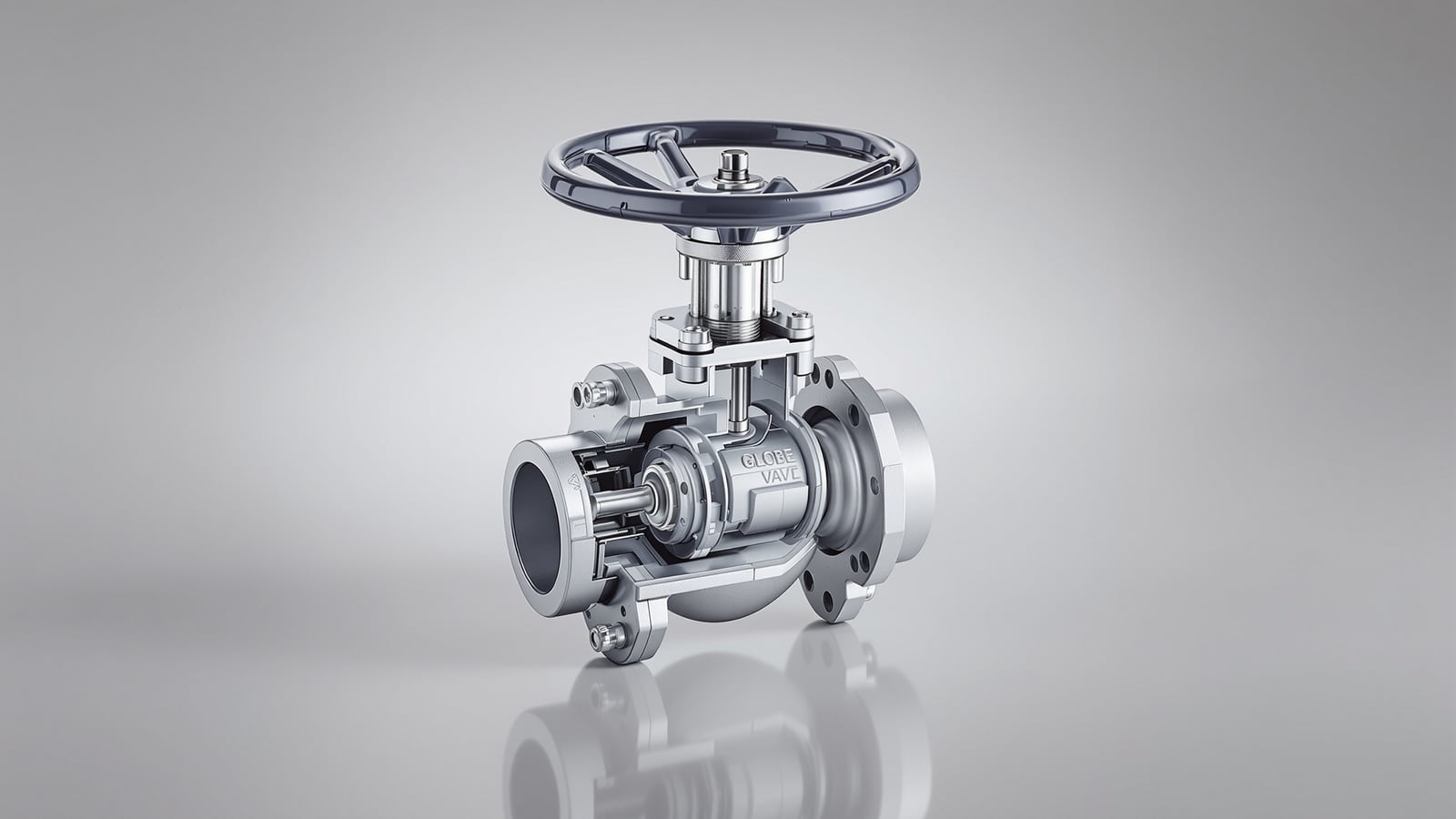
Globe Valves in India: The Throttling Valve — Mechanism, Selection, Install Orientation & Cost
The disc-and-seat valve built to regulate flow, not just stop it — how the S-shaped flow path and disc-on-seat give globe valves fine throttling control, why they are flow-direction dependent, where they belong in a plumbing system, and how to specify sizes, materials and cost.
A globe valve is the valve you reach for when you need to regulate flow, not merely stop it. Where a gate or ball valve is built to be either fully open or fully shut, a globe valve is designed to sit anywhere in between and hold that position — trading a higher pressure drop for genuine, controllable throttling. The name comes from the rounded, globe-like body, not from anything about the disc.
This is a professional's guide to specifying globe valves in Indian plumbing work. It sits under the Studio Matrx plumbing valves pillar and is the companion to the guides on gate valves — the isolation valve — and ball valves, the quarter-turn on/off valve. Read those alongside this one: choosing between the three is the everyday decision, and the globe valve is the odd one out that most fitters under-use.
What a globe valve is and how it works
Inside a globe valve, flow does not run straight through. The body is divided by an internal baffle with a horizontal circular opening — the seat. A movable disc (or plug) sits on a stem above that seat. Turning the handwheel drives the stem down until the disc lands squarely on the seat and seals, or lifts it to open a gap. Because the disc moves perpendicular to the seat, even a small lift opens a precise, repeatable annular gap — and that is what makes fine control possible.
To reach the seat, water is forced to change direction twice: it enters low, rises to pass up through the seat opening, then turns to leave. That S-shaped flow path is the defining feature of the valve.
A gate valve slides a flat gate across a straight bore; a ball valve rotates a bored ball a quarter turn. Both are on/off devices — throttle them and the flow chews the seat. A globe valve is built the opposite way: the disc meets the seat face-on, so partial opening is its normal, intended duty.
The trade-off is head loss. The double change of direction and the restriction at the seat mean a globe valve has a much higher pressure drop than a gate or ball valve of the same size — often several times higher when fully open. You accept that loss deliberately, in exchange for control.
Why it throttles well — and why gate and ball valves do not
Throttling means holding a valve part-open to set a flow rate. Three things make the globe valve good at it:
- Face-on seating. The disc lands on the seat rather than sliding across it, so a partly open valve does not drag the sealing faces through the flow. Gate and ball valves, half-open, expose their seat edges to a high-velocity jet that erodes and wire-draws them within months.
- Fine, progressive control. Disc lift is roughly proportional to handwheel turns, so a small adjustment gives a small, predictable change in opening. A quarter-turn ball valve does almost all its flow change in a narrow band of its travel — useless for setting a rate.
- Stable at part-open. The disc is held firmly on its stem thread and does not chatter or vibrate at intermediate positions the way an unsupported gate can.
That is the whole case for the valve: when you need to set and hold a flow — a bypass leg, a balancing point, a hose feed you want at a fixed trickle — the globe valve is the correct tool.
Flow-direction dependence — install with the arrow
A globe valve is not symmetrical. Standard practice is for flow to enter under the disc and leave above it, so that line pressure helps seat the disc and the packing is not under full pressure when closed. The body is cast with a flow-direction arrow; you must install it pointing downstream.
- Fit it backwards and the valve still works, but pressure fights the disc open, the seating is less positive, and on larger sizes it can slam or become hard to close against the flow.
- The arrow is not advisory. On any globe valve — brass domestic or cast-iron line valve — read it before it goes in the wall.
Gate and ball valves are bidirectional and can be fitted either way. A globe valve is one of the few plumbing valves where orientation is a specification, not a preference. Confirm the arrow and, for horizontal lines, keep the stem vertical (handwheel up) so debris does not collect on the disc.
Where globe valves are used in a plumbing system
You will not — and should not — use a globe valve everywhere. Its home is anywhere flow needs regulating rather than just interrupting:
- Flow regulation and balancing — setting the flow to a branch, a floor riser or a heat-exchanger loop so each leg gets its share.
- Bypass legs — around a pump, filter or pressure vessel, where you want to divert and meter a controlled fraction of flow.
- Where fine control matters — a garden or terrace feed you want at a steady trickle, a slow-fill line, a make-up line to a tank.
- Point-of-use taps. The everyday bib-cock (the wall tap you connect a hose or bucket to) and the stop-cock (the screw-down stop valve on a supply line) are, mechanically, globe valves — a disc screwed down onto a seat. That is why a tap gives you fine control of the stream and why a worn washer on the disc is the classic dripping-tap failure. Understanding the globe valve is understanding the humble tap.
For plain isolation — turning a line fully on or off with minimal head loss — use a gate or ball valve instead. Fitting a globe valve there just adds pressure drop for no benefit.
Materials, sizes and connections
| Size (mm / inch) | Body material | Connection | Typical use | Indicative price (each) |
|---|---|---|---|---|
| 15 mm (½") | Forged brass | Threaded (BSP) | Bib-cock, stop-cock, fixture feed | ₹350 – ₹900 |
| 20–25 mm (¾"–1") | Forged brass / bronze | Threaded (BSP) | Branch regulation, hose feed | ₹700 – ₹2,000 |
| 25–50 mm (1"–2") | Bronze / DZR brass | Threaded / union | Bypass legs, balancing | ₹1,500 – ₹6,000 |
| 50–150 mm (2"–6") | Cast iron, bronze-trim | Flanged | Pump bypass, plant regulation | ₹4,000 – ₹35,000 |
| 80–200 mm (3"–8") | Cast steel / SS trim | Flanged | Industrial / high-pressure control | ₹18,000 – ₹1,20,000 |
- Brass and bronze dominate domestic and light-commercial sizes up to about 50 mm — corrosion-resistant and cheap enough to replace. Use DZR (dezincification-resistant) brass on aggressive or long-standing water.
- Cast iron with bronze trim is the workhorse for larger flanged line valves on pump and plant duty.
- Stainless-steel or cast-steel bodies belong to industrial and high-pressure service — link out; that is beyond domestic plumbing.
- The renewable part is the disc washer / seat. On brass valves it is a replaceable washer; on line valves the seat and disc can be re-ground or replaced, which is why globe valves are considered maintainable.
Globe vs gate vs ball — pick by duty
| Property | Globe valve | Gate valve | Ball valve |
|---|---|---|---|
| Primary duty | Throttling / regulate | Isolation on/off | Isolation on/off |
| Throttling ability | Excellent | Poor (erodes seat) | Poor (erodes seat) |
| Pressure drop (open) | High | Very low | Very low |
| Flow direction | Directional — fit with arrow | Bidirectional | Bidirectional |
| Operation | Multi-turn handwheel | Multi-turn handwheel | Quarter-turn lever |
| Seat repair | Washer / re-grind — good | Moderate | Cartridge, usually replace |
| Typical home | Regulation, bypass, taps | Mains, riser isolation | Appliance & fixture isolation |
Pros, cons and common failures
Pros
- Genuine, fine, repeatable flow control — its whole reason to exist.
- Positive shut-off with a good seat, and easy to reseat or re-washer.
- Stable and quiet at part-open positions.
Cons
- High pressure drop even fully open — a real energy cost on a pumped system.
- Flow-direction dependent; one more thing to get right on install.
- Multi-turn operation is slow — not an emergency shut-off.
- Heavier and dearer than a ball valve of the same size.
Common failures
- Dripping through a closed valve — worn disc washer or a scored seat; replace the washer or re-grind the seat.
- Stiff or seized stem — packing gland over-tightened, or scale on the thread; ease the gland nut or service.
- Leak at the gland — repack or nip up the gland nut a fraction.
- Slam / hard to close — often a valve fitted against the flow arrow, or oversized for the duty.
Cost and specifying sensibly
For domestic work, a globe valve only makes sense where you actually need regulation — every bib-cock and stop-cock in the house already is one. A 15 mm brass stop-cock runs ₹350 to ₹900; a decent 25 mm bronze regulating valve on a bypass, ₹1,500 to ₹6,000. Larger flanged line valves scale with size and trim material. All figures here are indicative — confirm against current supplier quotes and the water quality on site. Do not pay for a globe valve where a gate or ball valve would isolate the same line at a fraction of the head loss.
References
- National Building Code of India (NBC), Part 9 — Plumbing Services
- CPHEEO Manual on Water Supply and Treatment (Ministry of Housing and Urban Affairs)
- Relevant Bureau of Indian Standards (BIS) product standards for bib-cocks, stop-cocks and metallic valves — verify the current standard number and material grade with your supplier before specifying.
Export this guide
Related Guides — Deep-dive reading
Butterfly Valves in India: Wafer vs Lug vs Flanged, Sizing, Operators & Cost
The compact quarter-turn disc valve that isolates and throttles large-diameter lines — building risers, pump headers, tank connections, HVAC chilled-water and fire mains — at a fraction of the size, weight and cost of a gate valve. How the rotating disc works, which body style to specify, lever versus gear operator, materials and sizes, pros, cons and indicative pricing.
PlumbingGate Valves in India: How the Wheel Isolation Valve Works, Where to Use It & When to Replace It
The multi-turn wheel valve that isolates larger water lines and mains with a full-bore, low-resistance opening — how the rising and non-rising wedge-gate mechanism works, why it is strictly ON/OFF and not for throttling, why it seizes and drips over time (and got replaced by ball valves at fixtures), where it still earns its place, and how to size, specify and cost it in an Indian home.
PlumbingPlumbing Valves Guide (India): Every Valve, What It Does and Where It Goes
A homeowner's master overview of the valves in an Indian plumbing system — the four jobs valves do (isolation, throttling, one-way, pressure control), which valve type does which job, where each one belongs from the main to every fixture, plus materials, threaded versus flanged connections and how to choose.
PlumbingRelated Tools — Try Free
Cross-Ventilation Analyzer
Estimate airflow and air changes per hour (ACH) from room size, window areas, layout, and local wind — with NBC 2016 Part 8 compliance check.
Ventilation CalculatorMaterial Decision Framework (M-Score)
Score 30+ Indian construction materials across cost, durability, climate fit, maintenance, and sustainability.
MaterialsPipe Friction Loss Calculator
Estimate head loss in a pipe run with the Hazen-Williams equation from flow, diameter, length and C factor, in metres and bar.
Plumbing Calculator