
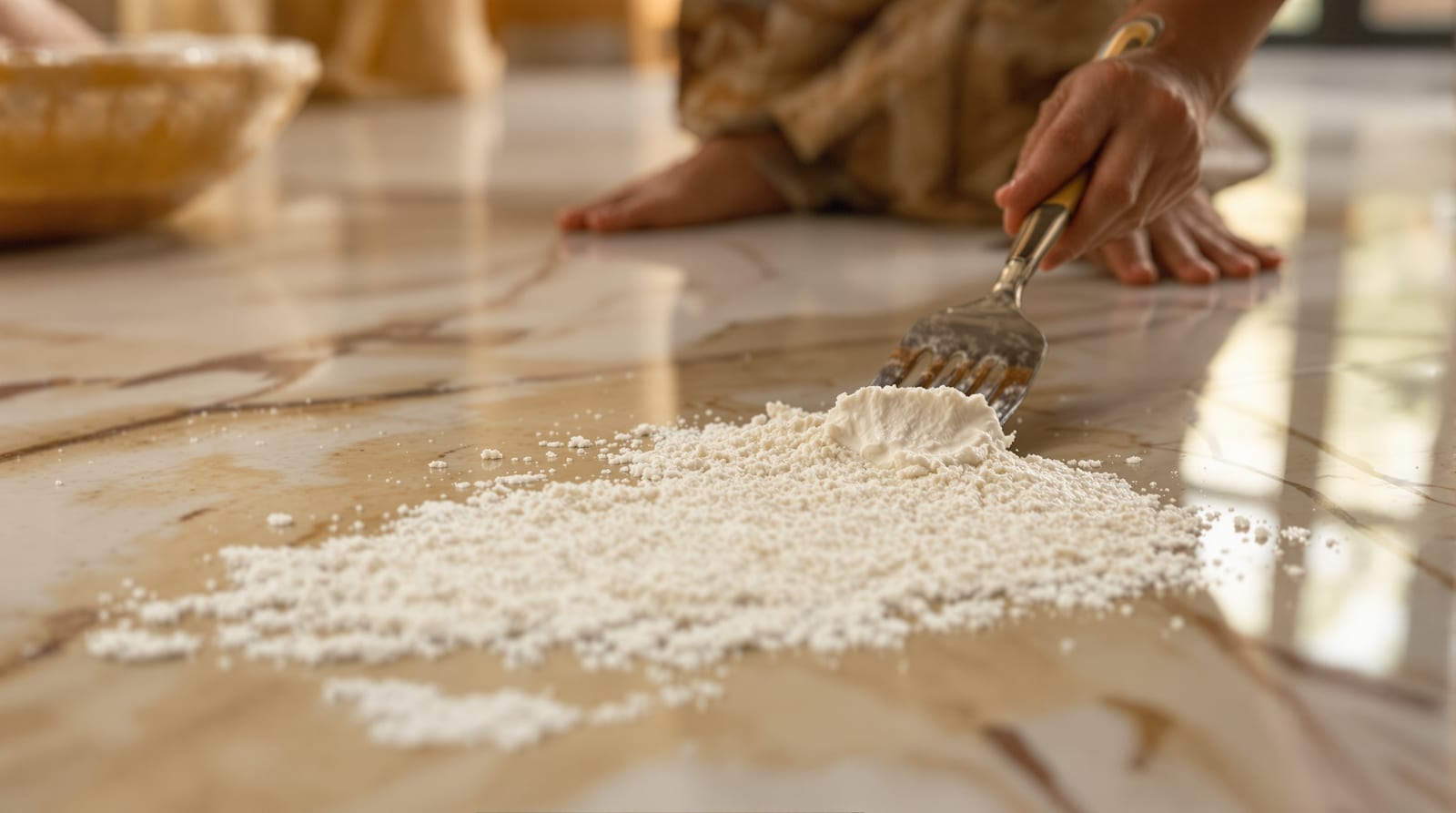
Floor Stain Removal India: How to Remove Turmeric, Oil, Rust, Hard-Water and Paan Stains by Stain Type and Floor Type
A practical, material-safe guide to removing the stains Indian floors actually get: turmeric and haldi, oil and ghee, tea and coffee, rust, hard-water marble rings, paan and ink, wine, cement and paint splashes, and mould, with the poultice method for marble and a what-is-safe-per-surface matrix.
Indian floors take a beating that floors elsewhere never see: turmeric from the kitchen, ghee and oil from the stove and the dining table, chai rings, paan spit near doorways, rust from steel almirahs and bucket bottoms, and the chalky white rings hard water leaves on marble. The single biggest mistake people make is reaching for whatever is under the sink, very often an acid like lemon, vinegar or Harpic, and pouring it on a stone floor that the acid then permanently etches and dulls. This guide is organised the way you will actually meet the problem: by the stain you are looking at and the floor it landed on, with a clear matrix of what is safe on each surface, plus the poultice method that draws a deep oil or turmeric stain out of marble.
First, identify your floor, because it decides everything
Before you touch any stain, name the surface. The same cleaner that rescues a vitrified tile can ruin a marble slab.
- Acid-sensitive stone: marble, Kota stone, limestone, travertine, and many Indian "marbles" are calcium carbonate. Acids etch them, leaving a dull, rough patch that is worse than the stain. Never use lemon, vinegar, Harpic, hydrochloric/muriatic acid or strong descalers on these.
- Acid-tolerant but grout-sensitive: granite is far more acid-resistant than marble, but the cement grout and the polished sealer around it are not, so keep acids off the joints.
- Highly resistant: vitrified, porcelain (PGVT/GVT) and ceramic tile bodies shrug off most chemicals. The weak point is the cement grout between them, which is porous and stains.
- Water-sensitive: solid wood, engineered wood and laminate hate standing water and most wet chemicals. Work nearly dry, fast, and never flood them.
- Resilient/seamless: epoxy, microcement and good vinyl/SPC are non-porous and tolerate most household cleaners but can be dulled by aggressive solvents.
If you are not sure whether a light-coloured floor is marble or vitrified, drip a little water in a hidden corner: stone darkens and slowly absorbs, glazed tile beads it. When in doubt, treat it as the more delicate material. For the everyday routine that prevents most staining in the first place, see Studio Matrx on the floor cleaning guide.
The golden rules of stain removal
A few principles apply to every stain on every floor.
- Act fast. A fresh spill blotted up in minutes rarely stains; the same spill left overnight soaks into pores and grout. Blot, never rub, so you do not spread it or grind it in.
- Work from the outside of the stain inwards so you do not enlarge the ring.
- Test any cleaner in a hidden spot first (under a sofa, inside a cupboard kickboard) and wait a few minutes.
- Use the gentlest thing that works, then escalate. Start with warm water and a pH-neutral cleaner before anything stronger.
- Match chemistry to stain: oily/greasy stains lift with alkaline or solvent cleaners; rust needs a rust-specific remover (and only on tolerant surfaces); organic colour (turmeric, chai, wine, paan) often responds to dilute hydrogen peroxide or oxygen bleach; mineral hard-water scale on tile needs a mild acid, but never on stone.
- Rinse thoroughly with clean water afterwards and dry, so no cleaner residue is left to attract dirt or, on stone, keep reacting.
The stain x surface matrix
This is the heart of the guide. Find your stain down the left, your floor across the top. "Poultice" means the draw-out paste method described in the next section.
| Stain | Marble / Kota (acid-sensitive stone) | Granite | Vitrified / porcelain / ceramic | Wood / laminate |
|---|---|---|---|---|
| Turmeric / haldi | Poultice with hydrogen peroxide; never lemon | pH-neutral cleaner, then dilute peroxide | Mild detergent, then dilute peroxide or oxygen bleach on grout | Wipe fast with damp cloth + wood cleaner; sunlight fades residue |
| Oil / ghee | Poultice with baking soda + acetone (the classic fix) | Degreaser or poultice; reseal after | Alkaline degreaser, hot soapy water | Blot, then wood-safe degreaser, barely damp |
| Tea / coffee | Poultice with dilute peroxide | pH-neutral cleaner, then dilute peroxide | Mild detergent; oxygen bleach on stained grout | Damp cloth + wood cleaner immediately |
| Rust (steel furniture, water) | Stone-safe (non-acid) rust remover ONLY; poultice | Stone-safe rust remover; granite tolerates more | Mild acidic rust remover OK on tile body, keep off grout | Wood rust remover sparingly; sand + recoat if deep |
| Hard-water white ring / scale | Fine steel wool / polishing powder, NOT acid; re-polish | Mild descaler quickly, then rinse | Dilute acidic descaler on tile face, rinse fast | Barely-damp cloth; usually a film, not a stain |
| Paan / supari | Poultice with peroxide or oxygen bleach | pH-neutral + dilute peroxide | Mild detergent + oxygen bleach; bleach grout | Act immediately; wood cleaner, then buff |
| Ink / marker | Poultice with acetone or hydrogen peroxide | Acetone on a cloth, then rinse | Rubbing alcohol or acetone on a cloth | Rubbing alcohol on cloth, fast, then dry |
| Wine / juice | Poultice with dilute peroxide | pH-neutral, then dilute peroxide | Detergent + oxygen bleach | Damp cloth + wood cleaner immediately |
| Cement / grout / paint splash (post-construction) | Mechanical: plastic scraper, fine pad; NO acid on marble | Plastic scraper; mild acid OK on granite face | Plastic scraper, then mild acidic cement-film remover on tile | Scrape gently with plastic; wood-safe stripper for paint |
| Mould / mildew (black spots) | Dilute hydrogen peroxide or stone-safe mould cleaner | Peroxide or dilute bleach, rinse | Diluted bleach on grout (1:4), scrub, rinse | Keep dry; mild vinegar-free anti-mould; fix the damp source |
Two patterns jump out. First, marble and Kota almost always want a poultice rather than a poured liquid, because you cannot scrub them hard or use acid. Second, the cement grout between tiles is the real weak spot on an otherwise bulletproof vitrified floor, which is why so many of the tile fixes are really grout fixes. For the deeper grout-restoration playbook, see Studio Matrx on grout cleaning and whitening.
The poultice method: drawing a stain out of stone
A poultice is an absorbent paste you spread over a stain so that, as it dries, it pulls the trapped stain up out of the stone's pores into the paste. It is the gold-standard fix for oil, turmeric, tea and ink stains in marble, Kota and granite because it cleans without scrubbing or acid. The diagram below shows the principle.
The recipe depends on the stain:
- Oil and ghee on marble: mix baking soda (or whiting/plaster of Paris) with a little acetone or hydrogen peroxide into a thick peanut-butter paste. Acetone is the classic solvent that dissolves oil.
- Turmeric, tea, coffee, wine, paan (organic colour): mix the absorbent powder with 6 percent hydrogen peroxide (the kind sold at chemists) instead of acetone.
- Ink: acetone-based paste, or peroxide for water-based inks.
Steps, the same for any poultice: clean and dry the area, spread the paste about 5-8 mm thick over the stain and a little beyond its edge, cover with cling film taped at the edges, and leave it 24-48 hours to dry fully. As it dries it draws the stain up. Remove the dried paste with a plastic (not metal) scraper, rinse with clean water, and dry. Deep stains may need two or three rounds. After the stain is gone, the small treated patch may look slightly duller, marble especially may need re-polishing and re-sealing, covered in Studio Matrx on marble polishing and care.
Acid: when it helps, when it destroys
Acid is the dividing line in floor care, so it deserves its own section.
On vitrified, porcelain and ceramic tile bodies, a dilute mild acid (a proprietary tile cement-film remover, or dilute spirit of salt used strictly as directed and well rinsed) is the standard way to clean off post-construction cement haze and dissolve hard-water scale. The fired tile body is not harmed. The catch is the cement grout between the tiles, which acid eats, so keep it off the joints, work fast, and rinse with plenty of water.
On marble, Kota, limestone and travertine, acid is the enemy. These are calcium carbonate, and acid reacts with them chemically, etching a dull, rough, slightly lighter patch into the polish that is permanent and can only be removed by re-grinding and re-polishing. This includes lemon juice, vinegar, Harpic, CIF/cream cleansers with acid, descalers and muriatic acid. A spilled glass of nimbu pani left on marble overnight will leave a visible etch ring. Granite is much more tolerant, but its sealer and the surrounding grout are not, so still keep strong acids off it. The safe takeaway: if the floor is or might be marble or Kota, no acid, ever, full stop.
Stain-by-stain notes for the common Indian culprits
A few stains are common and worth specific guidance.
- Turmeric / haldi: the classic yellow stain. On tile, mild detergent then dilute hydrogen peroxide on the grout usually clears it, and indirect sunlight fades the last yellow over a day or two. On marble, go straight to a peroxide poultice and resist the urge to scrub.
- Oil and ghee: the most common deep marble stain because it darkens the stone. Blot fresh oil immediately with paper, never wipe it across. Old oil rings need the baking-soda-and-acetone poultice, often twice.
- Rust: from steel almirah legs, plant pots, bucket bottoms and iron-rich borewell water. On tile, a mild acidic rust remover works on the tile face. On marble and Kota you must use a non-acidic, stone-safe rust remover, because acidic ones etch; severe rust in stone sometimes cannot be fully removed and needs professional honing.
- Hard-water white rings on marble: these are mineral scale plus light etching from mineral-rich water sitting on the stone (very common under planters and near RO units). Do not attack with acid. Buff gently with marble polishing powder or very fine steel wool, then re-polish; prevent recurrence with coasters and by wiping water off promptly.
- Paan and supari: the deep red is stubborn. Scrape the solid off, then peroxide poultice on stone or oxygen bleach on tile grout. Speed matters most.
- Cement, grout and paint splashes after construction: this is the single most common post-handover floor problem. Never use a metal blade on polished surfaces. Soften and lift with a plastic scraper and a proprietary cement-film remover on tile; for dried paint, a wood-safe or surface-appropriate paint stripper and patience. Builders should protect floors during work, see Studio Matrx on how to evaluate builder floor before buying.
- Mould and mildew: black spotting in bathrooms, balconies and monsoon-damp corners. Treat with dilute hydrogen peroxide (stone-safe) or diluted bleach on tile grout (about 1:4, scrub, rinse well), but the real fix is removing the damp: ventilation, slope to drains and waterproofing. For wet-area floors specifically, see Studio Matrx on anti-slip flooring for wet areas.
Prevent the next stain
The cheapest stain removal is the one you never have to do. Seal porous floors (marble, Kota, cement grout) and re-seal on schedule, covered in Studio Matrx on the floor resealing guide. Use coasters under planters and bucket-bottoms, felt pads under steel furniture legs to stop rust marks, doormats at entries to catch grit, and wipe spills immediately, especially anything acidic, oily or coloured. In kitchens and bathrooms, switching to epoxy grout removes the most stain-prone surface in the house entirely, as explained in Studio Matrx on the tile grouting guide. For day-to-day stone protection specifically, Studio Matrx covers granite floor care and vitrified tile maintenance.
Frequently asked questions
Can I use lemon or vinegar to clean stains off my marble floor?
No. Marble and Kota are calcium carbonate, and lemon, vinegar, Harpic and other acids react with them and etch a permanent dull patch into the polish that is worse than the original stain. Use only pH-neutral cleaners on these stones, and a poultice for deep stains. Acids are fine on vitrified and ceramic tile bodies, but keep them off the cement grout.
How do I get an old oil stain out of marble?
Use a poultice: mix baking soda or plaster of Paris with a little acetone or hydrogen peroxide into a thick paste, spread it 5-8 mm thick over the stain, cover with cling film, and leave it 24-48 hours to dry and draw the oil up. Scrape off with a plastic scraper, rinse and dry. Repeat two or three times for deep stains, then re-polish the patch.
What removes turmeric stains from floor tiles?
On vitrified and ceramic tile, wipe with mild detergent, then apply dilute hydrogen peroxide or oxygen bleach to any stained grout and leave it a few minutes before rinsing. Indirect sunlight helps fade the last of the yellow. Act quickly, fresh haldi comes off far more easily than a stain left overnight.
How do I remove rust stains from a stone floor?
On marble and Kota, use only a non-acidic, stone-safe rust remover, because acidic rust removers etch these stones. On vitrified tile, a mild acidic rust remover works on the tile face but keep it off the grout. Prevent rust by putting felt pads or coasters under steel furniture, almirahs and bucket bottoms, and by fixing iron-rich borewell water.
How do I clean cement and paint splashes left after construction?
Use a plastic scraper, never a metal blade on polished surfaces. On vitrified tile, soften cement haze with a proprietary cement-film remover (a mild acid) and rinse well, keeping it off the grout. For dried paint, use a surface-appropriate paint stripper and patience. On marble, work purely mechanically with a plastic scraper and a fine pad, never acid.
Export this guide
Related Guides — Deep-dive reading
Vitrified Tile Maintenance: How to Care for Vitrified & PGVT Floors in India
Vitrified and PGVT tiles are India's most common, near maintenance-free floor; the real weak point is the cement grout, not the tile, so this guide shows the simple routine, post-construction haze and stain removal, and how to keep the gloss.
Flooring & SurfacesMarble Polishing and Care India: Stop Etching and Stains, Daily pH-Neutral Cleaning, Diamond Polishing and Re-Sealing
How to keep marble floors gleaming in Indian homes: why marble etches and stains, pH-neutral daily care, the professional diamond grinding to crystallisation polishing process, how often to re-polish and reseal, and removing etch marks and oil stains.
Flooring & SurfacesGrout Cleaning and Whitening India: Why Grout Turns Yellow or Black and How to Restore It
Why porous cement grout yellows, stains and grows mould in Indian homes, plus the cleaning methods, grout whitener pens, regrouting and epoxy upgrades that actually restore white joints and keep them clean.
Flooring & SurfacesRelated Tools — Try Free
Apartment Furniture Size Chart
Standard furniture dimensions for Indian apartments — sofas, beds, tables, dining, storage.
Reference ChartDoor Material Comparison Tool
Compare 2–4 door materials on cost, durability, maintenance, security and moisture resistance.
Comparison ToolFlooring Cost Calculator
Estimate the all-in cost of a floor — material, laying, wastage, skirting and GST — by area and material.
Flooring Calculator