
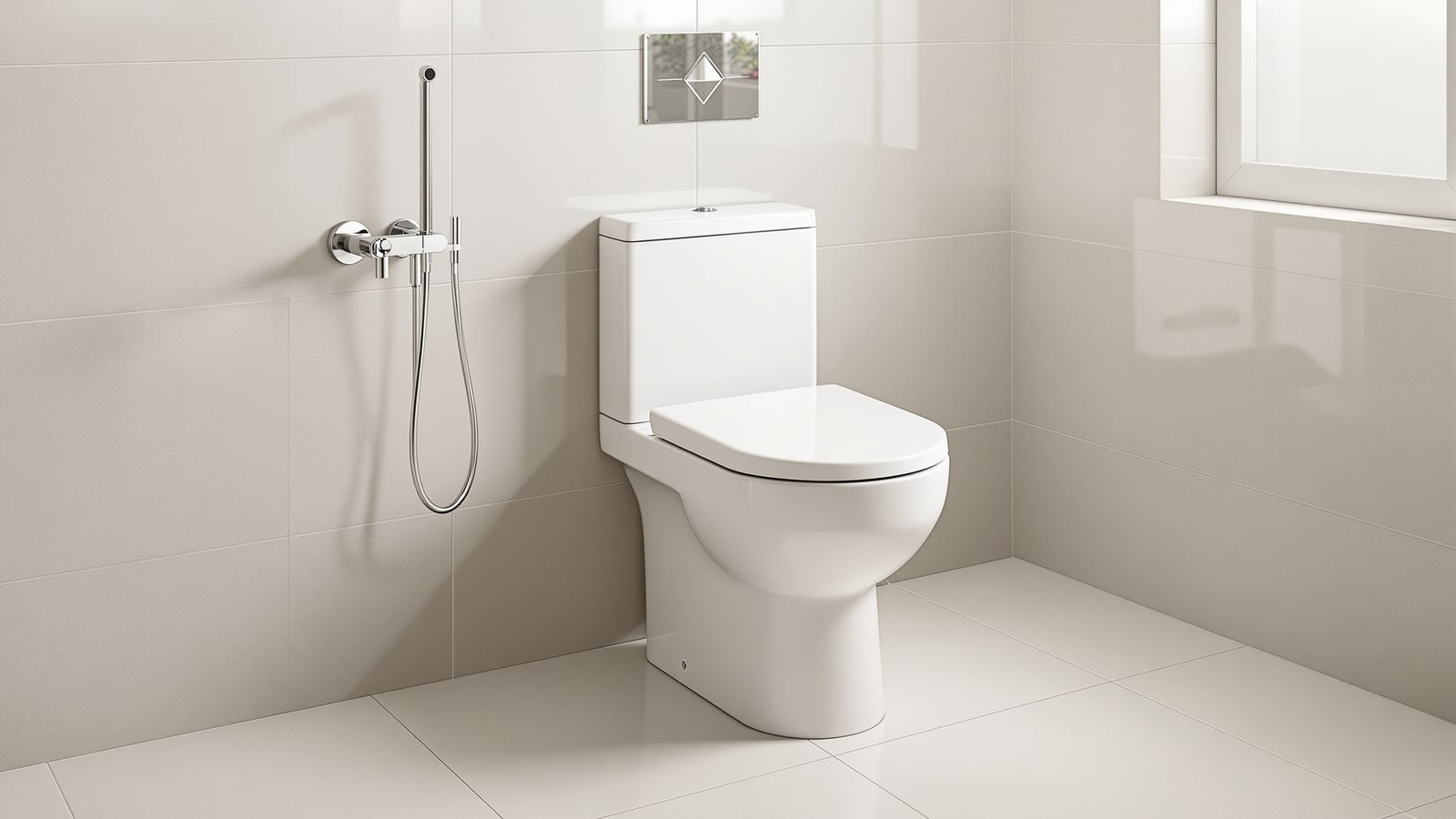
Floor Mounted Toilet India: S-Trap vs P-Trap, Rough-In & Cost (2026)
The practical default WC for most Indian homes — one-piece vs two-piece close-coupled, why the S-trap vs P-trap and trap-distance decision is the number one replacement mistake, floor fixing and sealing, cistern types, rupee costs, and an honest comparison with wall-hung.
Walk into nine out of ten Indian bathrooms and the WC is bolted to the floor. The floor-mounted toilet — the "European water closet" or EWC that stands on the tiles with its cistern behind it — is the workhorse of the Indian home for a reason: it is cheaper to buy, far cheaper to fix, forgiving of the pipework you already have, and any plumber in any town can service it without special parts. The glamorous wall-hung unit gets the magazine covers, but the floor-mounted WC is what most people should — and do — install.
That does not make it a thoughtless purchase. The single decision that trips up more Indian homeowners than any other is the trap — whether your outlet runs down through the floor (S-trap) or back into the wall (P-trap), and the exact distance from the wall or floor to the drain centre. Get that wrong and the shiny new pan you carried home simply will not line up with the pipe, no matter how good it is. This guide sits under the bathroom toilet guide for India; for the wall-mounted alternative read wall-hung toilet for India, and if you are ripping out an old suite see the bathroom renovation guide for India.
Buy the trap and rough-in first, the brand and colour second. A ₹40,000 designer pan that does not match your drain is worthless; a ₹6,000 pan that fits perfectly works for twenty years.
One-piece vs two-piece (close-coupled)
Every floor-mounted WC is either a one-piece unit or a two-piece close-coupled unit. Both stand on the floor; the difference is how the cistern joins the pan.
- Two-piece (close-coupled): the pan and the cistern are separate ceramic pieces bolted together on site with a spud washer and gasket. This is the classic, most common, most affordable form. Parts are universal, the plumber can swap a cracked cistern without replacing the pan, and it is easy to carry up stairs.
- One-piece: pan and cistern are cast and fired as a single seamless ceramic body. It looks sleeker, has no joint gap to trap grime, is quieter and generally flushes better — but it is heavier, pricier, and if any part cracks the whole unit is scrap.
| Feature | Two-piece (close-coupled) | One-piece |
|---|---|---|
| Typical price (₹) | 4,500 – 14,000 | 12,000 – 35,000+ |
| Cleaning | Joint gap collects grime | Seamless, easy to wipe |
| Flush quality | Good | Usually better, quieter |
| Repair | Swap cistern alone | Replace whole unit |
| Weight / handling | Lighter, two parts | Heavy, single piece |
| Best for | Most homes, rentals, budget | Premium en-suites, master bath |
For most Indian homes the two-piece close-coupled unit is the sensible default. Reserve the one-piece for the master bathroom where the cleaner look earns its premium.
The trap: the number one India replacement mistake
The "trap" is the U-shaped water seal built into the pan that stops sewer gas coming back up. What matters for buying is which way the outlet points and how far the drain sits from the wall or floor. Get a mismatch and the pan cannot connect.
S-trap vs P-trap
- S-trap: the waste exits downward through the floor. The drainpipe is buried in the slab and comes up under the pan. This is the traditional Indian arrangement — most older homes and ground-floor toilets are S-trap.
- P-trap: the waste exits horizontally into the wall behind the pan. Common in modern apartments, upper floors and anywhere the soil stack runs in the wall.
You cannot freely swap one for the other — the drain location is fixed in your slab or wall. Measure what you have before you shop. There are pan-connector adapters and offset couplings that give some tolerance, but they are a compromise, not a licence to ignore the measurement.
Trap distance / rough-in — the exact number
Even the correct trap type will not fit if the rough-in distance is wrong. This is the measurement from a fixed reference to the centre of the drain:
- S-trap: measure from the finished wall to the centre of the floor drain. Common Indian S-trap distances are 220 mm and 300 mm (roughly 8" and 12").
- P-trap: measure from the finished floor up to the centre of the wall outlet. The common P-trap height is around 180 mm.
Take the measurement to the finished tile surface, not the bare slab, and confirm it against the pan's spec sheet before paying. Sanitaryware to IS 2556 lists the trap type and setout dimension for exactly this reason.
| Term | What to measure | Common India values |
|---|---|---|
| S-trap set-out | Finished wall → floor drain centre | 220 mm or 300 mm |
| P-trap height | Finished floor → wall outlet centre | ~180 mm |
| Bolt / fixing spread | Between floor-bolt holes | Per model spec |
| Pan connector | Outlet-to-drain flexible coupling | 90–110 mm dia |
Floor fixing and sealing
A floor-mounted WC is held down by two floor bolts (or coach screws into plugs) and sealed to the drain. Do not let the plumber cement the whole pan to the floor with mortar the old way if you can help it — it makes future removal a hammer-and-chisel job.
- Fixing: mark and drill the tile carefully (a chipped hole cracks tiles), plug, and hand-tighten stainless bolts with a rubber and washer. Over-tightening cracks ceramic — snug, not brutal.
- Sealing the outlet: use a proper pan connector or gasket. The traditional wax ring seals well but is single-use and messy in warm climates; a rubber/silicone gasket connector is cleaner, reusable and now standard on most Indian installs.
- Sealing the base: run a bead of anti-fungal silicone around the base — but leave a small gap at the back so any leak shows on the floor instead of hiding under the pan and rotting the waterproofing. Never seal the base fully airtight all round.
Cistern types
- Close-coupled external cistern: the visible tank behind the pan. Cheapest, easiest to service, universal spares.
- Concealed cistern (in a wall/half-wall): the tank hides behind a false wall with only a flush plate showing — cleaner look, but needs an access panel and is closer to wall-hung territory in cost and complexity.
- Dual-flush mechanism: 3/6-litre dual flush is now the norm and worth insisting on for water saving. Check the flush valve is a common size so spares are easy in hard-water areas where valves scale up.
Indian realities to plan for
A floor-mounted WC in an Indian bathroom does not live in a dry Western toilet cubicle — it lives in a wet zone next to a health faucet, under monsoon humidity, fed by hard water. Design around that:
- The health faucet keeps one corner wet. Site the jet spray so it does not soak the flush mechanism or the wall socket of a smart bidet seat. Slope the floor so spray water reaches the drain, not the pan base.
- Hard water scales flush valves and stains the bowl. Choose a rimless or easy-clean glazed bowl — a smoother internal glaze resists the mineral film that hard water leaves. Prefer a flush valve from a common series so a scaled cartridge is a five-minute swap.
- Wet-vs-dry zoning. In a wet-and-dry bathroom layout keep the WC in the drier half where practical, so the ceramic and its silicone base seal stay drier and last longer.
- Trapway and glaze quality. A fully-glazed, wide trapway clears better and blocks less — a genuine differentiator between a cheap pan and a good one at similar prices. This matters more day-to-day than the badge on the tank.
Why floor-mounted is the practical default
The floor-mounted WC wins on the things that matter most to a real household: lower upfront cost, trivial servicing, and compatibility with the drain you already have. There is no concealed frame to design around, no bricked-in cistern to open up when the flush valve scales over in hard water, and no dependence on one brand's spares. For a replacement in an existing bathroom it is very often the only sane choice, because the drain position is already set. The wall-hung unit's one real advantage — a floor that wipes clean underneath — is genuine but costs several times more to build and repair.
Quick pros and cons
| Floor-mounted | Wall-hung | |
|---|---|---|
| Upfront cost | Low | High |
| Installation | Simple, fast | Frame + wall build |
| Repair access | Easy, universal | Behind flush plate |
| Cleaning under pan | Awkward | Effortless |
| Suits replacements | Excellent | Poor (needs rebuild) |
| Load rating | Sits on floor | Frame holds ~400 kg |
Choose a floor-mounted WC, match the trap and rough-in to your existing drain, insist on a dual-flush mechanism and a removable gasket connector, and you have the most sensible sanitary fixture money can buy in India. For the full fixture picture return to the bathroom toilet guide for India, and if you are still weighing the mounted-look alternative, read wall-hung toilet for India.
References
- IS 2556 — Vitreous Sanitary Appliances (Vitreous China): pan types, trap forms and set-out dimensions.
- National Building Code of India (NBC) 2016, Part 9 (Plumbing Services) — drainage, traps and water-seal requirements.
- IS 1172 — Basic Requirements for Water Supply, Drainage and Sanitation.
- CPHEEO Manual on Sewerage and Sewage Treatment — trap and soil-pipe practice.
- Bureau of Indian Standards (BIS) — sanitaryware and flushing cistern standards.
Export this guide
Related Guides — Deep-dive reading
Bathroom Toilet India: The Complete Guide to WCs, Commodes & Water Closets (2026)
Indian squat vs Western commode, floor-mounted vs wall-hung with concealed cistern, the S-trap and P-trap outlet and its rough-in distance, dual-flush water norms, rimless and comfort-height trends, the health-faucet rule, and a rupee cost comparison — everything that decides which toilet is right for an Indian home.
BathroomsHow to Choose a Toilet in India: A Buyer's Guide to WCs, Traps, Flush & Budget (2026)
The make-or-break trap and rough-in check, floor-mounted vs wall-hung, one-piece vs two-piece, flush type and water use, seat and rimless upgrades, good/better/best rupee tiers, what's actually in the box, and how to spot a fake before you pay.
BathroomsHow to Choose a Wash Basin in India: Mount Type, Size, Tap Holes & Budget (2026 Buyer's Guide)
A buyer's decision guide to picking the right wash basin — matching the mount type to your vanity and space, sizing it to the room, getting the tap-hole config right for your faucet, judging material and durability, checking what's in the box, good/better/best rupee tiers, the IS 2556 vitreous-china mark, and how to spot seconds, hairline cracks and warranty traps.
BathroomsRelated Tools — Try Free
Monsoon-Readiness Checklist
Pre-rain home audit across 9 categories — terrace, drains, waterproofing, electrical, HVAC, pest, vehicles, documents.
Seasonal AuditBathroom Renovation Cost Calculator
Cost to renovate an existing bathroom with a replace-vs-keep model — demolition, re-waterproofing, tiles, fittings and the money saved by keeping items.
Bathroom CalculatorCross-Ventilation Analyzer
Estimate airflow and air changes per hour (ACH) from room size, window areas, layout, and local wind — with NBC 2016 Part 8 compliance check.
Ventilation Calculator