
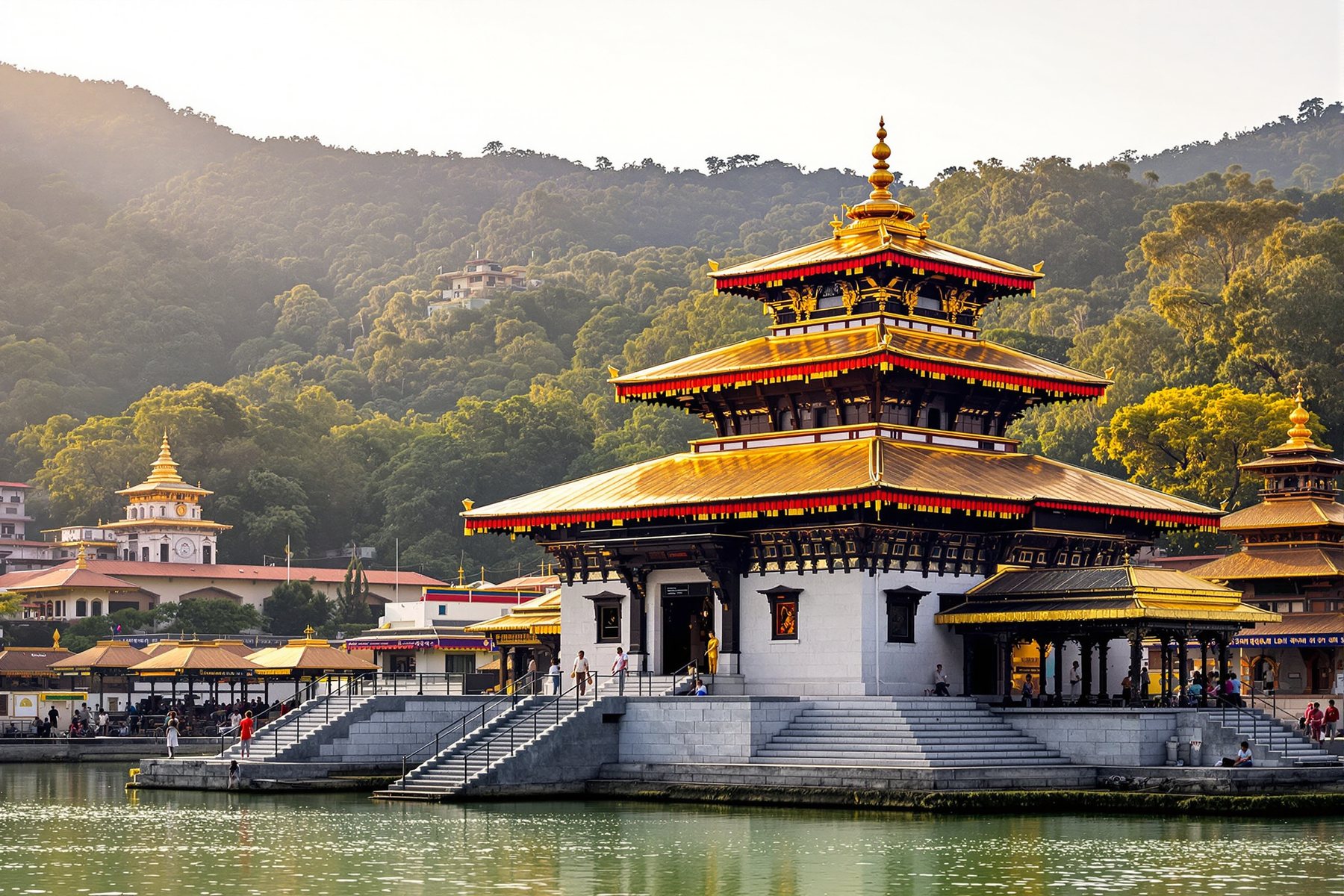
Pashupatinath: The Golden Pagoda on the Sacred River
How the master builders of the Kathmandu Valley made a temple of timber, brick and beaten gold — a tiered Nepalese pagoda whose form travelled across Asia, whose shape lets it sway through earthquakes, and which stands at the very threshold of life and death on the holy Bagmati.
Cross the Himalaya from the marble of Agra to the green valley of Kathmandu, and you find a wholly different idea of what a temple is. Almost every Indian wonder in this series was built in stone — assembled or carved. Pashupatinath, one of the holiest temples of Shiva anywhere on earth, is built of wood, brick and beaten gold. It is a pagoda — a tiered, gold-roofed temple of the Kathmandu Valley — and it stands on the bank of the sacred Bagmati river, at the very edge between this world and the next.
It is a living temple, worshipped without a break for some fifteen centuries; it is the masterwork of one of the world's great building cultures; and its form is so good that it travelled across a continent. It also teaches, in timber and on shaking ground, a lesson this series first learned in the stone of Thanjavur.
This is the eighteenth article in our Architectural Wonders series.
1. The Nepalese pagoda
The main temple is a classic Nepalese pagoda, built in the Newari tradition of the Kathmandu Valley — and it could hardly be more different from a South Indian stone temple.
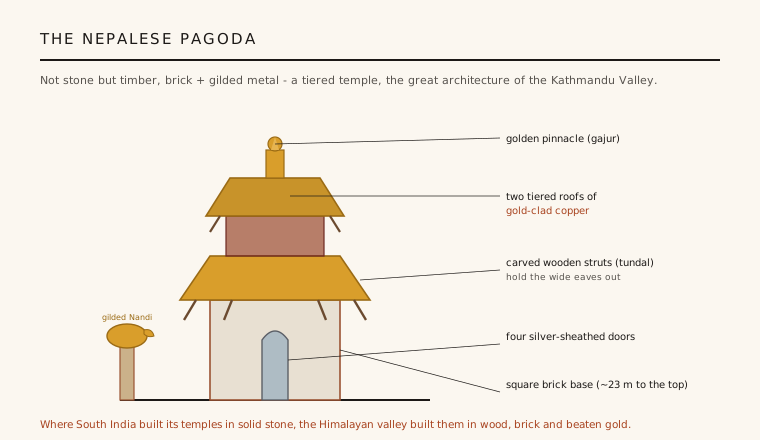
It rises about 23 metres from a square brick base through two tapering roofs of copper sheathed in gold, each roof's broad eaves carried on rows of carved wooden struts (_tundal_), and crowned by a golden pinnacle (_gajur_). Its four doors are sheathed in silver, and a great gilded Nandi (Shiva's bull) kneels before it. Where the temples of the Indian plains trusted everything to solid stone, the builders of the Himalayan valley worked in timber, fired brick and beaten metal — lighter, warmer materials, worked with extraordinary refinement. It is a complete and sophisticated architectural language of its own, every bit the equal of the stone vimana, and utterly distinct from it.
2. A temple at the threshold
To understand Pashupatinath you have to understand _where_ it stands, and what that place means. It sits on the bank of the Bagmati, a river holy to Hindus, and it is dedicated to Shiva as Pashupati — "lord of all living beings" — the god who presides over the whole cycle of life, death and rebirth.
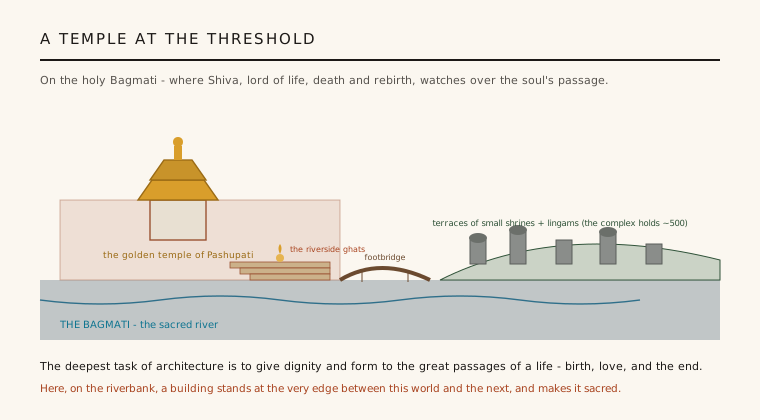
Along the river run the stone ghats, and this is one of Hinduism's most sacred places for the final rites and the soul's passage onward; the vast complex around the temple holds some five hundred smaller shrines and lingams climbing the banks. To stand here is to feel architecture doing its most profound and ancient work: giving form and dignity to the great thresholds of a human life — and to its end. A building on this riverbank is not only shelter or ornament. It is the place where a community meets birth, love, grief and death, and makes each of them sacred. For a project conceived in remembrance, there is no more honest thing a building can be asked to do.
3. The pagoda that travelled across Asia
Here is something most visitors never realise. The tiered, upturned-roofed temple that the world now thinks of as quintessentially Chinese or Japanese — the pagoda — owes a profound debt to this small Himalayan valley.
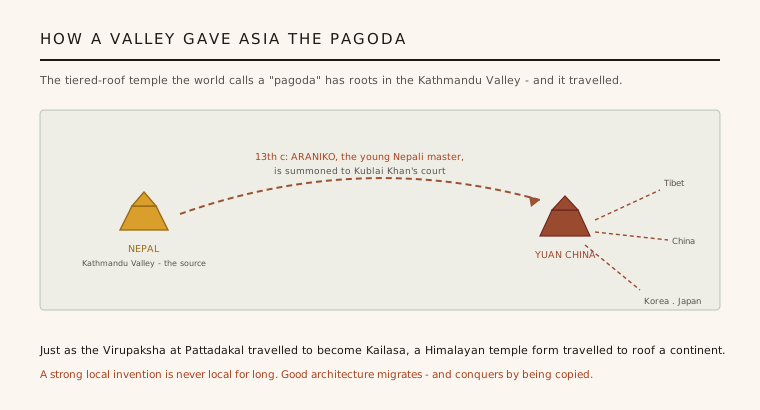
In the 13th century, a brilliant young Newari architect named Araniko (Arniko) was summoned north — to Tibet, and then to the court of Kublai Khan in Yuan China — where he became a celebrated master and helped carry the Nepalese tiered-temple style across the region. The multi-roofed form rippled outward through Tibet, China, Korea and Japan, shaping the skyline of half a continent. It is exactly the pattern we saw when the Virupaksha at Pattadakal travelled to become the Kailasa at Ellora, or when a young Norwegian firm carried a modern idea to Alexandria: a strong local invention never stays local. Good architecture migrates, and conquers by being copied.
4. The craft of the valley
A pagoda is only as good as the hands that make it, and the Newars of the Kathmandu Valley are one of the great building cultures of the world — hereditary masters of woodcarving, metalwork and brick, who make the ornament and the structure as a single act.
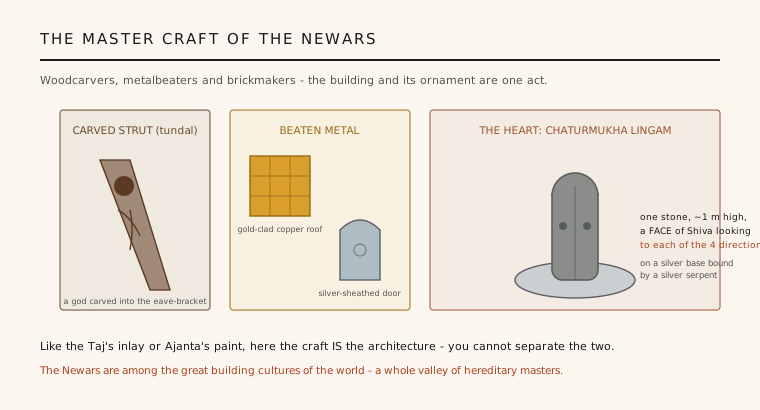
Every roof-strut is a carved deity; the roofs are sheets of gilded copper; the doors are clad in silver. And at the temple's heart is its most sacred object: the Chaturmukha Mukhalinga — a one-metre stone Shiva lingam with a face looking out to each of the four cardinal directions (with a fifth implied above), set on a silver base bound by a silver serpent — a single image of the god watching over the entire universe at once. As at the Taj with its pietra dura, or Ajanta with its murals, the craft here is not decoration applied to architecture; it is the architecture. You cannot pull them apart.
5. Why it still stands
And now the lesson that ties this timber temple back to the great stone tower of the south. Nepal sits on one of the most earthquake-prone fault lines on earth, and in 2015 a massive quake levelled monuments across the Kathmandu Valley. Pashupatinath stood.
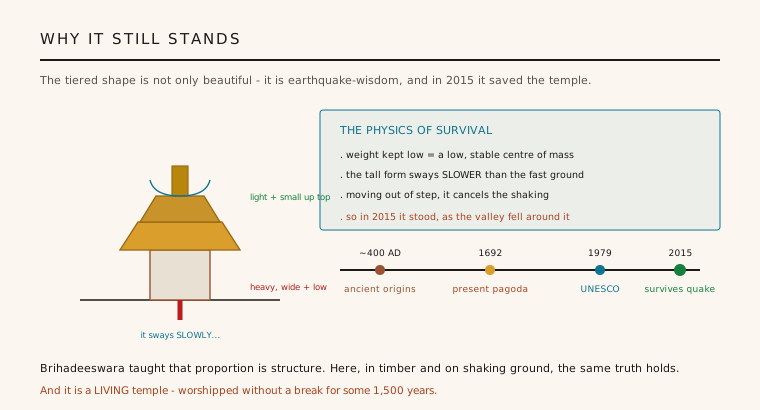
The reason is built into the pagoda's very shape. Its roofs are wide and heavy low down and small and light at the top, so the building's weight sits near the ground, giving it a low, stable centre of mass. A tall, lightly-topped form like this sways slowly — out of step with the fast jolting of the ground — and that mismatch _cancels_ much of the shaking instead of amplifying it. The same flexible timber frame that looks so delicate is in fact a superb piece of seismic engineering, refined over centuries on shaking ground. At Brihadeeswara we learned that proportion is structure; here the identical truth is proven in wood, against an earthquake. (The temple has ancient origins recorded by around 400 CE; its present form was rebuilt in 1692 after termites and earlier quakes, and the Kathmandu Valley was listed by UNESCO in 1979.) It is, above all, a living temple — and it survives because it is at once well-built and never abandoned.
6. What a modern architect can learn from Pashupatinath
- Honour local materials and traditions. The pagoda proves that timber, brick and metal can make architecture as profound as any stone monument. The best building grows from what a place has and what its people have mastered — not from imported fashion.
- Form can be structural intelligence. The tiered roof is not just a style; it is earthquake-wisdom made visible. Beauty and performance are often the same decision — the shape that looks right is frequently the shape that survives.
- Strong local ideas travel far. A temple form from one Himalayan valley shaped the skyline of a continent. Never assume your best, most rooted idea is too local to matter; the most original work is often the most exportable.
- Craft is architecture, not decoration. Where the carving stops and the building begins, at Pashupatinath, is impossible to say. Treat the makers' hands as central to the design, not as a finish applied at the end.
- Architecture's deepest task is the threshold. A building can give form and dignity to birth, love, grief and death — the passages no one escapes. To build well at those thresholds, as this riverside temple does, is architecture at its most necessary and its most humane.
References & further reading
1. UNESCO World Heritage Centre — Kathmandu Valley (inscribed 1979). https://whc.unesco.org/en/list/121/
2. Encyclopaedia Britannica — Pashupatinath Temple. https://www.britannica.com/place/Pashupatinath-Temple
3. Pashupatinath Area Development Trust (official). https://pashupatinathtemple.org/
4. World History Encyclopedia — Newari architecture and Araniko. https://www.worldhistory.org/
Last verified 2026-06-30. Dates, dimensions and attributions follow standard historical and institutional reference sources and are given as widely accepted approximations; the Newari pagoda form, the ~400 CE origins and 1692 rebuilding, Araniko's role in carrying the pagoda to Yuan China, and the temple's survival of the 2015 earthquake follow the established record. The temple's religious significance is described with respect for living tradition.
Export this guide
Related Guides — Deep-dive reading
Pattadakal: Where India's Two Temple Grammars Meet
How the 8th-century Chalukyas built the temple at last in the open air — and set the curved spires of the North beside the stepped towers of the South, on one riverbank, as if in a single open-air showroom of styles. The site that crowned kings, named its architects, and gave Ellora its model.
Architectural WondersThe Pantheon: The Dome That Has Never Been Beaten
Nearly nineteen centuries ago the Romans poured a hemisphere of concrete 43 metres across, left a single round hole open to the sky at its summit, and walked away — and it is still, today, the largest unreinforced concrete dome on Earth. A temple to all the gods that became a church, the best-preserved building of ancient Rome, and the ancestor of every great dome from Florence to the United States Capitol.
Architectural WondersBrihadeeswara: The Chola Tower That Never Fell
How an 11th-century Tamil emperor raised a 216-foot tower of solid granite — with no mortar, no iron and no machine — and why this colossal corbelled mountain has stood for over a thousand years where Konark's fell. The engineering, the 80-tonne capstone, and the lesson.
Architectural WondersRelated Tools — Try Free
Before & After Studio
Generate AI before-and-after renders to preview how your redesign could look.
DesignAIConcept Generator
Get 3 AI-generated design concepts for any room with style, materials, and cost estimate.
DesignAIDesign Style Finder Quiz
Answer 10 visual questions to discover your Indian interior style profile with materials and colours.
Interactive Quiz