
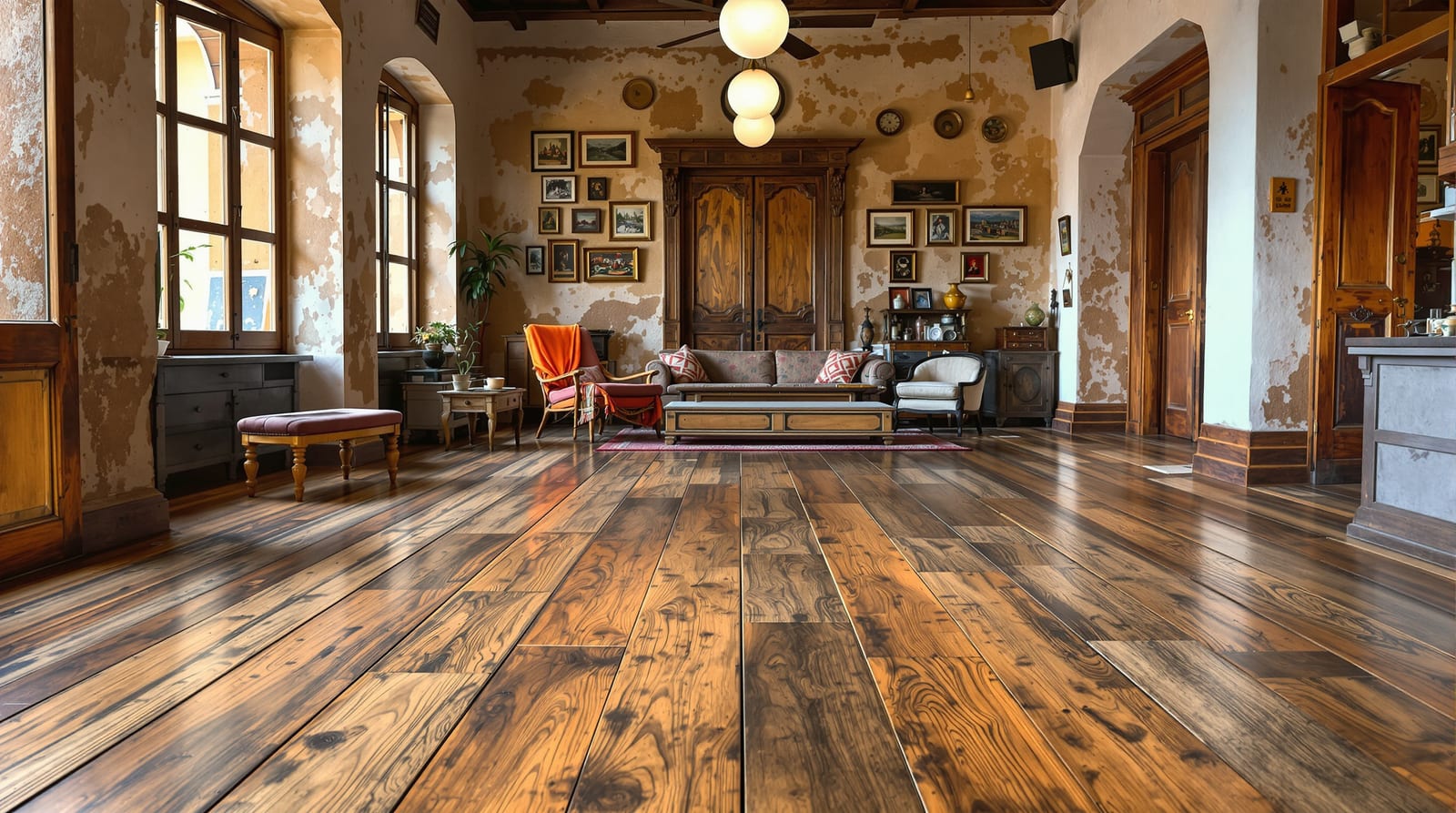
Reclaimed and Recycled Flooring in India: Salvaged Teak, Old Stone and Recycled-Content Floors
How to source, judge and lay reclaimed wood flooring and recycled floors in India — salvaged Burma teak and hardwood, reclaimed stone and old tiles, recycled-content vitrified, recycled-chip terrazzo and rubber from old tyres — with their real eco case, the cautions, and where to actually find them.
There is a quiet truth in flooring that the showrooms rarely mention: the most sustainable floor is almost always the one that already exists. A plank of Burma teak salvaged from a hundred-year-old Chettinad house has already done its growing, its drying and its travelling — laying it again costs the planet almost nothing, and gives you a depth of grain and patina that no new floor can fake. Reclaimed and recycled flooring is India's oldest habit and its newest trend at the same time: our grandparents reused old stone and broken china as a matter of thrift, and today the same instinct earns green-building credits and turns heads. This guide is the honest field manual — what is genuinely worth reclaiming, what to inspect before you pay, where to find it, and how to put a salvaged or recycled floor down so it lasts another lifetime.
Why reclaimed and recycled floors are the lowest-carbon choice
Every new floor carries a hidden bill called embodied carbon — the energy spent growing or quarrying the material, processing it, and hauling it to your site. A reclaimed floor has already paid that bill once, decades ago. Reusing it adds only the carbon of removal, cleaning and refinishing, which is a tiny fraction of making something new. That is why reclaimed solid teak is, by a wide margin, the most sustainable wood floor you can lay in India — far greener than even FSC-certified new hardwood, because no tree is felled at all.
The same logic runs through recycled-content floors. A vitrified tile pressed partly from factory waste and fly-ash, a terrazzo poured with crushed waste-marble and recycled-glass chips, a rubber floor made from shredded scrap tyres — each diverts material from a landfill and replaces virgin raw material. None of these is carbon-free, but all of them sit well below their all-new equivalents, and most qualify for recycled-content and regional-material points under IGBC Green Homes, GRIHA and LEED India. For the bigger picture of how these stack up against bamboo, cork and local stone, see our companion guides on sustainable flooring materials in India and eco-friendly flooring in India, and the deeper flooring embodied carbon breakdown.
The diagram below shows why reuse beats replacement — the circular loop a single timber floor can travel instead of ending in a skip.
The reclaimed and recycled flooring family
"Reclaimed" and "recycled" are not the same thing, and it helps to keep them straight. Reclaimed means the material is reused largely as-is — old teak beams re-milled into planks, salvaged stone slabs re-laid, antique tiles relifted. Recycled-content means a new product made partly from waste — a tile or terrazzo or rubber sheet that swallows somebody else's scrap. Here is the full menu Indians can actually source, with the eco case and the honest cautions.
| Material | What it is | Eco case | Indicative cost (material) | Watch out for |
|---|---|---|---|---|
| Reclaimed Burma teak / hardwood | Old beams, joists, doors, rafters re-milled into planks | Highest — no new tree felled, lowest embodied carbon | ₹350-1,200/sq ft depending on grade and prep | Old nail holes, borer/termite history, hidden cracks, variable widths |
| Reclaimed other Indian hardwood | Salvaged sal, rosewood, jackfruit, mango, sheesham | Very low embodied carbon, character grain | ₹250-700/sq ft | Mixed species, unknown seasoning, sapwood |
| Reclaimed stone slabs | Old Kota, Tandur, Jaisalmer, kadappa, granite lifted from demolished floors | Quarrying avoided; long second life | ₹40-150/sq ft + re-polish | Hairline cracks, uneven thickness, chipped edges |
| Reclaimed / antique tiles | Salvaged Athangudi, encaustic cement, vintage mosaic, old vitrified | Heritage character, waste diverted | Highly variable, often by the lot | Dye-lot gaps, chips, limited quantity for matching |
| Recycled-content vitrified | Morbi tiles bodied with factory waste, fly-ash, recycled cullet | Diverts industrial waste; regional in Gujarat | ₹40-90/sq ft (similar to standard) | Verify recycled claim; surface quality varies by grade |
| Recycled-chip terrazzo / IPS | In-situ or precast with crushed waste-marble & recycled glass | Reuses stone offcuts and glass; durable | ₹90-300/sq ft laid | Skilled labour needed; long set/cure |
| Recycled rubber flooring | Tiles/rolls from shredded scrap tyres | Diverts tyres from landfill; resilient, anti-slip | ₹120-400/sq ft | Smell when new; best for utility/gym/balcony, not formal rooms |
Reclaimed Burma teak and hardwood — the prize
Burma teak (and the dense old Indian hardwoods cut before plantation timber became the norm) is the headline act of reclaimed flooring. Wood that grew slowly over a century is tighter-grained, more dimensionally stable and far more rot- and termite-resistant than fast-grown new timber. When it is salvaged from an old haveli, wada or colonial bungalow, you get all of that plus a patina — soft sheen, mellowed colour, the faint history of nail marks and saw kerf — that brand-new wood spends decades trying to imitate. For how this compares with buying new, read our solid hardwood flooring in India guide.
The catch is that reclaimed timber is a graded, variable product, not a uniform box off a shelf. Beams and rafters must be metal-detected and de-nailed (a single missed nail wrecks a planer blade), re-sawn, kiln-dried back to a stable 8-10% moisture for Indian interiors, then planed and milled with a fresh tongue-and-groove. A reputable reclaimer does all of this; a roadside timber dealer selling "old teak" usually does not, which is why prices swing so widely. Pay for the processed, re-milled, moisture-corrected plank — not the raw beam, unless you have a carpenter you trust to do the work.
Reclaimed stone and old tiles
India demolishes thousands of stone floors every year, and much of that Kota, Tandur, kadappa and granite is perfectly sound. Lifted carefully, cleaned and re-honed, it lays as a second-life floor for a fraction of new stone's cost and almost none of its quarrying impact. The same is true of antique tiles — handmade Athangudi tiles, old encaustic cement tiles, vintage mosaic — which are increasingly hunted for accent floors and heritage restorations. Re-polishing reclaimed stone is routine: see floor polishing cost in India for the per-square-foot rates. For the broader sustainability case for stone, our natural stone sustainability in India guide explains why local Kota and granite beat imported marble on carbon.
Recycled-content tiles, terrazzo and rubber
If you want the eco benefit without hunting demolition sites, recycled-content products are the easy route. Morbi — India's tile capital in Gujarat — produces vitrified tiles that incorporate factory waste, fly-ash and recycled glass cullet into the body; these look and perform like standard tiles and qualify for recycled-content credits, though you must ask the manufacturer for the actual recycled percentage rather than trusting the marketing. Terrazzo and in-situ IPS poured with crushed waste-marble and recycled-glass chips turn somebody's offcuts into a seamless, decades-long floor — our terrazzo flooring in India guide covers the look and the laying. And rubber flooring made from shredded scrap tyres is a genuinely circular product, resilient and anti-slip, ideal for utility rooms, balconies, gyms and kids' areas.
The honest pros and cautions
Reclaimed and recycled floors reward you with character and a clear conscience, but they are not a frictionless purchase. Going in clear-eyed is what separates a treasured floor from an expensive regret.
| The pros | The cautions |
|---|---|
| Unmatched character — patina, grain, history | Sourcing is slow and irregular; quantity may be limited |
| Lowest embodied carbon of any equivalent floor | Condition is variable — inspect every plank or slab |
| Earns IGBC / GRIHA / LEED recycled-content & regional points | Repair and matching is harder with no dye-lot to reorder |
| Often cheaper than new for stone; premium for prepped teak | Hidden costs — de-nailing, kiln-drying, re-milling, extra wastage |
| Diverts waste from landfill, supports circular economy | Quality of "reclaimed" claims varies; vet the supplier |
The single biggest trap is the cost surprise. A pile of old beams looks cheap, but by the time you pay for metal-detection, de-nailing, re-sawing, kiln-drying, planing and milling — and accept 20-30% wastage from cracks, borer damage and short lengths — the finished, laid price of reclaimed teak can rival new engineered wood. That is still worth it for the carbon saving and the look, but budget for the full processed price, not the raw-beam price, and confirm whether quotes are "as-is" or "ready to lay." Always over-order: with no dye-lot to reorder later, a damaged plank or a future repair has to come from your own stock, so keep a spare bundle aside.
Where to find reclaimed and recycled flooring in India
Reclaimed material does not sit in mainstream tile showrooms — you have to go looking. The main channels are specialist reclaimed-wood dealers in metros (who salvage from demolitions and sell de-nailed, kiln-dried, re-milled planks), architectural-salvage and antique yards, demolition contractors and old-building auctions (raw, cheapest, most work), and heritage-restoration suppliers for antique tiles. For recycled-content tiles, ask Morbi manufacturers and their dealers directly for fly-ash or recycled-cullet ranges and request the recycled percentage in writing. Recycled-chip terrazzo is made by specialist in-situ contractors and a handful of precast terrazzo makers, while recycled-rubber flooring comes through sports-surface and industrial-flooring suppliers. Whatever the channel, vet the supplier: ask where the material came from, whether wood has been kiln-dried and metal-detected, and to see finished, prepared samples rather than raw stock.
Refinishing and laying salvaged wood
A salvaged wood floor is only as good as its preparation. The non-negotiables: confirm the planks have been kiln-dried to 8-10% moisture and re-milled with a clean tongue-and-groove; metal-detect again before any cutting; and acclimatise the planks on site for at least 48 hours so they settle to your home's humidity. Lay solid reclaimed planks nail-down or glue over a plywood subfloor, with a 200-micron polyethylene damp-proof membrane over concrete in humid and coastal zones and an 8-12 mm expansion gap at every wall hidden under the skirting — exactly as you would for new solid wood. The full method is in our solid hardwood flooring in India guide.
Once down, an old floor is sanded back through progressively finer grits to lift decades of grime and reveal fresh timber, then finished. For the lowest-VOC, most reversible result, use a natural hard-wax oil or a water-based finish rather than a solvent-heavy polyurethane — kinder to indoor air and easy to spot-recoat in future, which keeps the floor in the reuse loop. The beauty of solid reclaimed wood is that it can be sanded and refinished several more times across its life, so a few decades of scratches simply vanish at the next refinish. Keep furniture on felt pads, wipe with a damp (never wet) microfibre mop, and your salvaged floor will outlive its second building too.
Frequently asked questions
Is reclaimed wood flooring really more sustainable than new FSC-certified wood?
Yes, by a clear margin. FSC certification means new timber was harvested responsibly, but a tree is still felled and processed. Reclaimed wood fells nothing — it reuses timber that already exists, so its embodied carbon is limited to removal, drying and refinishing. That makes salvaged solid teak the single most sustainable wood floor you can lay in India.
Why is reclaimed teak sometimes as expensive as new flooring?
Because the raw beam is only the start. Proper reclaimed flooring is metal-detected, de-nailed, re-sawn, kiln-dried to stable moisture, planed and milled with a fresh tongue-and-groove, and 20-30% is lost to cracks, borer damage and short lengths. The finished, laid price reflects all that labour and wastage. You are paying for prepared, ready-to-lay timber, not the demolition pile.
How do I check the condition of reclaimed wood before buying?
Inspect every plank in daylight. Look for active borer holes (fresh powder), soft or spongy patches, deep cracks running across the grain, and lingering nail or screw fragments. Ask for the moisture content (8-10% for Indian interiors) and confirm the wood has been kiln-dried and metal-detected. Reject anything still damp, raw or unscanned.
Are recycled-content vitrified tiles as good as regular tiles?
Good-grade recycled-content tiles from reputable Morbi makers perform like standard vitrified tiles — the recycled material goes into the tile body, not the wearing surface. Quality varies by grade and factory, so check the water absorption (under 0.5% for vitrified, per IS 15622), inspect the surface, and ask for the actual recycled percentage in writing rather than trusting a generic green label.
Where can I buy reclaimed flooring in India?
Through specialist reclaimed-wood dealers in major cities, architectural-salvage and antique yards, demolition contractors and old-building auctions, and heritage-tile suppliers. For recycled-content tiles ask Morbi manufacturers directly; for recycled-chip terrazzo use in-situ terrazzo contractors; for recycled-rubber flooring approach sports-surface and industrial-flooring suppliers. Always vet sourcing and ask to see prepared samples.
Export this guide
Related Guides — Deep-dive reading
Sustainable Flooring Materials in India: A Material-by-Material Eco Catalogue
A deep catalogue of the genuinely sustainable floors you can actually buy in India — bamboo, cork, natural linoleum, reclaimed and FSC-certified wood, local granite, Kota and sandstone, recycled-chip terrazzo, fly-ash and recycled-content vitrified, and rubber from old tyres — with their real eco credentials, durability, cost, look and best use.
Flooring & SurfacesEco Friendly Flooring in India: The Homeowner's Guide to Greener Floors, Low-VOC Choices and Lower Embodied Carbon
What actually makes a floor green — embodied carbon, recycled content, VOC emissions, renewability, recyclability, lifespan and local sourcing — and which Indian flooring choices are genuinely sustainable, from bamboo, cork and linoleum to local stone, fly-ash tiles and recycled-chip terrazzo.
Flooring & SurfacesSolid Hardwood Flooring in India: Species, Cost, Refinishing & the Humidity Caveats (2026)
Real solid timber planks of teak, oak, merbau or walnut give the deepest premium feel and can be sanded and refinished for decades — but in India's humidity they need acclimatisation, expansion gaps and the right rooms. Here is the honest homeowner's guide, with species, Janka hardness, ₹/sq ft and how it compares with engineered wood.
Flooring & SurfacesRelated Tools — Try Free
Cross-Ventilation Analyzer
Estimate airflow and air changes per hour (ACH) from room size, window areas, layout, and local wind — with NBC 2016 Part 8 compliance check.
Ventilation CalculatorFlooring Cost Calculator
Estimate the all-in cost of a floor — material, laying, wastage, skirting and GST — by area and material.
Flooring CalculatorDoor Material Comparison Tool
Compare 2–4 door materials on cost, durability, maintenance, security and moisture resistance.
Comparison Tool