
Door Fitting Productivity: Man-Hours & Programme (India 2026)
How long door fitting really takes on an Indian site, how to estimate man-hours, plan the door programme, crew and sequence — and what slows the gang down.
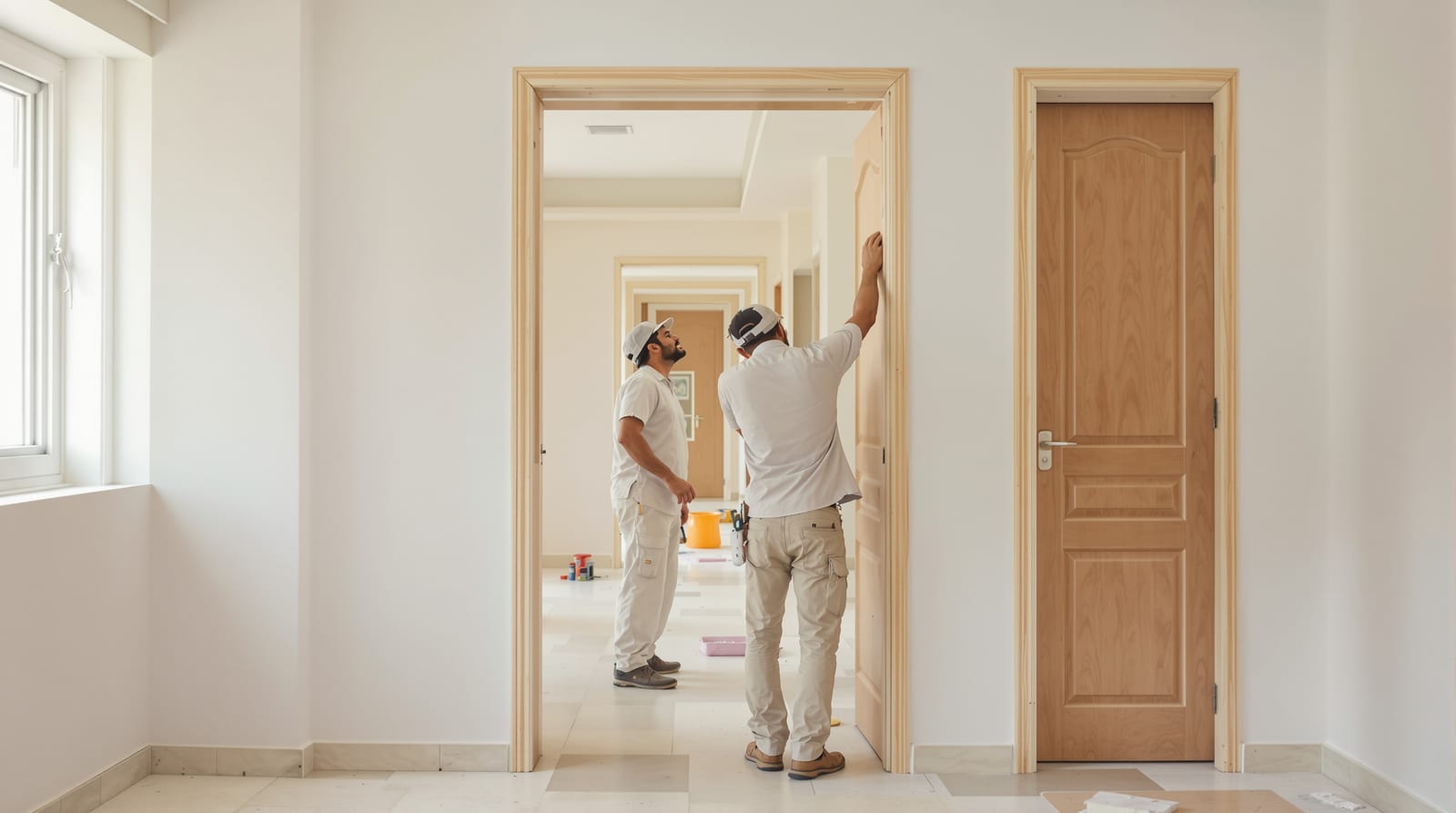
Ask three contractors how long it takes to fit a door and you will get three answers, because the question is incomplete. Door fitting productivity depends entirely on the leaf type, the quality of the opening, the hardware set and how well the gang is sequenced. As a rule of thumb, a skilled carpenter hangs and fits roughly 4-6 simple flush doors a day, but only 2-3 heavy, fire-rated or glazed leaves, and far fewer if the openings are out of square or the hardware schedule is missing. This guide turns those numbers into a usable estimate: how to count man-hours for a real project, build a door programme, size and sequence the crew, and recognise the snags that quietly halve a day's output on an Indian site with mixed-skill labour, dust, monsoon humidity and power cuts.
This is the planning layer above the craft of fitting door hardware and the costing in the door fitting cost breakdown: the numbers a site engineer needs to commit a date and a gang to a door package.
What drives door fitting productivity
Fitting a door is not one task but a chain — receive and check the leaf, mark and hang on hinges, set clearances, mortise and fit the lock and lever, fit bolts and closer, then adjust until it latches first time and self-closes. Each link adds time, and the leaf type multiplies it. A hollow-core flush door on a true, pre-hung-ready opening is quick; a 60mm solid teak main door with a glazed sidelight, a multi-point lock and a closer can take most of a day on its own.
The biggest single variable is the opening. A frame fixed plumb, level and square (see door frame plumb and level) lets the carpenter hang straight to clearance. An out-of-plumb or twisted opening forces packing, re-planing and repeated trial hangs — the same leaf can take twice as long. This is why productivity is a site-discipline metric, not just a carpenter's speed: the trades before the door largely set the pace.
The leaf-type multiplier
Simple, repetitive flush doors flow; one-off heavy, fire or glazed leaves do not. The table below is the working estimate every door programme starts from. Treat it as indicative bands for an experienced carpenter on reasonable openings, not a guarantee.
| Door type | Doors fitted per carpenter-day | Approx man-hours per door | Why |
|---|---|---|---|
| Hollow-core flush, internal, simple lever | 5-6 | 1.3-1.6 | Light leaf, single mortise lock, true opening |
| Solid-core flush, internal, lock + lever | 4-5 | 1.6-2.0 | Heavier, more careful mortising |
| Panelled / moulded internal | 3-4 | 2.0-2.7 | More fitting and adjustment |
| Main / entrance, heavy hardwood | 2-3 | 2.7-4.0 | Weight, multi-point lock, closer, tight reveal |
| Fire-rated set (FD30/FD60) | 2-3 | 2.7-4.0 | Tested set, intumescent seals, ≤3mm gaps, signage |
| Glazed / part-glazed leaf | 2-3 | 2.7-4.0 | Glazing care, heavier, more handling |
| Double / leaf-and-a-half | 1.5-2.5 pairs | 3.5-5.5 | Meeting stiles, rebates, two leaves to match |
Fire and glazed leaves sit at the slow end for good reason: a fire-door set must be installed as a tested assembly with gaps ≤3mm (4mm max), continuous intumescent and smoke seals, fire-rated hinges and "Fire door — keep shut" signage to satisfy IS 3614 and NBC 2016. That precision cannot be rushed without breaching life-safety — never trade fire-door integrity or free egress for output.
Estimating man-hours for a project
Turn the per-door numbers into a project total in four steps. The goal is a man-hour figure you can convert to crew-days and a date.
1. Count and classify every door from the door schedule — split into flush-simple, flush-solid, panelled, heavy/main, fire, glazed, doubles.
2. Apply man-hours per type from the table to get raw fitting hours.
3. Add the fixed extras — frame fixing if in scope, hardware fitting beyond the basic set (closers, multi-point locks, smart locks add 0.3-1.0 hr each), and protection.
4. Add an allowance for snagging, adjustment and site loss — typically 15-25% on a well-run job, more on a difficult one.
A worked example: a 40-door floor with 28 simple flush (≈1.5 hr), 6 solid flush (≈1.8 hr), 4 fire sets (≈3.5 hr) and 2 main doors (≈3.5 hr) gives 42 + 10.8 + 14 + 7 = about 74 raw man-hours, plus ~20% loss ≈ 89 man-hours. At one carpenter that is roughly 11-12 days; with a two-fitter gang plus a helper it phases comfortably across a working week. Use the door fitting time estimator to run your own door mix, and the door fitting cost estimator to convert man-hours to ₹ at local day-rates.
Day-rate and per-door reckoning
Labour is priced two ways in India: per door (internal flush ₹400-900, main/heavy ₹900-2,000, frame fixing ₹500-1,500) or per day (carpenter day-rate ₹800-1,800, plus a helper). Cross-check them: at 5 simple doors a day, ₹600/door equals ₹3,000/day — above a bare day-rate, which is fair because per-door carries the carpenter's tools and risk. If the two methods diverge wildly, the door mix or the opening quality is the reason. The door fitting contract should state which basis applies and who supplies materials.
Planning the door programme
A door programme phases the gang against the door count so trades flow without colliding. Because a carpenter manages 4-6 simple doors a day, a 200-door building is roughly 40 carpenter-days of simple-door work alone — plan it floor by floor, releasing openings as the wet trades dry. The diagram shows how output and cumulative progress build across a typical week.
Notice Day 3: switching the gang to fire sets drops output to three doors, so a smart programme batches like with like — run all the simple flush doors in a block, then the fire and glazed leaves in their own slower block, rather than alternating and losing rhythm. Stage door snagging floor by floor so defects are caught while the gang is still there, not at handover.
Crewing and sequencing the gang
The efficient unit on most jobs is a skilled carpenter plus a helper: the carpenter marks, mortises and hangs while the helper carries, holds, fetches hardware and protects fitted leaves. A second carpenter roughly doubles output if there are enough released openings to keep both busy — productivity collapses if two carpenters share one floor that is not ready.
Sequence the work to keep the skilled hands cutting:
- Batch by type so the carpenter stays in one rhythm (all simple flush, then all fire).
- Pre-stage hardware per door using the ironmongery schedule builder so no one hunts for a lock mid-hang.
- Release dry openings only — hanging into wet plaster guarantees swelling and rework.
- Protect as you go so a fitted leaf is not chipped and re-done.
- Keep a power buffer — power cuts stall routers, morticers and chargers, so keep charged batteries and, where the schedule is tight, a small inverter for the gang.
Where labour is mixed-skill, put your most experienced carpenter on the first openings and the fire sets, and use the sample-door sign-off to lock the standard before the batch runs. Coordinate the gang against the other trades in the door trades coordination sequence, and keep the whole programme aligned with the complete door guide.
What slows door fitting
Most lost time is avoidable and traces back to readiness, not craft. The table catalogues the common productivity killers and the fix.
| Productivity killer | Effect on output | Fix |
|---|---|---|
| Out-of-plumb / twisted openings | Repeated packing and re-planing; output halved | Fix and check frames plumb, level, square before the gang arrives |
| Hanging into wet plaster | Leaves swell, bind, need refitting | Hold the dry-out gate; release dry openings only |
| Missing / unclear hardware schedule | Carpenter waits, fits wrong set | Issue a numbered door + ironmongery schedule up front |
| Hardware not pre-staged | Time lost hunting per door | Kit each door's hardware before the day starts |
| Power cuts | Power tools stall mid-cut | Charged spare batteries; inverter on tight programmes |
| Blunt chisels / plane irons | Torn veneer, slow, rework | Sharpen daily; keep edges keen |
| Mixing leaf types ad hoc | Loss of rhythm | Batch like with like |
| Damaged / unprotected leaves | Refitting and refinishing | Protect edges; store flat, off the floor, dry |
| Snagging deferred to end | Gang demobilised, return trips | Snag floor by floor while the gang is on site |
| No supervision of mixed-skill labour | Inconsistent quality, redo | Lead carpenter on first openings + fire sets |
Monsoon humidity and dust deserve a special note: in the wet season, allow extra dry-out time before hanging, and check each leaf is flat before fitting hardware — a leaf that has absorbed moisture in storage will fight every adjustment. Honest planning beats heroics: a realistic programme with a 20% loss allowance lands on date, while an optimistic one collapses into overtime and snag-driven return trips.
Frequently asked questions
How many doors can a carpenter fit in a day?
As a rule of thumb, a skilled carpenter hangs and fits about 4-6 simple internal flush doors a day on true openings with a basic lock-and-lever set. Heavy hardwood main doors, fire-rated sets and glazed leaves drop that to roughly 2-3 a day because of weight, precision and the extra hardware. Out-of-square openings or a missing hardware schedule can halve even those figures.
How do I estimate man-hours for a door package?
Count and classify every door from the door schedule, apply per-type man-hours (about 1.3-1.6 hr for simple flush, 2.7-4.0 hr for fire, heavy or glazed), add fixed extras for closers and multi-point or smart locks, then add a 15-25% allowance for adjustment, snagging and site loss. Divide the total by the gang size to get crew-days, and use the door fitting time estimator to run your own mix.
What slows door fitting down the most on an Indian site?
The biggest losses come from openings that are not ready — out-of-plumb frames and hanging into wet plaster — followed by a missing or unclear hardware schedule, hardware not pre-staged, power cuts stalling power tools, and blunt tools tearing veneer. Almost all of it is a readiness and coordination problem, not the carpenter's speed.
Is per-door or per-day pricing more productive?
Neither is inherently faster; they price the same work differently. Per door (₹400-900 internal flush, ₹900-2,000 main/heavy) rewards a clean, repetitive run and carries the carpenter's tools and risk; per day (₹800-1,800 plus helper) suits one-off, difficult or fire-door work where output is unpredictable. Cross-check the two — at 5 doors a day, ₹600 per door equals ₹3,000 a day — and state the basis in the contract.
How big should the door-fitting gang be?
The efficient core is one skilled carpenter plus a helper, who together fit the 4-6 simple doors a day. Add a second carpenter only when enough dry openings are released to keep both cutting — otherwise two carpenters sharing one unready floor produce less than one. On fire and entrance doors, weight your most experienced hand to protect the standard and the life-safety details.
Does fire-door fitting really take longer, and can I speed it up?
Yes — a tested fire-door set takes roughly the time of a heavy main door because the gaps must be ≤3mm, the intumescent and smoke seals continuous, the hinges fire-rated and the signage fitted to satisfy IS 3614 and NBC 2016. You can speed the programme by batching all fire sets together and pre-staging the certified hardware, but never speed the fitting itself by skipping seals, gaps or checks — that compromises fire integrity and free egress, which is a defect, not a time-saving.
Export this guide
Related Guides — Deep-dive reading
Door Trades Coordination: Fitting Sequence on Site (India 2026)
How carpenter, mason, electrician and painter hand off work in the right order so doors fit without rework on an Indian site.
Home Doors & EntrancesDoor Delivery & Storage on Site: A Fitter's Guide (India 2026)
Receive, check and store doors flat, dry and acclimatised on an Indian site so leaves never warp, swell or arrive damaged before fitting.
Home Doors & EntrancesDoor Fitting Guide: Step-by-Step Installation (India 2026)
The complete step-by-step door fitting guide for India — set the frame plumb, fix it with holdfasts, grout, hang the leaf on three hinges, fit the lock, trim and seal — with the tools and checks a homeowner needs.
Home Doors & EntrancesRelated Tools — Try Free
Fire Door Rating Checker
See the likely fire-door rating (30/60/90/120 min) and components a location needs per IS 3614 / NBC — guidance, confirm with your architect.
Compliance ToolDoor Cost Calculator
Estimate the all-in cost of a door — leaf, frame, hardware, fitting and GST — by type, material and size.
Door CalculatorDoor Hardware Cost Estimator
Estimate the all-in hardware cost for a door — hinges, lock, handle, closer, bolts, stopper and fitting — with GST.
Door Calculator