
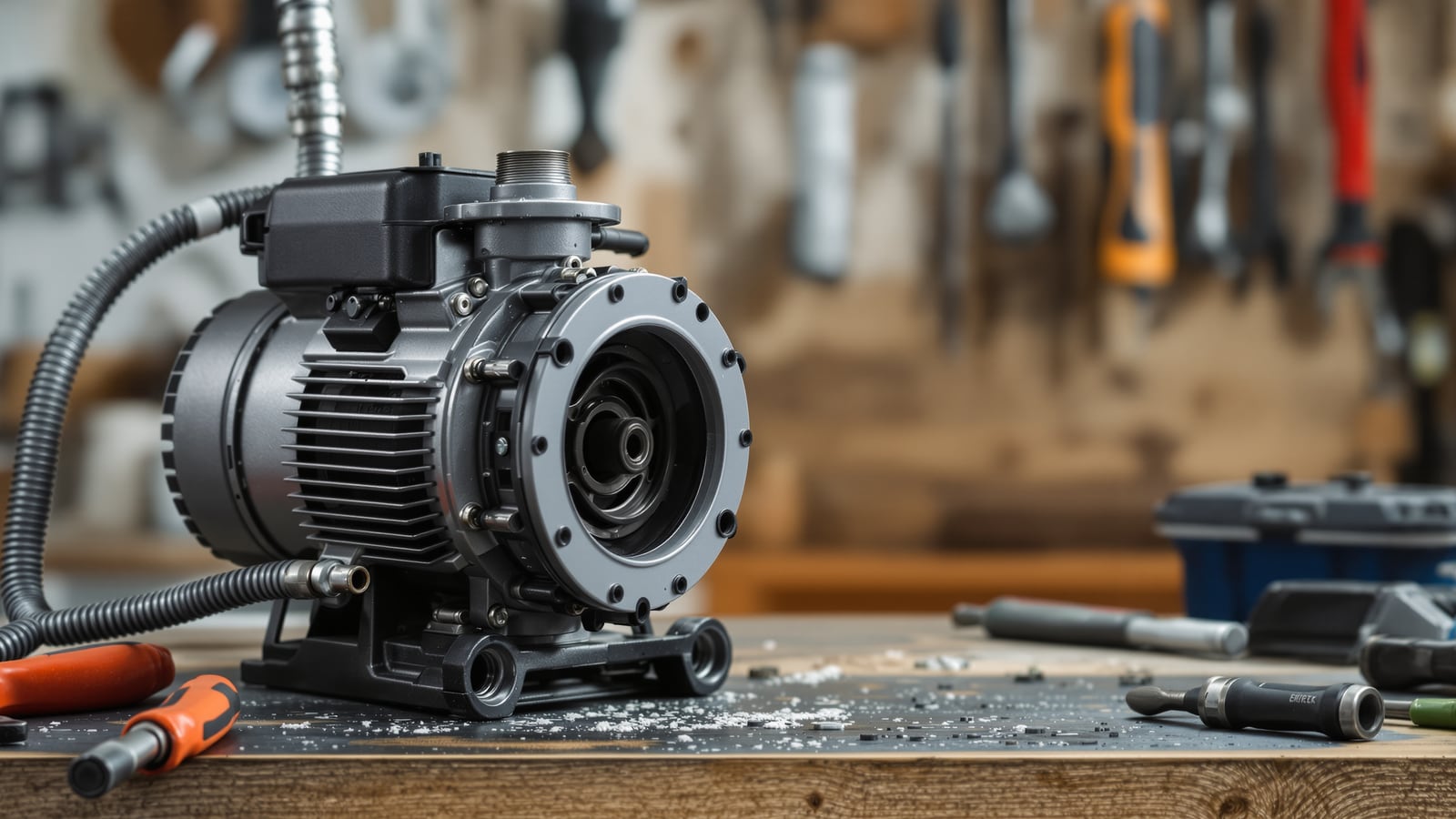
Water Pump Maintenance & Troubleshooting in India: Fix a Pump That Won't Start, Runs Dry or Loses Prime
A homeowner's guide to keeping a domestic water pump alive and diagnosing it when it fails — a routine maintenance schedule (leaks, bearing noise, capacitor, foot valve, priming, dry-run protection, impeller) and a symptom-to-cause-to-fix table for the five faults every Indian pump eventually throws: won't start, runs but no water, low flow, won't stop, and trips or overheats.
A water pump is the one machine in an Indian home that runs almost daily, sits in a damp corner, and gets ignored until the morning it hums but no water comes. The good news: most pump failures are a handful of predictable, cheap faults — a lost prime, a tired capacitor, a leaking foot valve, a choked impeller — and you can diagnose many of them yourself before you spend on a plumber or, worse, a new pump.
This is a maintenance-and-troubleshooting guide under the Studio Matrx plumbing maintenance pillar. It assumes you already know which pump you have — if not, start with the water pumps guide, the borewell pumps guide and how a check valve or foot valve works. Here we keep it running and, when it stops, find out why.
Safety first — this is a motor sitting next to water. Before you touch any pump for anything more than looking at it, switch off the MCB/isolator and unplug it. Never open a terminal box, drain the casing or clear an impeller with the power live. A capacitor can hold charge after power-off. If you are not confident isolating the electrical supply, stop and call a qualified electrician or pump mechanic.
Routine maintenance: small habits that prevent big failures
Pumps rarely die suddenly. They give warnings — a new noise, a slower fill, a warm casing, a faint drip — for weeks first. A ten-minute look every month catches almost all of it.
| Task | What you are checking | Frequency |
|---|---|---|
| Look and listen while running | New bearing whine, grinding, rattle, or knocking on stop (water hammer) | Weekly |
| Check for leaks | Drips at the mechanical seal, pipe joints, foot valve and discharge NRV; a puddle under the pump | Weekly |
| Feel the casing / motor | Warmer than usual = poor cooling, dry running or overload starting | Monthly |
| Clear the suction strainer / foot valve | Grit, leaves and sludge choking the intake | Monthly (quarterly if clean source) |
| Confirm dry-run protection works | Float switch, dry-run preventer or auto-controller actually cutting off | Monthly |
| Check the pressure switch (booster) | Correct cut-in / cut-out pressure, no rapid on-off cycling | Quarterly |
| Test the capacitor / starter | Weak start, humming, slow run-up = capacitor fading | Yearly (or on symptom) |
| Inspect wiring and terminal box | Loose lugs, moisture, discolouration, ant nests, corroded earth | Yearly |
| Grease/service bearings, check impeller | Bearing play, worn or scaled impeller reducing flow | Yearly (mechanic) |
| Full service | Seals, bearings, impeller, alignment, electrical | Every 1-2 years |
A few of these deserve a word:
- Priming and the foot valve. A surface pump only lifts if its casing is full of water — that is priming. The foot valve at the bottom of the suction pipe holds that water column when the pump stops. If it leaks, the pump loses prime overnight and spins on air next morning. A pump you have to re-prime by hand every start has a failing foot valve, an air leak on the suction line, or both.
- Dry-run protection. Running dry — no water to cool or lubricate — is the single fastest way to burn a pump, and Indian sumps and borewells run dry constantly. A dry-run preventer or float switch that cuts the pump before damage is not optional; test it every month by watching it actually cut off.
- The capacitor. A single-phase pump uses a capacitor to start spinning. As it ages the pump hums, struggles to start, or trips its overload — a ₹150-400 part that, ignored, cooks the motor winding.
- The impeller. Sandy borewell or hard water scales and erodes the impeller over years; flow slowly drops even though the motor sounds fine. This is a mechanic job — the pump comes apart to inspect it.
Troubleshooting: symptom to likely cause to fix
Work top-to-bottom within each symptom — the causes are ordered roughly cheapest-and-most-likely first. Isolate the power before any fix that involves touching the pump, opening the casing or the terminal box.
| Symptom | Likely cause | What to check / fix |
|---|---|---|
| Pump won't start (silent) | No power / tripped MCB / loose terminal | Check MCB, fuse, plug, voltage at the terminal; tighten lugs — power off first |
| Pump won't start (hums, doesn't spin) | Weak or dead capacitor; jammed impeller | Replace capacitor (matched microfarad rating); if still stuck, shaft is seized |
| Pump won't start (dead, warm) | Overload/thermal cutout tripped; seized bearing or winding | Let it cool; if it re-trips, motor needs a mechanic |
| Runs but no water | Lost prime / air lock | Refill the casing through the priming plug; bleed air; restart |
| Runs but no water | Leaking or blocked foot valve; air leak on suction | Foot valve won't hold water = replace it; seal suction joints |
| Runs but no water | Source dry — sump/borewell water below intake | Wait for recharge; this is why dry-run protection matters |
| Low / weak flow | Choked strainer, foot valve or partly closed valve | Clean the intake strainer; open valves fully |
| Low / weak flow | Worn or scaled impeller; suction air leak | Mechanic inspects/replaces impeller; find and seal the air leak |
| Low / weak flow | Head too high / pump undersized for the job | Confirm duty with the pump size calculator |
| Won't stop / short-cycles (booster) | Pressure switch set wrong or faulty; waterlogged pressure tank | Reset/replace the switch; re-charge the pressure vessel air |
| Won't stop (tank filling) | Leaking discharge NRV or foot valve sending water back | Replace the leaking check valve |
| Won't stop (auto system) | Stuck float / level sensor | Free or replace the float switch |
| Trips the MCB / RCCB | Winding to earth, moisture in terminal box, capacitor short | Dry the box; if it trips instantly on start, call an electrician |
| Trips on run | Overload from dry running, worn bearing, or low voltage | Fix the cause; a stabiliser helps chronic low voltage |
| Overheats | Dry running, blocked cooling, oversized/over-throttled, low voltage | Restore water flow; never throttle a running pump against a closed valve |
Repair or replace?
A pump is worth repairing when the fault is a serviceable part and the motor is sound. It is worth replacing when the motor itself has failed on an old pump, or when repeated repairs cost more than a new, correctly sized unit.
| Situation | Lean towards |
|---|---|
| Capacitor, foot valve, NRV, pressure switch, strainer | Repair — cheap parts, quick fix |
| Bearings or mechanical seal on a pump under ~5-6 years | Repair — routine service |
| Worn impeller, pump otherwise healthy | Repair — replace the impeller |
| Motor winding burnt on a 6+ year, out-of-warranty pump | Replace — rewinding rarely lasts |
| Frequent breakdowns, obsolete/undersized model | Replace — buy right for your head and flow |
| Pump was always wrong for the duty (weak flow from day one) | Replace and resize with the pump size calculator |
A rewound motor is a stopgap, not a fix — a rewind almost never matches original efficiency, and a second failure usually follows. If the winding has gone on an old, unrated pump, a new BEE-rated pump often pays back the difference in electricity within a couple of years.
When to DIY and when to call a professional
Reasonable to do yourself (power isolated): re-priming, cleaning the strainer or foot valve, tightening a pipe joint, resetting a tripped MCB once, swapping a foot valve or discharge NRV, replacing a like-for-like capacitor if you are comfortable and the pump is unplugged and discharged.
Call a pump mechanic or electrician when: the pump trips the MCB/RCCB the instant it starts, there is any sign of an electrical fault to earth, the shaft is seized, the pump must come apart to reach the impeller or seals, a borewell submersible has to be pulled up, or a three-phase pump is involved. Anything inside the borewell, and anything where you cannot cleanly cut the power, belongs to a professional.
Smart, app-based leak sensors and auto shut-off can flag a leaking pump or a running-dry event early — useful, but a layer on top of good maintenance, covered under smart water management, not a substitute for the checks above.
References
- Bureau of Energy Efficiency (BEE) — star-labelling programme for water pumps and motors; a higher star rating lowers running cost.
- Bureau of Indian Standards — standards for domestic monoblock, centrifugal and submersible pumpsets and their safety (confirm the current IS number with your supplier before specifying).
- Manufacturer's installation and maintenance manual — always follow your specific pump's capacitor rating, service interval and warranty terms.
- Studio Matrx: plumbing maintenance guide, water pumps guide, borewell pumps, check valves and foot valves, and the pump size calculator.
Export this guide
Related Guides — Deep-dive reading
Water Pumps Guide for India: Types, How to Choose & Size (Head, Flow, Phase)
The master overview of domestic and building water pumps — what a pump actually does (lift plus pressure), the two numbers that decide everything (HEAD in metres and FLOW in LPM), a pump-type-to-use table, single vs three phase, priming, foot valve and NRV needs, dry-run protection, and BEE star rating with running cost at a glance for an Indian home.
PlumbingCentrifugal Pumps in India: How Monoblock Water Pumps Work, Sizing & Cost
The impeller-and-volute workhorse behind almost every domestic monoblock and surface pump — how the spinning impeller lifts water, self-priming vs non-self-priming and the foot valve, reading the head-vs-flow pump curve, single vs three phase, cavitation and priming problems, and indicative prices for an Indian home.
PlumbingBathroom Leak Repair in India: Find & Fix Common Leaks (2026)
A practical, India-first guide to finding and fixing the everyday bathroom leaks — dripping taps, weeping traps and angle valves, a running cistern, failed silicone seals — plus how to tell a simple fixture leak from a waterproofing failure that needs a professional.
BathroomsRelated Tools — Try Free
Electrical Safety & Load Audit
Home electrical audit — 10 categories, 65+ checkpoints across earthing, RCCB, MCB, wiring, switchboards, appliance circuits, DG/inverter backup.
Safety AuditLift Running Cost Calculator
Monthly and yearly electricity cost of a home lift by type, trips per day and city.
Lift CalculatorRainwater Tank Sizer
How big should your rainwater tank be? Computes annual harvest, recommended tank capacity in litres, water-bill savings, and payback — for 10 Indian cities.
RWH Calculator