
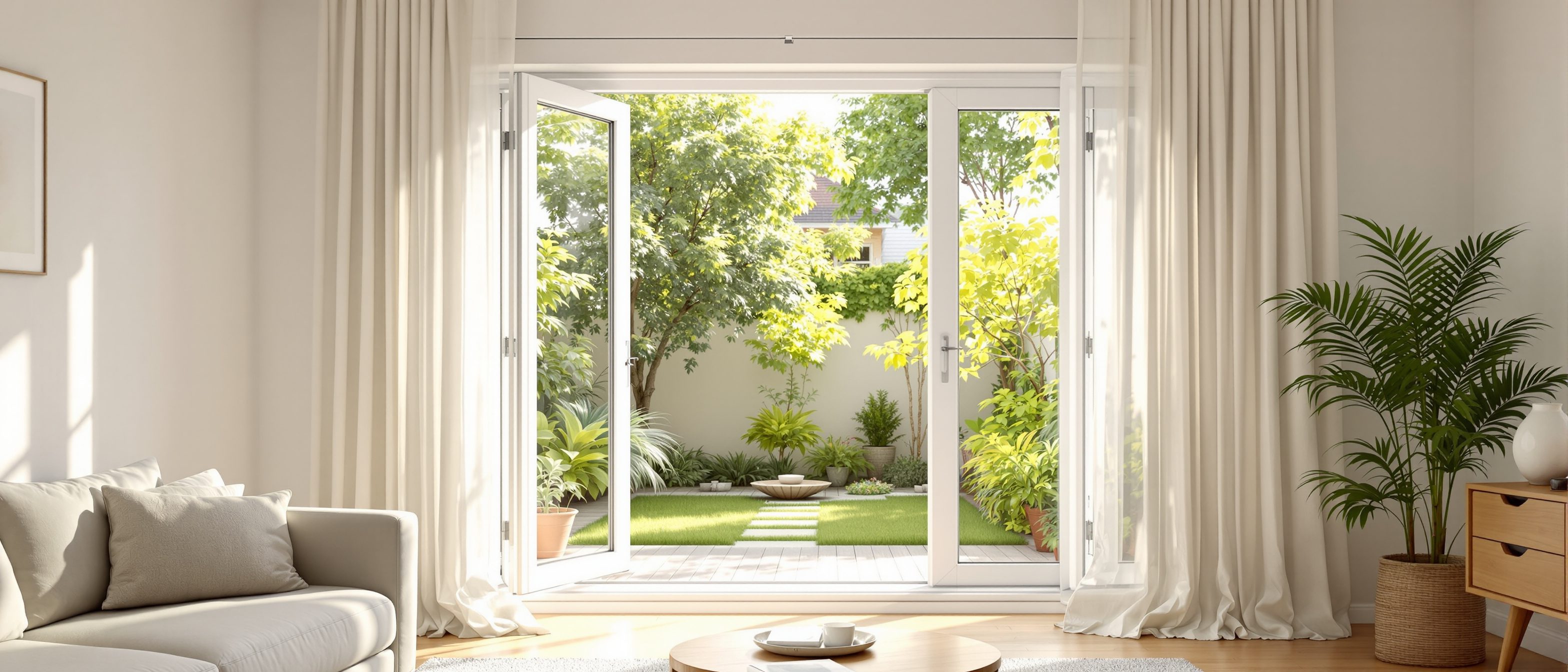
Casement Windows Explained (India): How They Work, Cost, Pros and Cons
The side-hinged window that cranks outward to open its whole face to the breeze and seals airtight when shut — operation, ventilation, frame fit, glazing and ₹/sqft cost for Indian homes.
If you want a window that opens its whole face to the breeze and seals tight as a fridge door when shut, the casement is the one to know. It is the side-hinged window that swings outward like a small door, usually turned by a crank handle. In Indian homes it is the quiet hero of good ventilation and energy efficiency — and once you understand its three trade-offs (a width limit, a swing-clearance need, and a frame-fit question), choosing one becomes simple.
This guide is the dedicated deep-dive on the casement window type. For the quick combined tour of every window and door decision, see Windows and Doors Design in India; for the physics of how air actually moves through a house, see Cross-Ventilation in Indian Homes. Here we stay on the casement itself: how it works, what it costs, and when it is the right call.
How a casement window works
A casement is hinged on one vertical side and swings outward on its hinges, opening up to about 90 degrees. A worm-gear crank handle (or a friction stay and lever) winds the sash open and pulls it shut against a perimeter gasket. Because the whole sash moves away from the frame, the entire opening clears for air — there is no fixed half, no overlapping track.
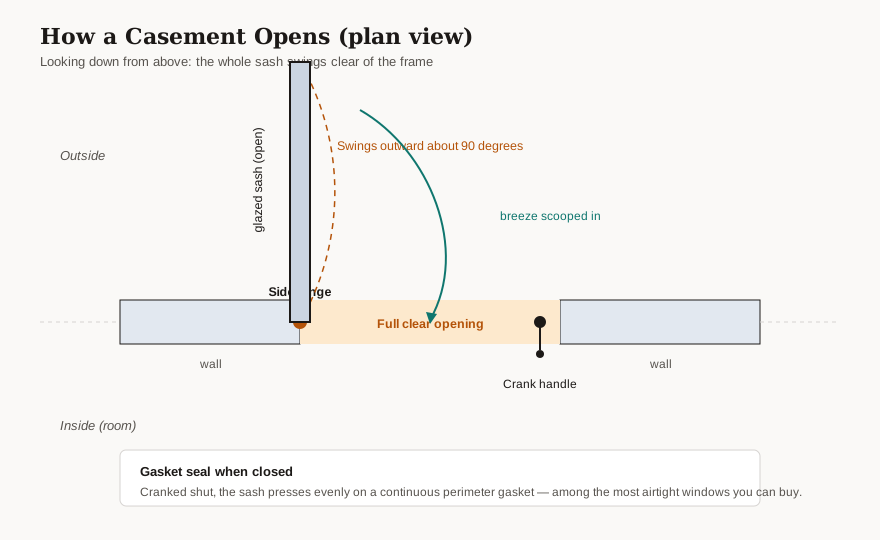
The two things that follow from that simple geometry shape everything else:
- The seal is excellent. When you crank it shut, the sash presses evenly onto a continuous gasket all the way around. A sliding window, by contrast, can only brush past its track. So a closed casement is among the most airtight, weather-tight windows you can buy — which is exactly what an air-conditioned, monsoon-lashed Indian home wants.
- It catches the wind. Open at an angle, the swung-out sash acts like a small scoop, deflecting a passing breeze into the room. Combined with the full clear opening, this gives a casement the best ventilation-per-rupee of any common window type.
Ventilation: why it beats a sliding window
The headline difference between a casement and India's most common window — the slider — is how much of the opening actually breathes.
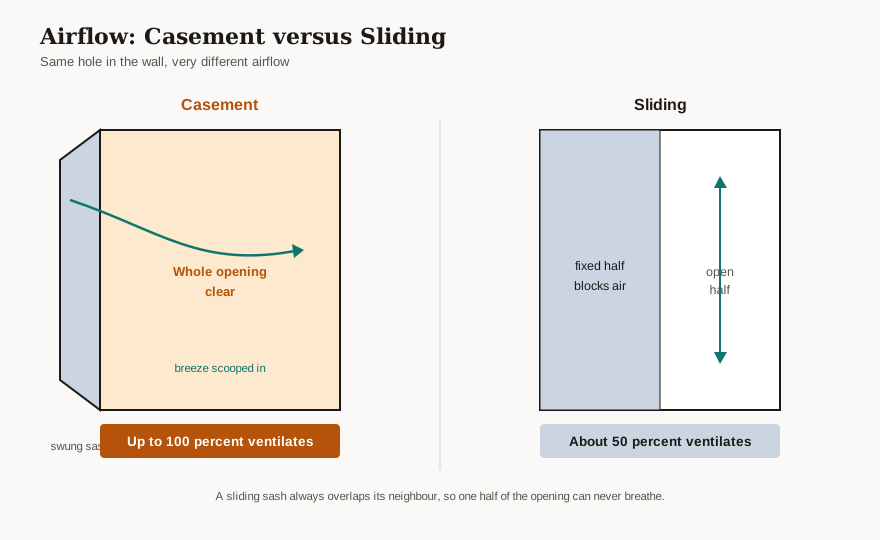
| Behaviour | Casement | Sliding |
|---|---|---|
| Share of opening that ventilates | Up to 100 percent | About 50 percent (one sash always covers half) |
| Breeze capture | Swung sash scoops air in | Passive — air must blow straight at it |
| Seal when closed | Tight gasket compression | Looser brush seal on tracks |
| Swing clearance needed outside | Yes | No |
That whole-opening airflow is why casements pair so well with cross-ventilation: place one on the windward wall and an outlet on the leeward side and you move a lot of air for free. To size openings against the NBC 2016 rule of thumb — openable inlet area of at least one-tenth of the floor area for a habitable room — and to test which walls catch your site's prevailing wind, use the Cross-Ventilation Analyzer.
A closed casement seals like a door; an open one breathes like an open door. That dual character — airtight or wide-open, nothing in between — is the whole point.
The three trade-offs to plan around
1. The roughly 3-foot width limit
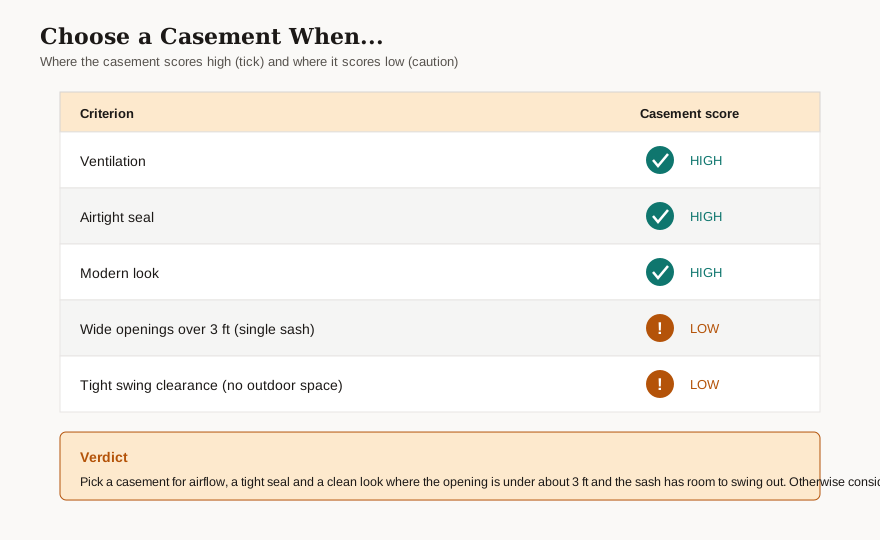
A casement hangs all its weight on hinges along one edge. Make the sash too wide and it sags, the handle strains, and wind catches it like a sail. So a single casement sash is practically capped at about 3 feet (around 900 mm) wide. For a wider opening you simply gang several casements side by side in a common frame, sometimes with a fixed pane between them. Height is far more forgiving — tall, narrow casements are perfectly happy.
2. Swing clearance
Because it opens outward, a casement needs clear space outside the wall. That rules it out where the sash would foul a walkway, a balcony railing, a neighbour's wall in a tight plot, or a security grille set close to the frame. This is the single most common reason apartments default to sliders instead — and the honest reason a casement is not always the answer.
3. Insect screens sit inside
Since the glazed sash swings out, the mosquito mesh goes on the inside of the frame (often a separate openable or pleated screen). It works well, but plan for it — a screen retrofitted as an afterthought rarely looks tidy.
Frame material: the fit question
The casement mechanism works in every frame material, but each suits it differently.
| Frame | Fit with casement | Indicative rate (₹/sqft) | Notes |
|---|---|---|---|
| uPVC | Excellent all-rounder | 250 to 800 (budget white 450 to 600; mid 600 to 900) | Best thermal and acoustic seal, low maintenance, termite and rust proof; the default for new homes |
| Aluminium | Strong, slim, modern | 350 to 3,000 (powder-coated 450 to 950) | Specify a thermal break — bare aluminium conducts heat and cold straight through |
| Wood (timber) | Classic, warm | 500 to 1,500+ | Premium look; needs sealing against the monsoon and costs 2.5 to 4 times uPVC over 10 years once you count repainting |
| Steel (MS) | Slimmest sightlines | Niche | Heritage Crittall-style look; rusts without good coating |
uPVC casements are the value sweet spot in India: the gasket-and-crank design plays to uPVC's strength as an insulator and weather-sealer. Choose aluminium when you want minimal frames or are ganging several large sashes, and remember the thermal break. Wood and steel are for heritage and luxury projects where look leads. Frame materials are compared in full in the pillar guide on home window types.
Glazing: match the glass to your climate and the energy code
The casement's tight seal is wasted on cheap glass, so glazing is where you protect comfort and energy bills.
| Glazing | What it does | When to use |
|---|---|---|
| Single glazing | One pane; cheapest; poor insulation and acoustics | Mild climates, tight budgets, secondary rooms |
| DGU (double glazed unit) | Two panes plus a spacer and air or argon; big jump in thermal and acoustic insulation | The energy-code default for air-conditioned and noisy homes |
| Low-E coating | Reflects radiant heat, cuts solar gain while keeping daylight | Essential for hot Indian exposures |
| Toughened | 4 to 5 times stronger; shatters into blunt granules | Large or low panes — a safety glass |
| Laminated | PVB interlayer holds glass together when broken; best acoustics and UV cut | Security, street noise, west sun |
Read glass by three numbers: VLT (visible light, higher lets in more daylight), SHGC (solar heat gain, lower keeps heat out) and U-value (lower insulates better). Indian heat wants low SHGC with adequate VLT.
This matters more as glass area grows. Under Eco-Niwas Samhita 2018 (the residential energy code), the wall envelope's RETV must stay at or below 15 W/m² across composite, hot-dry, warm-humid and temperate zones — and windows are the biggest lever on that number. The code also sets a minimum VLT by window-to-wall ratio (for example, VLT of at least 0.27 at a WWR up to 0.30). In plain terms: the more casement glass you add, the more the code pushes you toward low-SHGC, spectrally selective glazing to stay compliant and comfortable. For metal-frame casements, IS 1948:2024 governs the aluminium window's materials, construction and performance, and NBC 2016 sets the ventilation minimums.
What it costs
A practical band for a casement window in India, June 2026 and indicative — always confirm against itemised quotes from fabricators:
| Spec | Indicative rate (₹/sqft) |
|---|---|
| uPVC casement, single glazing | 250 to 500 |
| uPVC casement, mid-range | 500 to 700 |
| uPVC or aluminium casement with DGU and Low-E | 700 to 1,500+ |
| Installation and fixing | About 200 |
Casements sit in the medium band: dearer than a basic slider per square foot because of the crank hardware and gaskets, but the airtightness pays back in lower cooling load over the life of the window.
Casement at a glance — pros and cons
| Pros | Cons |
|---|---|
| Whole opening ventilates — best airflow of common types | Single sash limited to about 3 ft wide |
| Airtight gasket seal when shut — energy efficient | Needs clear swing space outside the wall |
| Catches and scoops a passing breeze | Insect screen sits on the inside |
| Suits every frame material, especially uPVC | Crank hardware costs more than a slider |
| Clean modern look, easy to clean from inside | Open sash can catch strong wind if oversized |
Choose a casement if / Avoid a casement if
Choose a casement if:
- Ventilation is a priority — bedrooms, living rooms, studies, anywhere you want a real breeze.
- The wall has clear outdoor space for the sash to swing (ground-floor windows onto a garden or setback, upper floors without obstructions).
- You run air-conditioning and want a tight, energy-efficient seal when closed.
- You want a clean modern look and are happy in the medium cost band.
Avoid a casement if:
- The opening is wider than about 3 ft and you do not want to gang several sashes.
- There is no swing clearance — a tight passage, a balcony railing, a close security grille, or a neighbouring wall. Here a sliding window is the sensible default.
- You want a window that can stay open in driving rain — its top-hinged cousin, the awning window, sheds water and keeps venting through a shower.
Casement versus its close cousin, the awning
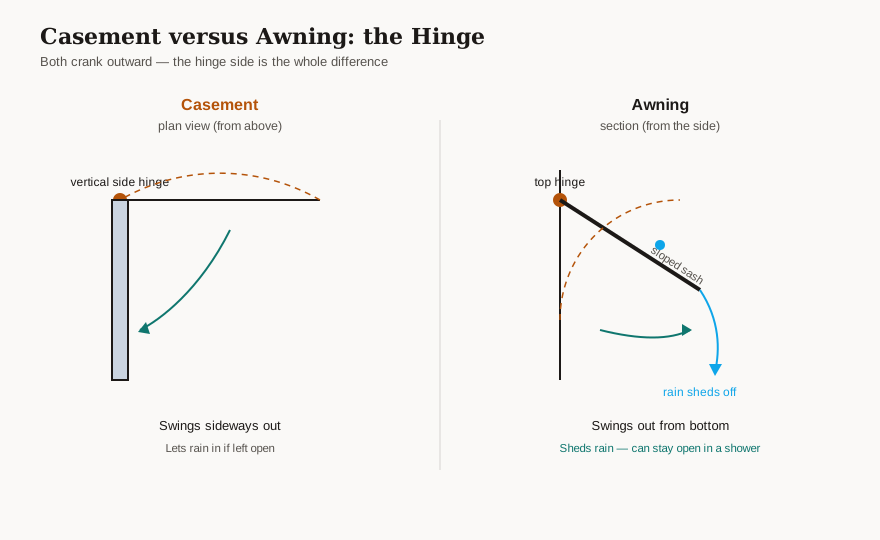
People mix these up because both crank outward on a stay. The difference is the hinge.
| Casement | Awning | |
|---|---|---|
| Hinge side | Vertical side edge | Top edge |
| Swings | Out, sideways | Out, from the bottom |
| In light rain | Let water in if left open | Sheds water — can stay open |
| Best spot | Most habitable rooms | Bathrooms, kitchens, high on a wall, over fixed glazing |
If you need ventilation that survives a monsoon shower or sits high for privacy, read the dedicated Awning Windows guide. For everything else with room to swing, the casement wins.
References
- IS 1948 (aluminium doors, windows and ventilators), BIS: https://law.resource.org/pub/in/bis/S03/is.1948.1961.pdf
- IS 1081 (fixing and glazing of metal doors and windows), BIS: https://law.resource.org/pub/in/bis/S03/is.1081.1960.pdf
- IS 3362 (natural ventilation of residential buildings), BIS: https://law.resource.org/pub/in/bis/S03/is.3362.1977.pdf
- Guide for Using NBC 2016, BIS: https://www.bis.gov.in/wp-content/uploads/2022/08/Booklet-Guide-for-Using-NBC-2016.pdf
- Eco-Niwas Samhita 2018 (BEE / ECBC residential): https://ecbc.in/econiwas.html
- uPVC windows price per sq ft 2026, Building and Interiors: https://buildingandinteriors.com/upvc-windows-price-per-sq-ft-india-2026-cost-guide/
Export this guide
Related Guides — Deep-dive reading
Floor-to-Ceiling Windows (India): Maximum Light, and the Heat Trade-Off
Full-height glazing for Indian homes — how to win the daylight and view without losing the energy code, comfort or safety.
Windows & GlazingPivot Windows Explained (India): The Dramatic, Easy-Clean Premium Window
A central-pivot sash that rotates open like a turnstile — large panes, an architectural statement, and glass you can clean on both faces from inside. The premium, easy-clean alternative to the everyday casement.
Windows & GlazingSliding Windows Explained (India): The Apartment Favourite, Costed and Compared
How sliding windows operate, why they ventilate only half their opening, what uPVC sliders cost in rupees per square foot, and exactly when to choose one over a casement or bi-fold.
Windows & GlazingRelated Tools — Try Free
Cross-Ventilation Analyzer
Estimate airflow and air changes per hour (ACH) from room size, window areas, layout, and local wind — with NBC 2016 Part 8 compliance check.
Ventilation CalculatorWindow Material Comparison Tool
Compare uPVC, aluminium, wood, steel and composite windows on cost, life, upkeep and insulation.
CompareGlass Selection Tool
Single vs double (DGU) vs triple glazing and the right glass type for your climate, priority and sun.
Window Tool