
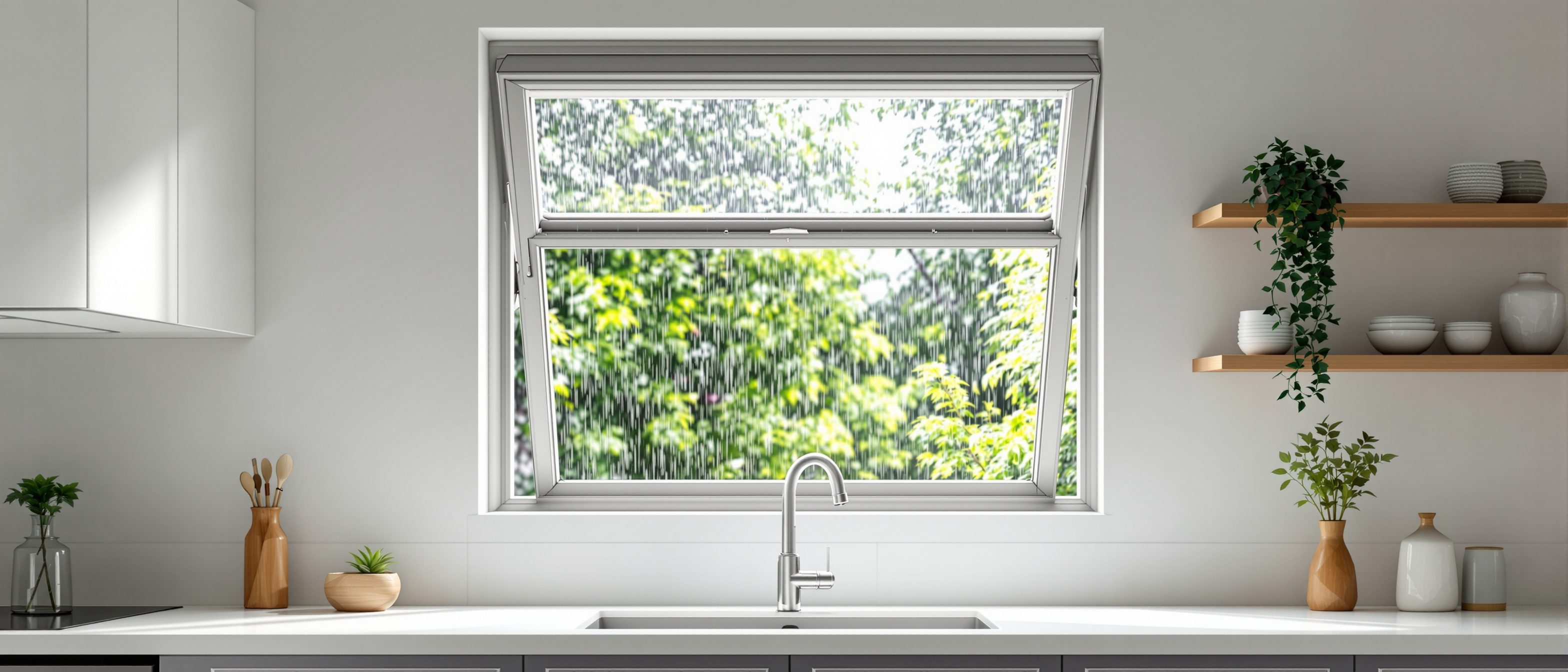
Awning Windows Guide (India): Rain-Proof Ventilation for Kitchens and Baths
Top-hinged, outward-opening windows that shed rain and breathe high on the wall — the monsoon-smart choice for baths, kitchens and over picture windows.
The awning window is the one type built for Indian rain. Hinged at the top and pushed open from the bottom, the sash tilts outward like a small canopy — so it can stay open during a light monsoon shower while the glass sheds water away from the opening. That single trick makes it the quiet workhorse of kitchens, bathrooms and the band of glazing above a fixed picture window, where you want fresh air without inviting in either the weather or the neighbours' eyes.
This guide is the dedicated deep-dive on awning windows. For the broad combined intro to windows and doors, see our windows and doors design overview; this page goes much deeper on one type — how it operates, where it earns its place, the size limits set by sash weight, and how to spec frame and glass for it.
How an awning window operates
The hinge sits along the top of the frame. A friction stay or a chain winder (a small crank) pushes the bottom edge of the sash outward, so the window opens like an awning over the opening below it. Let go of the handle and the sash holds its position — it does not swing shut on a gust.
Because the sash projects outward and downward, the open glass forms a sloped shield. Rain runs down the outer face of the glass and drips clear of the opening rather than into the room. That is the defining behaviour, and it is exactly the opposite of its inward-opening mirror, the hopper.
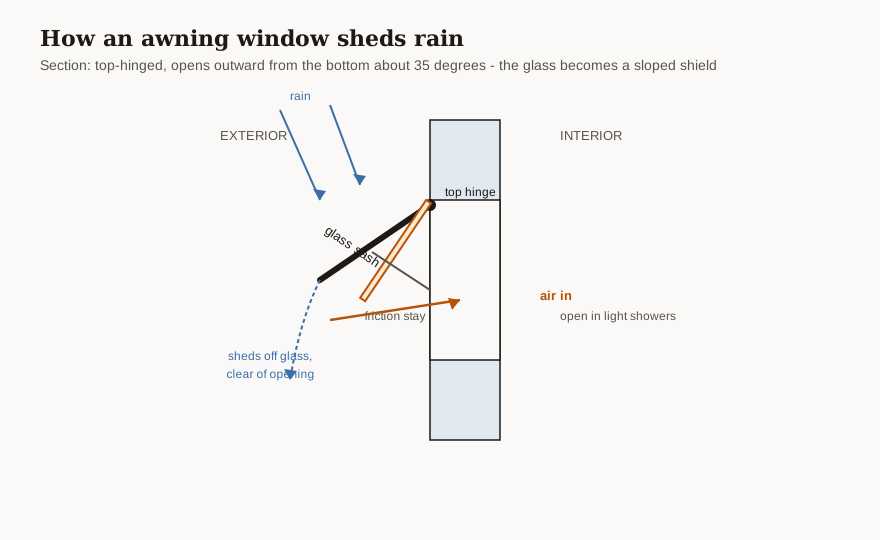
Top-hinged and outward-opening, the awning is the only common window you can confidently leave open in a drizzle — the glass becomes its own little roof.
A typical awning opens to about 30 to 45 degrees. That is less than a casement's near-90-degree swing, which is the trade-off you accept in exchange for the rain protection.
Awning versus casement versus hopper
These three are close cousins — all are hinged, single-leaf windows that seal tightly when shut. The difference is entirely in where the hinge sits, and that one detail changes everything about how each behaves.
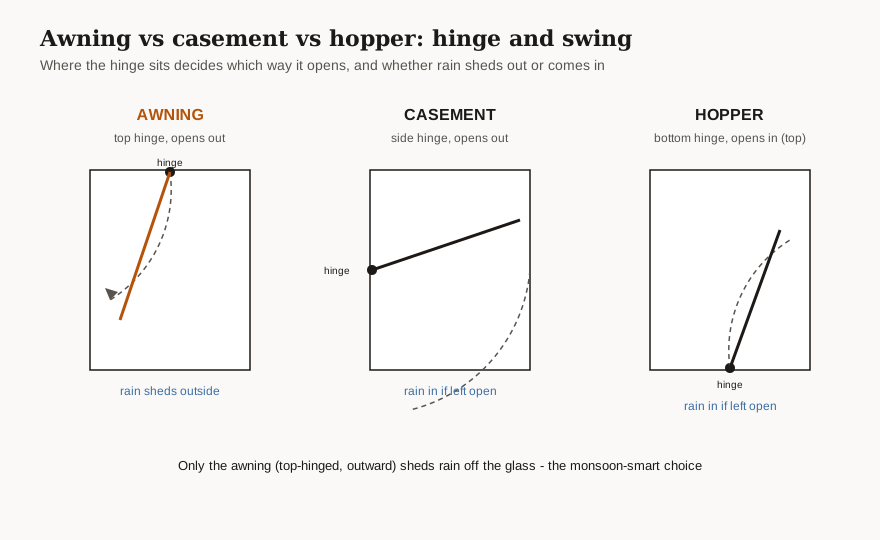
| Feature | Awning | Casement | Hopper |
|---|---|---|---|
| Hinge position | Top | Side | Bottom |
| Opens | Outward, from the bottom | Outward, sideways | Inward, from the top |
| Rain behaviour | Sheds rain, can stay open | Catches rain when open | Lets rain run inward |
| Ventilation | Good | Excellent (whole opening) | Good |
| Best placement | High, or over fixed glass | Most rooms, at eye level | Low, basements, baths |
| Debris when open | Falls outside | Falls outside | Falls inside |
The short version: choose a casement when you want the most airflow at eye level, choose an awning when you need ventilation that survives rain and sits up high, and choose a hopper when the window is low and opening inward is safer. We cover the side-hinged cousin in full in our casement windows guide and the inward-opening mirror in the hopper windows guide — link out there rather than choosing blind.
Ventilation and privacy
An awning ventilates well, though not quite as completely as a casement: the angled sash gives you a usable opening but not the full clear span. Where it shines is placement. Because it works while sitting high on a wall, you can mount it above a sofa, above kitchen counters, or as a ventilating strip above a large fixed picture window — bringing air in at ceiling level where hot air collects.
That high position is also a privacy win. A high awning lets a bathroom or a ground-floor kitchen breathe without giving anyone a line of sight in. And because the sash itself screens the opening at an angle, awnings naturally pair with insect mesh fitted on the inside.
For working out where these high inlets sit in a room's airflow path — and pairing them with low inlets for a proper stack effect — run your layout through the cross-ventilation analyzer.
Where awnings earn their place
- Bathrooms — privacy from height, plus rain-tolerant venting so you can leave it cracked open after a shower.
- Kitchens — a strip above the counter or over the sink clears steam and cooking smells without a wide swing into the workspace.
- Over fixed or picture windows — a slim awning band above a big sealed pane gives you the view and the air, the classic "fixed glass below, awning above" combination.
- Stairwell and clerestory positions — high on the wall, drawing hot air out under the stack effect.
Size limits — sash weight is the constraint
An awning is held open by a friction stay or chain that fights gravity at an angle. The heavier the sash, the harder that hardware works, so awnings are deliberately kept on the smaller, wider-than-tall side. A unit roughly 600 to 1200 mm wide and 400 to 700 mm tall is the comfortable range; go larger and you either over-stress the stay or have to step up to heavier-duty hardware. For a big opening, mullion several awnings together, or pair one awning over a fixed pane rather than building one oversized sash.
Frame material and glazing
Awnings are made in every common frame material; pick by climate and budget.
| Frame | Indicative ₹/sqft | Notes for awnings |
|---|---|---|
| uPVC | 450 to 900 | Best all-round value; good thermal and acoustic seal; rust and termite proof — ideal for damp baths and humid coasts. |
| Aluminium | 450 to 950 (powder-coated) | Slim, strong, modern; insist on a thermal break, as bare aluminium conducts heat. |
| Wood | 500 to 1,500+ | Warm and classic, but needs sealing against the monsoon and far more upkeep. |
Add roughly ₹200/sqft for installation. Because awnings live in wet rooms, lean toward uPVC for kitchens, bathrooms and coastal homes.
On glass: a DGU (double glazed unit) with a Low-E coating cuts solar heat while keeping daylight, and the air gap calms both heat and noise. For any bathroom or kitchen pane that someone could knock into, specify toughened (safety) glass, which shatters into blunt granules rather than shards. Indian heat wants low SHGC with adequate VLT — and as your overall window-to-wall ratio rises, the Eco-Niwas Samhita 2018 code effectively demands lower-SHGC, spectrally selective glazing to keep the envelope within the RETV limit of 15 W/m² for composite, hot-dry, warm-humid and temperate zones.
Cost band
| Spec level | Indicative ₹/sqft (installed) |
|---|---|
| Budget — uPVC, single glazing | 450 to 650 |
| Mid — uPVC or aluminium, DGU | 700 to 1,000 |
| Premium — thermal-break aluminium, Low-E DGU, branded hardware | 1,100 to 1,500+ |
These are indicative for June 2026 and vary by city, brand and size — always confirm against itemised quotes from fabricators. Awnings carry slightly more hardware cost than a plain fixed pane because of the stay or winder.
Pros and cons
| Pros | Cons |
|---|---|
| Sheds rain — can stay open in light showers | Lower airflow than a casement |
| High placement gives privacy plus ventilation | Limited size — sash weight caps it |
| Tight, weather-resistant seal when shut | Sash projects outward into walkways or balconies |
| Pairs neatly above fixed and picture windows | Outer face is awkward to clean from inside |
| Excellent fit for baths, kitchens, humid coasts | Crank or stay hardware needs occasional upkeep |
Choose this if / avoid if
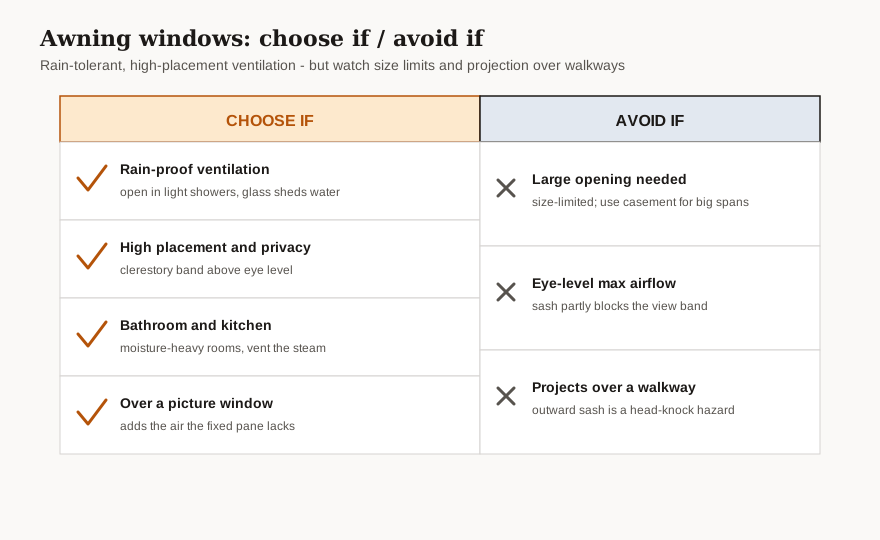
Choose an awning if you need rain-tolerant ventilation, want a high window that breathes without compromising privacy, are glazing a bathroom or kitchen, or want a ventilating band above a fixed picture window.
Avoid an awning if you need maximum airflow at eye level (a casement is better), the opening is large (sash weight will fight you — mullion several units instead), or the sash would project into a tight balcony, walkway or path where it becomes a hazard.
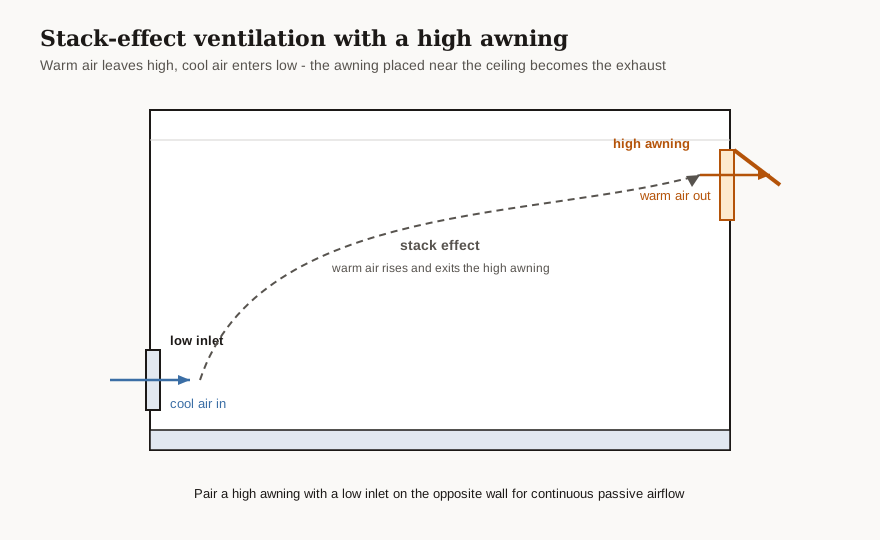
Awnings rarely work alone. They are the rain-proof, high-level partner in a window scheme — most powerful when paired with a low inlet for the stack effect, or with a fixed picture window for the view. To see where every type fits the whole house, start from the pillar guide, types of home windows in India, and size your openings against the NBC 2016 rule of thumb that openable inlet area should be at least one-tenth of the room's floor area.
References
- IS 1948 — Aluminium doors, windows and ventilators (BIS): https://law.resource.org/pub/in/bis/S03/is.1948.1961.pdf
- IS 1081 — Fixing and glazing of metal doors and windows (BIS): https://law.resource.org/pub/in/bis/S03/is.1081.1960.pdf
- IS 3362 — Natural ventilation of residential buildings (BIS): https://law.resource.org/pub/in/bis/S03/is.3362.1977.pdf
- BIS Guide for Using NBC 2016: https://www.bis.gov.in/wp-content/uploads/2022/08/Booklet-Guide-for-Using-NBC-2016.pdf
- Eco-Niwas Samhita 2018 (BEE/ECBC): https://ecbc.in/econiwas.html
- uPVC windows price per sqft 2026 (Building and Interiors): https://buildingandinteriors.com/upvc-windows-price-per-sq-ft-india-2026-cost-guide/
Export this guide
Related Guides — Deep-dive reading
Floor-to-Ceiling Windows (India): Maximum Light, and the Heat Trade-Off
Full-height glazing for Indian homes — how to win the daylight and view without losing the energy code, comfort or safety.
Windows & GlazingTypes of Home Windows in India (2026): Complete Comparison and How to Choose
Every window type compared on ventilation, cost and best use, plus a frame, glazing and climate framework to choose right.
Windows & GlazingCasement Windows Explained (India): How They Work, Cost, Pros and Cons
The side-hinged window that cranks outward to open its whole face to the breeze and seals airtight when shut — operation, ventilation, frame fit, glazing and ₹/sqft cost for Indian homes.
Windows & GlazingRelated Tools — Try Free
Cross-Ventilation Analyzer
Estimate airflow and air changes per hour (ACH) from room size, window areas, layout, and local wind — with NBC 2016 Part 8 compliance check.
Ventilation CalculatorGlass Selection Tool
Single vs double (DGU) vs triple glazing and the right glass type for your climate, priority and sun.
Window ToolWindow Material Comparison Tool
Compare uPVC, aluminium, wood, steel and composite windows on cost, life, upkeep and insulation.
Compare