
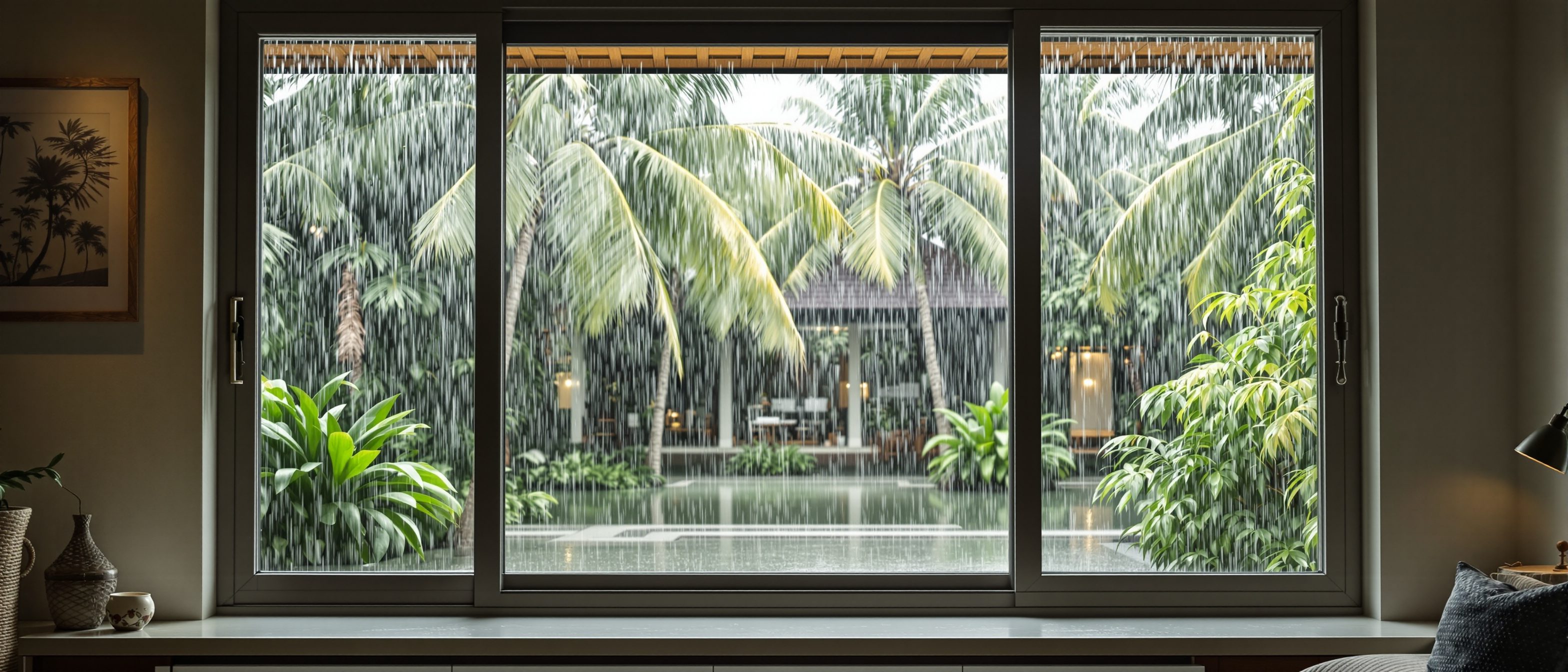
Best Window Material for Monsoon Regions (India): Beating Rain, Swell and Rust
For Kerala, the Konkan, the Northeast, the Western Ghats and Mumbai: which frame shrugs off driving rain, humidity, swelling and rust.
If you live in Kerala, the Konkan coast, Mumbai, the Northeast or anywhere along the Western Ghats, you already know the test a window faces here. It is not a hot afternoon or a single storm. It is weeks of horizontal rain, air that never drops below 80 percent humidity, and the slow, patient way water finds every weak joint. In a monsoon belt the wrong window frame does not just leak. It swells until it will not close, it rots from the inside, or it bleeds rust streaks down your wall by the second season.
This guide is about beating three specific enemies: water ingress (rain getting past the frame), swelling and warping (timber and cheap profiles distorting in damp), and rust (metal corroding in humid air). It is a climate decision, not a shape decision.
The monsoon does not care how expensive your window looked in the showroom. It only tests whether water can get in, and whether the material holds its shape when it does.
The verdict, up front
For heavy-rain, high-humidity India, two materials win and two should be avoided.
| Material | Monsoon verdict | Why |
|---|---|---|
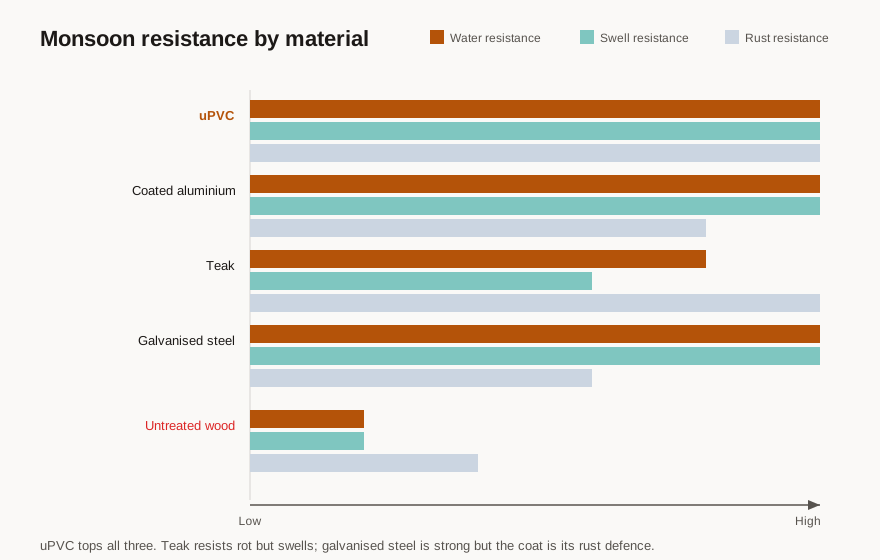
| uPVC | Best all-round | Waterproof, sealed, non-metallic — no swell, no warp, no rust |
| Aluminium | Strong (coat it) | Does not swell or rot; coat against humid-air corrosion |
| Teak (premium wood) | Only with diligence | Natural oils resist water, but needs sealing every 2-4 years |
| Untreated/ordinary wood | Avoid | Swells, warps, rots, fades — the classic monsoon failure |
| Un-galvanised steel | Avoid | Rusts fast in humid air without hot-dip galvanising and coat |
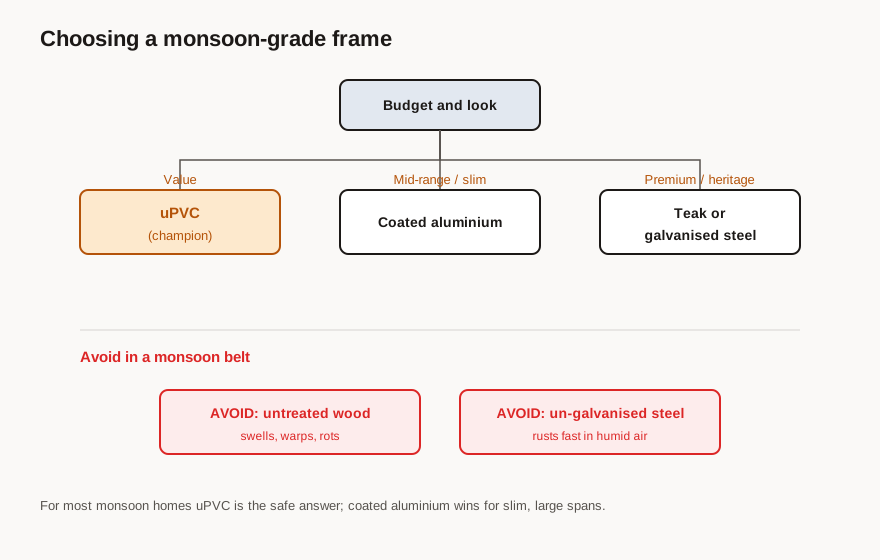
If you want the single safe answer for most monsoon homes: uPVC. It is corrosion-proof by nature, fully waterproof, sealed with quality gaskets, and the lowest-maintenance frame you can buy. Aluminium is the equal-or-better choice when you want slim sightlines and large spans — provided it is properly coated.
Why monsoon is its own problem (not heat, not salt)
Studio Matrx has separate guides for coastal homes (where airborne salt corrodes metal) and hot-climate homes (where heat gain and frame warping dominate). The monsoon decision overlaps with both but is distinct. Here the dominant stress is liquid water under pressure plus relentless humidity — driving rain forced against the frame, and damp air that keeps timber and metal wet for months.
That changes priorities. SHGC and thermal break matter less than sealing, drainage and a material that simply does not react to water.
Water ingress and sealing: where windows actually fail
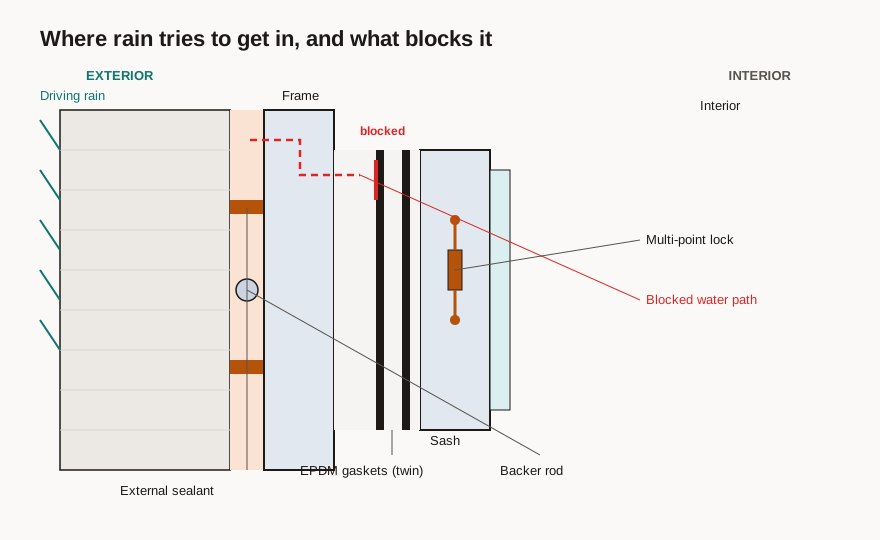
Most "leaking windows" do not leak through the glass. Water gets in through the frame-to-wall joint, the frame-to-sash gap, and failed gaskets. In a monsoon belt your specification must address all three.
- Gaskets: Look for continuous EPDM rubber gaskets (not cheap PVC) on both sash and frame. EPDM stays elastic for years; cheap gasket hardens, cracks, and lets water past. uPVC systems typically run twin gasket lines.
- Multi-point locking: Casement windows that pull the sash tight against the gasket all around (multi-point) seal far better than a single central catch.
- Frame-to-wall sealing: The gap between frame and masonry must be packed and sealed with a weatherproof sealant, ideally over a backer rod, plus an external drip detail so water cannot track back along the sill into the room.
Drainage, weep holes and drip sills
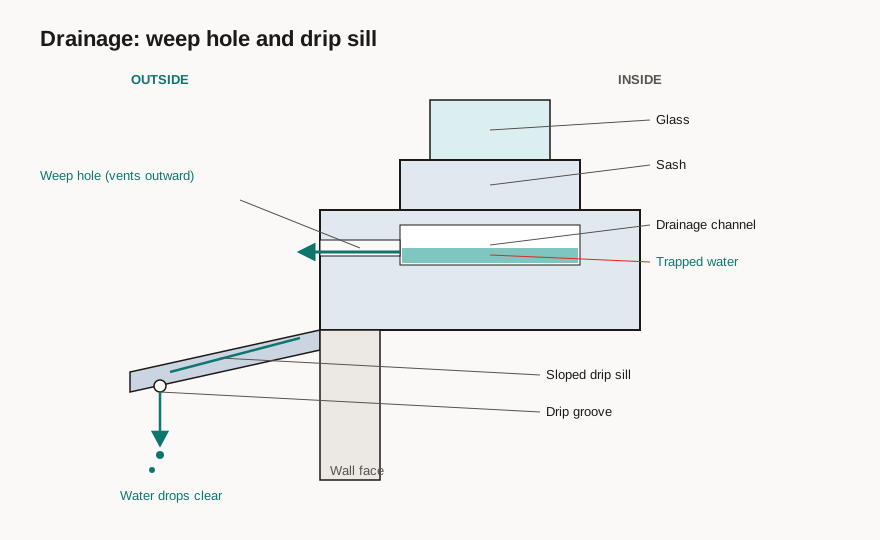
A monsoon window is designed to manage water, not just block it. Some rain will always get into the frame cavity. The frame must then drain it back out.
- Weep holes: Small slots on the outer face of the bottom frame let trapped water escape outward. A blocked or missing weep hole turns the frame channel into a bathtub. Clean them before every monsoon.
- Sloped sill (drip sill): The external sill should slope away from the building (a fall of a few degrees) and carry a drip groove on its underside so water drops clear of the wall instead of wicking back.
- Awning and louvered windows shed rain by design — top-hinged awnings stay open in light rain, and louvered (jalousie) windows give rain-proof ventilation. They pair well with monsoon-grade frames.
The material verdict, in detail
uPVC — the monsoon champion
A multi-chamber plastic profile, steel-reinforced inside for large spans. It is non-metallic and fully waterproof, so it cannot rust, rot, swell or warp from water. It will not react with humid air at all. Quality uPVC ships with EPDM gaskets, drainage channels and weep holes built in — the monsoon detailing is engineered, not improvised. Add excellent thermal and acoustic insulation and the lowest maintenance of any frame, and it is the default for new monsoon-region homes.
The caveats are real: lower-grade profiles can soften in extreme inland heat (less relevant in a wet, milder coast), and quality varies enormously by brand, so buy from a reputable fabricator. See our deep dive on uPVC windows in India.
Aluminium — strong, but coat it
Aluminium does not swell, warp or rot, and handles wet weather structurally with ease. It gives the slimmest frames and largest glass spans. Its weakness in humid air is surface corrosion, so insist on a good powder coat or anodised finish (marine-grade if you are also near the coast). With that, a 30-50 year life is realistic. Choose aluminium when you want big openings and a modern look — full detail in aluminium windows in India.
Wood — premium teak only, with discipline
Wood does not rust, but it is the most water-vulnerable frame. Ordinary or under-seasoned timber swells, warps and rots in a monsoon, and may not close by August. Teak is the exception — its natural oils resist water and it tolerates humidity — but even teak needs resealing or polishing every 2-4 years. Choose wood only for heritage or luxury homes where you accept the upkeep. Compare the trade-off in wooden vs aluminium windows.
Steel — only if galvanised
Mild steel gives the slimmest, most elegant heritage sightlines, but rusts fast in humid air without protection. It is only acceptable in a monsoon belt if it is hot-dip galvanised (zinc) plus powder coated — then it can exceed 60-100 years. Un-galvanised steel is a guaranteed rust failure here. Niche, premium, and few fabricators do it well.
Lifespan, cost and maintenance
All prices are indicative for June 2026 — confirm with itemised fabricator quotes. Add 18 percent GST and roughly ₹200/sqft for installation.
| Material | Cost (₹/sqft) | Lifespan | Maintenance | Monsoon behaviour |
|---|---|---|---|---|
| uPVC | 250-800 (premium DGU 900-1,500+) | 20-30 yr | Low — wipe clean | No swell, warp or rust |
| Aluminium (coated) | 350-3,000 (powder-coat 450-950) | 30-50 yr | Low | No swell; coat against corrosion |
| Wood (teak) | 500-1,500+ | Decades if maintained | High — seal every 2-4 yr | Resists water but needs upkeep |
| Steel (galvanised) | Premium | 60-100 yr | Low-medium | Must galvanise and coat |
Glazing helps too: a DGU (double glazed unit) cuts the condensation and mould that plague single-glazed windows in humid rooms, because the inner pane stays warmer and drier.
Hardware, condensation and mould
Two details quietly ruin monsoon windows.
- Hardware corrosion: Handles, hinges, friction stays and locks must be stainless steel or properly coated. Plain steel hardware rusts and seizes even when the frame is fine.
- Condensation and mould: Warm, humid indoor air meeting a cold single pane sweats, and that moisture feeds mould on sills and reveals. Counter it with DGU glass, openable windows for cross ventilation, and trickle vents or louvered windows so the room can breathe.
A ranked recommendation by budget
| Budget | Recommendation |
|---|---|
| Value / most homes | uPVC with EPDM gaskets, weep holes and DGU — the safest monsoon all-rounder |
| Mid-range, slim look or large spans | Powder-coated aluminium with good drainage detailing and stainless hardware |
| Premium / heritage | Teak (with a maintenance commitment) or galvanised steel for restoration character |
| Avoid | Untreated or ordinary wood, and un-galvanised steel — both fail in monsoon |
How this fits the bigger picture
Material is your first choice; window type is the second. A monsoon-grade uPVC casement seals beautifully; an awning sheds light rain while open; a louvered window ventilates through a downpour. Read the window types pillar to match the right shape to your monsoon material, and the window frame materials comparison for the full side-by-side across all climates.
The short version: in a monsoon belt, pick a material that does not care about water — uPVC first, coated aluminium close behind — then detail it for drainage and seal it well. Do that and your windows will shrug off twenty monsoons.
References
Export this guide
Related Guides — Deep-dive reading
Window Frame Materials in India (2026): uPVC vs Aluminium vs Wood vs Steel vs Composite
The buyer's decision guide for choosing a window frame material by budget, climate, thermal priority, look, maintenance and lifespan.
Windows & GlazingAluminium Windows Guide (India): Slim, Strong, and the Thermal-Break Question
Why aluminium gives you the most glass and least frame, why bare metal conducts heat, and how a polyamide thermal break plus DGU fixes it.
Windows & GlazingMonsoon-Friendly Window Designs: Keeping Wind-Driven Rain Out
Drainage channels, baffled weep holes, outward-sloped sills, EPDM seals and the right window type for an Indian monsoon
Windows & GlazingRelated Tools — Try Free
Window Maintenance Cost Calculator
Estimate annual window upkeep by frame material — yearly, per-window and 5-year cost.
Window CalculatorWindow Material Comparison Tool
Compare uPVC, aluminium, wood, steel and composite windows on cost, life, upkeep and insulation.
CompareCross-Ventilation Analyzer
Estimate airflow and air changes per hour (ACH) from room size, window areas, layout, and local wind — with NBC 2016 Part 8 compliance check.
Ventilation Calculator