
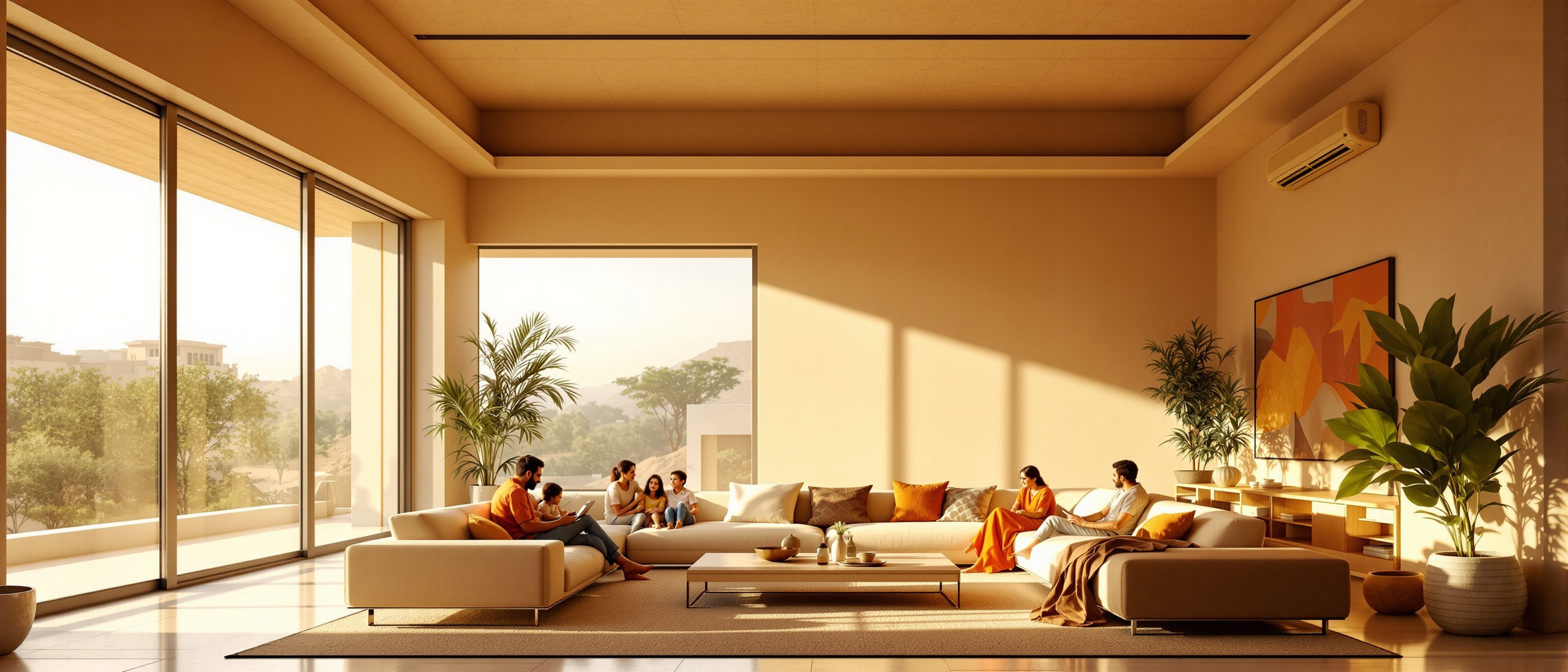
Best Window Material for Hot Climates (India): Keeping 45-Degree Heat Out
For Delhi, Rajasthan, Vidarbha and Telangana homes: thermally-broken aluminium or heat-stabilised uPVC, paired with a low-SHGC Low-E DGU and external shading.
In Delhi, Rajasthan, Vidarbha and the Telangana plateau, the summer afternoon does not knock politely. It arrives at 45 degrees, leans on your west wall for six hours, and pours heat through every square foot of glass you own. For an inland hot-climate home, the window is not a view feature. It is the single largest hole in your thermal defence, and the question of what frame and glass to fit it with decides whether your air conditioner runs at a hum or a scream.
This guide is about heat specifically. If you live by the sea, salt corrosion changes the answer, so read Best Window Material for Coastal India. If your enemy is driving rain, read Best Window Material for Monsoon Homes. Here the enemy is solar heat gain plus a frame that has to survive surface temperatures well above the air temperature without warping.
In a 45-degree heatwave, west-facing glass can dump more heat into a room in an afternoon than the wall does all day. The frame is half the battle. The glass is the other half.
The two enemies: heat gain and heat tolerance
A hot-climate window has to win on two fronts at once.
- Heat gain is how much of the sun's energy gets through the glass and frame into the room. This is governed mostly by the glazing (its SHGC) and by how conductive the frame is.
- Heat tolerance is whether the frame itself survives. A south or west profile in Nagpur or Bikaner can reach 60 to 70 degrees surface temperature in May. A frame that expands, sags or warps at those temperatures fails early.
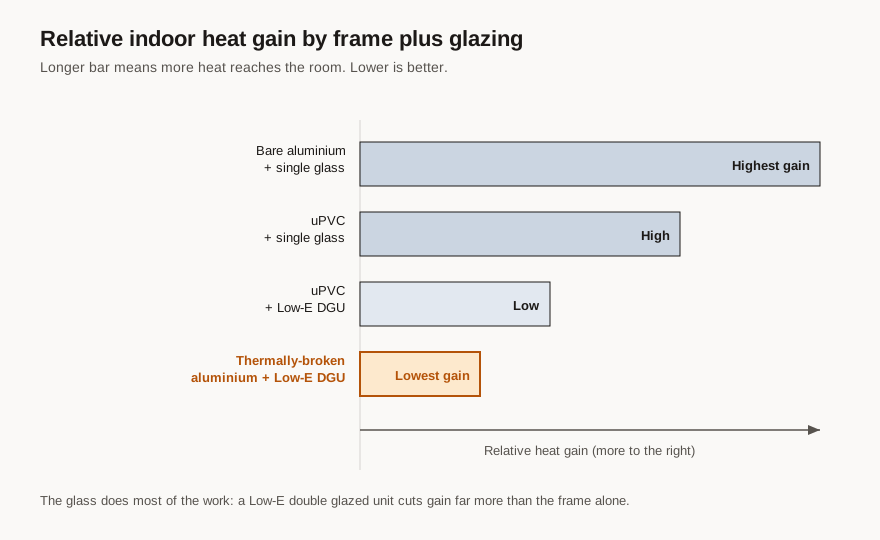
Get one right and ignore the other and you have wasted money. A premium low-SHGC double-glazed unit set in a bare, un-broken aluminium frame still bleeds heat through the metal. A thermally excellent frame holding cheap single glazing still cooks the room.
Why bare aluminium betrays you in heat (and the fix)
Aluminium gives you the slimmest sightlines and the largest spans of any frame, which is exactly why architects love it for big openings. But aluminium is an outstanding conductor of heat. A bare aluminium frame sitting in the sun becomes a radiator, carrying outdoor heat straight across the frame into your room regardless of how good your glass is.
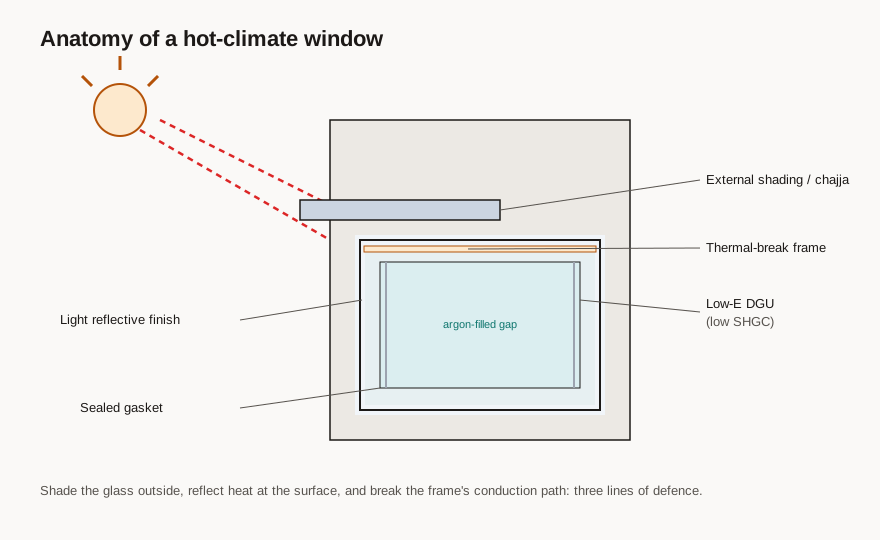
The fix is a thermal break: a polyamide (nylon) strip set into the middle of the frame that physically separates the hot outer half of the aluminium from the cool inner half. Heat cannot jump the gap. This is the difference between "system aluminium" and the cheap aluminium section your local fabricator may quote.
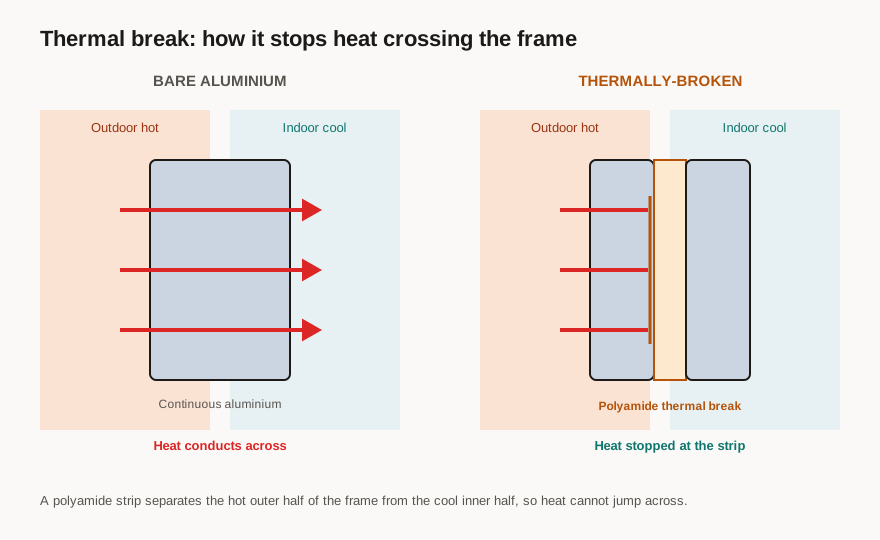
For a hot inland home, bare aluminium is a false economy. If you want aluminium for big spans, it must be thermally broken. Otherwise its conductivity hands your cooling savings straight back. See Aluminium Windows in India for the full frame breakdown.
The uPVC heat-warp caution
uPVC (steel-reinforced plastic profile) is the best all-round value frame in India and a genuinely strong insulator, which makes it tempting for hot climates. It does not conduct heat the way metal does, so the frame itself is a thermal asset.
The catch is purely about heat tolerance. Lower-grade uPVC profiles can soften, expand and warp when surface temperatures climb past 45 degrees on a sun-facing wall, especially dark-coloured profiles. The fix is to specify a heat-stabilised, lead-free grade with high UV and titanium-dioxide content, ideally in white or light shades that reflect rather than absorb. A reputable brand profile holds; a no-name white plastic section on a west wall in Jaipur is asking for trouble.
uPVC is excellent in heat only if you buy the grade rated for it. Ask the fabricator for the profile's heat-deflection spec in writing, not just the brand sticker.
Read the full picture in uPVC Windows in India.
Glazing matters as much as the frame
This is the point most homeowners miss. In a hot climate the glass does the heavy lifting, and the three numbers that matter are:
- SHGC (Solar Heat Gain Coefficient) — the fraction of solar heat the glass lets through. Lower is better. This is your single most important hot-climate number. Aim low.
- VLT (Visible Light Transmittance) — how much daylight passes. You want enough to avoid a gloomy, lights-on-all-day room.
- U-value — how well the unit insulates. Lower is better.
The winning hot-climate glass is a DGU (Double Glazed Unit) with a Low-E (low-emissivity) coating. The two panes and the air or argon gap cut conduction; the Low-E coating reflects radiant solar heat back out while letting visible light through. A good Low-E DGU can keep SHGC low while keeping VLT usable, which a single dark-tinted pane cannot.
What the energy code expects (Eco-Niwas Samhita)
India's residential energy code, Eco-Niwas Samhita 2018 (ENS), makes this explicit. For composite and hot-dry zones (which is exactly Delhi, Rajasthan and the dry inland belt), the wall envelope's RETV (Residential Envelope Transmittance Value) must be 15 W/m2 or lower — and windows are the biggest lever on RETV.
ENS also sets a minimum VLT by your window-to-wall ratio (WWR): the more glass you fit, the lower the SHGC the code effectively demands to stay compliant.
| WWR band | Minimum VLT | What it means for you |
|---|---|---|
| 0.00 to 0.30 | 0.27 or more | Modest glazing; easiest to comply |
| 0.31 to 0.40 | 0.20 or more | Standard homes; specify Low-E DGU |
| 0.41 to 0.50 | 0.16 or more | Lots of glass; low-SHGC glass mandatory |
| 0.51 to 0.60 | 0.13 or more | Glass-heavy; spectrally selective glazing |
| 0.61 to 0.70 | 0.11 or more | Maximum glass; performance glazing only |
The takeaway: more glass means you must buy better glass. If you are planning floor-to-ceiling windows on a hot-side wall, your WWR jumps and the code (and your electricity bill) will demand a genuinely low-SHGC Low-E DGU plus external shading. Big glass and hot climate is a combination you can have, but only with the right glazing.
Shading: the free win
No frame or glass beats keeping the sun off the window in the first place. External shading stops solar heat before it reaches the glass, which is far more effective than any internal blind. In hot India this is the cheapest performance you can buy:
- Deep chajjas / overhangs on south and west windows.
- Vertical fins / louvres for low west sun.
- Jali screens — India's original climate-smart fenestration — to diffuse harsh light.
- Light-coloured frames and reflective surrounds.
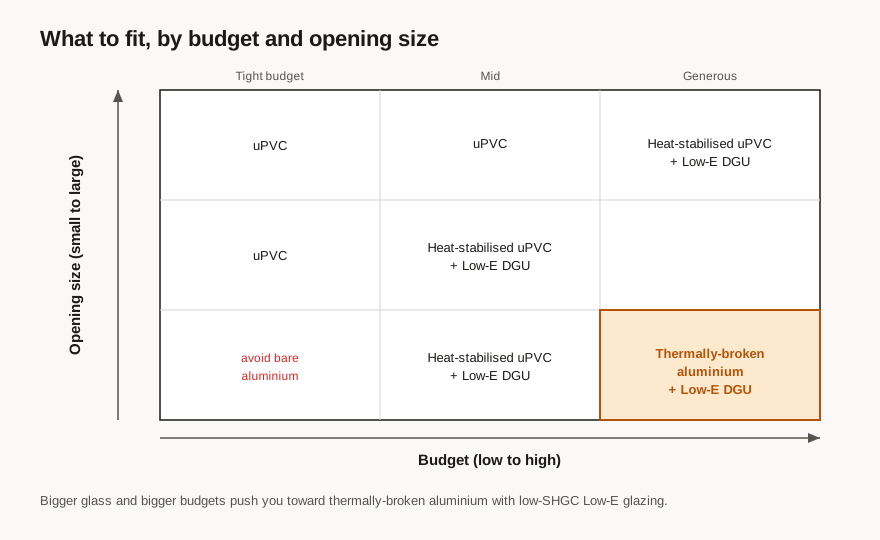
The decision: ranked by budget
| Priority / budget | Frame | Glazing | Why |
|---|---|---|---|
| Best big-opening performance (premium) | Thermally-broken system aluminium | Low-E DGU, low SHGC | Slim, huge spans, no conduction, code-ready |
| Best value insulation (mid-range) | Heat-stabilised uPVC | Low-E DGU | Non-conductive frame, strong seal, half the cost |
| Tight budget | Good-grade uPVC | DGU (Low-E if affordable) | Insulating frame; add external shading |
| Avoid | Bare/non-broken aluminium | Single glazing | Frame conducts heat; glass cooks the room |
Indicative costs (June 2026, confirm with fabricator quotes)
| Option | Frame cost ₹/sqft | Lifespan | Notes |
|---|---|---|---|
| uPVC, heat-stabilised | 250 to 800 (premium DGU 900 to 1,500) | 20 to 30 yr | Best value; specify the grade |
| Aluminium, powder-coated | 450 to 950 | 30 to 50 yr | Needs thermal break for heat |
| Thermally-broken system aluminium | 350 to 3,000 (system higher) | 30 to 50 yr | Top performer for big glass |
Add 18% GST and installation of roughly ₹200/sqft. Specify glazing under IS 1948:2024 (aluminium windows) and design to ENS 2018 for RETV and VLT compliance.
Choose if / avoid if
- Choose thermally-broken aluminium + Low-E DGU if you want large openings or floor-to-ceiling glass on a hot wall and can fund the system.
- Choose heat-stabilised uPVC + Low-E DGU if you want the best insulation per rupee for normal-sized windows.
- Avoid bare aluminium on sun-facing walls — it conducts heat in.
- Avoid cheap unbranded uPVC in dark colours on west walls — it can warp at 45-degree surface heat.
- Never skip external shading — it is the cheapest degree you will ever save.
How this fits the bigger picture
Material is one of two choices. The other is window type — casement, sliding, fixed, jali — which decides ventilation and operation. Pair this guide with the types of home windows pillar: in hot India, operable casement or louvered windows on shaded sides give you cross-ventilation to flush heat at night, while fixed low-SHGC glass handles the view. For the full material head-to-head across all climates, start at the window frame materials comparison pillar.
References
- Eco-Niwas Samhita 2018 (BEE/ECBC): https://ecbc.in/econiwas.html
- BEE ENS Residential Code (Building Envelope): https://beeindia.gov.in/sites/default/files/Residential%20Code_Building%20Envelope_Draft_rev4.pdf
- IS 1948 (aluminium doors/windows/ventilators, BIS): https://law.resource.org/pub/in/bis/S03/is.1948.1961.pdf
- uPVC windows price per sq ft 2026 (Building and Interiors): https://buildingandinteriors.com/upvc-windows-price-per-sq-ft-india-2026-cost-guide/
- Wood vs uPVC vs aluminium frames (PlyPrice): https://www.plyprice.com/blog/window-frame-material-comparison
Export this guide
Related Guides — Deep-dive reading
Floor-to-Ceiling Windows (India): Maximum Light, and the Heat Trade-Off
Full-height glazing for Indian homes — how to win the daylight and view without losing the energy code, comfort or safety.
Windows & GlazingAluminium Windows Guide (India): Slim, Strong, and the Thermal-Break Question
Why aluminium gives you the most glass and least frame, why bare metal conducts heat, and how a polyamide thermal break plus DGU fixes it.
Windows & GlazingBest Glass for Hot Indian Climates (2026): Beating 45-Degree Heat at the Window
Which window glass keeps the daylight but stops the heat in Delhi, Rajasthan, Telangana and the hot plains, by orientation, budget and payback.
Windows & GlazingRelated Tools — Try Free
Brise-Soleil Visualizer
Interactive horizontal-louvre cut-off angle calculator — sun altitude, louvre depth, and spacing inputs with a live shadow preview. Computes θ = arctan(spacing/depth) for façade shading, ECBC envelope compliance, hospital daylight design, and tropical sun-control detailing.
Sun Shading ToolCross-Ventilation Analyzer
Estimate airflow and air changes per hour (ACH) from room size, window areas, layout, and local wind — with NBC 2016 Part 8 compliance check.
Ventilation CalculatorWindow Energy Savings Calculator
Compare standard glazing vs Low-E and DGU windows — annual cooling savings, 10-year savings and payback.
Window Calculator