
Basin Mixer Tap India: Single-Lever Buying Guide, Spout Height, Cartridge & Cost (2026)
How a single-lever basin mixer blends hot and cold on one control — what supplies it needs, the spout height that matches your basin, the ceramic cartridge that decides its life, pop-up waste, tall vessel mixers, finishes, flow rate, and rupee tiers versus separate pillar taps.
Walk into any Indian bathroom showroom and the wall of taps is bewildering — pillar taps, mixers, tall mixers, sensor faucets, wall-mounted spouts. For the wash basin, the choice that quietly decides how the sink feels every single day is the basin mixer: a single-lever tap that blends hot and cold water through one control instead of the two separate pillar taps most older Indian homes still run. Lift the lever for flow, swing it left for hot and right for cold, and you set both temperature and volume with one wet hand.
This guide is India-first: what the tap actually needs behind the wall, the spout height that matches your basin type, the ceramic cartridge that determines whether it lasts two years or twenty, and honest rupee tiers. It sits under the bathroom faucets guide for India; read it alongside the pillar taps guide if you are weighing the two, and the countertop basin guide because the basin and the tap must be chosen together, not separately.
A basin mixer is only as good as its cartridge and only as usable as its spout height. Spend on the ceramic disc cartridge, then match the spout to the basin — a beautiful tap that dribbles below the rim or splashes over it is a daily annoyance no finish can fix.
What a single-lever basin mixer actually is
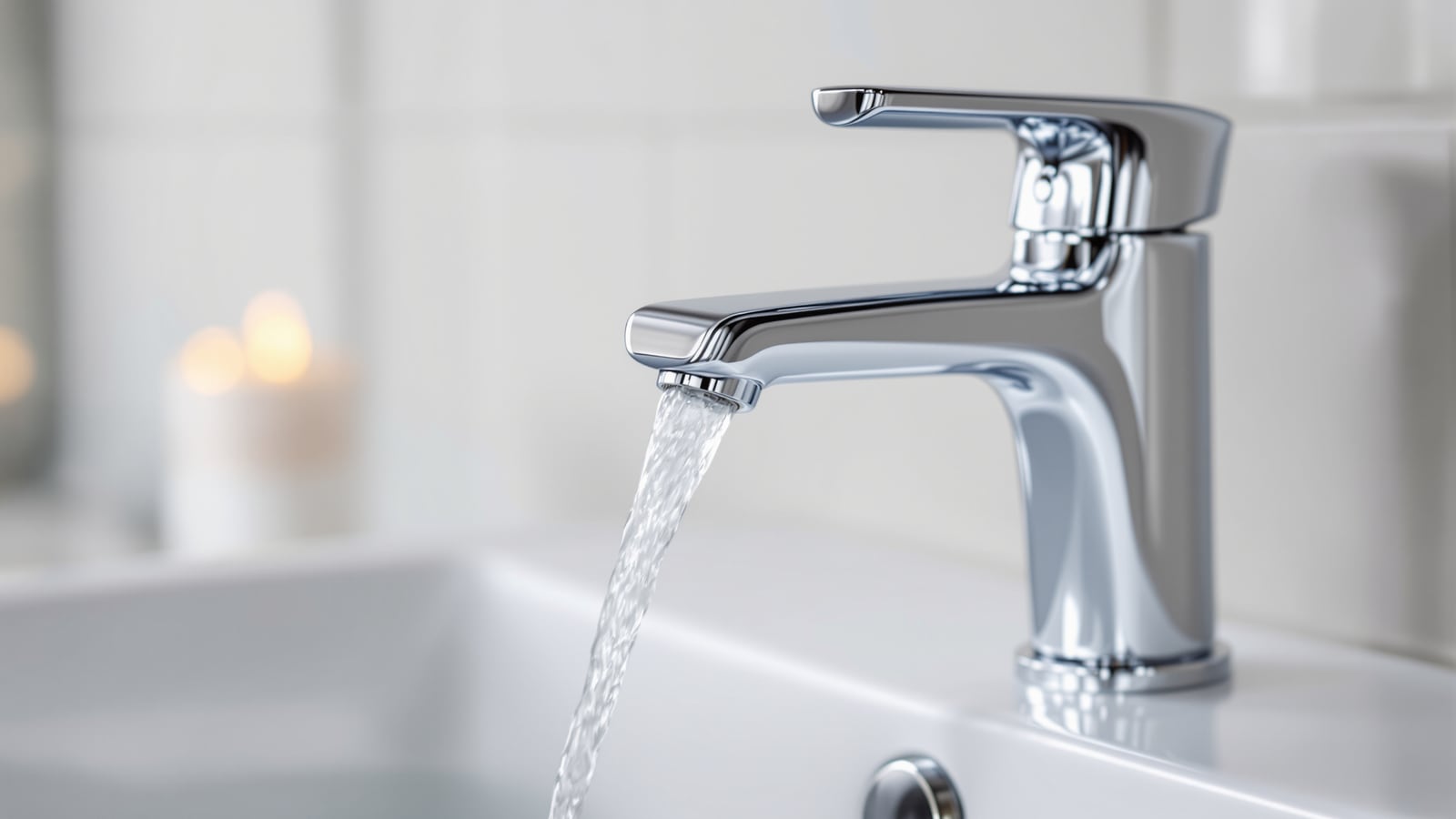
A pillar tap is a single-water-source tap: one tap for cold, and if you want hot, a second identical tap beside it. A basin mixer brings both supplies into one body and mixes them, so you get blended warm water at one spout. The single lever does two jobs at once — raise/lower for flow rate, rotate for temperature — through a ceramic cartridge that is the heart of the fitting.
Three things follow from this, and they trip up first-time buyers:
- A standard basin mixer needs two water supplies — a hot inlet and a cold inlet, usually two flexible braided hoses hanging below the tap. If your basin position only has a single cold line (very common in Indian second bathrooms and older flats), a normal mixer will not work as intended.
- The single-supply / single-hole "mixer" exists for exactly that case. Sold as a single-lever basin tap with one inlet, it gives you lever control of flow on a cold-only line — the ergonomics of a mixer without the hot water. Confirm inlet count before you buy.
- It mounts in a single hole in the basin or countertop (35–40 mm), so the basin you choose must have — or allow drilling — one central tap hole, not the three-hole layout older basins used for separate taps and a spout.
Supplies, mounting and the pop-up waste
Behind the shine, a basin mixer is a plumbing decision. Get these right before you fall in love with a finish.
- Inlets: two G½" angle valves (hot + cold) on the wall, connected by 350–450 mm braided flexi hoses. For a single-supply tap, one valve. Angle valves let you isolate the tap for service without shutting the whole bathroom.
- Mounting: deck-mounted (on the basin or counter, the default) or wall-mounted (spout and lever come out of the wall, used with counter-top and vessel basins for a clean look but needing in-wall plumbing decided at rough-in stage).
- Pop-up waste: better mixers include a pop-up (click-clack or lever-lift) waste so you can hold water in the basin. The classic lever-lift rod pokes up behind the spout; the modern click-clack push-waste is neater and now standard mid-range. Cheaper mixers ship with a plain slotted waste and no plug — fine, but decide deliberately.
- Water pressure: most Indian mixers are designed for 0.5–3 bar. Overhead-tank gravity-fed homes on upper floors can drop below 0.5 bar and make an aerated mixer trickle. If you are on tank pressure, either fit a pressure pump or pick a tap the maker rates for low pressure — ask specifically.
Spout height — the number people forget
This is where taps and basins meet, and where most regret happens. The spout must clear the basin rim enough to wash your hands under it, but not so high that water hits the bottom of the bowl and sprays your shirt. Match the mixer to the basin type, not the other way round.
| Basin type | Mixer to use | Typical spout height above deck | Why |
|---|---|---|---|
| Standard drop-in / under-counter | Regular basin mixer | 100–160 mm | Spout reaches into the recessed bowl |
| Semi-recessed / half-counter | Regular basin mixer | 130–170 mm | Slightly taller for the raised front |
| Countertop (above-counter) basin | Tall / high-neck mixer | 220–320 mm | Bowl sits on top of the slab, so the spout must clear a tall rim |
| Vessel / bowl on a slab | Extra-tall vessel mixer | 280–380 mm | Deep bowl needs maximum clearance |
| Wall-hung with no deck | Wall-mounted mixer | Projection 150–220 mm | Spout comes from the wall, height set by rough-in |
The single biggest mistake in Indian bathrooms is putting a standard-height mixer on a countertop basin — the spout ends up level with or below the rim, and you cannot get your hands under it. A countertop or vessel basin almost always wants a tall basin mixer. Conversely a tall mixer over a deep drop-in basin can splash. Decide the basin first (see the countertop basin guide), then pick the spout height to suit.
The ceramic cartridge — where quality lives
Everything you feel when you use the tap — the smooth quarter-turn, the drip-free shut-off, the temperature that stays where you set it — comes from the cartridge, a pair of polished ceramic discs inside the body. This is where you should spend, because it is the part that wears and fails.
- Ceramic disc cartridge: two hard-fired ceramic plates slide against each other. Excellent life, no rubber washer to perish, drip-free for years. This is the standard in any mixer worth buying. Look for 35 mm or 40 mm cartridge (40 mm is more robust; some low-pressure taps use 35 mm).
- Body metal: a solid brass body (often marketed as forged brass) resists corrosion and hard water far better than the zinc-alloy (Zamak) bodies in the cheapest taps. Zinc-alloy taps corrode and crack at the threads within a few Indian monsoons.
- Hard water is the real enemy. India's hard water scales up aerators and can score inferior cartridges. A ceramic cartridge tolerates it; a rubber-washer tap will not. Choose a removable, cleanable aerator so you can descale it.
| Component | Budget tap | What to insist on |
|---|---|---|
| Cartridge | Rubber washer / cheap disc | Ceramic disc, 35–40 mm |
| Body | Zinc alloy (Zamak) | Solid / forged brass |
| Aerator | Fixed, non-serviceable | Removable, descalable |
| Finish | Thin plated coat | Thick chrome or PVD |
| Waste | Plain slotted, no plug | Click-clack pop-up |
Finishes, flow rate and water saving
The finish is what you see; the flow is what you pay for on the water and geyser bill.
- Chrome is the Indian default — bright, cheap to replate, forgiving of hard-water spotting. Brushed / matte nickel and stainless hide water spots and fingerprints best (great for hard-water homes). Matte black and gold/rose-gold are PVD-coated for durability but show limescale; budget for wiping. Insist on PVD for coloured finishes — cheap sprayed colour peels.
- Aerator and flow: the aerator mixes air into the stream so it feels full at low volume. A good basin mixer runs 4–6 litres per minute (LPM); a plain non-aerated tap can gush 12+ LPM. On a geyser-fed basin, lower flow also means less hot water wasted. For water-efficient homes, look for a flow regulator / low-flow aerator — see the eco-friendly bathroom guide for the wider water-saving picture.
Basin mixer vs separate pillar taps
The honest comparison. Pillar taps are cheaper, dead simple, and fine where you only have a cold line — but you cannot set a comfortable temperature at one, and two taps means two things to maintain. A mixer costs more and needs a hot supply, but the day-to-day ergonomics are in a different league. Full detail is in the pillar taps guide; the short version:
| Single-lever basin mixer | Two separate pillar taps | |
|---|---|---|
| Supplies needed | Hot and cold (or single-supply variant) | One line per tap |
| Temperature control | One-hand, blended, instant | None — hot or cold only |
| Basin hole layout | Single hole | Two holes (or three with spout) |
| Ergonomics | Excellent | Basic |
| Cost | Higher | Lower |
| Maintenance | One cartridge | Two washers/cartridges |
| Best for | Any basin with a hot line | Cold-only / budget / utility basins |
Cost tiers in India (2026)
Prices are for the tap alone; add angle valves and flexi hoses (₹300–₹900 the pair) and, if not included, a pop-up waste (₹400–₹1,500).
| Tier | Deck basin mixer | Tall / vessel mixer | What you get |
|---|---|---|---|
| Budget | ₹1,200–₹2,500 | ₹2,000–₹3,500 | Brass or alloy body, basic ceramic cartridge, chrome |
| Mid | ₹2,500–₹6,000 | ₹4,000–₹8,000 | Solid brass, 35–40 mm cartridge, click-clack waste, aerator |
| Premium | ₹6,000–₹15,000 | ₹8,000–₹20,000 | Forged brass, PVD finishes, low-flow aerator, long warranty |
| Luxury / imported | ₹15,000+ | ₹18,000+ | Designer ranges, coloured PVD, extended cartridge warranty |
Brand-neutral note: Jaquar, Hindware, Cera and Kohler all sell across these tiers in India — buy by the cartridge, body metal and finish spec, not the label. A mid-tier solid-brass mixer with a ceramic cartridge and PVD or thick chrome finish is the value sweet spot for most Indian homes.
Buying checklist
- Confirm you have a hot supply at the basin — else buy a single-supply single-lever tap.
- Match spout height to the basin: tall mixer for countertop/vessel, regular for drop-in.
- Insist on a ceramic disc cartridge (35–40 mm) and a solid brass body.
- Choose a click-clack pop-up waste and a removable, descalable aerator for hard water.
- Check the tap is rated for your water pressure (0.5–3 bar; add a pump if you are below).
- For coloured finishes, insist on PVD; for hard-water homes, brushed nickel hides spots best.
- Budget separately for angle valves + flexi hoses.
References
- IS 8931 — Copper alloy single-lever mixing fittings for water services: dimensions and performance.
- IS 1701 / IS 1795 — Copper alloy pillar taps, bib taps and stop valves (comparison basis for separate taps).
- National Building Code of India (NBC 2016), Part 9 — Plumbing services: water supply and sanitary fittings.
- IS 1172 — Code of basic requirements for water supply, drainage and sanitation.
- Bureau of Indian Standards (BIS) — Water-efficient fittings and flow-rate guidance for taps and mixers.
- CPHEEO Manual on Water Supply and Treatment — reference for supply pressure and fixture provisioning in Indian buildings.
Export this guide
Related Guides — Deep-dive reading
Bathroom Faucets India: The Complete Guide to Taps, Cartridges, Finishes & Flow (2026)
Every faucet type explained for Indian bathrooms — pillar taps, basin mixers, single-lever vs two-handle, wall vs deck vs concealed, sensor and thermostatic — plus the ceramic-disc cartridge that survives hard water, CP-fitting quality to IS standards, finishes, aerators and honest rupee ranges.
BathroomsHow to Choose a Bathroom Faucet in India: A Buyer's Guide to Cartridges, Brass & Fakes (2026)
A buyer's decision guide to CP fittings — the ceramic-disc cartridge that decides life in hard water, the brass-vs-zinc weight test, finish durability, warranty, honest good/better/best rupee tiers, and how to spot the huge fake-faucet problem in the Indian market.
BathroomsPillar Taps India: The Single-Supply Basin Tap, Quarter-Turn vs Washer, Cost & Where They Still Win (2026)
What a pillar tap (pillar cock) actually is, why it stays the default on Indian basins, quarter-turn ceramic-disc versus conventional washer types, sizes, finishes, rupee costs, and an honest comparison with a basin mixer.
BathroomsRelated Tools — Try Free
Monsoon-Readiness Checklist
Pre-rain home audit across 9 categories — terrace, drains, waterproofing, electrical, HVAC, pest, vehicles, documents.
Seasonal AuditPlumbing Pressure-Test & Leak Checklist
Pre-closure pressure and leak test — 9 categories, 60+ checkpoints across water supply, drainage, fixtures, waterproofing, hot water, tanks.
Pre-Closure TestShower Water Flow Calculator
Shower water use per shower, day and month by head type, plus a pressure-adequacy check for your tank height or pump and low-flow savings.
Bathroom Calculator