
Magnifying Bathroom Mirror India: Vanity Mirrors for Shaving, Grooming & Make-up (2026 Guide)
How to choose a magnifying vanity mirror in India — 3x, 5x and 10x magnification explained, wall-mounted extendable-arm vs freestanding vs LED-lit, exactly where to mount it, why it is a small mercy for elderly and low-vision users, and honest rupee ranges.
Your main bathroom mirror shows you the whole face; it cannot show you the single grey hair, the missed patch under the jaw, the lens sitting on a fingertip, or the fine line where the eyeliner should go. That is the job of a magnifying vanity mirror — a small, focused second mirror that pulls one part of your face close enough to work on it properly. It is not a replacement for the big mirror. It is an add-on, and one of the cheapest upgrades that genuinely changes how a bathroom is used every single morning.
This guide is India-first: what 3x, 5x and 10x magnification actually mean, the three formats you can buy — wall-mounted extendable arm, freestanding, and LED-lit — where to place it so it earns its keep, and the reason it matters far more than looks for elderly and low-vision users. Read it alongside the main bathroom mirror guide for India for sizing, placement and demisting of the primary mirror, the LED bathroom mirror guide if you want the magnifier lit, and the elderly-friendly bathroom guide for the wider ageing-in-place picture.
A magnifying mirror is a tool, not decoration. Choose the magnification for the task and the mount for the wall, then light it — the wrong strength or a shadowed face makes an expensive mirror useless.
What magnification actually means
The number — 3x, 5x, 7x, 10x — is how much larger the reflection appears than life. It is achieved with a gently concave (curved-inward) glass, not a flat mirror. The stronger the curve, the bigger the image but the smaller the useful area and the closer you must sit before the image stays sharp. This trade-off is the single most misunderstood thing about these mirrors: people buy 10x expecting a magic mirror and find they can only see one eyebrow at a time, from 12 cm away.
Match the strength to the job:
| Magnification | What you see | Best for |
|---|---|---|
| 2x – 3x | Most of the face | Everyday shaving, general grooming, styling |
| 5x | Half the face at a time | Make-up base, brows, blackheads, tweezing |
| 7x | Eye-and-cheek zone | Detailed eye make-up, fine eyebrow work |
| 10x | One feature (an eye, lips) | Precise liner, lens insertion, splinter/hair removal, mature or low-vision eyes |
For a single household mirror, 5x is the sweet spot — strong enough to be genuinely useful, forgiving enough that you are not glued to the glass. The most popular format sidesteps the choice entirely: a double-sided mirror with a plain 1x face on one side and a magnified face on the other, so the big picture and the close-up are a flip apart.
- Concave = magnifying. A true magnifying face is always concave; a flat second mirror only reflects, it does not enlarge.
- Focal distance matters. Higher magnification has a shorter focal length — 10x wants your face roughly a hand-span away or the image blurs and swims.
- Distortion at the edges is normal on curved glass; work in the centre of the face for the truest image.
- Glass quality decides the honest colour and a distortion-free centre — cheap curved glass warps enough to make make-up matching unreliable.
The three formats: which mount suits you
Wall-mounted extendable arm
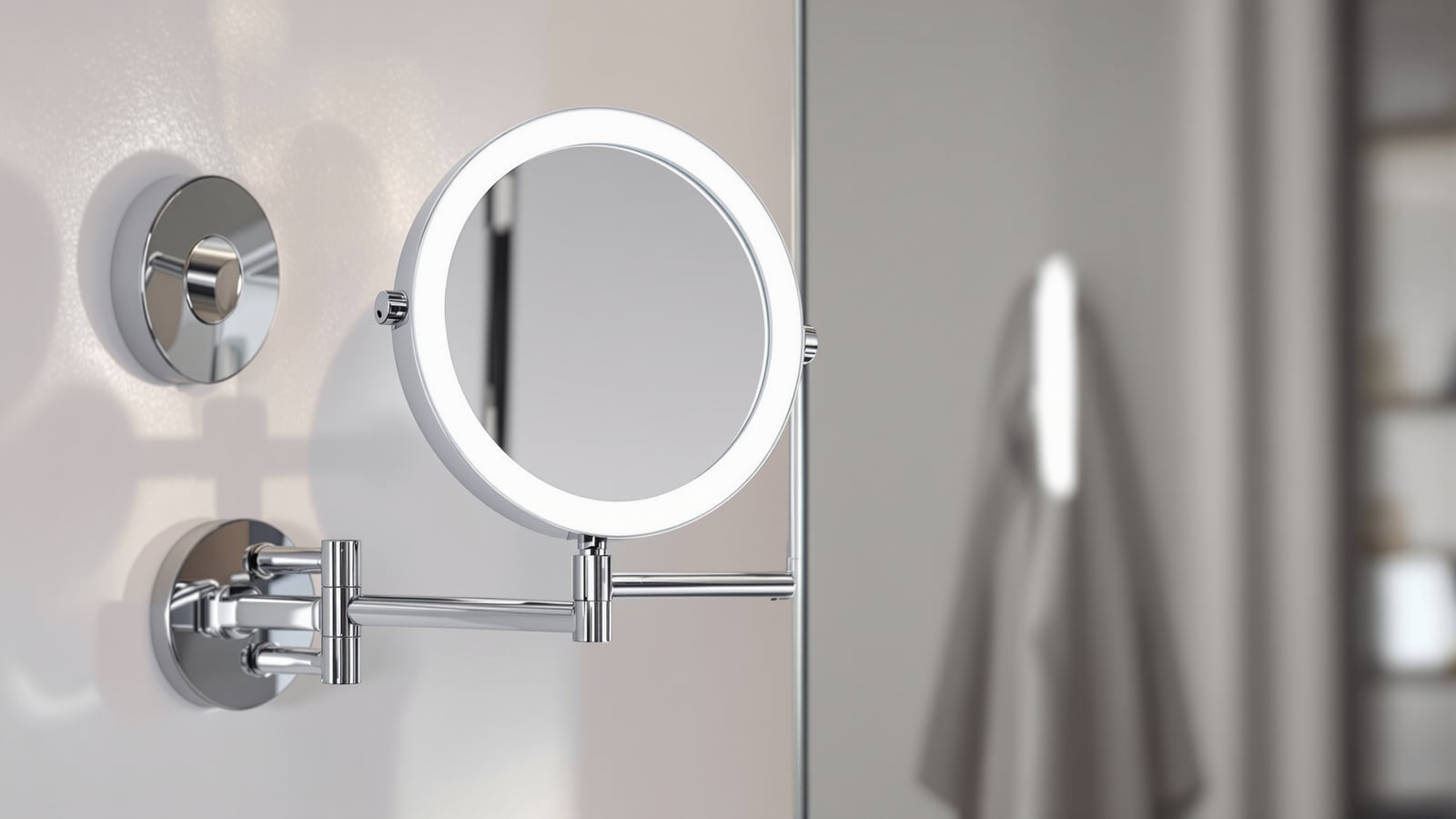
The most practical fixed option. A round mirror head on a scissor or double-jointed arm that folds flat to the wall and pulls out 30–45 cm when needed, swivelling to any angle. It reaches you instead of you leaning into it — a real advantage at a basin. It occupies no counter space and, once mounted, is always in the same reliable spot.
- Best for a permanent grooming station beside the main mirror, and for anyone who does not want clutter on the counter.
- Watch the fixing: the cantilever arm puts leverage on the wall plug, so it needs proper anchors into solid wall or tile, not a hollow-block afterthought.
Freestanding / countertop
A weighted-base mirror that sits on the vanity, tilts and often flips between 1x and a magnified face. Zero installation, moves with you, packs for travel. The trade-off is counter space and stability — it can be knocked into a wet basin, and hard water spots the base.
- Best for renters, retrofits, small make-up rituals done sitting down, and anyone unwilling to drill tile.
LED-lit (wall or freestanding)
A magnifying mirror with a built-in light ring or edge LED, mains- or battery/USB-powered. Because grooming accuracy depends as much on light as on magnification, a lit magnifier is often the biggest single improvement — it throws even, shadow-free light exactly where you are working. Look for adjustable colour temperature (roughly 3000K warm to 6000K daylight) so make-up matches the light you will actually be seen in. The full lighting logic sits in the LED bathroom mirror guide.
| Format | Install | Counter space | Reach to face | Typical India range (₹) |
|---|---|---|---|---|
| Freestanding, no light | None | Uses counter | You lean in | 500 – 2,500 |
| Freestanding, LED | Plug/USB/battery | Uses counter | You lean in | 1,800 – 6,000 |
| Wall extendable arm, no light | Drilled + anchored | None | Arm reaches you | 1,500 – 5,000 |
| Wall extendable arm, LED | Drilled + wired/battery | None | Arm reaches you | 4,000 – 15,000+ |
Where to place it
Placement is what separates a mirror you use daily from one that gathers dust.
- Beside, not behind, the basin. Mount a wall arm on the wall next to the main mirror, centred around eye level — roughly 1500–1650 mm to the mirror centre for a standing adult — so it folds out into your natural sightline. The main mirror stays the hero; the magnifier is the specialist tool next to it. See the primary-mirror heights in the bathroom mirror guide.
- Within reach of a socket if lit. A mains LED model needs a fused, RCD-protected point outside the wet zone, per the electrical-safety intent of IS 732; battery or USB versions dodge this and suit apartments where you cannot re-wire.
- Where the light is good. Even a lit mirror benefits from being off to the side of, not directly under, a downlight that would cast a shadow off your brow.
- A seated option for the elderly. Grooming and make-up are often done sitting; a freestanding magnifier at a dressing counter, or a wall arm low enough to use from a stool or wheelchair, matters for anyone who tires standing — the ergonomic thinking runs through the elderly-friendly and accessible bathroom design guides.
Position for the task, not the tiles. A magnifier looks tidy folded flat on a side wall, but if it cannot fold out into your line of sight over the basin, it will not get used. Test the arm's reach before you drill.
The elderly and low-vision case
This is where a magnifying mirror stops being a grooming nicety and becomes genuinely useful. As eyesight declines with age — presbyopia, cataracts, macular changes — close work at the mirror gets steadily harder. A 5x–10x lit magnifier restores independence for tasks that would otherwise need another person:
- Shaving safely without nicks, seeing the razor line clearly.
- Inserting and removing contact lenses, and spotting a lens folded on the eye.
- Managing skin and eye care — checking a stye, a cut, a splinter, applying drops or ointment accurately.
- Reading a thermometer, a blister-pack, or grooming detail that a 1x mirror simply cannot resolve for ageing eyes.
For a low-vision user, prioritise high magnification (10x), the brightest even LED you can get, adjustable daylight colour temperature, and a stable mount at a comfortable seated height. It is a small, cheap piece of assistive design that pays back every day.
India realities: hard water, humidity and fixing
A magnifying mirror lives in the same tough Indian bathroom as everything else, so a few practical points decide its life:
- Hard water spots the glass and, on cheap units, creeps under the silvering at the edge to cause black-edge corrosion. Choose a mirror with a sealed or copper-free backing, wipe it dry after use, and clean scale with a mild descaler — not an abrasive that scratches the coating.
- Monsoon humidity fogs the concave face fast. Some LED models offer an anti-fog demister pad or heated element; failing that, a small wipe or a smear of anti-fog before a hot shave works. The main-mirror demisting options are covered in the bathroom mirror guide.
- Fixing the arm. An extendable arm is a cantilever — it must anchor into solid masonry or through tile into a firm substrate with proper wall plugs, ideally two fixings. A single screw into a hollow partition will sag and pull out.
- Electrical safety for a mains LED unit follows IS 732 — RCD/ELCB protection, the transformer and any socket sited in the dry zone, low-voltage DC at the mirror. Battery and USB-rechargeable models avoid the issue and suit rented or apartment bathrooms where re-wiring is off the table.
- Finish should match your fittings — chrome, brushed nickel, matt black — and, like the rest of the brassware, be judged on the plating quality that survives humidity, not the showroom shine. Brand-neutral names such as Jaquar, Hindware, Cera or Kohler matter only for the finish warranty and spares you can reach locally.
Cost and honest expectations
A magnifying mirror is a low-stakes buy — even a good one costs a fraction of the main mirror or the vanity. Set expectations, not just budget:
- A plain freestanding double-sided mirror at ₹500–2,500 does the everyday job for most homes.
- A lit LED mirror at ₹1,800–6,000 is the single upgrade most people notice daily, because light matters as much as magnification.
- A wall extendable arm, lit or unlit, at ₹1,500–15,000+ is the tidiest permanent solution and the best for a fixed grooming station or an elderly user.
- Do not chase 10x for a whole family; buy 5x for general use, or a double-sided 1x/10x if one member needs the detail. And remember the glass quality, not the number on the box, decides whether the reflection is honest.
Get the strength, the light and the mount right and a magnifying mirror is the most-used square-metre in the bathroom you never planned for. For the primary mirror it complements, and for the wider fit-out, loop back to the bathroom mirror guide, the LED bathroom mirror guide and the elderly-friendly bathroom guide.
References
- National Building Code of India (NBC) 2016, Part 9 (Plumbing Services) and Part 8 (Building Services) — bathroom fittings, lighting and services.
- IS 732 — code of practice for electrical wiring installations (low-voltage supply, RCD/ELCB protection for lit mirrors).
- IS 2556 — sanitaryware and bathroom fittings reference for accessory quality and finish.
- IS 15498 / accessibility guidance and the Harmonised Guidelines & Standards for Universal Accessibility in India (CPWD, Ministry of Housing & Urban Affairs) — reach ranges and seated-use heights for elderly and low-vision users.
- IGBC Green Homes and GRIHA — where low-energy LED accessories contribute to lighting efficiency credits.
Export this guide
Related Guides — Deep-dive reading
How to Choose a Wash Basin in India: Mount Type, Size, Tap Holes & Budget (2026 Buyer's Guide)
A buyer's decision guide to picking the right wash basin — matching the mount type to your vanity and space, sizing it to the room, getting the tap-hole config right for your faucet, judging material and durability, checking what's in the box, good/better/best rupee tiers, the IS 2556 vitreous-china mark, and how to spot seconds, hairline cracks and warranty traps.
BathroomsBathroom Mirror Lighting India: Shadow-Free Vanity Light, Colour Temp, CRI & Cost (2026)
Why a single ceiling downlight throws ugly shadows on your face, how vertical sconces either side of the mirror beat a light bar above, when a backlit mirror is glow not task light, plus the colour temperature, CRI, mounting height, IP rating and 2026 rupee costs that actually get make-up and shaving right.
BathroomsBathroom Mirror India: Plain vs LED vs Backlit vs Smart, Size, Height & Cost (2026)
The complete India-first guide to bathroom mirrors — plain, LED, backlit, smart, anti-fog and magnifying types; the right size and mounting height over a basin; copper-free silvered glass that resists black-edge corrosion in humid bathrooms; fixing to tile, lighting a mirror the right way, demister pads and rupee costs.
BathroomsRelated Tools — Try Free
Bathroom Mirror Size Calculator
Recommended mirror width, height and mount height above the vanity, plus vanity-light sizing — by basin width and mirror type.
Bathroom PlannerCross-Ventilation Analyzer
Estimate airflow and air changes per hour (ACH) from room size, window areas, layout, and local wind — with NBC 2016 Part 8 compliance check.
Ventilation CalculatorElectrical Safety & Load Audit
Home electrical audit — 10 categories, 65+ checkpoints across earthing, RCCB, MCB, wiring, switchboards, appliance circuits, DG/inverter backup.
Safety Audit