
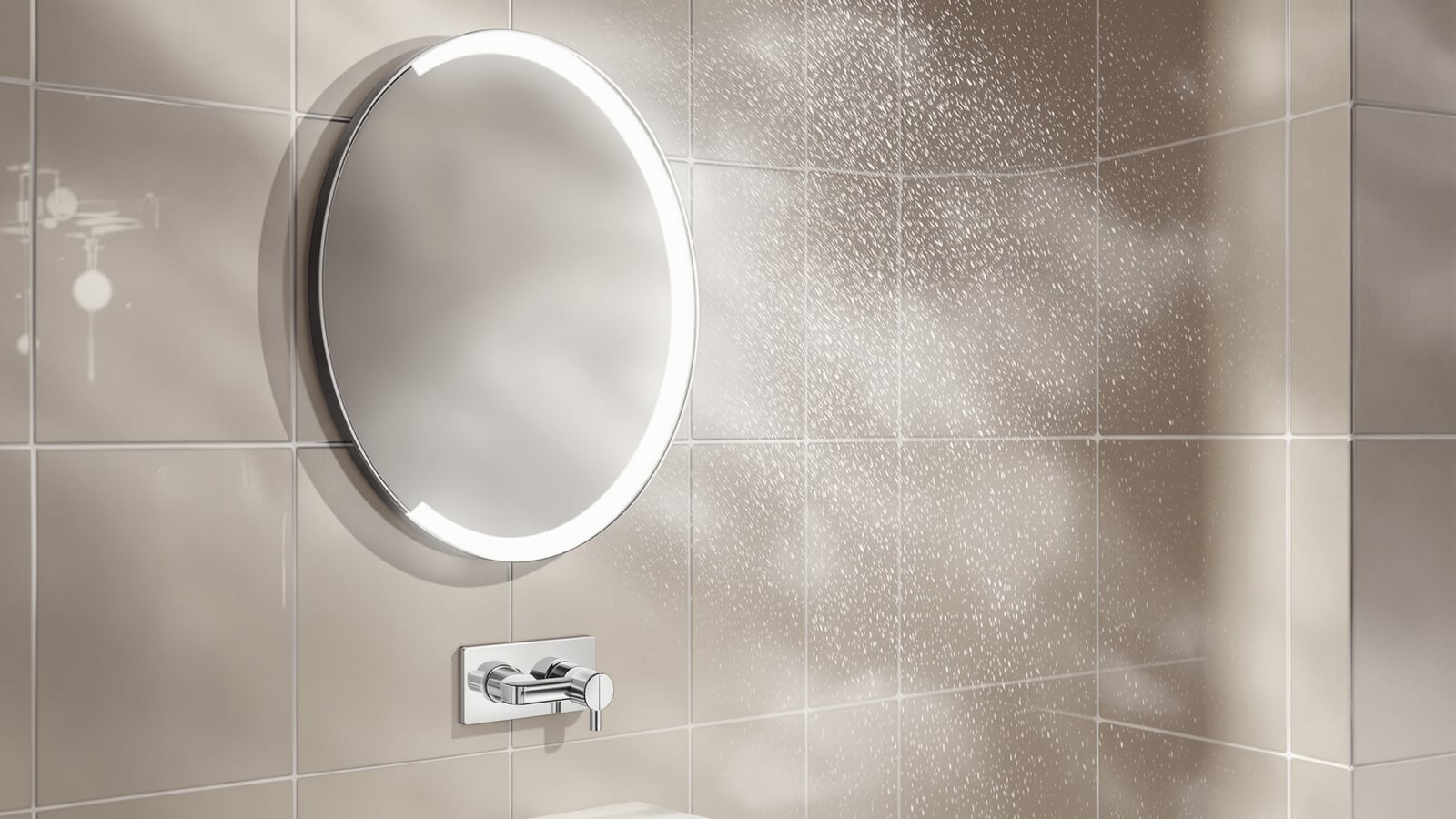
Anti-Fog Bathroom Mirror India: How Demister Pads Work, Wattage, Wiring, Coatings & Cost
A clear mirror the moment you step out of a hot shower — how the heated demister pad behind the glass keeps it fog-free, the wattage and wiring it needs, how anti-fog film and coatings compare to a built-in demister, why Indian bathrooms fog so badly, and what it all costs.
You step out of a hot shower, reach for the mirror, and it is a blank grey wall of fog. You wipe it with a towel, it smears, and thirty seconds later it has misted over again. Every Indian bathroom knows this ritual — and an anti-fog bathroom mirror is the fixture that ends it. The best of them do nothing dramatic: the glass simply stays clear, all the way through the shower, as if the steam had agreed to leave one rectangle alone.
There are two completely different technologies sold under the "anti-fog" label, and they are not equal. One is a heated demister pad bonded to the back of the mirror — a small electric heater that keeps the glass warmer than the room so vapour never condenses on it. The other is a film or coating on the front face that spreads the condensation into an invisible sheet instead of droplets. This guide explains how each works, the wattage and wiring a demister actually needs, why Indian bathrooms fog so aggressively, and what you should pay. It sits inside the Studio Matrx bathroom hub — read it alongside the complete bathroom mirror guide for India for sizing, silvering and placement, and the LED bathroom mirror guide for lighting.
A demister does not "clear" a foggy mirror — it stops the fog forming in the first place by keeping the glass a few degrees above dew point. Switch it on before the shower, not after, and the mirror never mists at all.
Why Indian bathrooms fog so badly
Fog on a mirror is condensation: warm, water-laden air touches a surface colder than its dew point and gives up its moisture as a film of tiny droplets that scatter light. The mirror looks grey because those droplets diffuse your reflection. Three things make this worse in an Indian bathroom than in a European one.
- Hot bucket-and-geyser showers in a sealed room. A geyser delivers very hot water into a compact, hard-tiled bathroom. Ceramic, stone and glass surfaces stay cool while the air saturates fast — a perfect condensation engine.
- Weak ventilation. Many Indian bathrooms have only a small openable window or an undersized exhaust fan, and in monsoon the outside air is already humid, so opening the window barely helps. The steam has nowhere to go and dwells on the coldest surface — the mirror.
- Monsoon and coastal humidity. For months the ambient air is near saturation. The margin between room temperature and dew point is tiny, so even a mildly warm shower tips the glass into fogging.
The mirror fogs because it is one of the coolest, smoothest surfaces in the room. Anything that keeps its surface above the dew point — heat — or changes how water sits on it — a coating — solves the problem. Good ventilation helps the whole room; see the exhaust-fan sizing in the moisture-resistant ceiling guide. But ventilation alone rarely keeps a mirror clear during the shower itself. That is the demister's job.
How a heated demister pad works
A demister pad is a thin, self-adhesive heating film — usually a printed conductive element sandwiched in a polyester foil, a few tenths of a millimetre thick — stuck to the back of the mirror, behind the silvering, so it is completely hidden and never touches water. When powered, it warms the glass by a few degrees, typically to around 40 to 45 degrees C. Because the mirror surface now sits above the dew point of the room air, water vapour simply cannot condense on it. The rest of the room fogs; the mirror stays clear.
Key points that matter in practice:
- It is preventive, not curative. The pad has to warm the glass before the steam arrives. Wired to the same switch as the bathroom light (or a dedicated switch), it is warming through your whole shower and the glass never mists. Switch it on after the mirror has already fogged and it will take several minutes to clear.
- The warm patch matches the pad. A demister pad clears the area of glass it covers, plus a small halo. On a large mirror a modestly sized pad keeps the central "face" zone clear while the edges may still mist — fine for most people. For an edge-to-edge clear mirror, the pad should cover most of the back.
- It is low, gentle heat. You are not making a hot mirror, only a warm one. The pad draws modest power and runs cool to the touch on the front.
Wattage and wiring: what the point actually needs
This is where an anti-fog mirror stops being a homeware purchase and becomes a small electrical job. A demister pad is a resistive heater, so it draws real current and must be wired safely in a wet room.
Pads are sized to the mirror area. As a rough guide, a demister pad runs at roughly 150 to 250 watts per square metre of pad. So the load depends on how big a pad you (or the manufacturer) fit behind the mirror:
| Mirror / pad size | Typical pad power | Current at 230 V | What it clears |
|---|---|---|---|
| Small pad (~0.1 m², behind a compact mirror) | 25–40 W | ~0.1–0.2 A | central face zone |
| Medium pad (~0.25 m²) | 45–65 W | ~0.2–0.3 A | most of a 600×800 mm mirror |
| Large pad (~0.5 m²) | 90–130 W | ~0.4–0.6 A | most of a large mirror, edge to edge |
| Full-back pad (~0.8 m²+) | 140–200 W | ~0.6–0.9 A | whole face of a big mirror |
The load is small — comparable to one or two light bulbs — but it is still a 240 V appliance in a wet zone, and that dictates the wiring:
- It needs a fused electrical point behind the mirror. Plan this at the wiring stage. Retro-fitting a demister to an existing mirror means chasing the wall for a concealed point, which is far more disruptive than adding it during construction.
- Wire it through an RCD/RCCB. Under IS 732 (electrical wiring for buildings), circuits serving a bathroom must be protected by a residual current device — typically 30 mA — so any earth fault trips instantly. This is the single most important safety point.
- Keep it out of the wet zones. The connection sits behind the mirror over the basin, well away from the shower spray. Fittings and any junction in the bathroom should suit the location; a mirror itself in the splash area should carry an appropriate ingress rating (commonly IP44 for the wall zone around a basin).
- Switch it with the light, or on its own switch. Ganging the demister with the light switch means it is always pre-warming — the simplest way to guarantee a clear mirror. A separate switch saves the wattage when you do not need it. Either way the switch stays outside or at the door, per bathroom wiring practice.
Because the load is tiny, running cost is negligible — a rupee or two a month. The cost of a demister is the mirror and the wiring point, not the electricity.
Anti-fog film and coatings: the no-wiring alternative
If you cannot run a point, the other route is a surface treatment on the front of the mirror. These do not heat anything; they change how water behaves when it lands.
- Hydrophilic (anti-fog) films and coatings make the glass so water-loving that condensation cannot bead up. Instead of thousands of tiny light-scattering droplets, the moisture spreads into a single thin, transparent sheet — so the mirror stays optically clear even though it is technically wet. These are sold as a stick-on film or a wipe/spray coating.
- Sprays and wipes (including household tricks like a smear of shaving foam or dish soap buffed thin) work on the same principle but wash off. They are a stop-gap, not a fixture.
The trade-offs are real:
| Heated demister pad | Anti-fog film / coating | |
|---|---|---|
| How it works | keeps glass above dew point | spreads water into a clear sheet |
| Needs wiring | yes — a fused, RCD-protected point | no |
| Mirror stays dry | yes, genuinely dry | no, it is wet but clear |
| Longevity | life of the mirror | film peels / coating wears; reapply |
| Works in worst humidity | very reliable | can be overwhelmed by heavy steam |
| Retrofit to any mirror | hard (needs a point) | easy (stick or wipe on) |
| Typical cost | ₹1,500–₹6,000 pad + wiring | ₹300–₹1,500 film, ₹150–₹500 spray |
The honest summary: a built-in demister is the durable, install-once answer and the only one that keeps the glass truly dry; films and coatings are the tenant-friendly, no-wiring answer but need reapplying and can be beaten by a really steamy monsoon shower. For a new bathroom, wire the point and fit a demister. For a rented flat, a good hydrophilic film is a sensible compromise.
Pairing a demister with an LED mirror
Most anti-fog mirrors sold in India today are LED mirrors — backlit or front-lit glass with the demister as a built-in option. This is a natural pairing because both are electrical and share the same concealed point behind the mirror. A combined unit typically has the LED driver and the demister on one connection, sometimes with a touch sensor that toggles light, colour temperature and demister separately.
Practical notes for a combined LED-plus-demister mirror:
- One point serves both. Plan a single concealed point behind the mirror for the LED and demister together — cleaner and cheaper than two runs. See wiring and lighting choices in the LED bathroom mirror guide.
- Colour temperature still matters more than demist. A demister keeps the glass clear; the LED decides whether you look good in it. Aim for a neutral 4000 K front light for grooming — the demist is a convenience layer on top.
- Check the demister is genuinely included. Many budget "LED mirrors" advertise a demister but ship without the pad. Confirm the pad and its wattage on the spec sheet, not the listing photo.
- Ventilate anyway. A demister protects the mirror, but the rest of the room still needs air changes to control mould on ceiling and grout. Anti-fog is not a substitute for an exhaust fan.
Cost and buying checklist for India
Rough all-in numbers for planning:
| Item | Typical cost (₹) | Notes |
|---|---|---|
| Stick-on demister pad (retrofit) | 1,500–4,000 | plus wiring point |
| LED mirror with built-in demister | 6,000–25,000+ | by size, brand, backlight |
| Anti-fog film (stick-on) | 300–1,500 | reapply every year or two |
| Anti-fog spray / wipe | 150–500 | stop-gap, washes off |
| Wiring point + RCD-protected circuit | 1,000–3,000 | electrician, at wiring stage |
Before you buy, confirm:
- A point is planned or possible. No point, no demister — decide film vs demister on this alone.
- Pad wattage and coverage match the mirror size and the "clear zone" you want.
- The circuit is RCD/RCCB protected to IS 732 — non-negotiable in a wet room.
- The mirror glass is proper silvered float glass with a moisture-sealed backing suited to bathrooms, so the silvering does not "black-spot" at the edges over time — covered in the bathroom mirror guide.
- You still have an exhaust fan sized for the room, so the demister is not carrying the whole humidity load alone — see the moisture-resistant ceiling guide.
Get those five right and the foggy-mirror ritual is simply gone: you step out, and your reflection is already there, clear and lit, while the tiles behind it steam.
References
- National Building Code of India (NBC) 2016, Part 8 (Building Services) — ventilation and electrical installation provisions for wet areas.
- IS 732: Code of Practice for Electrical Wiring Installations — residual current device (RCD/RCCB) protection and safe wiring in bathrooms and wet locations.
- IS 3564 / relevant IS glass standards — silvered mirror and float glass quality for building interiors.
- Bureau of Indian Standards (BIS) — ingress protection (IP) rating framework (IS/IEC 60529) for fittings in bathroom zones.
- CPWD General Specifications for Electrical Works — practice for concealed points and circuit protection in residential wet areas.
Export this guide
Related Guides — Deep-dive reading
LED Bathroom Mirror India: Backlit vs Front-Lit, Colour Temperature, Cost & The Point Behind the Glass
A practical India-first guide to LED and backlit bathroom mirrors — integrated shadow-free face lighting, 2700K-6500K colour temperature and tunable white, halo backlight versus sandblasted front strips, plus the concealed electrical point, IP rating, demister and driver access you must plan behind the mirror before you tile.
BathroomsSmart Bathroom Mirror India: Touch Display, Voice, Defogger, Cost & Is It Worth It
A practical India-first guide to smart bathroom mirrors — the embedded touch display showing time, weather and news, the Bluetooth speaker, voice assistant, mood-lighting scenes and defogger — plus the power and optional data point behind the glass, the IP and electrical safety it demands, how hard water and monsoon humidity decide whether it lasts, and whether it is really worth the money over a good LED mirror.
BathroomsBathroom Electrical India: Loads, IP Zones, RCD Protection & the Complete Wiring Plan
The complete guide to bathroom electrical planning for Indian homes — the loads and points (geyser on a dedicated 16 A circuit, exhaust, mirror and lights, shaver socket, smart WC), the IP zones 0/1/2 that fix where fittings can sit near water, mandatory 30 mA RCD/RCBO earth-leakage protection, earthing, keeping switches outside the wet zone, cable sizing and getting conduits right before plastering — all per IS 732 and NBC 2016.
BathroomsRelated Tools — Try Free
Cross-Ventilation Analyzer
Estimate airflow and air changes per hour (ACH) from room size, window areas, layout, and local wind — with NBC 2016 Part 8 compliance check.
Ventilation CalculatorElectrical Safety & Load Audit
Home electrical audit — 10 categories, 65+ checkpoints across earthing, RCCB, MCB, wiring, switchboards, appliance circuits, DG/inverter backup.
Safety AuditBathroom Humidity Calculator
Gauge condensation and mould risk in a bathroom and the ventilation needed to control it — a 0-100 risk score with drivers and fixes.
Bathroom Calculator