
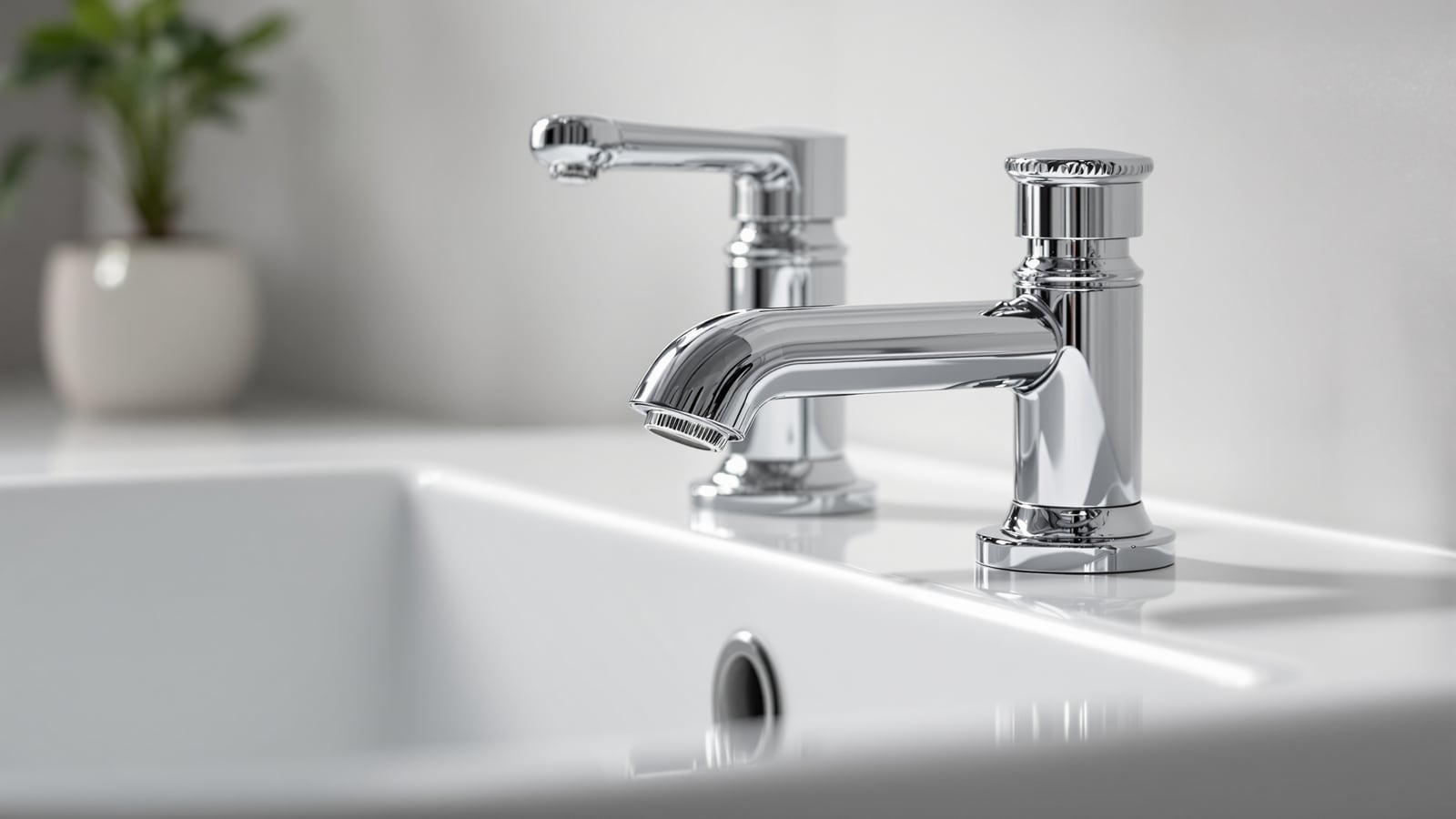
Pillar Taps India: The Single-Supply Basin Tap, Quarter-Turn vs Washer, Cost & Where They Still Win (2026)
What a pillar tap (pillar cock) actually is, why it stays the default on Indian basins, quarter-turn ceramic-disc versus conventional washer types, sizes, finishes, rupee costs, and an honest comparison with a basin mixer.
Walk into almost any Indian home, guest toilet, office washroom or hospital and look at the wash basin: the tap standing up out of the deck, one handle, one spout, is a pillar tap — the plumber and the catalogue call it a pillar cock. It is the most fitted, least discussed piece of bathroom brassware in the country. Everyone has used a thousand of them and almost nobody chooses one on purpose. That is a mistake, because the pillar tap is often the right answer — cheaper, simpler and longer-lived than the basin mixer that showrooms push — and the difference between a good one and a bad one is a few hundred rupees and one word: quarter-turn.
This guide is India-first. It assumes hard water that chews washers and films chrome, a basin fed by a single overhead tank line as often as not, a geyser that lives in the bathroom rather than at the basin, and a budget that has to buy taps for three or four basins in one flat. It sits under the bathroom faucets guide for India, which frames the whole tap decision; here we go deep on just the pillar tap. When you do want temperature control at the basin, read the companion basin mixer taps for India, and for how the tap sits inside a shared family or guest bathroom see common bathroom design in India.
A pillar tap is not a cheaper mixer — it is a different tool. It delivers one water supply, beautifully, at a fraction of the cost. Fit it where you only have one supply to deliver, and it beats a mixer on every count that matters.
What a pillar tap actually is
A pillar tap is a single-inlet, deck-mounted tap: it rises vertically ("pillar") out of a hole in the basin deck or the counter, takes one water supply from below through a single connection, and delivers it through a fixed spout under one handle. That single-supply nature is the whole identity of the fitting:
- It connects to one line — typically cold, drawn from the overhead tank or the municipal supply. There is no mixing chamber and no second inlet.
- Because it carries one supply, the classic Indian basin arrangement is a pair of pillar taps: one cold on the right, one hot on the left, each with its own spout, where a geyser feeds the basin. You blend by running both into the bowl — old-fashioned, but robust and repair-friendly.
- It sits in a standard deck hole and is held by a shank, back-nut and washer under the basin. Any basin sold in India with a single tap hole is drilled for a pillar tap.
Contrast this with a basin mixer, which takes two supplies (hot and cold) into one body, blends them internally, and delivers a single tempered stream under one lever. The mixer is more convenient; the pillar tap is more fundamental. Most Indian basins genuinely have only one supply worth delivering — which is exactly why the pillar tap refuses to die.
Quarter-turn vs conventional washer — the one choice that matters
Every pillar tap you can buy uses one of two mechanisms to start and stop the water, and this single decision governs its feel, its lifespan and its behaviour in hard water.
Conventional (washer / spindle) taps work the way taps have for a century: turning the handle drives a threaded spindle down onto a rubber washer that presses against a seat to seal. You turn it two or three full rotations to open, and you turn it firmly to close. It is cheap and any plumber can service it — but the rubber washer is a wear part. In hard water it hardens, the seat pits, and within a year or two the tap drips. The cure is a five-rupee washer change, but you will be doing it repeatedly.
Quarter-turn taps replace the washer-and-spindle with a ceramic-disc cartridge: two polished ceramic discs, one fixed and one that rotates a quarter-turn (90 degrees) to align or block ports. Full flow to full stop in one flick of the wrist, no threads to wear, and no rubber washer to perish. The ceramic discs shrug off hard water far better and a good cartridge lasts many years. It costs a little more up front and, when it eventually fails, you swap the whole cartridge rather than a washer — but for most homes it is unambiguously the better buy.
| Feature | Conventional washer tap | Quarter-turn ceramic tap |
|---|---|---|
| Mechanism | Threaded spindle onto rubber washer | Two ceramic discs, 90° rotation |
| Operation | 2–3 turns to open/close | Single quarter-turn flick |
| Hard-water tolerance | Poor — washer hardens, seat pits | Good — discs resist scale |
| Typical drip onset | 1–2 years, recurring | Many years, rare |
| Repair | ₹5–20 washer, frequent | ₹150–500 cartridge, infrequent |
| First cost (brass, chrome) | ₹350–800 | ₹700–1,600 |
| Best for | Rarely-used taps, tight budget | Every daily-use basin |
Sizes, connection and standards
Pillar taps are refreshingly standard. The inlet thread is almost always 15 mm nominal bore — the ½-inch BSP connection every Indian plumbing line and angle-valve is built around, so a pillar tap drops onto the same supply that would feed anything else. A few basin fittings use ¾-inch (20 mm) for higher flow, but ½-inch is the basin norm.
- Inlet: ½-inch (15 mm) BSP male thread is standard; the tap connects to the wall angle-valve via a flexible braided connection pipe (hose), so exact reach is forgiving.
- Spout height and reach: basin pillar taps typically stand 100–160 mm tall with a short fixed spout; choose reach so the stream lands near the centre of the bowl, not on the rim or against the back wall.
- Deck hole: basins are drilled for a standard shank; the tap is secured with a back-nut and rubber washer under the deck — no special cut-out.
- Flow control: a good pillar tap ends in a foam-flow aerator or flow regulator that mixes air into the stream. It softens splash, feels fuller and cuts water use — worth insisting on, especially in a home chasing the water-efficiency goals in the eco-friendly bathroom guide.
Indian pillar cocks are made and marked to IS 8931 (the specification for copper-alloy pillar taps/cocks for water services), and the brass bodies to the copper-alloy requirements of the plumbing standards; reputable brands test to these. Ask for the IS marking on the box rather than trusting a bright chrome shine.
Finishes and body material
The body should be brass (a copper-zinc alloy) — it is corrosion-resistant, machines cleanly and takes plating well. Avoid unbranded zinc-alloy (pot-metal) taps, however cheap: they crack at the threads and pit under hard water within a year or two. On top of the brass sits the finish:
| Finish | Look | Durability in hard water | Relative cost |
|---|---|---|---|
| Chrome plated (CP) | Bright mirror | Very good; wipe off water film | Baseline |
| Matte / brushed nickel | Soft satin grey | Good; hides water spots | +15–30% |
| Matte black | Contemporary, bold | Good, but shows lime scale | +25–50% |
| Brushed gold / rose gold | Warm, premium | Good on PVD coats | +40–80% |
| Antique / bronze | Traditional | Varies; buy PVD, not lacquer | +30–70% |
Chrome remains the sensible default in Indian hard water: it is the most forgiving of the daily lime film every glossy surface collects, and a quick wipe keeps it bright. Where you want a designer finish, insist on PVD (physical vapour deposition) coating rather than lacquer or paint — PVD is bonded at a molecular level and survives scrubbing and scale; lacquered "gold" peels. Coordinate the tap finish with the other metals in the room as set out in the bathroom faucets guide for India.
Where a pillar tap still wins
The pillar tap is not a compromise. There are whole categories of Indian basin where it is simply the correct fitting — and where a mixer would be waste or even a nuisance.
- Single water supply. If the basin is fed only from the overhead tank — no geyser line, no hot supply at all — a mixer has nothing to mix. One cold-only pillar tap is honest, cheaper and has fewer joints to leak.
- No geyser at the basin. In most Indian bathrooms the geyser is plumbed to the shower, not the basin. People wash hands, brush and shave in ambient-temperature water. A pillar tap serves that reality perfectly.
- Budget builds and multiple basins. Fitting out a whole flat, a rental, a hostel, a clinic or an office washroom, the per-basin saving of a pillar tap over a mixer multiplies fast — and the maintenance saving compounds it.
- Guest toilets and powder rooms. Occasional-use basins do not justify a mixer; a smart quarter-turn pillar tap looks crisp and never gets fiddly. See the common bathroom design guide for shared-basin planning.
- Robustness and repairability. Fewer parts, simpler cartridge, any plumber can service it. In a building without on-call maintenance, that simplicity is a feature.
Pillar tap vs basin mixer — an honest comparison
The mixer is not "better"; it is different, and it earns its extra cost only where you genuinely blend hot and cold at the basin every day.
| Pillar tap | Basin mixer | |
|---|---|---|
| Water supplies | One (cold, or hot/cold pair of taps) | Two, blended internally |
| Temperature control | None (or blend two spouts) | Single lever, tempered stream |
| Parts / leak points | Fewer, simpler | More seals, cartridge, both inlets |
| Typical cost (decent brass) | ₹350–1,600 each | ₹1,800–6,000+ |
| Hard-water maintenance | Low, cheap | Higher; cartridge more costly |
| Best fit | Single supply, guest, budget, hostel | Master/family basin with hot line |
| Deck hole needed | Single | Single (for single-lever mixer) |
The clean rule: if the basin has a hot supply you actually use, buy a mixer; if it does not, a pillar tap is not a downgrade — it is the right fitting. Many well-designed Indian homes mix both, putting mixers on the master and daily-use basins and quarter-turn pillar taps on guest, utility and children's basins.
Buying and living with a pillar tap — do and don't
- Do buy quarter-turn ceramic-disc for any daily-use basin; reserve washer taps for rarely-used or ultra-tight-budget points.
- Do insist on a brass body and an IS-marked box; refuse light, unbranded zinc-alloy taps.
- Do choose chrome or PVD finishes in hard-water regions and wipe the tap dry after use to stop lime film.
- Do fit an aerator and an isolating angle-valve below each tap, so a future service needs no mains shut-off.
- Don't pair a mixer's plumbing (two supplies) to a single pillar tap — you will cap and waste one line.
- Don't overspend on a designer finish for a guest basin used twice a week; put that budget on the master.
- Don't ignore a drip — on a washer tap it is a five-rupee fix, but a running tap wastes thousands of litres a year.
References
- IS 8931 — Copper alloy pillar taps (pillar cocks) for water services, Specification (Bureau of Indian Standards).
- IS 8934 / IS 1795 — Bib taps and stop cocks for water services; related copper-alloy fittings standards (BIS).
- National Building Code of India (NBC) 2016, Part 9 — Plumbing Services, water supply and sanitary appliances.
- IS 1172 — Code of Basic Requirements for Water Supply, Drainage and Sanitation (BIS).
- CPHEEO Manual on Water Supply and Treatment, Ministry of Housing and Urban Affairs — fixtures and fittings guidance.
- IGBC Green Homes and GRIHA rating references — water-efficient fixture and aerator/flow-rate criteria.
Export this guide
Related Guides — Deep-dive reading
Basin Mixer Tap India: Single-Lever Buying Guide, Spout Height, Cartridge & Cost (2026)
How a single-lever basin mixer blends hot and cold on one control — what supplies it needs, the spout height that matches your basin, the ceramic cartridge that decides its life, pop-up waste, tall vessel mixers, finishes, flow rate, and rupee tiers versus separate pillar taps.
BathroomsBathroom Faucets India: The Complete Guide to Taps, Cartridges, Finishes & Flow (2026)
Every faucet type explained for Indian bathrooms — pillar taps, basin mixers, single-lever vs two-handle, wall vs deck vs concealed, sensor and thermostatic — plus the ceramic-disc cartridge that survives hard water, CP-fitting quality to IS standards, finishes, aerators and honest rupee ranges.
BathroomsHow to Choose a Bathroom Faucet in India: A Buyer's Guide to Cartridges, Brass & Fakes (2026)
A buyer's decision guide to CP fittings — the ceramic-disc cartridge that decides life in hard water, the brass-vs-zinc weight test, finish durability, warranty, honest good/better/best rupee tiers, and how to spot the huge fake-faucet problem in the Indian market.
BathroomsRelated Tools — Try Free
Before vs After — Cost Reality Check
Compare what you expected to pay vs what you actually paid, category by category.
Reality CheckShower Water Flow Calculator
Shower water use per shower, day and month by head type, plus a pressure-adequacy check for your tank height or pump and low-flow savings.
Bathroom CalculatorMaterial Comparison Sheet
India's interior material cheatsheet — plywood, finishes, hardware, countertops, paints, waterproofing.
Reference Guide