

Septic Tank Design for Indian Sites
IS 2470 Part 1 + Part 2, Soak Pit Design, Soil Percolation, and Decentralised Sanitation — A Comprehensive Guide for Architects and Plumbing Consultants
In the great Indian urban imagination, the septic tank is an embarrassment — a crude rural contrivance, to be hidden, forgotten, and eventually replaced by the municipal sewer line. In engineering fact, the septic tank is the most important single piece of sanitation infrastructure for the roughly 65% of Indian households that remain outside trunk sewerage coverage (CPHEEO, 2023). In a country of 300 million households, this means 195 million septic tanks — most poorly designed, many undersized, a significant fraction unsafe to occupants and neighbours.
This guide is written for architects, plumbing consultants, and informed homeowners commissioning buildings on plots outside sewerage coverage. It covers the design methodology of IS 2470 Part 1:1985 and its companion IS 2470 Part 2:1985, the decisions that matter — user count, flow rate, detention time, desludging frequency — and the alternatives to conventional septic that may be more appropriate for particular sites. It assumes the reader has a basic familiarity with plumbing but pauses to explain the sanitation vocabulary where it matters.
"The septic tank is the unsung hero of Indian sanitation. Ignored in policy, feared in design, but holding up the water quality of two-thirds of India's rural households." — J.V.R. Murty, Deputy Director, CPHEEO (Murty, 2019)
1. Why Septic Tank Design Still Matters
India's urban sanitation narrative has long emphasised networked sewerage — the century-old colonial ideal of comprehensive underground drainage flowing to centralised treatment plants. For cities like Mumbai, Delhi, Chennai, Bengaluru, and Kolkata, this remains the aspiration, and coverage has expanded substantially since the Swachh Bharat Mission began in 2014.
Yet the limits of networked sewerage are also becoming clearer. Even in Class I cities (population over 100,000), the 2021 Census found that only 32% of households were connected to public sewers; the remaining 68% used septic tanks, pit latrines, or (in diminishing numbers) open defecation. In Class II towns (50,000–100,000) the sewered fraction drops to 12%. In rural India — 65% of the population — sewerage coverage is effectively zero.
The implication is that decentralised sanitation remains the functional reality for most of India's built environment. Septic tanks, soak pits, biodigester tanks, and small-scale Decentralised Wastewater Treatment Systems (DEWATS) together constitute the sanitation infrastructure that serves most Indians most of the time. Designing these systems well is therefore not an optional or specialist activity; it is central to responsible architectural practice across the country.
The stakes are measurable. Groundwater contamination from poorly-designed septic systems is a significant source of the E. coli loading that affects roughly 70% of India's shallow aquifers (Central Ground Water Board, 2021). The Kolar district study by Prasad and Shree (2018) documented a direct correlation between septic-tank-to-borewell distance and bacteriological contamination in drinking water samples — a correlation that reverses the long-assumed safety of the 15 m minimum prescribed in IS 2470. Responsible design is not just a code-compliance exercise; it is a public health intervention.
2. The Regulatory Framework
Three Indian Standards and one national code govern septic tank design:
IS 2470 Part 1:1985 — Code of Practice for Design and Construction of Septic Tanks — Part 1: Design Criteria and Construction of Septic Tanks for Small Installations. This is the primary sizing standard, covering residential and small commercial installations up to roughly 50 users (Bureau of Indian Standards, 1985a).
IS 2470 Part 2:1985 — Code of Practice for Design and Construction of Septic Tanks — Part 2: Secondary Treatment and Disposal of Septic Tank Effluent. Governs the soak pit, dispersion trench, and evapotranspiration bed that receive the septic tank's outflow (Bureau of Indian Standards, 1985b).
IS 15800:2008 — Decentralised Wastewater Treatment System (DEWATS) — Guidelines for Design, Construction, Operation and Maintenance. Covers the larger, multi-stage alternatives to simple septic systems for sites above roughly 50 users or with elevated wastewater strength (Bureau of Indian Standards, 2008).
NBC 2016 Part 9 — Plumbing Services, Section 2: Drainage and Sanitation. Provides the regulatory framework within the National Building Code, including setback distances between septic systems and water sources (Bureau of Indian Standards, 2016).
State Public Works Departments and municipal bodies often have additional provisions — BBMP requires DEWATS for apartment buildings above 50 dwellings; PMC requires biodigester tanks on plots above 750 sqm; GHMC mandates septic tank desludging certification at occupancy. Architects must consult the relevant ULB sanitation code in addition to the BIS standards.
3. The Physics of a Septic Tank
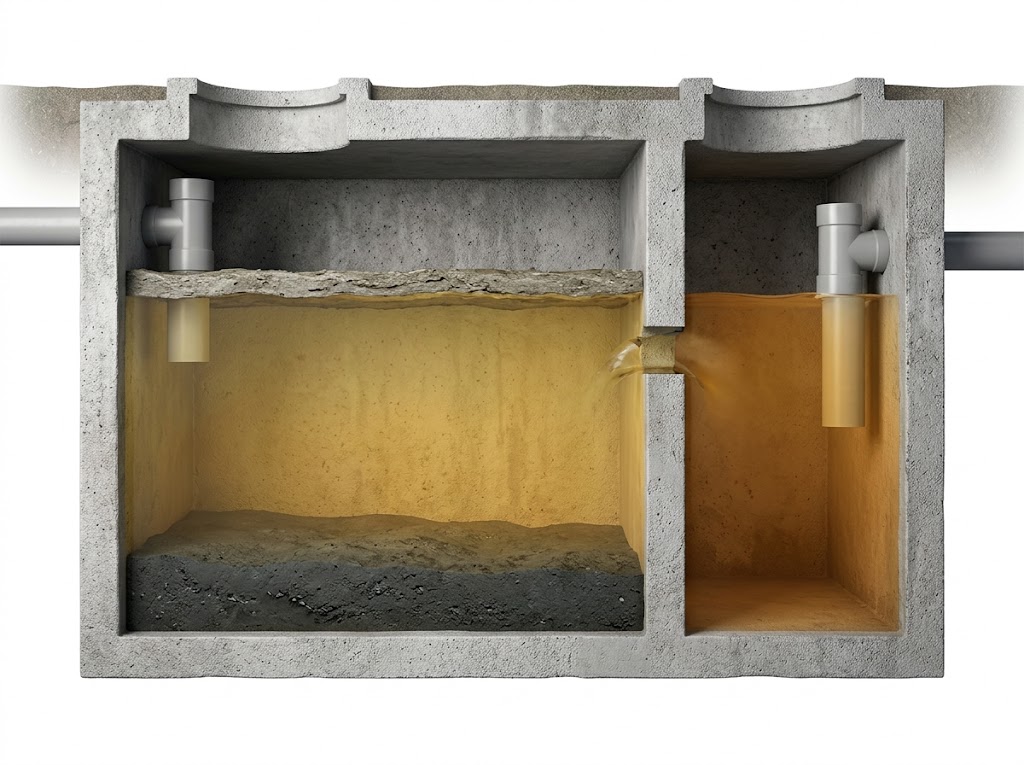
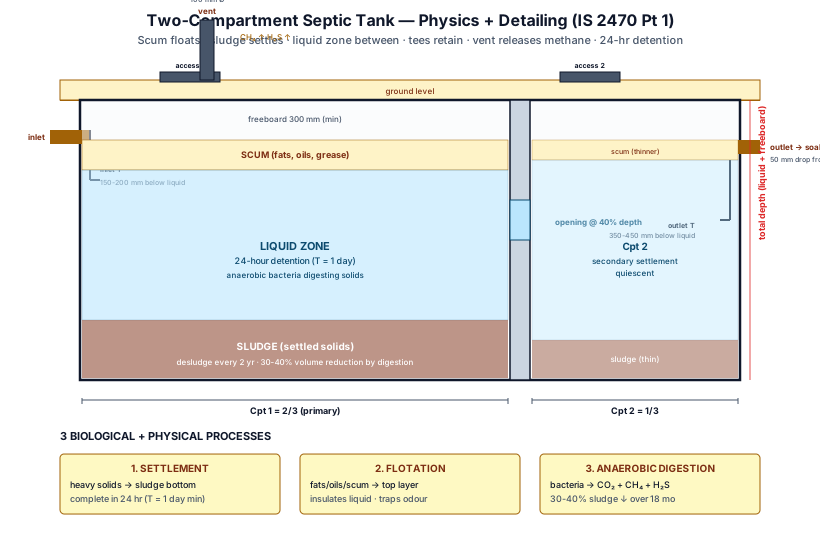
A septic tank is a watertight underground chamber that receives domestic sewage and retains it long enough for three biological and physical processes to occur:
Settlement. Heavier solids — fecal matter, food waste — sink to the bottom and form a sludge layer. This takes minutes to hours depending on particle size; complete settlement of fine solids requires up to 24 hours, which is why IS 2470 specifies 24-hour minimum detention.
Flotation. Lighter solids — fats, oils, grease, soaps — rise to the surface and form a scum layer. The scum layer insulates the underlying liquid from air and traps odours within the tank.
Anaerobic digestion. Bacteria in the sludge layer slowly convert solid organic matter into gases (carbon dioxide, methane, hydrogen sulphide) and into a reduced quantity of stable residue. This process is slow — typical anaerobic digestion in a septic tank reduces sludge volume by 30–40% over 18 months — which is why desludging is still required even with biological activity.
Between the scum layer above and the sludge layer below lies the liquid zone, which continuously receives new influent and releases partially clarified effluent through the outlet tee. The outlet tee extends below the scum layer to prevent floating solids from exiting, and above the sludge layer to prevent solids from being resuspended and carried out.
The tank is subdivided into two compartments in a typical 2:1 ratio by volume. The first compartment handles the primary settlement and sludge accumulation; the second provides quiescent secondary settlement before the effluent leaves. The wall between them has an opening at mid-depth (roughly 40% of liquid depth from the top) that allows liquid to transfer while retaining scum above and sludge below.
"The septic tank is a biological reactor that happens to be inside a civil engineering problem. Ignore the biology and you get the wrong size; ignore the civil engineering and the biology never gets a chance to work." — Arthur M. Buswell, pioneer of septic tank science (Buswell, 1939)
4. The IS 2470 Sizing Formula
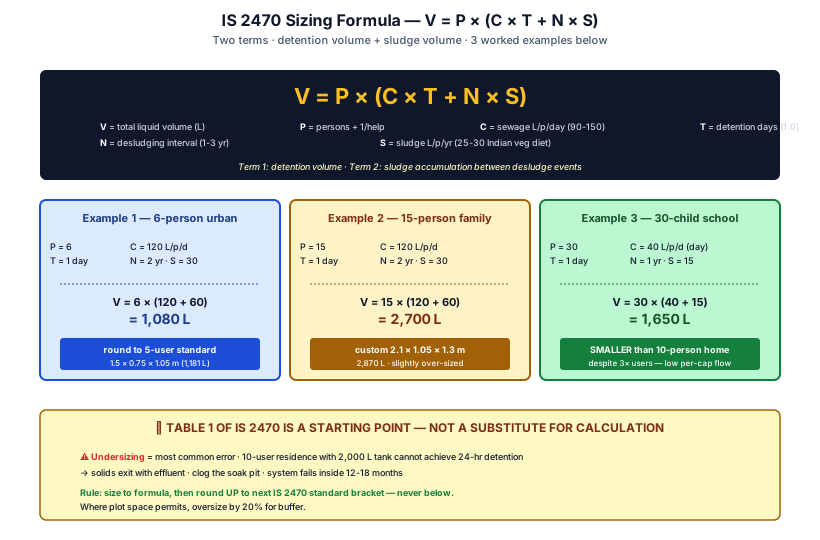
IS 2470 Part 1:1985 Clause 6.2 prescribes the total liquid volume of the septic tank as:
V = P × (C × T + N × S)
Variable definitions and typical values:
- P — Number of contributing persons. For residential tanks, include all regular residents plus 1 extra per domestic help. For institutional tanks, use the 24-hour peak occupancy.
- C — Sewage flow rate per person per day, in litres. IS 2470 specifies 90–150 L/person/day depending on fixture count and usage pattern. Rural residence with squat pan and bucket flush: 85–90 L. Urban residence with full plumbing: 120 L. Premium residence with multiple bathrooms: 135–150 L. Office: 45 L. School: 40 L. Hostel: 135 L.
- T — Detention period in days. Standard is 1.0 day (24 hours). For low-flow rural tanks, 1.5 days gives additional settlement time.
- N — Desludging frequency in years. IS 2470 recommends 1 year for commercial and 2 years for residential; 3 years is acceptable for over-sized tanks that can accommodate the extra sludge without risk to detention volume.
- S — Sludge accumulation rate per person per year, in litres. For Indian diets with high vegetable fibre: 25–30 L/person/year. For mixed diets: 30–35 L. For institutional installations with anti-scaling chemicals in cleaning agents, up to 40 L.
Worked Example 1 — Standard 6-Person Urban Residence
- P = 6
- C = 120 L/person/day
- T = 1 day (24 hours)
- N = 2 years
- S = 30 L/person/year
V = 6 × (120 × 1 + 2 × 30) = 6 × (120 + 60) = 6 × 180 = 1,080 L liquid volume
Round up per IS 2470 Table 1 (nearest bracket ≥ 5 users): use the 5-user standard tank with 1,181 L liquid capacity at 1.5 × 0.75 × 1.05 m (L × W × liquid depth).
Total depth = liquid depth + 300 mm freeboard = 1.35 m.
Worked Example 2 — 15-Person Extended Family
- P = 15
- C = 120 L/person/day
- T = 1 day
- N = 2 years
- S = 30 L/person/year
V = 15 × (120 + 60) = 15 × 180 = 2,700 L liquid volume
Per IS 2470 Table 1, use the 15-user standard tank with 2.0 × 0.9 × 1.3 m and 2,340 L capacity — slightly undersized relative to formula, which is why the calculator permits override.
Or design custom: liquid depth 1.3 m, plan area required = 2.70 / 1.3 = 2.08 m², L:W = 2:1 → L = 2.04 m, W = 1.02 m. Round to 2.1 × 1.05 × 1.3 m = 2.87 m³ (2,870 L) — slightly over-sized, safe.
Worked Example 3 — 30-Child Primary School
- P = 30
- C = 40 L/person/day (day scholars)
- T = 1 day
- N = 1 year (institutional, more frequent desludging)
- S = 15 L/person/year (lower Indian schoolchild sludge rate)
V = 30 × (40 + 15) = 30 × 55 = 1,650 L liquid volume
Despite 30 users, the school's lower per-capita flow means a smaller tank than a 10-person residence. The 20-user bracket in IS 2470 Table 1 (2.3 × 1.1 × 1.4 m, 3,542 L) is larger than required; custom sizing is justified. This example illustrates why IS 2470 Table 1 is a starting point, not a substitute for calculation.
5. Tank Geometry and Detailing
IS 2470 Part 1 prescribes specific geometric constraints that give effect to the biological and hydraulic requirements:
Length-to-width ratio. Recommended 2:1 to 4:1, typically 2:1 for small tanks. The elongated shape ensures that the inlet and outlet are far enough apart for proper settlement without short-circuiting.
Liquid depth. Minimum 1.0 m below inlet invert to ensure adequate detention volume and scum-to-sludge separation. Maximum 1.8 m — deeper tanks do not settle any better and become construction-expensive.
Freeboard. Minimum 300 mm above liquid level. This prevents overflow during peak inflow and accommodates scum layer growth between desludging events.
Compartment division. First compartment 2/3 of total volume (by length for rectangular tanks); second compartment 1/3. The wall between them extends from floor to top slab with an opening at 40% of liquid depth from the top — high enough to avoid sludge, low enough to avoid scum.
Inlet tee. A T-fitting at the inlet side, with the lower leg extending 150–200 mm below the liquid surface (into the liquid zone, below scum). The inlet tee dissipates incoming sewage momentum and prevents short-circuiting of flow across the top of the tank.
Outlet tee. Identical T-fitting at the outlet side, with the lower leg extending 350–450 mm below the liquid surface. The deeper outlet tee ensures that neither scum (at the top) nor sludge (at the bottom) can exit with the effluent.
Inlet-to-outlet level drop. The outlet invert is 50 mm below the inlet invert to ensure positive gravity flow. In small tanks this is almost imperceptible; in large tanks it becomes a significant design consideration.
Access covers. Minimum 600 × 600 mm covers above each compartment, positioned to allow manual and mechanical desludging. IS 2470 Part 1 Clause 8.4.3 requires removable RCC slabs with air-tight seals.
Ventilation pipe. A 100 mm diameter vent pipe extending above the roofline, positioned over the first compartment where gas generation is highest. The vent prevents pressure build-up from methane generation and allows escape of hydrogen sulphide before it acidifies the liquid.
"Detail the tees properly and you have a working septic tank. Skip the tees and you have an expensive pond." — B.B. Sundaresan, senior sanitation consultant (Sundaresan, 2012)
6. Soak Pit Design per IS 2470 Part 2
The septic tank effluent — 70–90% of the input sewage volume — must be dispersed safely into the ground. IS 2470 Part 2:1985 governs this secondary treatment step.
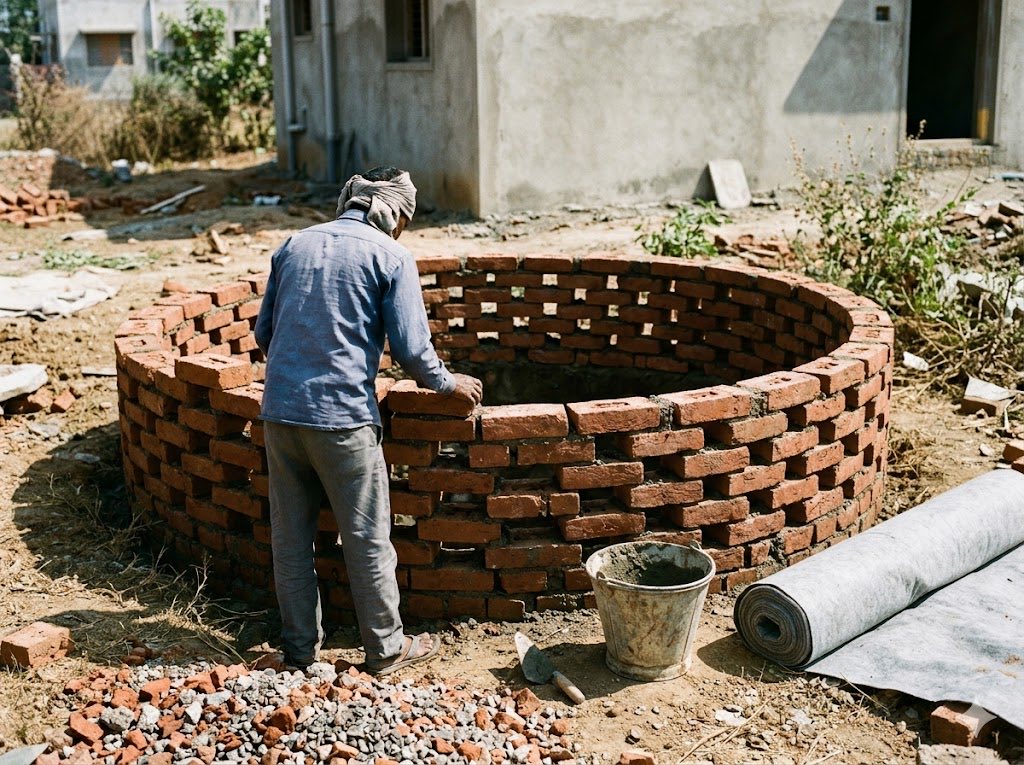
The soak pit is a cylindrical excavation lined with loose brickwork or gabion mesh, filled with graded aggregate, and covered at the top. Effluent enters through a perforated pipe and percolates outward through the pit wall and downward through the base. Soil absorption completes the aerobic biological treatment that the anaerobic septic tank has begun.
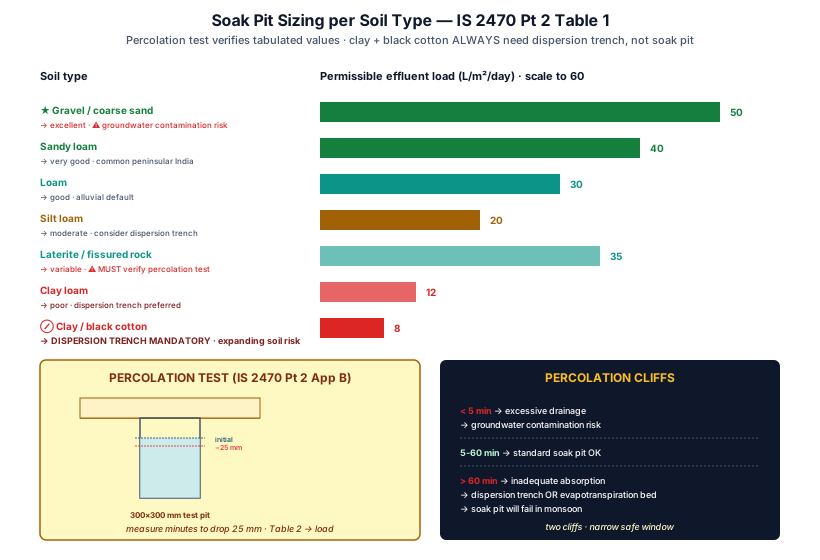
Soak Pit Sizing per Soil Type
| Soil Type | Permissible Effluent Load (L/m²/day) | Typical Pit Size for 1,000 L/day Effluent | Suitability |
|---|---|---|---|
| Gravel / Coarse Sand | 50 | 1.5 m diameter × 2.0 m deep | Excellent; groundwater contamination risk |
| Sandy Loam | 40 | 1.8 m × 2.0 m | Very good; common in peninsular India |
| Loam | 30 | 2.0 m × 2.5 m | Good; alluvial default |
| Silt Loam | 20 | 2.5 m × 2.5 m | Moderate; consider dispersion trench |
| Clay Loam | 12 | 3.0 m × 3.0 m or dispersion trench | Poor; dispersion trench preferred |
| Clay / Black Cotton | 8 | Dispersion trench MANDATORY | Very poor; expanding soil risk |
| Laterite / Fissured Rock | 35 | 1.8 m × 2.0 m | Variable; verify with percolation test |
Sources: IS 2470 Part 2:1985 Clause 5.2.1 Table 1; Tilley et al. (2014) Compendium of Sanitation Systems and Technologies; field data from CPHEEO (2013).
Percolation Test
For any site, the tabulated values should be verified with a percolation test per IS 2470 Part 2 Appendix B. The test procedure:
1. Dig a 300 × 300 mm test pit to the depth of the proposed soak pit base.
2. Fill the pit with 300 mm of clear water and allow to stand for 4 hours (pre-soaking).
3. Fill again and measure the time for the water level to drop 25 mm (1 inch).
4. Calculate absorption rate: minutes to drop 25 mm = percolation time.
5. Use IS 2470 Part 2 Table 2 to convert percolation time to allowable effluent load.
Percolation tests under 5 minutes indicate excessive drainage (risk of groundwater contamination); over 60 minutes indicates inadequate absorption (dispersion trench or evapotranspiration bed required instead of soak pit).
Separation from Water Sources
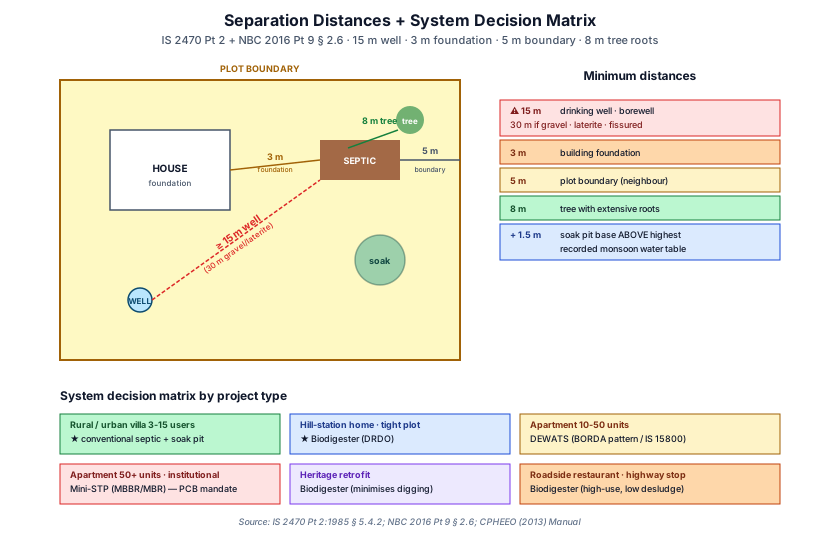
IS 2470 Part 2 Clause 5.4.2 and NBC 2016 Part 9 Section 2 Clause 2.6 require minimum horizontal separation between septic systems and water sources:
- 15 m to any drinking water well or borewell (minimum for all soil types)
- 30 m for fissured rock, laterite, and gravel soils where bacteria can travel rapidly
- 3 m to building foundations (to prevent moisture migration)
- 5 m from plot boundary (to protect neighbours)
- 8 m from trees with extensive root systems (to prevent root intrusion)
In plots where these distances cannot be achieved, alternative systems are mandatory — biodigester with UV treatment for groundwater-contaminating soils, or connection to a clustered sewerage system serving multiple plots.
7. Alternatives to Conventional Septic
For specific site conditions, three alternatives to conventional septic tank + soak pit deserve consideration:
Biodigester Tank (DRDO Technology)
Developed by the Defence Research and Development Organisation for the Indian armed forces, biodigester tanks use a cocktail of psychrophilic bacteria that operates at Indian temperatures (5–40 °C). The tank is compartmentalised like a conventional septic but with bacterial inoculation that accelerates anaerobic digestion. Sludge accumulation is reduced to near-zero; desludging intervals extend to 5–10 years.
Capital cost: 2–3× conventional septic. Operational cost: nil (no chemicals or energy). Best for: single residences on small plots where soak pit space is limited, and for high-use commercial (restaurants, highway stops). Available from: DRDO-licensed manufacturers, notable brands include Sintex, Tata, and Kent.
DEWATS (Decentralised Wastewater Treatment System)
DEWATS combines a septic tank with a series of anaerobic baffled reactor, anaerobic filter, and planted gravel filter stages, producing treated water suitable for gardening and (with UV disinfection) flushing. Designed by BORDA (Bremen Overseas Research and Development Association) in the 1990s and codified in IS 15800:2008.
Capital cost: 5–8× conventional septic. Operational cost: low (occasional desludging of first compartment, vegetation maintenance). Best for: apartment buildings (20–100 units), institutional campuses (schools, hospitals), small industries with biodegradable wastewater.
Mini-STP (Sewage Treatment Plant)
For projects above roughly 100 users or with regulatory requirements (many state pollution control boards mandate STPs for apartment complexes > 50 units), a packaged Moving Bed Biofilm Reactor (MBBR) or Membrane Bioreactor (MBR) STP produces treated water meeting CPCB discharge standards. The treated water can be reused for landscaping, flushing, cooling towers, and groundwater recharge via injection wells.
Capital cost: 10–20× conventional septic (per user basis decreases with scale). Operational cost: moderate (electricity, chemicals, skilled operator). Best for: any project where regulations require or site context justifies — most new apartment developments in Karnataka, Maharashtra, Tamil Nadu, and Telangana fall in this category.
Decision Matrix
| Project Type | Users | Recommended System | Why |
|---|---|---|---|
| Rural residence | 3–10 | Conventional septic + soak pit | Lowest cost; low user count viable |
| Urban villa | 5–15 | Conventional septic + soak pit OR biodigester | Depends on soak-pit space availability |
| Tier-3 city independent house | 4–12 | Conventional septic + soak pit | Groundwater constraints may push to biodigester |
| Hill-station home | 4–8 | Biodigester (cold-tolerant strain) | Low temperature limits conventional bacteria |
| Apartment 10 units | 40–50 | DEWATS | State PCB likely to require |
| Apartment 50+ units | 200+ | Mini-STP (MBBR) | State PCB mandatory; reuse economics work |
| School (day scholars) | 50–500 | DEWATS or Mini-STP | Institutional scale; use treated water for landscape |
| Roadside restaurant | Variable | Biodigester | Reduces desludging frequency for high-use site |
| Heritage building retrofit | Variable | Biodigester | Minimises digging; self-contained |
8. Common Design Errors
Three decades of post-occupancy investigation across Indian residential construction reveal a consistent set of septic design errors:
Undersizing. The most common error. A 10-user residence with only 2,000 L tank (IS 2470 requires 2,340 L minimum) will have inadequate detention time; solids will not settle fully and will exit with the effluent, clogging the soak pit. Never size below the IS 2470 minimum; size 20% above it where plot space permits.
Omitting the second compartment. Single-compartment tanks are permitted only for < 5 users. The two-compartment design is a structural feature of IS 2470; omitting it reduces settlement efficiency by approximately 30% (Metcalf and Eddy, 2014).
Skipping the tees. The inlet and outlet tees are non-optional. A tank with inlet and outlet as simple pipe stubs (no tees) will allow floating scum to exit with the effluent and disturb the soak pit. This is the failure mode most commonly observed in retrofit investigations.
No ventilation pipe. Methane and hydrogen sulphide accumulate in an unvented septic tank. The result: hydrogen sulphide dissolves into the liquid and produces sulphuric acid, which corrodes concrete walls; methane ultimately leaks through small cracks and produces the characteristic septic smell around poorly-designed systems.
Soak pit in wrong soil. Installing a conventional soak pit in clay or black cotton soil. The pit floods during monsoon, effluent rises to ground level, and the system fails. Black cotton soil requires dispersion trench or evapotranspiration bed per IS 2470 Part 2 Clause 5.6.
Inadequate well separation. Placing septic tank within 10 m of a drinking water well. Bacterial contamination is almost certain in gravel or fissured laterite; likely in sandy loam; possible even in clay over time. The 15 m minimum is a floor, not a target.
Not planning for desludging access. The tank is installed against a compound wall with no vehicle access for the desludging tanker. Desludging becomes impractical, and the owner simply stops doing it. Tanks should be accessible to a 6 m-long tanker truck.
Ignoring seasonal water table. Installing a soak pit in ground where the post-monsoon water table rises to within 1 m of the pit base. The pit submerges in monsoon, effluent fails to percolate, and surface backup occurs. Soak pit base must be at least 1.5 m above the highest recorded water table.
9. Maintenance and Operation
A well-designed septic tank requires minimal maintenance, but the maintenance it does require is non-negotiable:
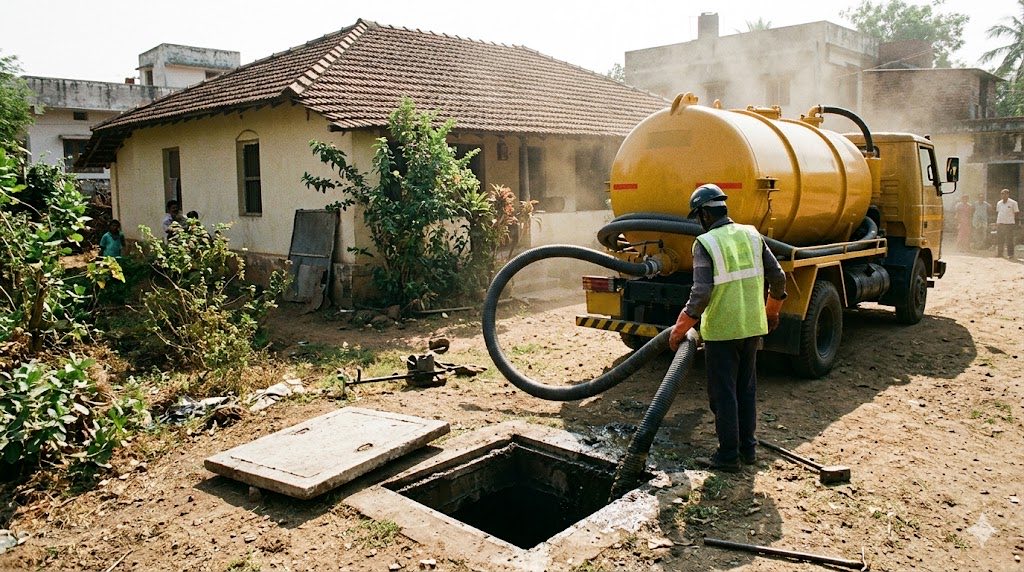
Desludging every 2 years for residential (1 year for commercial, 3 years for over-sized residential). A professional desludging service uses a vacuum truck to remove accumulated sludge; the process takes 1–2 hours per tank and costs ₹3,000–6,000 depending on tank size and location. Never delay desludging — sludge eventually fills the compartment and reduces detention volume, causing the system to fail rapidly.
Vent pipe inspection annually. Check that the vent pipe is not blocked by bird's nests, dried leaves, or debris. A blocked vent leads to pressure build-up and accelerated corrosion.
Soak pit periodic flushing. Some systems benefit from annual flushing of the soak pit feed line with clear water to displace any solid build-up. Consult your plumbing consultant.
Avoid harsh chemicals. Bleach, strong acids, and disinfectants kill the anaerobic bacteria that process sludge. Occasional use is acceptable; daily use (e.g., bleach-based toilet cleaners) seriously impairs septic performance. Enzymatic cleaners are preferred.
Never enter the tank. Septic tank interiors contain hydrogen sulphide concentrations that are immediately lethal. Every year, cleaning workers in India die from entering septic tanks without safety equipment — a practice that is explicitly prohibited under the Prohibition of Employment as Manual Scavengers Act 2013 but continues to occur (Ministry of Social Justice and Empowerment, 2023). Professional desludging requires vacuum equipment and, where confined-space entry is necessary, breathing apparatus and atmospheric monitoring.
10. Regional Notes
Septic design varies subtly by region within India:
Himalayan hill stations (Shimla, Mussoorie, Darjeeling, Gangtok). Low temperatures slow anaerobic digestion; over-size the tank by 20% and consider biodigester with cold-tolerant strains. Sloping sites complicate soak pit placement; stepped pits or dispersion trenches down-slope are usually required.
Rajasthan and arid zones. Low water use (60–80 L/person/day) permits smaller tanks. Sandy soils allow efficient soak pits but also deliver effluent to groundwater quickly; maintain 25 m minimum from wells. Evaporation-based disposal (evapotranspiration beds) performs well in low-humidity, high-evaporation conditions.
Kerala and coastal Karnataka. High water table (often within 1 m of surface in monsoon) makes soak pit infeasible in much of the state. Raised dispersion fields or DEWATS become mandatory. Laterite soils are highly variable; always conduct a percolation test.
Goa and Konkan coast. Proximity to coast creates elevated risk of seawater intrusion into groundwater; avoid any septic placement within 100 m of coast in sandy soils. CRZ regulations may impose additional setbacks.
North-East India. Seismic Zone V plus high water table plus saturated soils produces compounded risk: settlement damage to tank walls, effluent breakthrough in floods, and liquefaction-induced collapse. Reinforced concrete construction to IS 13920 detailing (even for small residential tanks) is strongly recommended; pile-supported tanks are sometimes used in Assam delta areas.
Western Ghats and laterite regions. Fissured laterite allows rapid bacterial travel; increase well separation to 30 m and verify with tracer studies where groundwater is primary drinking source. Kerala and Karnataka coastal areas are most affected.
11. The Economics of Good Design
The cost differential between a well-designed and a poorly-designed septic system is modest — roughly 15–20% of the sanitation budget, or typically 1–2% of total construction cost. The consequences of poor design, however, are expensive:
- Premature failure. Poorly-sized or poorly-detailed tanks fail within 5–10 years rather than the 30-year design life. Replacement in an occupied building is 3–5× the cost of correct initial construction.
- Groundwater contamination. Affects the client's own drinking water supply in most independent plots; the cost of switching to bottled water or treating groundwater adds ₹20,000–40,000 per year over the life of the building.
- Regulatory penalties. State PCB investigations and court-ordered remediation (occasional but increasingly common) can cost ₹1–5 lakh per incident.
- Property value impact. Documented septic problems reduce property resale value by 5–10% in Indian markets (based on property portal advertised price differentials from Murty 2019).
- Public health liability. Contamination affecting neighbours' wells can produce civil liability under the Water (Prevention and Control of Pollution) Act 1974 and tort claims.
The responsible architect treats septic design as a first-tier design concern, not an afterthought. Specification, supervision during construction, and handover documentation including desludging schedules are all part of competent practice.
12. References
- BORDA (2009) DEWATS — Decentralised Wastewater Treatment in Developing Countries. Bremen: Bremen Overseas Research and Development Association.
- Bureau of Indian Standards (1985a) IS 2470 (Part 1):1985 — Code of Practice for Design and Construction of Septic Tanks: Design Criteria and Construction of Septic Tanks for Small Installations. New Delhi: BIS.
- Bureau of Indian Standards (1985b) IS 2470 (Part 2):1985 — Code of Practice for Design and Construction of Septic Tanks: Secondary Treatment and Disposal of Septic Tank Effluent. New Delhi: BIS.
- Bureau of Indian Standards (2008) IS 15800:2008 — Decentralised Wastewater Treatment System (DEWATS) — Guidelines for Design, Construction, Operation and Maintenance. New Delhi: BIS.
- Bureau of Indian Standards (2016) National Building Code of India 2016 — Part 9: Plumbing Services, Section 2: Drainage and Sanitation. New Delhi: BIS.
- Buswell, A.M. (1939) The Anaerobic Fermentations. Urbana: University of Illinois Engineering Experiment Station.
- Central Ground Water Board (2021) Ground Water Year Book — India 2020–21. Faridabad: CGWB, Ministry of Jal Shakti.
- CPHEEO (2013) Manual on Sewerage and Sewage Treatment Systems. 3rd edn. New Delhi: Central Public Health and Environmental Engineering Organisation, Ministry of Urban Development.
- CPHEEO (2023) Status of Urban Sanitation in India. New Delhi: Central Public Health and Environmental Engineering Organisation, Ministry of Housing and Urban Affairs.
- Metcalf and Eddy, Inc., Tchobanoglous, G., Stensel, H.D., Tsuchihashi, R. and Burton, F.L. (2014) Wastewater Engineering: Treatment and Resource Recovery. 5th edn. New York: McGraw-Hill.
- Ministry of Social Justice and Empowerment (2023) Prohibition of Employment as Manual Scavengers and Their Rehabilitation Act 2013 — Compliance Report. New Delhi: Government of India.
- Murty, J.V.R. (2019) 'Decentralised sanitation in India — status and way forward', Journal of the Indian Water Works Association, 51(3), pp. 167–178.
- Prasad, K.V.S.G. and Shree, M.D. (2018) 'Groundwater contamination from septic tanks in peri-urban Bengaluru', Current Science, 115(11), pp. 2072–2080.
- Sundaresan, B.B. (2012) Wastewater Engineering for Small Communities. New Delhi: Oxford and IBH.
- Tilley, E., Ulrich, L., Lüthi, C., Reymond, P. and Zurbrügg, C. (2014) Compendium of Sanitation Systems and Technologies. 2nd edn. Dübendorf: Swiss Federal Institute of Aquatic Science and Technology (Eawag).
- WHO (2018) Guidelines on Sanitation and Health. Geneva: World Health Organization.
Author's Note: Septic tank design is one of those topics where the engineering is straightforward but the consequences of poor execution are serious. The IS 2470 formula and Table 1 dimensions have been stable since 1985 and represent the consensus of Indian sanitation engineering practice. However, the Studio Matrx Septic Tank Sizer implements the formula plus the soak pit sizing per IS 2470 Part 2; for sites with unusual soil, high water table, or special regulatory requirements, a site-specific review by a qualified plumbing consultant or sanitary engineer is recommended.
Disclaimer: This article is for informational and educational purposes only. It does not constitute plumbing, sanitary, or public health engineering advice. Septic systems design must comply with applicable state and local regulations and with the Indian Standards cited. For any specific project, consult a qualified plumbing consultant and the relevant Urban Local Body. Studio Matrx, its authors, and its contributors accept no liability for decisions made on the basis of the information contained in this guide.
Interactive · Septic tank sizer (IS 2470-1)
6 users · Tank 1.40 × 0.56 × 1.50 m
IS 2470-1 minimum is 24 h for residential.
Daily inflow
810 L
Sewage volume
810 L
Sludge volume
360 L
Total capacity
1.17 m³
Side section · 2.5:1 L:B ratio · single-chamber with baffle. Add a 2nd chamber for users > 20.
Export this guide
Related Guides — Deep-dive reading
Bathroom Plumbing Code India: NBC 2016 Part 9, UPC-I & the IS Standards That Govern Pipework
A professional reference to the codes and standards that govern bathroom plumbing in India — the National Building Code (NBC 2016) Part 9 on Plumbing Services, the Uniform Plumbing Code India (UPC-I), the CPHEEO Manual, and the IS standards for water supply, drainage, trap seals, pipe sizing, slopes and venting — with a caveat to always verify the current code and your local authority.
BathroomsSTP for IT Parks & Campuses: Central-Plant Design, Reuse & Redundancy Guide
How to plan a campus-scale sewage treatment plant for a multi-building IT park in India — the daytime flow pattern, the right technology, sizing for a central plant, and a reuse network feeding landscape, flushing and cooling towers.
Sewage Treatment PlantsSludge Generation Estimation in STPs: How Much Sludge Will Your Plant Produce?
Every STP that cleans water also makes sludge — and the biosolids you forget to plan for become the operating headache you cannot ignore. Here is how to estimate sludge generation, understand the yield concept, and size dewatering before you build.
Sewage Treatment PlantsRelated Tools — Try Free
Rainwater Tank Sizer
How big should your rainwater tank be? Computes annual harvest, recommended tank capacity in litres, water-bill savings, and payback — for 10 Indian cities.
RWH CalculatorProperty Tax Calculator — 10 Indian Cities
Estimate annual municipal property tax across BBMP / MCD / MCGM / GHMC / GCC / KMC / PMC / AMC / TMC / PCMC — with self-occupied, tenanted, and age-rebate adjustments.
Property TaxMonsoon-Readiness Checklist
Pre-rain home audit across 9 categories — terrace, drains, waterproofing, electrical, HVAC, pest, vehicles, documents.
Seasonal Audit