
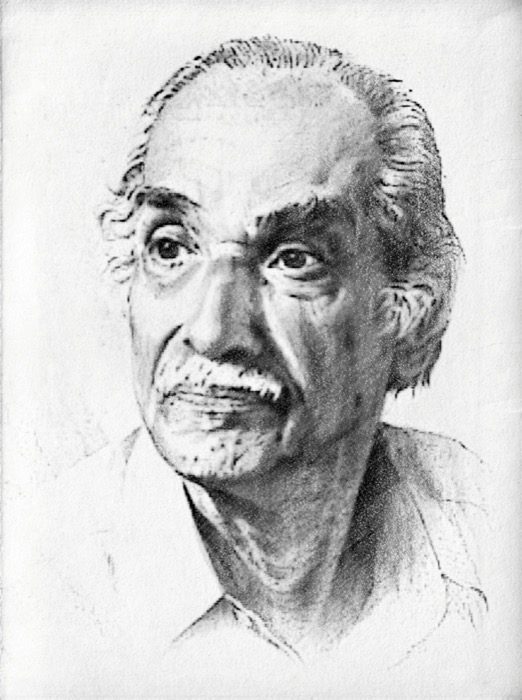
Achyut Kanvinde
He brought the Bauhaus home and built the institutions of a new India
Photo: Sarbjit Bahga, CC BY-SA 4.0, via Wikimedia Commons
Movements
Signature works
- ATIRA — Ahmedabad Textile Industry's Research Association (1954)
- IIT Kanpur campus and key buildings (1960s)
- National Dairy Development Board (NDDB) campus, Anand
- Dudhsagar Dairy, Mehsana
- Nehru Science Centre, Mumbai (late 1970s–1980s)
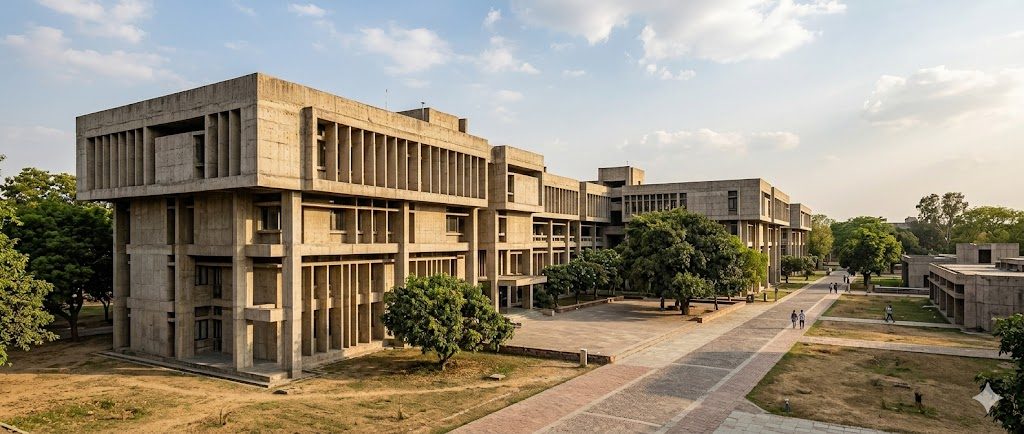
Walk into the campus of a national research institute built in India in the 1960s — a laboratory at IIT Kanpur, a research association in Ahmedabad — and you feel the weather change before you see a single room. The sun is held off by deep concrete fins. A covered walkway runs you from block to block in shade. The buildings are not pretty in any decorative sense: their walls carry the grain of the timber boards the wet concrete was poured against, raw and unpainted. And yet the whole thing breathes like a small town, planned so that scientists and students can move, meet and gather between the laboratories as easily as inside them. This was the architecture of a nation building itself, and one man drew an extraordinary share of it.
Achyut Purushottam Kanvinde — born in 1916, died in 2002 — was one of the founders of modern, post-Independence Indian architecture. He was the architect who carried the discipline of the Bauhaus home from Harvard and turned it, over half a century, into the laboratories, dairies, science centres and campuses of a young republic.
His central contribution was to give independent India a working modern architecture — functional, honest, built in raw concrete, and organised around the campus as a humane, walkable community. Where Le Corbusier gave India the spectacle of Chandigarh and Louis Kahn the monument of IIM Ahmedabad, Kanvinde quietly built the everyday institutional fabric of the new nation: the places where India would do its science, train its engineers, and process its milk. He did it with a Bauhaus mind and an Indian climate sense, and he did it as a builder of teams rather than a soloist.
The idea
Kanvinde's architecture begins with a conviction he brought back from Harvard and never abandoned: that a building should be the honest expression of what it is for. He had absorbed it at the source — from Walter Gropius, the founder of the Bauhaus — and it organised everything that followed. The plan came first, driven by use; the structure followed the plan; the form expressed the structure. There was no styling, no façade applied like a mask. What you saw was what the building was.
But Kanvinde was not content to import that idea unchanged. The Bauhaus had been forged in temperate Germany and refined in cool New England; he was building in the heat, glare and monsoon of India. So the second half of his idea was adaptation. Functionalism, for Kanvinde, had to include the function of keeping the Indian sun out and the air moving. Deep brise-soleil fins, shaded verandahs, oriented blocks and covered walkways were not ornament; they were the program made visible. The raw concrete that became his signature — board-marked, unpainted beton brut — was honest in the Bauhaus sense and practical in the Indian one: it weathered the climate, it suited the limited finishing trades of the period, and it carried mass and shadow well under a hard sun.
The third part of his idea was social, and it is the one most worth remembering. Kanvinde almost always worked at the scale of the campus, and he thought about campuses the way a town planner thinks about towns. A research institute or a college was not a collection of buildings but a community of people, and the architecture's job was to make that community work — to put a shaded street where colleagues would naturally meet, a court where students would gather, housing within a walk of the labs. He cared as much about the spaces between the buildings as the buildings themselves.

Life and path
Kanvinde was born in 1916 in Achra, a coastal village in the Konkan region of Maharashtra. He trained first at the Sir J.J. School of Art in Bombay, then the foremost school of art and architecture in the country, the same institution that schooled a remarkable generation of Indian modernists. His talent won him something rare for an Indian student in that era: a scholarship to study abroad, at the Harvard Graduate School of Design.
He arrived at Harvard in the mid-1940s, at a charged moment. Walter Gropius — who had founded the Bauhaus in Weimar Germany in 1919, then fled the Nazis — had been made chair of architecture at Harvard, and he had brought the Bauhaus method with him. To study under Gropius was to be inducted not just into a style but into a philosophy: that architecture was a rational, collaborative discipline serving society; that the designer should work as part of a team rather than as a lone artist; that good design could and should be brought to the masses. Kanvinde absorbed all of it — the functionalism, the social purpose, and above all the teamwork ethic that Gropius preached and practised.
Then, in 1947, the year India became independent, Kanvinde came home. The timing was everything. A new nation under Jawaharlal Nehru was committing itself to science, industry and education as the engines of progress, and it needed buildings to house that ambition. Kanvinde stepped directly into that work, serving as chief architect to the Council of Scientific and Industrial Research (CSIR), the government body charged with building India's national laboratories. From that position he designed a whole generation of research institutions across the country — an almost unimaginable commission for a young architect, and the foundation of his career.
He soon established his own practice. With partners it became Kanvinde & Rai, and later Kanvinde, Rai & Chowdhury — a firm structured, in true Gropius fashion, as a collaborative office rather than a vehicle for a single name. Over the following decades that practice produced the body of work for which he is remembered: research associations, technical institutes, dairies, science museums and housing, spread across India. His architecture evolved as he built it. The earliest works, such as the Ahmedabad Textile Industry's Research Association of 1954, are crisp, light, plainly Bauhaus-descended exercises in functional modernism. As the years passed, the forms grew heavier and more sculptural, the concrete rawer and more expressive, until by the 1960s and 70s Kanvinde had arrived at a powerful, distinctly Indian brutalism. He worked, taught and wrote until late in life, and died in New Delhi in 2002.
The signature works
Kanvinde's output is large and overwhelmingly institutional, which is exactly its significance: he built the working infrastructure of modern India. A handful of projects map the arc of his career, from early functionalism to mature brutalism, and from the single building to the whole campus.
| Work | Place & date | Why it matters |
|---|---|---|
| ATIRA — Ahmedabad Textile Industry's Research Association | Ahmedabad, 1954 | An early, crisp work of functional modernism; one of the first signs of a new institutional architecture for independent India. |
| IIT Kanpur — campus and key buildings | Kanpur, 1960s | His masterwork of campus planning: laboratories, lecture halls and a learning community organised as a shaded, walkable town. |
| Dudhsagar Dairy | Mehsana, Gujarat | Architecture for the cooperative dairy movement — robust, functional concrete buildings serving the engine of India's "white revolution". |
| National Dairy Development Board (NDDB) campus | Anand, Gujarat | A campus for the institution behind Operation Flood; programme, climate and community fused in raw concrete. |
| Nehru Science Centre | Mumbai, late 1970s–1980s | A muscular, board-marked brutalist science museum; mass, shadow and exhibition space shaped into civic form. |
| National Science Centre | New Delhi | A later science museum continuing his civic, didactic public architecture for a scientifically-minded nation. |
ATIRA, completed in 1954, is the clearest window into the young Kanvinde. The Ahmedabad Textile Industry's Research Association needed laboratories and offices for an industry modernising itself, and Kanvinde answered with a lucid functional building — clean lines, a rational plan, shading where the Gujarat sun demanded it. It belongs to the same heroic early-1950s moment in Ahmedabad that drew Le Corbusier and, soon after, Louis Kahn, and it announced that India could produce its own modern architects, trained at home and abroad, ready to build the new economy.
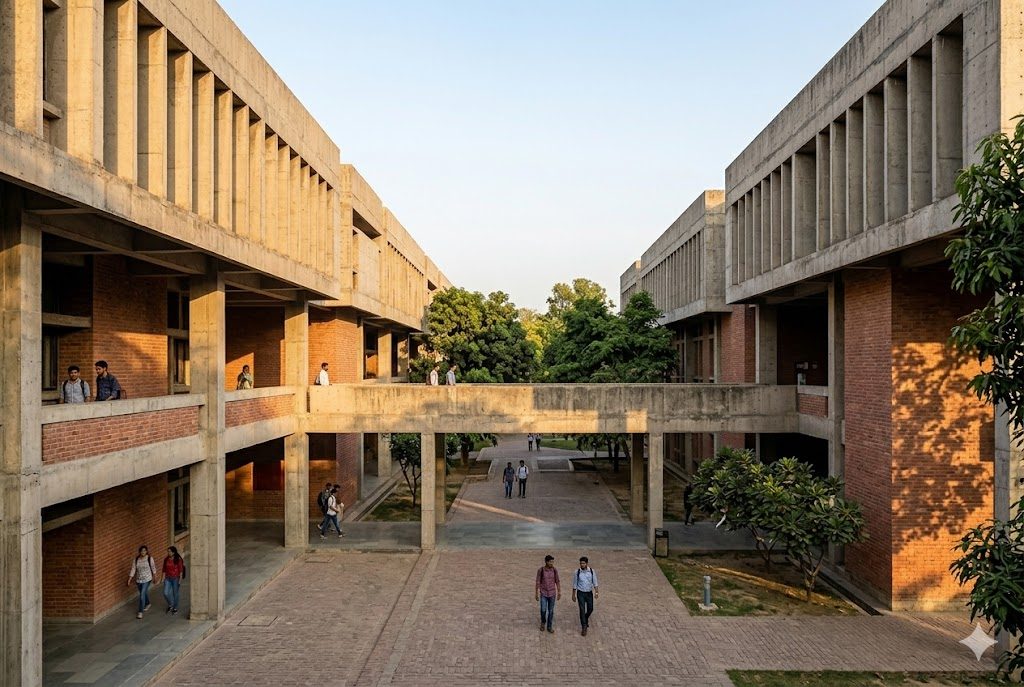
IIT Kanpur is the heart of his legacy and the fullest statement of his campus philosophy. As one of the new Indian Institutes of Technology — the elite engineering schools Nehru's government founded to power national development — it needed not just buildings but a complete academic environment. Across the 1960s Kanvinde planned and built it as a learning community: laboratory and academic blocks clustered around courts, knit together by long covered walkways that gave shade and made the campus walkable in any weather, with the social spaces — library, gathering courts, housing — woven through so that intellectual life could happen between the rooms as much as inside them. It is one of the defining campuses of independent India, and a textbook of how a research institution can be planned as a humane town.
The Gujarat dairy works show Kanvinde's reach beyond the obviously prestigious. The Dudhsagar Dairy at Mehsana and the National Dairy Development Board campus at Anand served the cooperative milk movement — Operation Flood, the programme that turned India into the world's largest milk producer. These were buildings for processing, research and administration, and Kanvinde gave them the same care he gave a technical institute: functional, climate-aware, robust concrete architecture for the unglamorous but nation-changing business of feeding a country. That he treated a dairy with the seriousness of a laboratory says everything about his Bauhaus conviction that good design should serve real, everyday needs.
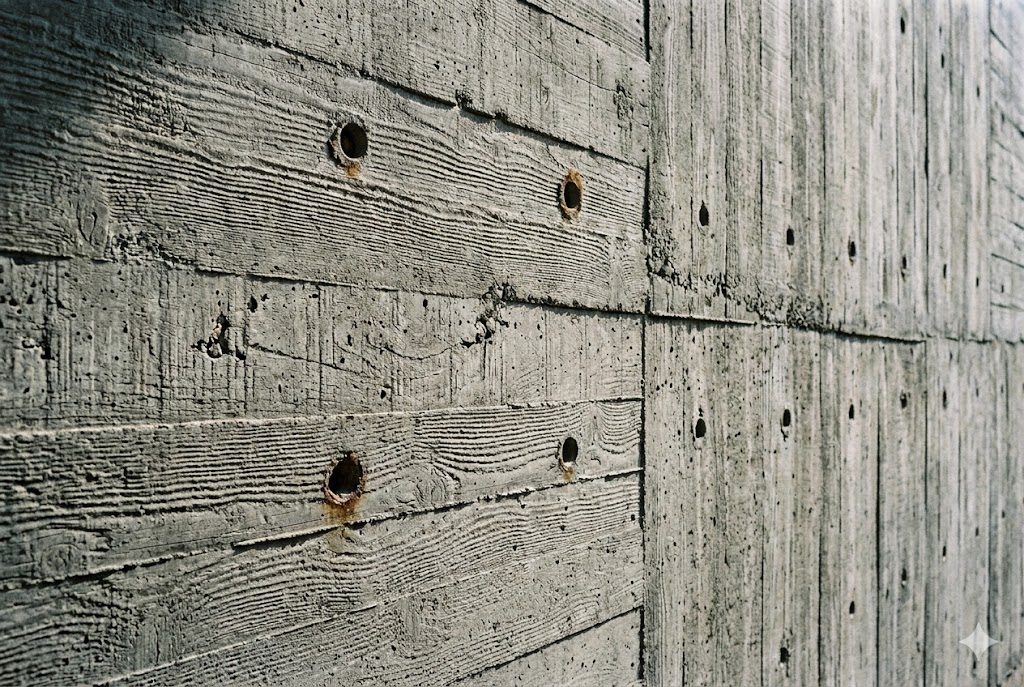
His later science museums — the Nehru Science Centre in Mumbai, built across the late 1970s and 1980s, and the National Science Centre in Delhi — are his mature brutalism at full civic scale. Here the concrete is at its most muscular and board-marked, the massing most sculptural, the buildings designed both to house exhibitions and to teach by their very presence that science was central to the national project. The texture below — the grain of the formwork timber pressed permanently into the concrete — is the closest thing Kanvinde had to ornament, and it is entirely honest: a record of how the wall was made.
The philosophy
Kanvinde sits at the centre of two of the great strands of twentieth-century architecture, and his career is the story of fusing them.
The first is Brutalism — the architecture of raw, board-marked concrete, honest structure and strong massing that defined so much serious building from the 1950s onward. Kanvinde's mature institutions are among India's most important brutalist works, standing alongside Le Corbusier's Chandigarh and Louis Kahn's IIM Ahmedabad in the country's great age of concrete modernism. But his brutalism was never about brute spectacle for its own sake; the rawness was a means — honest, durable, climate-suited — toward functional, social ends. To understand the language he worked in, see what is Brutalism.
The second is critical regionalism — the conviction that good modern architecture should resist both bland international sameness and nostalgic pastiche, instead rooting itself in the climate, light, materials and life of its place. Kanvinde embodied this before the term was widely used. He took the universal grammar of the Bauhaus and inflected it everywhere with the specifics of India: the brise-soleil against the glare, the shaded street against the heat, the orientation for the monsoon breeze, the campus organised around how Indians actually gather. His whole life's work is an argument that you can be fully modern and fully of your place. That lineage is traced in what is critical regionalism.
Underneath both lay the Gropius teamwork ethic — the belief that architecture is a collaborative service, not a personal monument. It is why Kanvinde built a partnership firm and not a cult of personality, and why he was content to give a nation its quiet, working buildings rather than chase iconic gestures.
He brought the Bauhaus home not as a style to copy but as a discipline to adapt — functional, collaborative and honest, bent patiently toward the Indian sun.
India
For Kanvinde, India is not a chapter of the story; it is the entire story. He is one of the small group of architects who, in the years immediately after 1947, had to invent what a modern Indian architecture would even be — and he did it not in a handful of showpieces but across a vast, sustained body of national infrastructure.
Consider what his position as chief architect to the CSIR actually meant. A newly independent country, betting its future on science and self-reliance, needed laboratories and research institutes across its territory, and it handed much of that responsibility to a young architect fresh from Harvard. The buildings Kanvinde and his firm produced from that mandate — research associations, the IITs, dairy institutions, science centres — are the physical form of the Nehruvian project. When India decided to industrialise, to educate engineers, to modernise agriculture, it was very often in a Kanvinde building that the work was done. Few architects anywhere have been so directly woven into the making of a nation.
His influence ran just as deep through ideas and education. By co-authoring "Campus Design in India", Kanvinde set down a way of thinking about the institutional campus — as a walkable, climate-responsive, socially-knit community — that shaped how generations of Indian planners and architects approached the brief. His insistence that climate be designed for rather than fought, that shade and orientation and the spaces between buildings mattered as much as the buildings, anticipated the climate-conscious turn that now defines serious Indian practice. Those threads run directly into today's questions, explored in guides on climate-responsive courtyard homes, passive design across India's climate zones, and what defines contemporary Indian architecture.
He belongs, finally, to a specific and luminous generation. He shared the era with Charles Correa and Balkrishna Doshi, the architects who, alongside him, taught Indian modernism to belong to India; and with the visiting masters Le Corbusier and Louis Kahn, whose Indian work formed the backdrop to his own. Among them, Kanvinde was the institution-builder — less celebrated than Correa, less garlanded than Doshi, but present in more of the everyday fabric of the nation than almost any of them.
Legacy and what we can learn
Kanvinde's influence is woven so deeply into India's institutional landscape that it is easy to overlook — which is itself a measure of how thoroughly he succeeded. Every Indian architect who treats a campus as a community, who designs concrete to weather the climate honestly, who works in a collaborative practice serving real institutional needs rather than chasing the iconic object, is working in a tradition he helped establish. His brutalism stands beside that of Le Corbusier and Louis Kahn; his climate sense connects him to Charles Correa and Balkrishna Doshi.
The practical lesson for today is bracingly relevant. Kanvinde reminds us that the most important architecture is often not the monument but the working building — the lab, the school, the dairy — and that such buildings deserve real design intelligence. He shows that climate response is not an add-on but the heart of functionalism in India: orient the block, shade the wall, cover the walk, and the building works before any machinery is switched on. And he models a humane scale of planning, where the spaces between buildings — the shaded street, the gathering court — are where community actually lives. For anyone designing in India today, those are not historical curiosities but live tools; the kind of sun-and-shade thinking you can begin to test with a sun-path analyzer.
His principles — function, honesty, collaboration, climate and community — live on in how we design today, and you can bring the same instincts to your own spaces with DesignAI.
References
- William J.R. Curtis, "Modern Architecture Since 1900" (Phaidon).
- Achyut Kanvinde and H.J. Miller, "Campus Design in India: Experience of a Developing Nation".
- Jon Lang, "A Concise History of Modern Architecture in India" (Permanent Black).
- Vikramaditya Prakash and others, "The Architecture of Modern India" — surveys of the post-Independence generation.
- Kanvinde, Rai & Chowdhury — practice records and project documentation.
- Council of Scientific and Industrial Research (CSIR) — institutional building histories.
- Architexturez / DOCOMOMO India — documentation of mid-century Indian modern and brutalist works.
Explore the philosophies Kanvinde championed — Brutalism and critical regionalism — and the architects beside him: Le Corbusier, Louis Kahn and Balkrishna Doshi.
Philosophies they championed