

Lawrence Halprin
The choreographer of human experience in the landscape
Movements
Signature works
- Ira Keller & Lovejoy Fountains, Portland
- Freeway Park, Seattle
- FDR Memorial, Washington
- Sea Ranch, California
- Ghirardelli Square, San Francisco
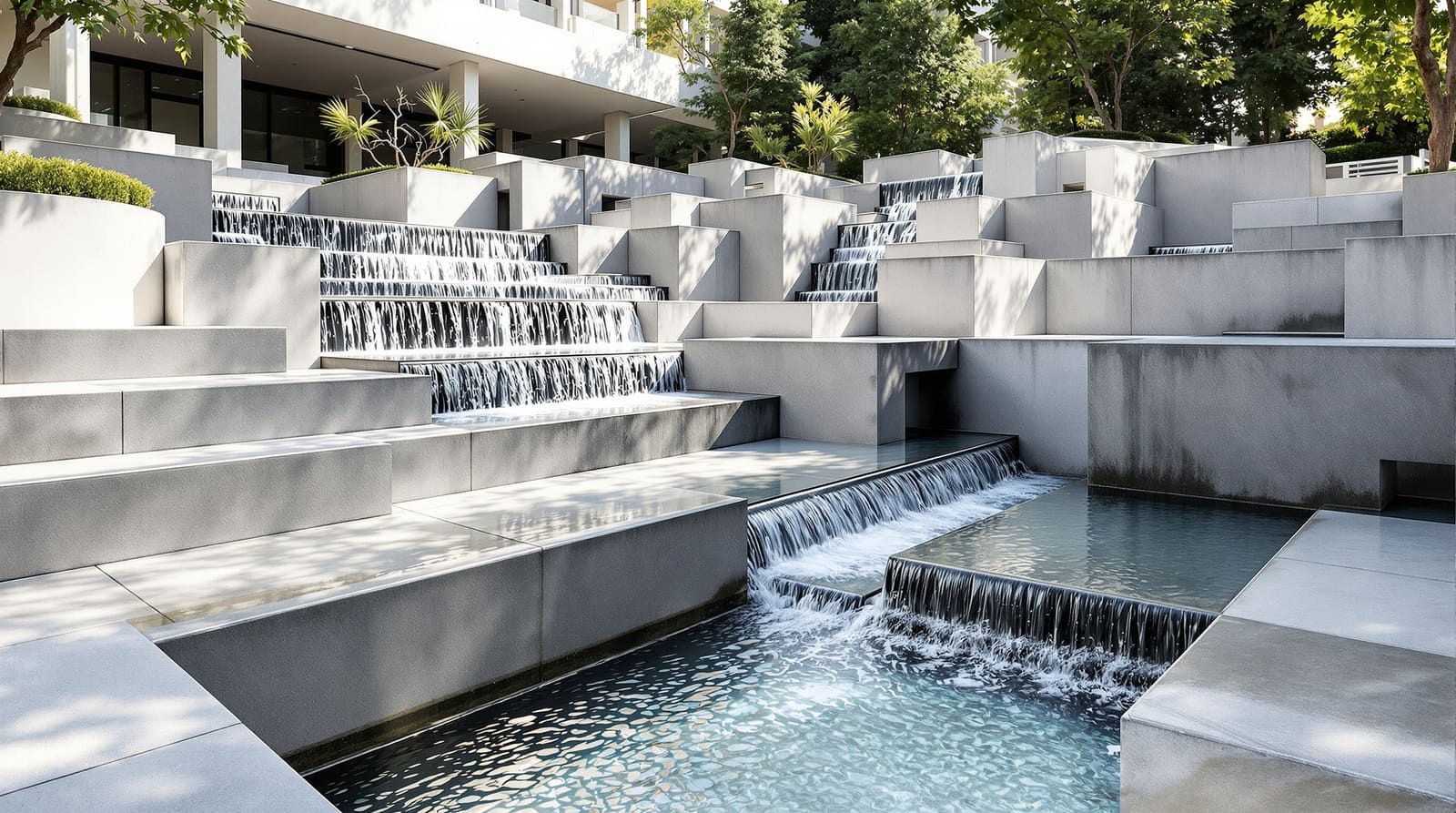
In the heart of downtown Portland, Oregon, a wall of water tumbles over blunt concrete ledges into a sunken pool, and on a warm afternoon you will find people in it — children leaping between the terraces, office workers with their shoes off and their feet in the cool, families perched on the dry ledges with their lunch. This is the Ira Keller Forecourt Fountain, an enormous abstract waterfall set down in the middle of a city, and it was never meant to be looked at from a polite distance. It was meant to be entered, climbed, splashed through and inhabited. It is not a picture of nature. It is a remembered High Sierra mountain stream, rebuilt in concrete and re-tuned for human bodies in a city.
The man who made it was Lawrence Halprin, the American landscape architect (1916–2009) who, more than almost anyone in the twentieth century, taught his profession to design for what people do rather than only for what they see. Born in New York, trained first as a plant scientist and then as a designer, he built a San Francisco practice that reshaped how cities think about plazas, parks, waterfronts and memorials — and how designers think about people moving through them.
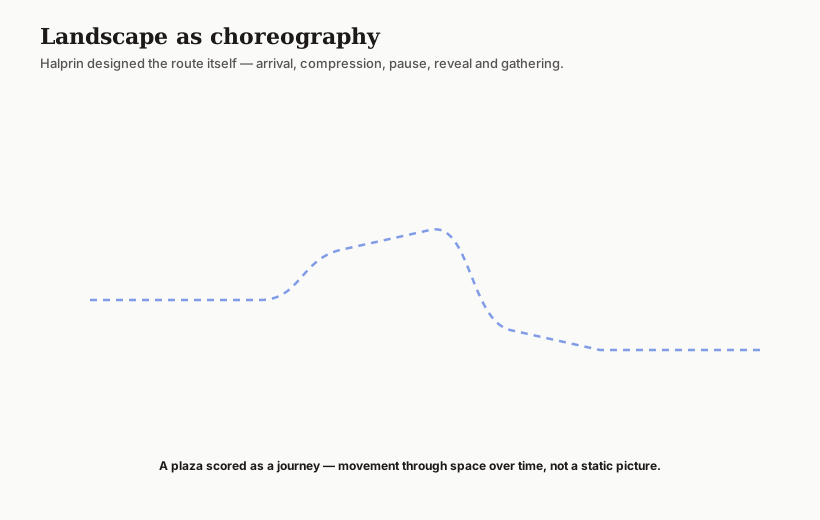
Halprin's central idea was simple and radical: landscape design is the choreography of human experience and movement through space over time — a sequence of arrivals, pauses, narrowings and reveals to be moved through and felt — not the making of a static, beautiful picture.
The idea: landscape as choreography
Most designers, before Halprin, drew the landscape as a composition — a plan or a perspective that looked good on paper. Halprin asked a different question: what happens to a person as they move through it? He thought in time, not just in space. A plaza was a journey: you arrive here, the path squeezes, you slow, you turn a corner, and suddenly the view opens onto water and a crowd. Every one of those moments could be designed, sequenced and tuned, the way a piece of music is tuned across its length.
That language of sequence and movement came in large part from his marriage to the avant-garde dancer and choreographer Anna Halprin. He watched her score movement — notating where bodies went, when they paused, how a group gathered and dispersed — and he borrowed the method wholesale. He began to make what he called "scores": notations of activity and movement in space and over time, a way of designing the experience itself rather than only its container. From this grew his "RSVP Cycles" — Resources, Scores, Valuaction, Performance — a creative process he set out in a book of the same name, and which he used to open design up to ordinary people through his "Take Part" community workshops.
The other deep source was his own body in the mountains. Halprin hiked the High Sierra for decades, sketchbook in hand, watching how water cuts a granite shelf, how a stream pools and then leaps, how a meadow gives onto a ridge. He abstracted those landforms and water-movements into concrete and brought them into the city — not as imitation rock, but as the felt structure of a natural place, rebuilt at urban scale.
Life and path
Lawrence Halprin was born in New York in 1916. He came to design by an unusual route, studying plant sciences at Cornell and then at the University of Wisconsin before turning to design at the Harvard Graduate School of Design — where he absorbed modernism directly from Walter Gropius, the founder of the Bauhaus, then teaching there. That double grounding mattered: he understood plants and living systems as a horticulturist, and form and abstraction as a modernist. He never lost either lens.
After the war he settled in San Francisco and built a practice there, and the city and its region became his laboratory. His marriage to Anna Halprin gave him the vocabulary of movement and scoring that would define his mature work. In the early 1960s he led the planning of Sea Ranch on the northern California coast — an ecological, landscape-led community in which the design was fitted to the wind, the meadows and the bluffs rather than imposed on them. Through the 1960s and 1970s came the sequence of Portland fountains and plazas, the adaptive reuse of Ghirardelli Square, and the audacious Freeway Park in Seattle. He kept working into old age, completing the Franklin Delano Roosevelt Memorial in Washington in 1997, and he wrote influential books and kept the notebooks and sketchbooks that documented a lifetime of looking. He died in 2009, having changed the terms on which landscape architecture is practised.
The signature works
| Work | Place & dates | Why it matters |
|---|---|---|
| Sea Ranch | Northern California, 1960s | Early icon of ecologically responsive, site-led planning — design fitted to wind, meadow and bluff |
| Ghirardelli Square | San Francisco, 1960s | Pioneering adaptive reuse — an old factory turned into a layered public plaza |
| Lovejoy & Ira Keller Fountains | Portland, 1960s–70s | Abstract concrete cascades evoking the High Sierra, made to be climbed and played in |
| Freeway Park | Seattle, 1976 | A park built as a lid over an urban freeway — a landmark idea in urban repair |
| FDR Memorial | Washington DC, 1997 | A sequential, room-by-room experiential memorial you walk through over time |
| Levi's Plaza | San Francisco | A corporate plaza shaped as a soft, water-threaded sequence of gathering places |
The Portland fountains remain his clearest statement. Lovejoy Fountain and the Ira Keller (Forecourt) Fountain are not ornaments at the edge of a square; they are the square. Their stepped concrete terraces abstract the way a Sierra stream falls down a granite slope, and they were detailed so that human feet, hands and bodies could safely occupy them. Halprin trusted people to play, to find their own paths across the water, to make the place theirs — a radical act of confidence in the public.
Freeway Park took the same humane instinct to a larger civic problem. Cities of the 1960s had been split open by freeways; whole neighbourhoods were cut in two by trenches of noise and traffic. Halprin's answer in Seattle was to build a park on a lid stretched over the freeway — to stitch the severed city back together with planting, concrete canyons and falling water that, not by accident, also masked the roar of the cars below. The freeway-lid is now a standard tool of urban repair worldwide; Halprin built one of the first.
The FDR Memorial distilled his whole philosophy into a single commission. Rather than a single monument to be viewed, he designed a sequence of four outdoor "rooms" — one for each term of Roosevelt's presidency — that a visitor walks through in order, moving from the optimism of the early years, through the hardship of the Depression and the gravity of the war, to a final quiet. Water runs differently in each room; the granite changes character; the experience unfolds in time as you move. It is a memorial scored like a piece of music, the dancer's lesson made permanent in stone.
The philosophy
Halprin's design language can be reduced to a few convictions that any designer, anywhere, can carry. People come first, and people move — so design the journey, not just the view. Water and landform should be abstracted from real nature, felt rather than copied. Gathering matters, so make places that invite crowds rather than repel them. And the people who will use a space should help shape it — design is a performance the community takes part in, not a finished object delivered to them.
These ideas map closely onto the fundamentals Studio Matrx teaches. Halprin's insistence on sequence and feeling is exactly what underlies the principles of landscape architecture and the question of why some gardens feel peaceful — peace is not a look, it is an experience composed over time. His mastery of moving water is the deep subject of water features in landscape design, and his site-led method speaks directly to residential site planning and the seven elements of landscape design.

A landscape, he believed, is not a scene to be admired but a score to be performed — the designer sets the path, the pauses and the reveals, and the people who walk through complete the work with their own movement.
India
Halprin never worked in India, yet his way of thinking belongs here perhaps more naturally than anywhere. India already designs its public spaces as choreographed sequences of movement, water and gathering — and has done so for a thousand years. A temple tank is not a static pool; it is the destination of a procession, approached down stepped ghats where bodies descend, pause, immerse and rise. A stepwell pulls you down through cool, narrowing storeys to the water and back up into the light — a vertical sequence of arrival, descent, reveal and return that Halprin himself would have recognised as a perfect score. The ghats of a riverfront are choreography in their purest form: thousands of people moving, pausing and gathering around water, every day.
This is the gift of reading Halprin from India. His experiential thinking does not import a foreign idea; it names and sharpens one already alive in our own tradition. For anyone designing an Indian plaza, a courtyard, a temple precinct or a residential water feature, the lesson is to design around how people actually move, pause and gather — to begin with residential site planning that follows the body's journey, and to aim, as Halprin always did, for a place that feels alive rather than merely looks correct — the difference at the heart of why some gardens feel peaceful. For wider context, read him alongside his great forebear in public landscape, Frederick Law Olmsted, and the contemporary urban-plaza provocateur Martha Schwartz.
Legacy and what we can learn
Halprin changed two things at once. He made experiential design — the choreography of movement and feeling — central to landscape architecture, and he made ecology and community participation part of its conscience. The freeway-lid he pioneered in Seattle has become a global tool for healing cities torn apart by infrastructure. Sea Ranch remains a touchstone for site-led, ecologically responsive planning, proof that buildings and landscape can settle into a place rather than conquer it. And his "Take Part" workshops helped legitimise the idea that the public should have a hand in shaping public space.
For an Indian reader, the practical takeaway is portable to any outdoor space, from a city plaza to a single home's courtyard: do not start with the plan-view or the planting palette. Start with the person. Trace how they will arrive, where they will slow, what will be hidden and then revealed, where they will want to sit and gather, and how water and shade will make the place feel. Design the sequence; the picture will look after itself. When you are ready to test such a sequence for your own outdoor space, DesignAI can help you see it before you build it.
References
- Lawrence Halprin, The RSVP Cycles: Creative Processes in the Human Environment (George Braziller, 1969).
- Lawrence Halprin, Cities (Reinhold, 1963; rev. MIT Press, 1972).
- Lawrence Halprin, Freeways (Reinhold, 1966).
- Lawrence Halprin and others, The Sea Ranch — documentation of the coastal community plan.
- Kenneth I. Helphand, writings on Halprin and the experiential landscape.
- The Cultural Landscape Foundation, Lawrence Halprin landscape resources and oral-history archive.
Explore the ideas Halprin championed — landscape as the choreography of human movement, water abstracted from nature, and places designed for how people gather — alongside fellow masters Frederick Law Olmsted and Martha Schwartz, and plan an experiential outdoor space of your own with DesignAI.
Philosophies they championed