
FSI in Mumbai — A 2026 Architect's Working Reference
DCPR 2034 base FSI by zone, plus Mumbai's distinctive Premium FSI, Fungible FSI, and TDR mechanisms — the most layered FSI framework in any Indian city, and the architectural-financial heart of every Mumbai redevelopment.
Governing framework: Development Control and Promotion Regulations 2034 (DCPR 2034)
Working reference tables
Print or screenshot these for the studio wall. Cross-check against the current authority notification before any specific filing.
Base FSI by zone (DCPR 2034)
DCPR 2034 baseline. Premium, Fungible, and TDR layers stack on top.
| Zone / Category | Base FSI |
|---|---|
| Residential — Island City (R-zones) | 1.33 |
| Residential — Suburbs | 1.00–2.00 (varies by zone) |
| Commercial | 5.00 |
| Mixed-use | 4.00 |
| Industrial | 1.50 |
| Slum land (SRA scheme) | 4.0+ (scheme-specific) |
| MHADA layouts (redevelopment) | 3.00–4.00 (project-specific) |
| Cluster Development Scheme (CDS) | 4.00 |
| TOD zones (within 500 m of metro stations) | Up to 4.00 with bonus |
DCPR 2034 baseline values. Verify against current amendments at filing — Mumbai's regulatory framework is the most-amended in India, with material changes in nearly every six-month period.
Premium FSI by abutting road width
Premium FSI is purchased from MCGM against premium fees, calibrated by road width and infrastructure capacity.
| Plot Frontage Road | Premium FSI Available | Effective Cap |
|---|---|---|
| < 9 m | 0.20 | ≈ 1.53 (1.33 + 0.20) |
| 9–12 m | 0.50 | ≈ 1.83 (1.33 + 0.50) |
| 12–18 m | 0.75 | ≈ 2.08 (1.33 + 0.75) |
| > 18 m | 1.00 + (negotiated) | ≈ 2.33+ |
Premium FSI rates are revised by State Government notification periodically. The architect's pre-design feasibility quantifies premium FSI cost as ₹/sqft of additional FSI consumed.
Fungible FSI — what counts as compensatory area
Fungible FSI (≈35% of consumed FSI) is consumed for these specific functions and is OUTSIDE the FSI count.
| Function | Indicative share of fungible | Notes |
|---|---|---|
| Balconies (residential) | ≈ 40% | Per unit; carpet-area driver |
| Service ducts and shafts | ≈ 25% | Dedicated, continuous |
| Refuge areas (high-rise) | ≈ 15% | One refuge floor per fire-NOC |
| Common-area lobby / circulation | ≈ 15% | Includes mezzanines in lobbies |
| Mezzanines / other | ≈ 5% | Architect-allocated per design |
Optimal fungible FSI consumption is the central design strategy for Mumbai residential. Excess consumption spills into countable FSI; unused fungible is wasted.
Special schemes — outside the standard stack
Three special-scheme frameworks operate with their own FSI rules; the standard DCPR 2034 stack does not apply.
| Scheme | FSI | Authority |
|---|---|---|
| SRA — Slum Rehabilitation Scheme | 4.0+ (typically 4.0–6.0) | Slum Rehabilitation Authority |
| MHADA — redevelopment of MHADA layouts | 3.0–4.0 (project-specific) | Maharashtra Housing and Area Development Authority |
| CDS — Cluster Development Scheme | 4.0 | MCGM (cluster-level) |
| TOD — Transit-Oriented Development | Up to 4.0 (within 500 m of metro) | MCGM with State approval |
| CRZ-II redevelopment | No FSI increase over existing | MCZMA |
Mis-routing a project — claiming SRA FSI on a non-slum plot, or applying DCPR base FSI within a CRZ-II zone — is among the costliest planning errors in Mumbai practice.
The working reference, in full
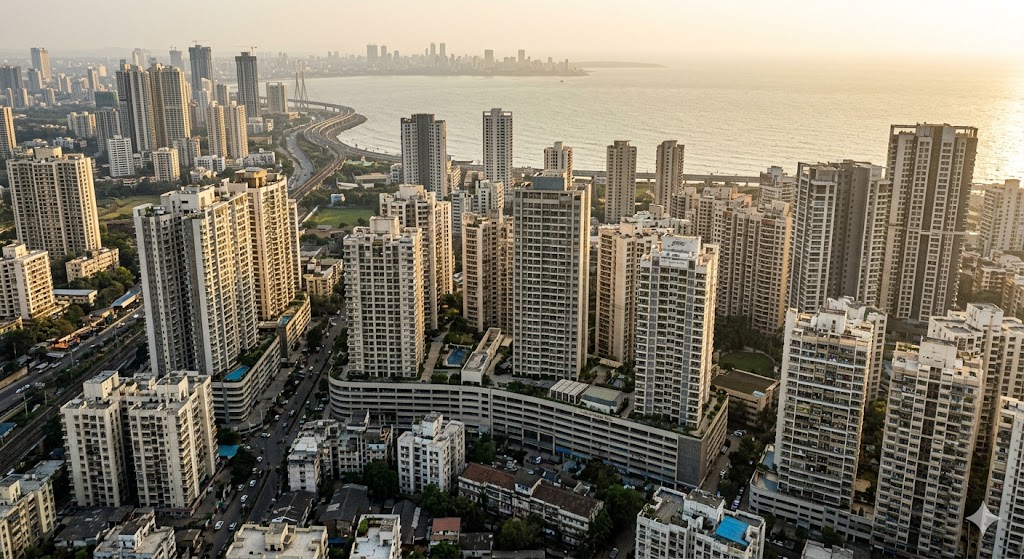
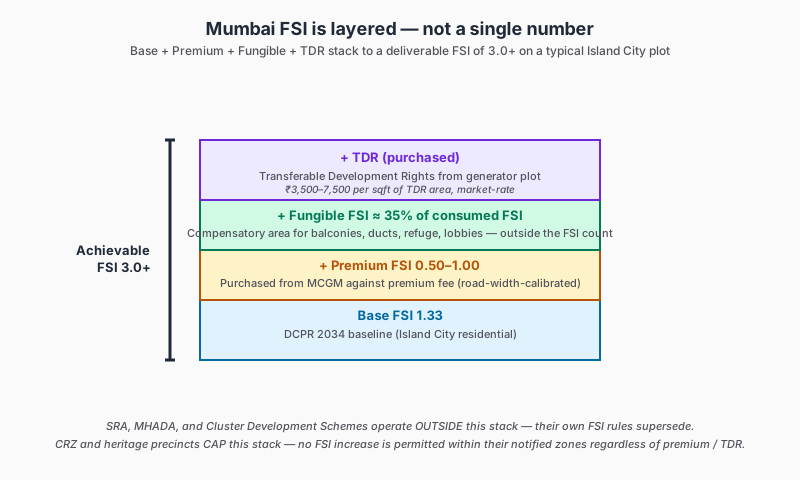
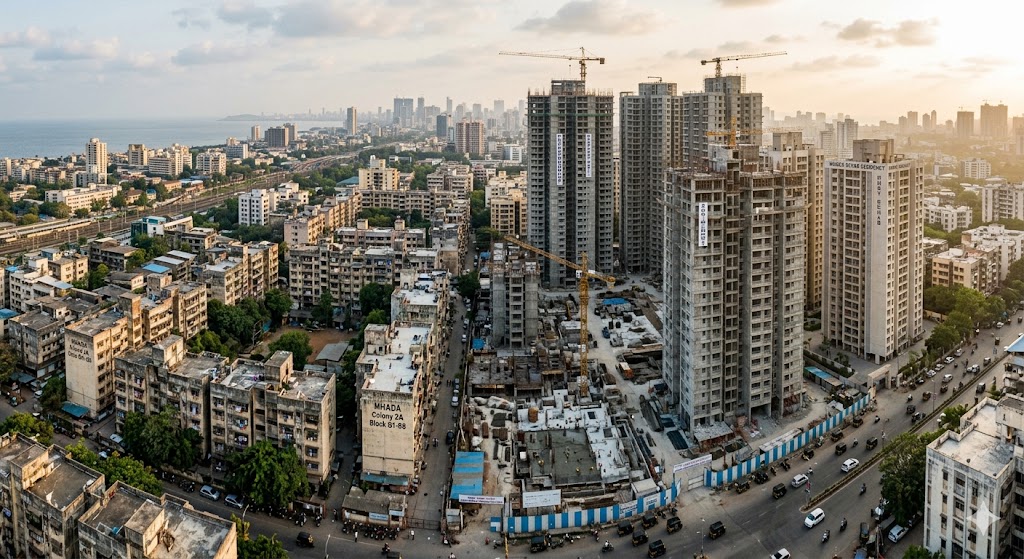
Mumbai operates the most layered FSI (Floor Space Index) framework of any Indian city. DCPR 2034 prescribes a base FSI per zone — 1.33 for Island City residential, 1.00–2.00 for suburbs, 5.00 for commercial — then layers Premium FSI (purchased from MCGM), Fungible FSI (a 35% compensatory area allowance), and TDR (Transferable Development Rights from elsewhere). For a typical Island City residential plot, the base 1.33 stacks to a deliverable FSI of 3.0+ once Premium and Fungible FSI and TDR are layered. This stacking is the architectural-financial heart of every Mumbai project; missing a layer is leaving money on the table.
Premium FSI — buying additional bulk
DCPR 2034 permits Premium FSI over the baseline against payment of a premium to MCGM, calibrated by abutting road width. Plots on roads less than 9 m wide get limited premium (0.20); 9–12 m roads get 0.50; 12–18 m get 0.75; over 18 m get 1.00+ with negotiated upper bounds. Premium FSI rates are revised periodically by State Government notification — the architect's pre-design feasibility quantifies the premium FSI cost as ₹/sqft of additional FSI consumed, and balances it against the developer's expected sale-side revenue. For high-rise residential in Bandra, Worli, and Lower Parel, premium FSI typically adds ₹2,000–4,000 per sqft of additional saleable area.
Fungible FSI — Mumbai's distinctive 35% allowance
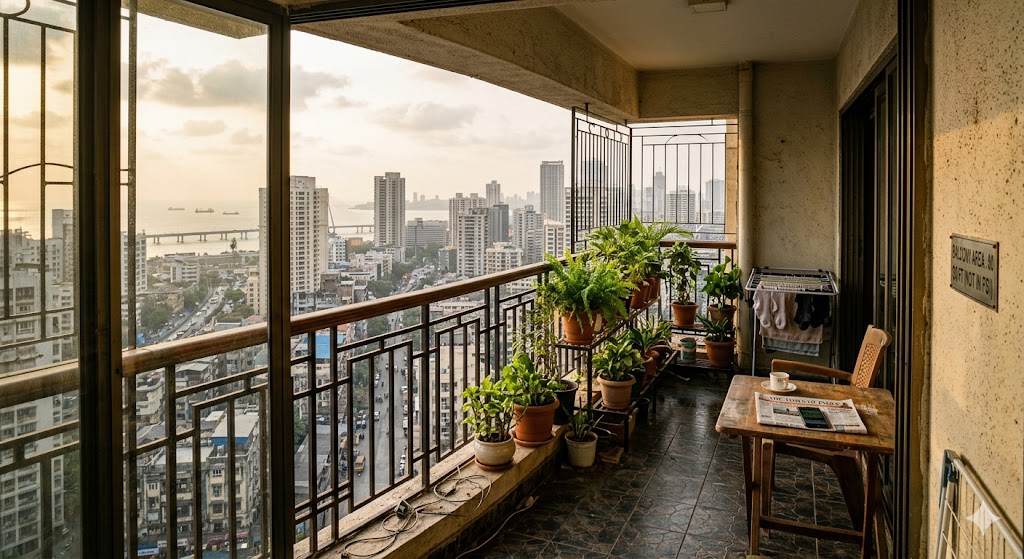
The most distinctive DCPR 2034 feature is Fungible FSI — a compensatory area allowance of typically 35% of consumed FSI that the developer may consume outside the conventional FSI count. Fungible FSI is consumed for balconies, service ducts, common-area circulation, refuge-area allocation, and lobby mezzanines. It allows a project to deliver carpet area to the buyer roughly equivalent to (built-up area minus FSI consumption) — a major economic improvement over the older DCR 1991 framework. Optimal Fungible consumption is the central design strategy for Mumbai residential — too much in balconies and the carpet under-delivers, too little and the layout feels cramped.
TDR — the Mumbai market mechanism
Mumbai operates the largest TDR (Transferable Development Rights) market in India. TDR is FSI generated on one plot — the generator, typically slum-cleared land or land surrendered for road widening — that may be transferred to another plot, the receiver. The receiver consumes TDR over and above baseline + Premium FSI, subject to ceiling caps. Market rates run ₹3,500–7,500 per sqft of TDR area, varying by source category and receiver-zone eligibility. For mid-to-high-rise residential, TDR purchase is a routine design strategy — the architect must confirm receiver-plot TDR eligibility (zone, road width, infrastructure capacity) before committing the purchase. TDR is non-refundable once paid; eligibility errors are uncorrectable post-transaction.
SRA, MHADA, CDS — different FSI rules entirely
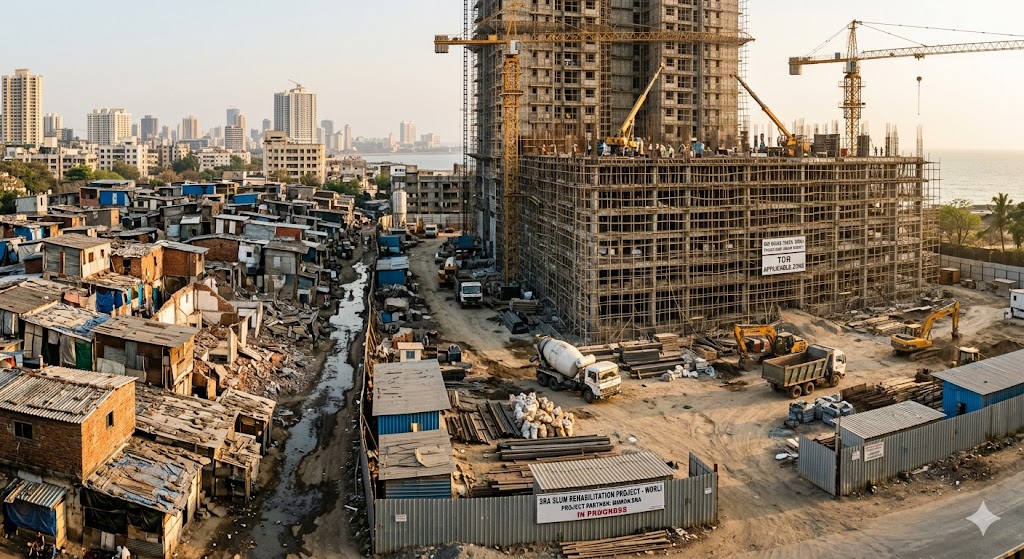
Three special schemes operate outside the standard DCPR 2034 FSI framework. SRA (Slum Rehabilitation Authority) projects typically run FSI 4.0+ in exchange for free housing delivery to slum-tenants — one of the most lucrative redevelopment pathways in Mumbai. MHADA (Maharashtra Housing and Area Development Authority) layouts permit FSI 3.0–4.0 against tenant rehabilitation. Cluster Development Scheme (CDS) plots permit FSI 4.0 against cluster-level amalgamation and infrastructure contribution. The architect's project type — fresh sanction vs. redevelopment vs. SRA vs. CDS — determines which FSI framework applies; mis-routing a project into the wrong scheme is among the costliest planning errors in Mumbai practice.
Heritage and CRZ — the FSI ceiling
Mumbai's 16 notified heritage precincts impose FSI caps below the baseline — typically capping redevelopment to the existing built FSI plus a marginal supplement. CRZ-II zones permit redevelopment within existing footprint with no FSI increase regardless of premium or TDR availability. CRZ-IA zones prohibit new construction. The architect's pre-design verification must confirm the absence (or quantum) of heritage / CRZ FSI restrictions before committing the FSI strategy — a project committing to premium FSI purchase that turns out to be CRZ-II-capped wastes the premium fee and the design effort.
Common pitfalls
- Treating Premium FSI and Fungible FSI as additive without checking the road-width-based premium ceiling — they stack but the ceilings differ.
- Buying TDR before confirming receiver-plot eligibility — TDR may not be consumed in eco-sensitive zones, heritage precincts, or below minimum road width, and is non-refundable.
- Mis-routing a redevelopment project as a fresh sanction — redevelopment of MHADA/SRA layouts has different FSI rules than fresh DCPR 2034 sanction.
- Forgetting that CRZ-II permits redevelopment only within existing footprint and FSI — no FSI increase, regardless of premium or TDR availability.
- Over-consuming Fungible FSI on balconies — excess balcony area spills into countable FSI; the 35% cap is on the total fungible allowance.
- Applying DCPR 2034 base FSI in Thane or Navi Mumbai — Thane DCR and CIDCO Building Bylaws have different FSI rules.
Frequently asked questions
›What is base FSI in Mumbai's Island City?
›What is the difference between Premium FSI and TDR?
›How much Fungible FSI is allowed?
›Does SRA scheme FSI follow DCPR 2034?
›Can TDR be consumed anywhere in Mumbai?
›What is TOD FSI bonus?
Sources & references
Maharashtra Regional and Town Planning Act, 1966
MRTP Act, 1966 — statutory authority for DCPR 2034 dimensional rules
Development Control and Promotion Regulations 2034 (DCPR 2034)
MCGM, DCPR 2034 — Regulation 30 (FSI), 31 (Fungible Compensatory Area), 33 (Premium FSI), 41 (TDR), 33(7)(B) (CDS), 33(10) (SRA)
Slum Areas (Improvement, Clearance and Redevelopment) Act, 1971
Maharashtra Slum Act 1971 — SRA scheme FSI framework; redevelopment-against-rehabilitation
MHADA Act 1976 + redevelopment guidelines
Maharashtra Housing and Area Development Act 1976; MHADA layout redevelopment FSI rules
Coastal Regulation Zone Notification 2019
MoEFCC CRZ Notification 2019 — CRZ-II FSI restrictions on redevelopment
MCGM Premium FSI and TDR Notifications
Premium-FSI rate notifications and TDR market regulations, revised periodically by Urban Development Department, Maharashtra
AGNI / DPMS Online Sanction Portal
MCGM AGNI portal — FSI auto-validation under DCPR 2034 rule-based engine
Disclaimer: Regulatory rates and dimensional rules change frequently and may be modified by mid-year notifications. Values reflect the framework as of 2026-05-10; verify against the current authority notification before any specific filing. This page is informational and is not legal or planning advice — engage a registered architect and a qualified planning consultant for project-specific compliance.
Related guides from the library
The companion deep-dives that practising architects keep alongside this reference.
Building Setbacks Across India
A State-by-State Guide to Development Control Regulations, Plot Setbacks, Ground Coverage, and FAR — for Architects, Planners, and Developers
42 min read · Open ConstructionBuilding Plan Approval Process in India
State-Wise Guide — BBMP, BMC, CMDA, GHMC, MCD, PMC & 14 More Cities
30 min read · Open ConstructionArchitect Fee Structures in India
Slab, Lump-Sum, Hourly, and Hybrid — A Working Reference for Indian Practice
21 min read · Open Design StylesDefining Luxury in Residential Architecture
Quality, Materiality, Craftsmanship, and Restraint — Beyond the Cost-Per-Square-Foot Fallacy
21 min read · OpenCompare across cities
The same FAR / FSI topic, different regulatory frameworks, different city quirks. Architects practising across metros should bookmark the adjacent reference.
FAR / FSI in Bengaluru
BBMP Building Bye-laws 2003 + Revised Master Plan 2031 (RMP 2031)
Open DDA · Delhi (NCT)FAR / FSI in Delhi
Master Plan for Delhi 2021 (MPD 2021) + Unified Building Bye-laws 2016
Open CMDA · Tamil NaduFAR / FSI in Chennai
Tamil Nadu Combined Development & Building Rules 2019 (TNCDBR 2019)
Open HMDA · TelanganaFAR / FSI in Hyderabad
Telangana Building Rules 2012 + GO Ms No. 168
OpenFSI / FAR Computation in India
A State-by-State Working Reference for Indian Architects
Read the deep-dive Mumbai compliance mapThe Architect's Compliance Map — Mumbai
MCGM, MMRDA, SRA, MahaRERA, MPCB, CRZ — DCPR 2034, Premium and Fungible FSI, TDR, Heritage Overlays, and the Operational Workflow for Residential Practice in 2026
Read the city map