
Low Flow Shower Head India: Aerating vs Laminar vs Pulse, Feel & Payback
How a water-saving low-flow shower head cuts flow from 12-15 down to 6-8 litres per minute while keeping a full, warm feel through air infusion — aerating vs laminar vs pulse types, the geyser-energy saving, the gravity-fed pressure caveat, retrofit vs new, IGBC and GRIHA credits, and the real payback.
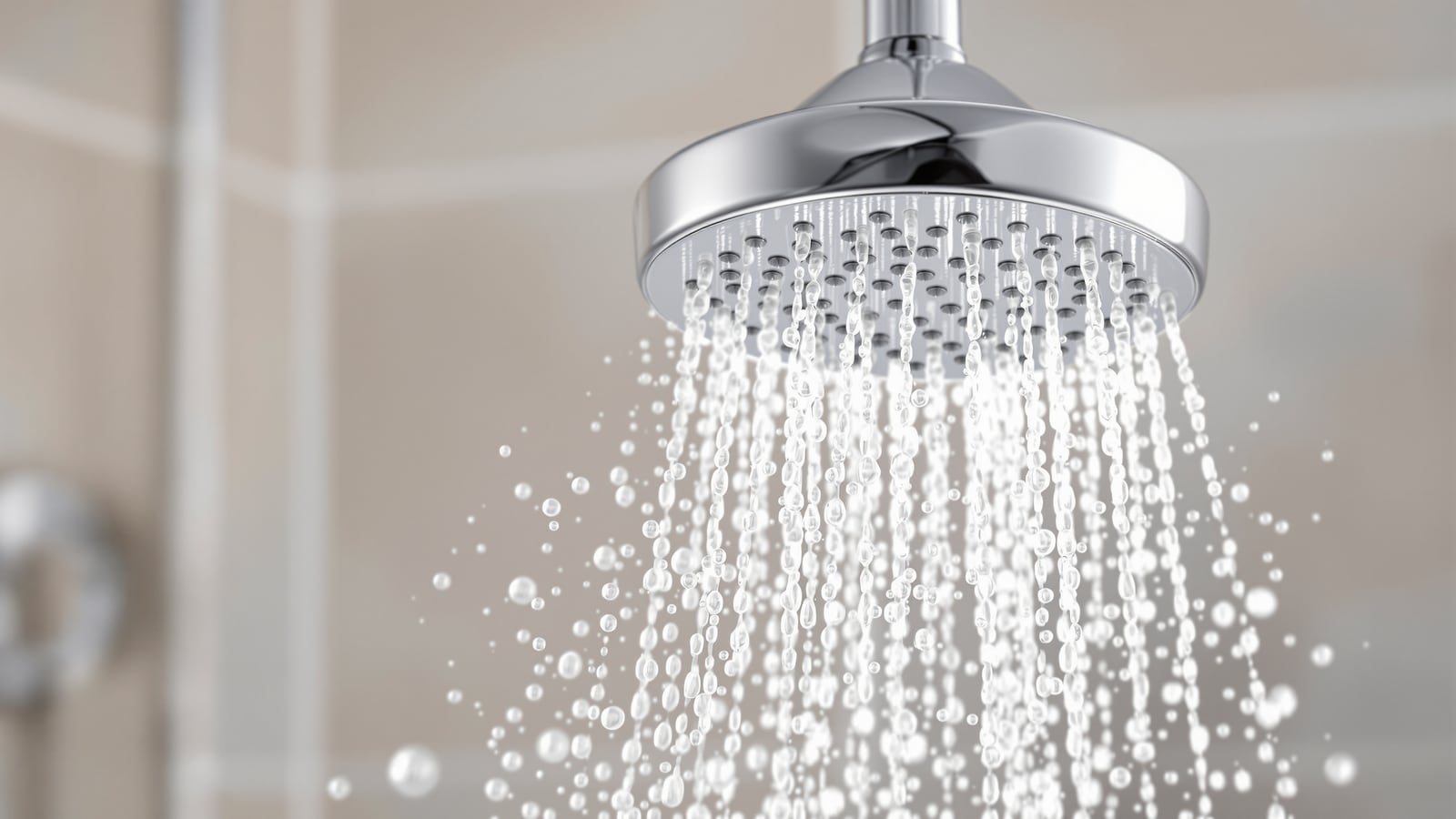
A conventional shower head in an Indian home pours out 12 to 15 litres every minute, and a long rain-can head can push past 20. Stand under it for eight minutes and you have used more water than a person is meant to drink in two months — and in the cool season much of it was heated in a geyser you are paying to run. A low flow shower head solves both problems at once. By restricting the opening and mixing air into the water, it delivers a full, warm, satisfying spray at just 6 to 8 litres a minute, so you barely notice the difference on your skin but the water meter and the electricity bill certainly do.
This is the low-flow shower head guide of the Studio Matrx bathroom hub. Read it alongside the eco-friendly bathroom guide for how the shower fits into a whole-house water strategy, and the complete shower systems guide for India for valves, rails and diverters. Its two closest siblings are the water-saving faucet guide and the dual-flush toilet guide — together those three fittings are the cheapest way to halve a bathroom's water demand.
A good low-flow shower head is the highest-return upgrade in any Indian bathroom after the tap aerator: a ₹600-2,500 part that roughly halves both the water and the hot-water bill of every shower, with no felt loss of comfort.
How a low-flow shower head keeps the feel
The trick is not simply choking the flow — a bare restrictor makes a shower feel weak and cold. A well-designed water-saving head does two things together. It restricts the water through a smaller, calibrated set of orifices, and it infuses air into each jet so the droplets arrive fatter, softer and more numerous. Your skin reads coverage and warmth, not litres, so an aerated 7 LPM spray feels close to a wasteful 14 LPM open head. The air is doing the work your restraint would otherwise have to.
The numbers below show why the fitting, not willpower, does the heavy lifting.
| Shower head | Typical flow (LPM) | Feel | Water in an 8-min shower |
|---|---|---|---|
| Old fixed head / rain-can, no restrictor | 12-20 | Drenching, wasteful | ~100-160 litres |
| Standard head as sold | 9-12 | Strong | ~72-96 litres |
| Water-saving aerating head | 6-8 | Full, warm, aerated | ~48-64 litres |
| High-efficiency eco head | 4-6 | Softer, adequate | ~32-48 litres |
| Ultra low-flow / spray | 3-5 | Fine mist, needs good pressure | ~24-40 litres |
For a main bathroom used daily, a 6-8 LPM aerating head is the sweet spot in India: it feels generous, works on most pumped and overhead-tank supplies, and roughly halves consumption. Drop to 4-6 LPM only where pressure is reliably strong or the shower is lightly used, such as a guest bathroom.
Aerating, laminar and pulse: the three stream types
Matching the stream type to your water supply and climate matters more than chasing the lowest headline flow.
- Aerating (air-infused) head. Draws room air into each jet so the spray is soft, fat and splash-free — the classic bubbly feel. Best all-rounder and the most forgiving at low flow. The one caveat for India: because it mixes in cooler room air, the spray can feel a degree or two cooler by the time it lands, so people occasionally nudge the geyser up. In warm Indian bathrooms this is rarely a problem, but in a cold-climate hill town a laminar head may feel warmer.
- Laminar (non-aerated) head. Emits many individual, crystal-clear, non-bubbled jets. It does not mix in air, so it stays warmer and splashes less — good for cold-weather regions and for anyone who dislikes the "fizzy" aerated feel. It needs slightly more flow than an aerating head for the same sense of coverage, and it holds up better on lower pressure.
- Pulse / massage head. Uses a spinning turbine to break the flow into a rhythmic, pulsing pattern that feels like a stronger, deeper spray at a low actual flow rate. Excellent for making 6-8 LPM feel powerful, and popular in hand-showers. It concentrates water into fewer jets, so it can feel "harder" and is less relaxing than a broad aerated rose.
For a normal Indian home, choose an aerating head first. Pick laminar for cold climates or if you want maximum warmth retention, and a pulse head where you want a low-flow spray to still feel powerful.
The pressure caveat on gravity-fed supply
This is the single most important thing to get right in India. Many homes run their showers off an overhead tank by gravity alone, with no pump. A tank one storey above the shower gives only about 0.3 bar of pressure, and some low-flow heads — especially aerating ones — are designed for 1-3 bar mains and will dribble weakly on that little head of water.
- On gravity-fed / overhead-tank supply with no pump: choose a head rated to work at low pressure (often labelled "0.3 bar" or "gravity" or "low pressure"). Larger orifices, a laminar or open pattern, and 8 LPM rather than 5 LPM all help. Avoid tight aerating heads that assume mains pressure.
- On a pressure pump / booster or municipal mains at 1.5-3 bar: almost any low-flow head works, and pressure-limited aerating types shine — they hold a steady spray and you get the full saving.
- The quick test: the vertical distance from the bottom of your overhead tank to the shower rose. Under about 3-4 metres of drop, treat it as low-pressure and specify accordingly, or add a small booster pump.
| Supply type | Approx pressure | Best head choice | Watch for |
|---|---|---|---|
| Overhead tank, gravity, no pump | ~0.2-0.5 bar | Low-pressure / laminar, 7-8 LPM | Tight aerators dribble |
| Overhead tank + booster pump | ~1-2 bar | Aerating or pulse, 6-7 LPM | Set pump for steady flow |
| Municipal mains / hydro-pneumatic | ~1.5-3 bar | Any low-flow, aerating ideal | Pressure-compensating best |
Retrofit vs new: what to buy
You rarely need to replace the whole shower to save water — the head or its restrictor is usually all that changes.
- Swap the whole head. Nearly all Indian shower arms use a standard ½-inch (15 mm) BSP thread, so a water-saving head unscrews and screws on in minutes with plumber's tape. A good aerating or pulse head costs ₹600-2,500; premium overhead rain-cans with efficient cores run ₹3,000-8,000.
- Add or change a flow restrictor. Many existing heads have a small removable washer-style restrictor at the inlet. A calibrated 6 or 8 LPM restrictor disc costs ₹80-300 and caps the flow of the head you already own — the cheapest possible fix.
- Retrofit a hand-shower. A low-flow hand-shower with a pulse or eco spray is ₹500-2,000 and doubles as a controllable, low-flow rinse.
- Only buy a new mixer if the valve itself is failing; the head does 90% of the saving for a fraction of the cost.
Because a restrictor or head swap is cheap and reversible, do it to every shower in the house on a single afternoon. For a full new bathroom, specify low-flow heads in the fixture schedule from the outset — see bathroom planning for new homes and bathroom renovation.
The payback: water and geyser energy
The saving is not only water. In the cooler months a large share of every shower is hot water off a geyser, so every litre you do not spray is also energy you do not spend heating. That hidden second dividend is what makes a low-flow head pay for itself so fast.
A rough four-person household calculation, assuming each person showers once a day:
- Cutting a shower from ~14 LPM to ~7 LPM over an 8-minute shower saves about 56 litres per shower.
- Across four people daily, that is roughly 80,000-90,000 litres a year off one bathroom — a serious dent in a metered or tanker-fed bill.
- The heated share of that water represents on the order of 300-600 units of electricity saved annually on the geyser, depending on season, geyser efficiency and how much hot water each shower used.
- Payback on a ₹1,200 aerating head is measured in weeks to a couple of months — among the best-returning fittings in the whole home.
Green ratings: IGBC and GRIHA credit
Low-flow showers are not just a bill saving — they earn points under India's green-building systems. IGBC (Green Homes and Green New Buildings) awards water-efficiency credits for shower heads that beat a baseline flow, typically rewarding heads at or below roughly 6-8 LPM measured at a stated test pressure. GRIHA (Green Rating for Integrated Habitat Assessment) similarly scores reduced water demand. Under the water-conservation intent of NBC 2016, low-flow fittings are the simplest compliance lever. If you are chasing a rating, put the certified LPM at the test pressure (usually 3 bar) into the fixture schedule and keep the datasheets — that certified figure is what auditors want to see, not the marketing number.
Living with a low-flow head: hard water and upkeep
India's hard water is the low-flow head's main enemy. Calcium scale builds on the fine spray face and the air ports, choking the flow and splitting the jets until the spray sputters.
- Descale every 1-3 months. Unscrew the head (or just the face), soak it overnight in warm white vinegar or a mild descaler, brush the nozzles, rinse and refit. Modern heads use flexible rubber nozzles you can rub clean with a thumb.
- Prefer heads with silicone/rubber spray tips in hard-water areas — scale wipes off them easily, unlike drilled metal faces.
- Do not remove the restrictor to "fix" weak flow. That undoes the entire saving. Descale first, and only then check whether your supply pressure is genuinely too low.
- Match the thread when buying — ½-inch BSP is near-universal on Indian shower arms; take the old head or a photo to the shop.
- Whole-house softening protects the head, the geyser and the taps together where scale is severe.
Do and don't
| Do | Don't |
|---|---|
| Match the head to your supply pressure | Fit a tight aerator on a gravity-only tank |
| Retrofit a restrictor or head to every shower | Assume you must replace the whole mixer |
| Choose aerating for warm climates, laminar for cold | Ignore that aerated spray can feel a touch cooler |
| Descale the spray face every 1-3 months | Remove the restrictor to "boost" a scaled head |
| Keep the certified LPM datasheet for green ratings | Guess the flow rate for IGBC / GRIHA claims |
A low-flow shower head is the rare upgrade with almost no downside: it costs little, installs in minutes, needs no wall-breaking, feels nearly the same on the skin, and saves water and geyser power together while helping a green rating along the way. Get the pressure match right for your supply, start with an afternoon of head or restrictor swaps, and specify low-flow heads from the outset in any new or renovated bathroom. Pair it with a water-saving faucet and a dual-flush toilet and you have halved the bathroom's water demand for a few thousand rupees — the heart of an eco-friendly bathroom.
References
- NBC 2016 (National Building Code of India), Part 9 Plumbing Services — water supply and water conservation provisions.
- IS 8931 — Copper alloy taps and fittings for water services (shower and mixer fittings).
- IS 1172 — Code of basic requirements for water supply, drainage and sanitation.
- IGBC Green Homes / Green New Buildings rating — water efficiency credits for low-flow showers and fixtures (Indian Green Building Council).
- GRIHA (Green Rating for Integrated Habitat Assessment) — reduced water demand criteria.
- CPHEEO Manual on Water Supply and Treatment — demand and conservation benchmarks.
Export this guide
Related Guides — Deep-dive reading
How to Choose a Shower System in India: A Buyer's Guide by Water Pressure, Type & Budget
A buyer's decision guide to picking a shower system for an Indian bathroom — start by measuring your water pressure, then choose overhead, hand, combo or jets, pick concealed versus exposed, and buy the right finish, warranty and ₹ tier without getting sold a fake.
BathroomsWater Saving Faucet India: Aerators, Flow Restrictors & Efficient Taps
How water-efficient faucets and retrofit aerators cut basin flow from 12-15 down to 4-6 litres per minute with no felt loss of pressure — foam vs spray aerators, pressure-compensating flow, IGBC and GRIHA credits, and the real payback on water and geyser energy.
BathroomsBathroom Water Supply India: Cold & Hot Feed, Pipe Sizing, Pressure & Booster Pumps (2026)
How water actually reaches your fixtures in an Indian home — gravity-fed cold from the overhead tank, hot from the geyser, the pipe sizes that decide whether your shower gushes or dribbles, isolation valves at every fixture, booster pumps and hard-water protection, all mapped to IS 1172.
BathroomsRelated Tools — Try Free
Shower Water Flow Calculator
Shower water use per shower, day and month by head type, plus a pressure-adequacy check for your tank height or pump and low-flow savings.
Bathroom CalculatorBathroom Water Savings Calculator
See the water and money saved by switching to efficient bathroom fittings — dual-flush, low-flow shower and tap aerators — per year.
Bathroom CalculatorGreen Building Water Score Calculator
Score a building's water efficiency 0–100 from treated-water reuse, rainwater harvesting, low-flow fixtures and metering, with an IGBC/GRIHA-style rating and your biggest improvement lever.
Sustainability