
Video Door Phone vs Smart Doorbell (2026): Which Should Answer Your Door?
A neutral, India-grounded head-to-head between a wired video door phone (a self-contained intercom you answer from a wall monitor at home) and a Wi-Fi smart doorbell (a camera-doorbell you answer on your phone from anywhere) — what each is, where each wins, and how to decide for a flat, a villa or a rented home.
You want to see and speak to whoever is at your door before you open it. In 2026 there are two clean ways to do that, and they answer a surprisingly different question. A video door phone (VDP) is a wired intercom: a camera-and-mic door station outside, and one or more indoor monitors on your wall, that you answer from inside your home. A smart doorbell is a Wi-Fi camera in the shape of a doorbell that you answer on your phone, through an app, from anywhere in the world — as long as your internet, the vendor's cloud and your phone are all up.
So which should you buy? The honest answer is: it depends on whether "answer the door" means "from my sofa, reliably, even in a power or internet cut" or "from my office, my commute, or another city." A VDP optimises for a robust, always-there panel at home that also releases a gate; a smart doorbell optimises for answering from anywhere with a quick, renter-friendly install. Neither is "better" in the abstract — they are tuned for different lives, and plenty of Indian homes sensibly end up with both.
Scope and how to read this. This is a neutral head-to-head to help you choose, not a sales pitch and not a price list. Both options are legitimate; each genuinely wins in some situations. For real numbers and models, see the dedicated cost guides linked below — here we compare how they behave and who each suits. Any doorbell or door phone with a camera records people at your entrance, which is personal data under the DPDP Act 2023; how each handles footage (local versus a vendor cloud) is part of the comparison, not a footnote.
What each one actually is
The video door phone (VDP)
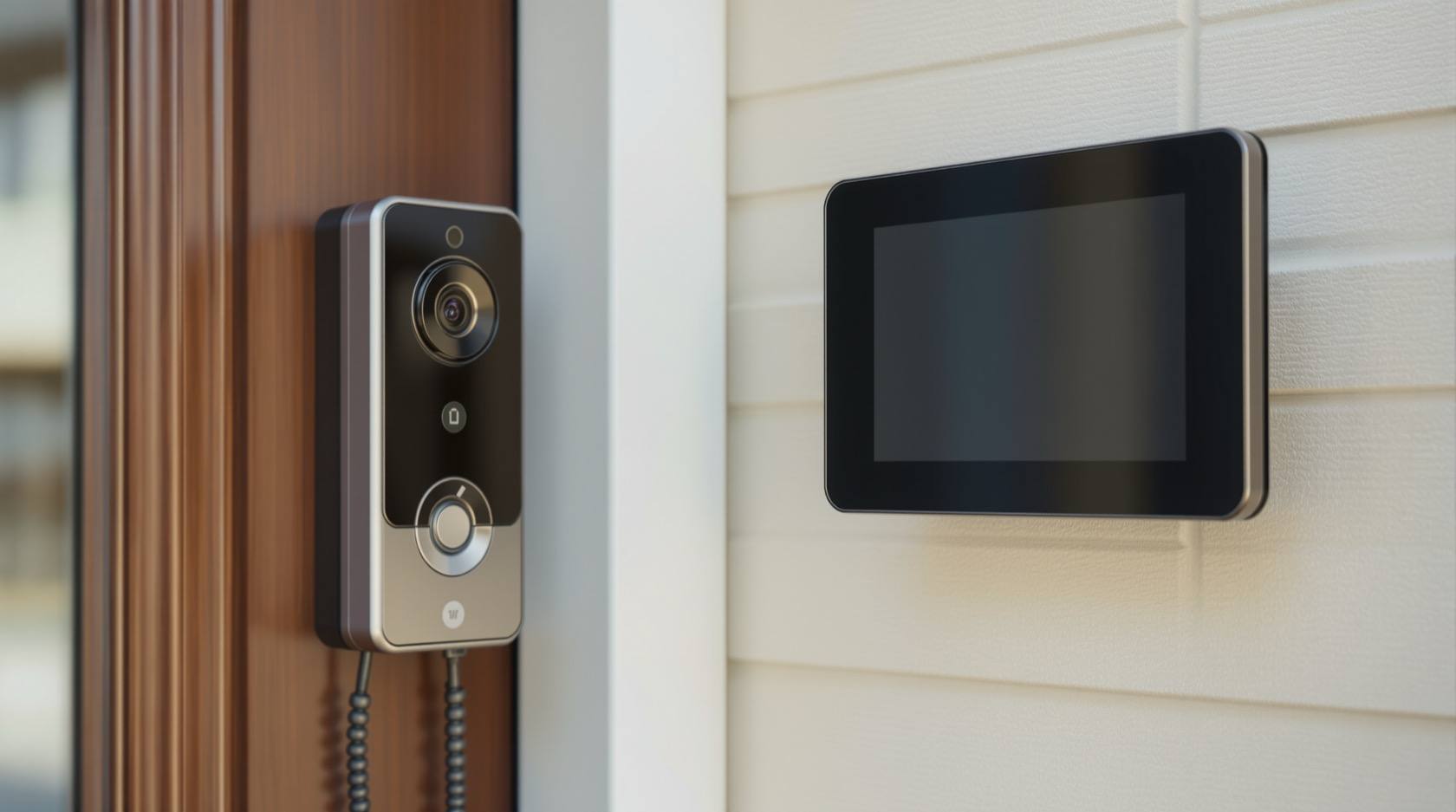
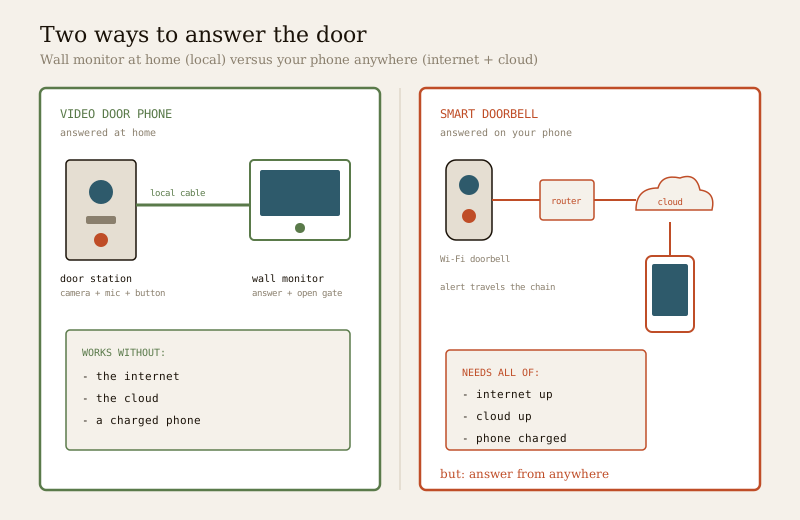
A VDP is a self-contained wired system. Outside your door or at the gate sits a door station — a weatherproof unit with a camera, microphone, speaker and a call button. Inside, on your wall, sits one or more indoor monitors. Press the button outside and the monitor inside chimes and lights up with live video; you talk through the panel, and in many models you press a button on the monitor to release an electric lock or open a gate. It is mains-wired, it talks to its own monitors over its own cable, and crucially it does not need the internet to work — the outside station and the inside screen are a closed loop. Modern VDPs often add a Wi-Fi bridge and an app so you can also answer on your phone, but the wall panel is the heart of the system.
The smart doorbell
A smart doorbell is a Wi-Fi camera in a doorbell body. It replaces (or sits beside) your existing bell, connects to your home Wi-Fi, and when someone presses it — or, with motion detection, simply approaches — it sends a notification to the app on your phone. You see the visitor, speak through two-way audio, and decide what to do, whether you are in the next room or in another city. There is usually no wall panel inside; your phone is the panel. Recorded clips typically live in the vendor's cloud, often behind a monthly or yearly subscription, though some models keep footage on a local microSD card.
The one-line difference: a VDP is an intercom you answer at home that happens to have video; a smart doorbell is a camera you answer on your phone that happens to be a doorbell.
The head-to-head
Both do the core job — see and speak to a visitor — so the decision lives in how they differ. Here is the honest comparison across the dimensions that matter in an Indian home.
| Dimension | Video door phone (VDP) | Smart doorbell |
|---|---|---|
| How you answer | Always-on wall monitor inside the home; instant, no phone needed | Your phone, via an app — anywhere you have signal |
| Works in an internet cut | Yes — the station-to-monitor link is local wiring | No — needs Wi-Fi and the vendor cloud to reach your phone |
| Works in a power cut | Monitor is mains-wired; many take a battery backup | Battery models keep working; wired-to-chime models depend on power and router |
| Remote access | Home-only, unless the model adds a Wi-Fi bridge and app | Its whole point — see your door from another city |
| Install | Needs wiring and a wall monitor; usually professional | Quick, often DIY; renter-friendly; battery models need no wiring |
| Recording | Can record locally (SD card or unit); no subscription needed | Usually a cloud plan for saved clips; some do local microSD |
| Lock or gate release | Yes — can buzz open an e-lock or gate from the panel | Usually not; it is a camera-and-bell, not an access controller |
| Multiple flats / scale | Scales well — the standard apartment intercom backbone | One doorbell per door; not an apartment intercom |
| Ongoing cost | Mostly one-time; local recording is free | Often a recurring cloud subscription for full features |
| Privacy / DPDP | Footage can stay local, on your own storage | Footage typically on a vendor cloud outside your control |
Read even-handedly, each column has real strengths. The VDP wins on independence, local recording, gate release and apartment scale; the smart doorbell wins on answer-from-anywhere, quick install and renter friendliness. Neither sweeps the table.
Reliability and independence
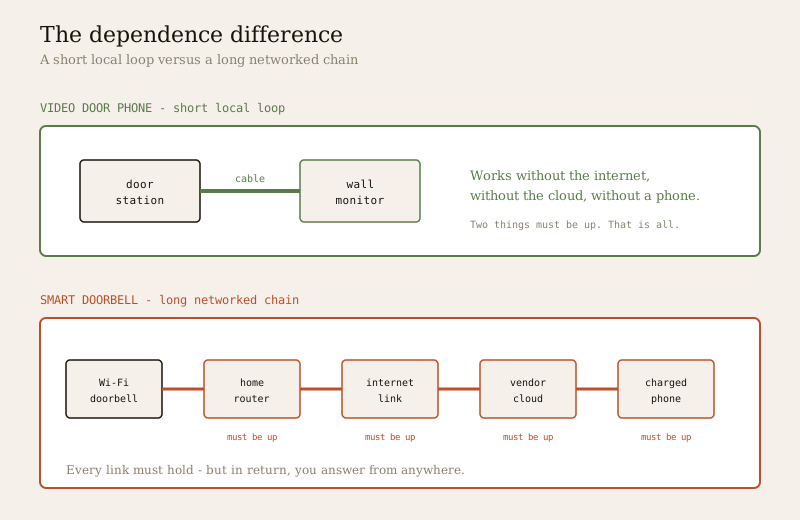
This is where the two philosophies part. A VDP is wired and local: the door station and the indoor monitor are joined by cable, so a visitor's call reaches your wall panel whether or not your broadband is working, and whether or not your phone is charged, in your hand, or has signal. A smart doorbell is networked: the call travels over your Wi-Fi, out to the vendor's cloud, and back down to your phone. That chain buys you enormous reach — but it also means a broadband outage, a router reboot, an app being logged out, or a dead phone can all leave you unable to answer. In a country where power cuts and patchy home internet are real, that independence is a genuine VDP advantage, not a theoretical one. (If your VDP keeps missing calls for other reasons, see the video door phone not ringing troubleshooting guide.)
Remote access
The mirror image: a smart doorbell lets you see and speak to your door from anywhere — accept a delivery while at work, tell a courier where to leave a parcel from your commute, check who rang while you are travelling. A classic VDP is home-only; if nobody is on the wall panel, the call is missed. Many 2026 VDPs close this gap with a companion app, and that is often the best-of-both answer — but out of the box, remote access is the smart doorbell's home turf.
Install, power and recording
A smart doorbell is quick and renter-friendly: battery models need no wiring at all and can move house with you, and even wired-to-chime models are a modest job. A VDP needs a door station, cable runs and a wall monitor — a more involved, usually professional install that suits a home you own or a building being wired anyway. On recording, a VDP can save locally with no ongoing fee, while a smart doorbell usually keeps clips in the cloud behind a subscription (a real running cost to factor in), though some models offer local microSD as an alternative.
Which suits whom
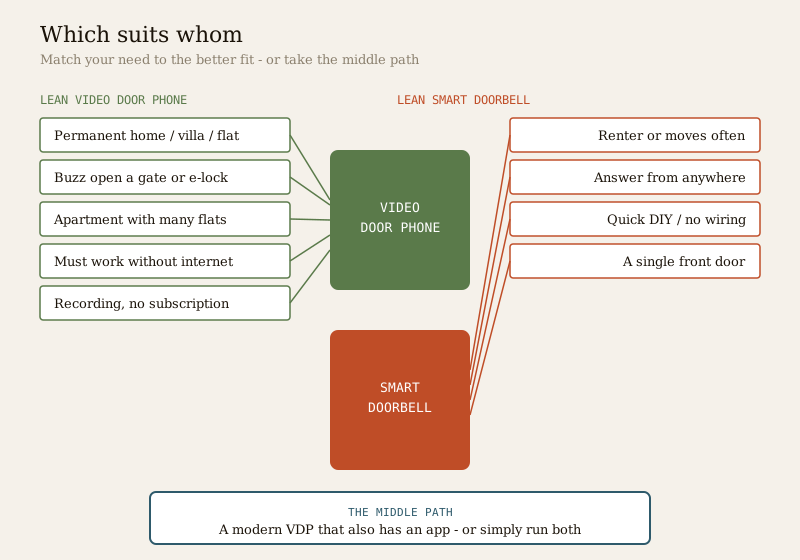
The most useful part of any comparison is not the table — it is matching each option to a real household.
- A permanent home, villa or flat you own, wanting a robust local intercom: lean VDP. You are staying, you can wire it, you want a panel that just works from the wall, records locally, and does not depend on your broadband. This is the classic Indian home-and-gate setup.
- You need to buzz open a gate or an electric lock from inside: VDP, clearly. Releasing a compound gate or an e-lock from the panel is a core VDP feature and something a plain smart doorbell simply does not do.
- An apartment or a building with a guard and multiple flats: VDP is the intercom backbone — a lobby or gate station calling individual flat monitors is exactly what the technology is for; a smart doorbell does not scale to that.
- A renter, or someone who moves often: lean smart doorbell. No wiring, minimal wall damage, and a battery model comes with you to the next home.
- You are out a lot and "answering the door" mainly means from work or another city: smart doorbell, for answer-from-anywhere — or a VDP that includes an app.
- A single front door on a modern flat, wanting the quickest useful upgrade: smart doorbell — fast to fit and immediately useful.
- You want both local robustness and remote reach: a modern VDP with a companion app, which increasingly delivers both from one system.
The honest middle ground. These are not mutually exclusive. Many Indian homes end up with both — a wired VDP as the dependable house intercom and gate release, plus a smart doorbell (or the VDP's own app) for answering when nobody is home. If the app matters to you, a VDP that has one may be all you need. Do not force a single winner where a small combination fits your life better.
Privacy and the neighbours
Both devices point a camera at your entrance, and that carries responsibility under the DPDP Act 2023. The practical difference is where the footage lives. A VDP can keep recordings on your own local storage, entirely under your control. A smart doorbell usually stores clips in the vendor's cloud, which means your visitors' images sit on a third-party server, often abroad, governed by that vendor's policy — something to weigh, and a reason to choose a reputable brand and understand its retention and access terms. Either way, aim the camera at your own door and threshold, not into a neighbour's window, their private balcony or the shared corridor beyond what you need. Pointing a doorbell camera at someone else's home is both bad manners and a privacy problem, whichever device you pick.
How to decide
There is no universal winner here — there is a winner for your situation. Walk these questions in order and the answer usually falls out:
1. Do you need to release a gate or lock from inside, or serve multiple flats? If yes, it is a VDP — a smart doorbell does not do this. Stop here.
2. Do you own the home and plan to stay, or are you renting / moving? Owning and staying favours the VDP (wire it once, keep it); renting or moving favours the smart doorbell (no wiring, takes the move with you).
3. What does "answer the door" mostly mean — from your sofa, or from anywhere? Reliable-at-home, internet-independent answering favours the VDP; answer-from-another-city favours the smart doorbell (or a VDP with an app).
4. Are you willing to pay a recurring cloud subscription? If you want recording with no ongoing fee, a VDP recording locally fits; if a monthly cloud plan is acceptable, the smart doorbell is fine.
5. Do you want both? Then get both, or a VDP that includes an app — the sensible outcome for many homes.
For the money side of each choice, the video door phone cost guide and the smart doorbell cost guide go deep on what you will actually spend. For the wider picture of how a doorbell or door phone fits into a whole-home security plan, see how to choose a security system and the security comparison pillar.
Key takeaways
- A VDP is a wired intercom you answer at home — always-on wall monitor, works without internet or a phone, can record locally and release a gate or lock, and scales across apartment flats.
- A smart doorbell is a Wi-Fi camera you answer on your phone — see your door from anywhere, quick renter-friendly install, but dependent on internet, the vendor cloud and a charged phone, usually with a cloud subscription for saved clips.
- Neither is universally better — the VDP wins on independence, local recording, gate release and scale; the doorbell wins on remote access, install and renter friendliness.
- Match to your life: permanent home, gate release or apartment intercom lean VDP; renter, answer-from-anywhere or a single door lean smart doorbell.
- Many homes sensibly run both, or a modern VDP that also has an app.
- Mind privacy and DPDP — a VDP can keep footage local; a smart doorbell puts it on a vendor cloud; either way, point the camera at your own door, not the neighbours.
Where to go next
- Video door phone cost guide and smart doorbell cost guide — what each option actually costs in India.
- Video door phone not ringing — troubleshooting a VDP that misses calls.
- How to choose a security system and the security comparison pillar — fitting the door into a whole-home plan.
- The video door phones sub-hub, the comparison sub-hub and the main security hub.
References
- Digital Personal Data Protection Act, 2023 — a doorbell or door-phone camera records identifiable people at your entrance, which is personal data; whether footage is stored locally or on a vendor cloud, agree on where it lives, how long it is kept and who can view it, and avoid capturing a neighbour's private space.
- Bureau of Indian Standards catalogue — for electrical safety and wiring provisions relevant to a mains-wired door station and monitor, verify current standards via https://www.services.bis.gov.in/
This is an educational, neutral comparison for homeowners and renters, not a product endorsement, price list or installation manual. Both a video door phone and a smart doorbell are legitimate choices that win in different situations; match the device to your home, ownership, connectivity and privacy needs, and engage a licensed electrician or installer for any mains-wired door station.
Export this guide
Related Guides — Deep-dive reading
Local Storage vs Cloud CCTV in India (2026): Where Your Footage Should Live
A homeowner's honest head-to-head on where CCTV footage is kept — on a hard disk in the recorder at home, or uploaded to a per-camera cloud plan — across cost, theft resilience, internet dependence, retention, remote access and DPDP privacy, ending in a clear which-suits-whom, with hybrid usually the smartest answer.
SecurityCCTV vs Video Door Phone: Which Does Your Home Need?
They look similar and get confused constantly, but a CCTV camera and a video door phone do different jobs — one watches the whole property and records, the other answers your door and controls who comes in. This guide settles CCTV vs video door phone for Indian homes: what each is for, where they overlap, real rupee costs, apartment versus villa relevance, and why most homes end up wanting both.
Smart HomeOffline Access Control in India (2026): Standalone Locks That Work Without a Network
How standalone, non-networked access control works when the permission lives on the door or on the card, where offline is the right choice, how you manage it, and the honest trade-offs versus a live cloud system.
SecurityRelated Tools — Try Free
Video Door Phone Type Selector
Answer a few questions about your building, cabling, budget and internet and get the right video door phone — analog / wired / wireless / IP, single-home or multi-apartment, monitor or app.
Door Phone SelectorApartment Video Door System Planner
Enter flats, entrances, floors and guard desk for a first-pass building intercom plan — door stations, indoor monitors, guard station, the right architecture and an indicative cost band.
Building PlannerCCTV Cloud vs Local Cost Calculator
Compare cloud CCTV subscription against a local NVR + HDD — upfront, 5-year total, monthly fee and break-even.
Cloud vs Local