
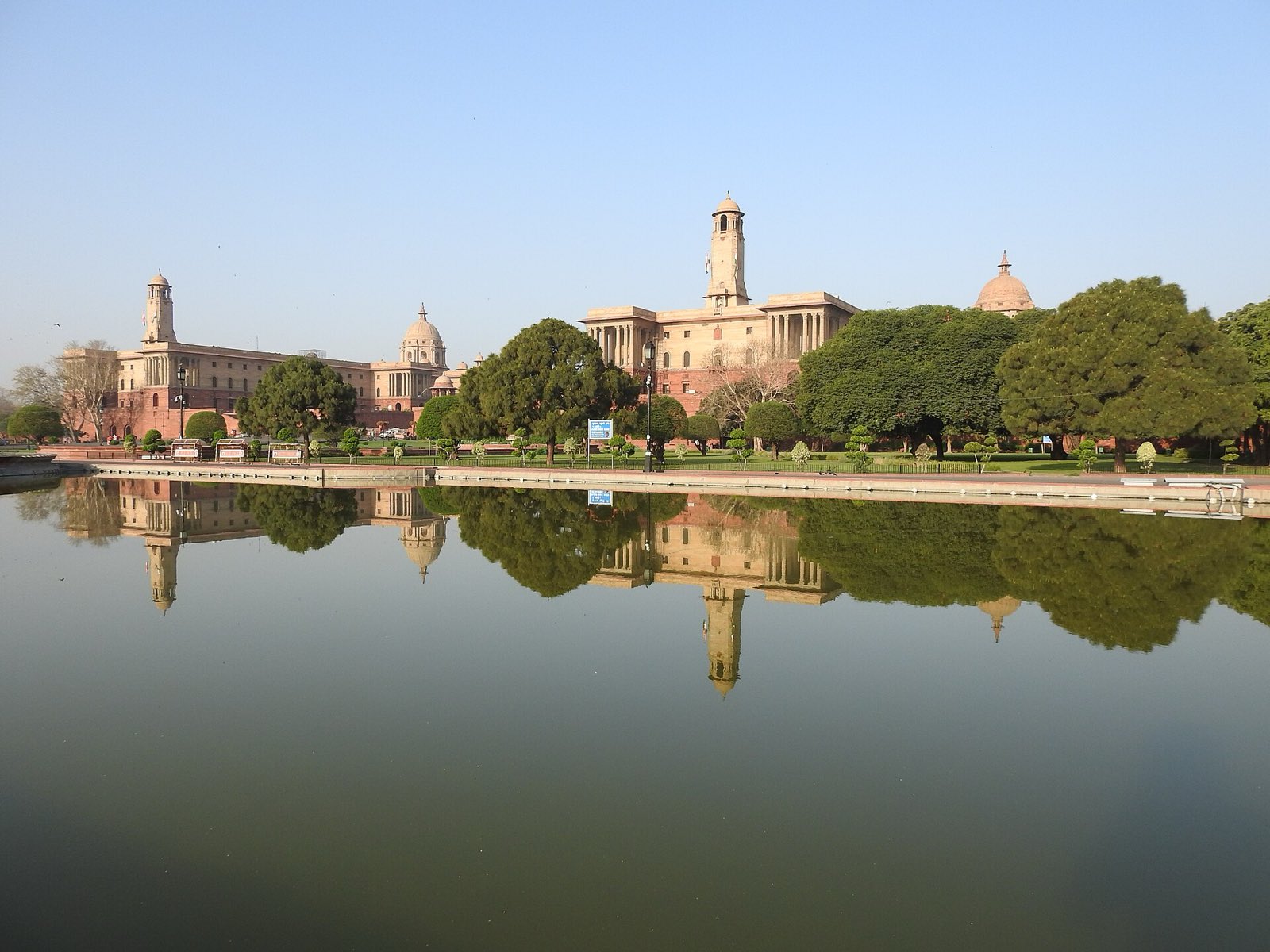
Rashtrapati Bhavan and Lutyens' Delhi: The Empire's Last Capital, Crowned by a Stupa
How the British built one final imperial city at New Delhi — a palace of 340 rooms whose great dome is a Buddhist stupa on a classical body — and how, within eighteen years, it became the house of the Indian republic
By the early twentieth century the British had built three great architectural statements in India that we have already visited: the Gothic railway cathedral of Chhatrapati Shivaji Terminus and the classical white marble of the Victoria Memorial. Rashtrapati Bhavan is the fourth, the last, and the grandest — the centrepiece of an entire new imperial capital, New Delhi, laid out to proclaim that British rule in India was permanent and eternal. It is one of the largest residences of any head of state in the world, a palace of some 340 rooms, and it is a fascinating, contradictory building: an act of imperial confidence completed at the very moment that confidence was about to collapse, a European palace crowned by a Buddhist stupa, a house built for a Viceroy that became, within a generation, the home of the President of a free India.
A city built to say "forever"
In 1911 the British decided to move the capital of India from Calcutta to Delhi, and to build there a wholly new administrative city — New Delhi — beside the old Mughal one. The commission for the great new capital went chiefly to the English architect Edwin Lutyens, working with Herbert Baker, and construction ran from 1912 to around 1929–31. At the heart of it all stood the Viceroy's House, now Rashtrapati Bhavan ("President's House"), on the low eminence of Raisina Hill.
The city was conceived as a piece of grand Beaux-Arts urban design — the monumental axial planning of imperial capitals — and understanding that plan is understanding the building's whole purpose.
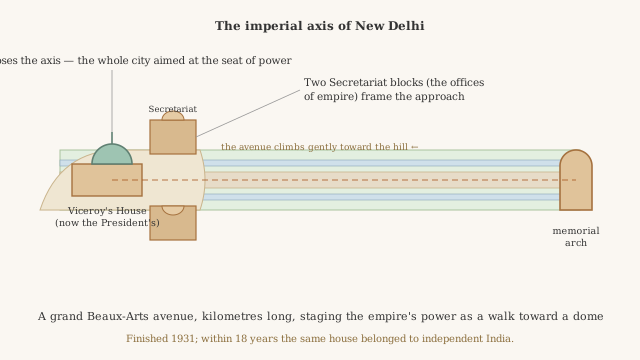
A single immense ceremonial avenue — the Kingsway, now Rajpath or Kartavya Path — runs dead straight for kilometres, from a great memorial arch (India Gate) at one end, up a gentle rise to Raisina Hill at the other. There, two vast Secretariat blocks, the offices of imperial government, flank the final approach, and the whole axis terminates at the domed mass of the Viceroy's House. The entire city, in other words, was staged as a processional route aimed at the seat of power: you walk or ride kilometres up a rising avenue, between the offices of empire, toward a great dome on a hill. It is the architecture of authority made into urban theatre, in the tradition of Washington, Paris and imperial Rome — a plan whose message is that this power is central, permanent, and to be approached with awe.
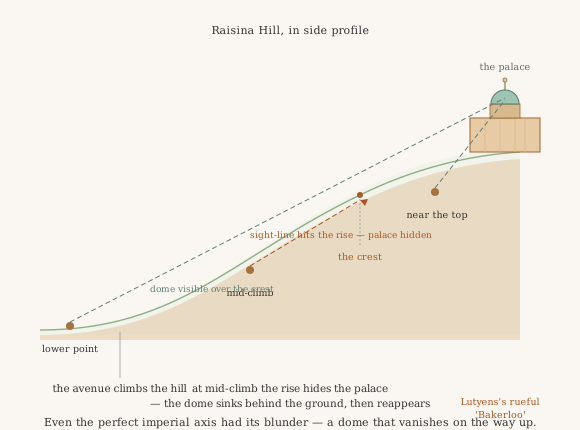
(There is a famous flaw, beloved of architects: because of a dispute over the gradient of the hill between Lutyens and Baker, as you climb the final stretch the palace appears to sink behind the rise, its dome briefly swallowed by the ground before reappearing — an error Lutyens ruefully called his "Bakerloo." Even the perfect imperial axis had its human mistake.)
The building: a classical body in Indian dress
Rashtrapati Bhavan itself is where Lutyens did something more subtle and more interesting than the earlier imperial buildings in this series.
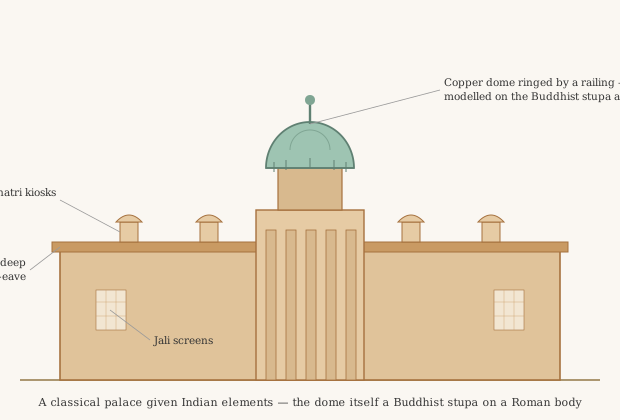
At its core the building is classical — symmetrical, monumental, ordered, with a great columned portico, in the stripped and simplified classicism that was Lutyens's own manner. But Lutyens, unlike the architect of the Victoria Memorial, did not simply stick Mughal ornament onto a European frame. He studied Indian architecture seriously and wove genuinely Indian elements into the very substance of the design. The deep projecting stone eave that runs round the building — the chhajja, the drip-stone that throws off the monsoon rain and casts a band of shade — is Indian. The small domed kiosks along the roofline are chhatris, from Rajput and Mughal architecture. There are jali lattice screens, and carved Indian elephants and bells. The red and cream sandstone is the material of Mughal Delhi.
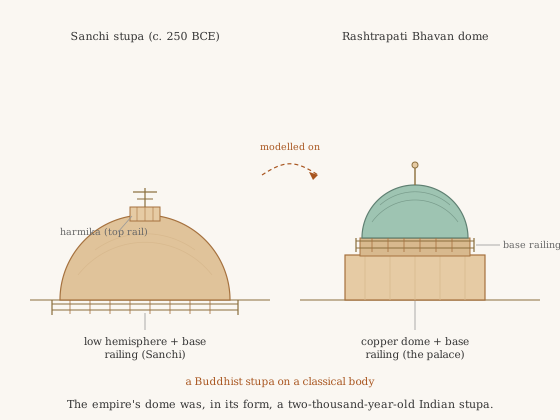
And then there is the dome — the building's crown and its most remarkable idea. The great copper dome of Rashtrapati Bhavan is not a European dome at all. Lutyens modelled it, quite deliberately, on the Great Stupa at Sanchi — the very Buddhist stupa that opens the ancient story of this series. Look at it and you can see the stupa's form: the low, calm hemisphere, and around its base a stone railing directly echoing the carved railing that encircles the mound at Sanchi. It is an extraordinary gesture: the supreme symbol of the British Raj, the dome that closes the whole imperial axis of New Delhi, is in its form a two-thousand-year-old Indian Buddhist monument. A classical palace, an Indian eave and kiosks and screens, and a Buddhist stupa for a crown — the building is a deliberate synthesis, a European structure that tried, far more thoughtfully than its predecessors, to speak in an Indian architectural voice.
Behind the palace lie the great Mughal Gardens (now the Amrit Udyan), a formal charbagh of the kind we met at Humayun's Tomb, with its quartering water channels and terraces — the Persian-Indian paradise garden adopted, once more, as the private ground of a ruler.
The irony written into the stone
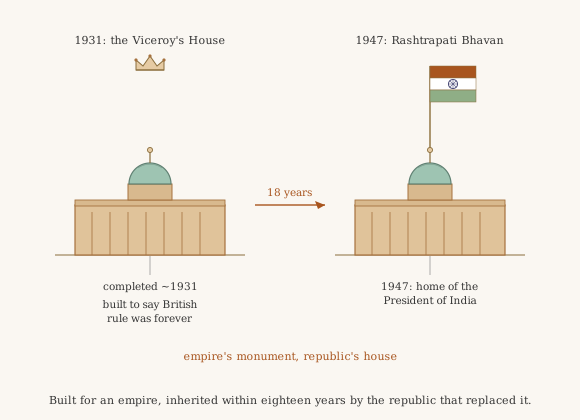
Rashtrapati Bhavan's deepest meaning lies in its timing. It was designed and built to declare that the British Empire in India was permanent — a capital for the ages, a processional city aimed forever at the Viceroy's dome. It was substantially completed around 1929–31. And within just eighteen years, in 1947, the empire it was built to glorify was gone, and the Viceroy's House became Rashtrapati Bhavan, the residence of the President of the Republic of India. The greatest and most confident monument the British ever raised in India served its intended purpose for less than two decades before passing, intact, to the very nation it had been built to rule.
That irony makes it the perfect near-final chapter in this series' long story of how power builds. Set the imperial buildings side by side and you can read the whole colonial argument about architecture: CSMT dressed a Gothic frame in Indian carving; the Victoria Memorial dressed a classical frame in Mughal ornament; and Rashtrapati Bhavan went furthest, trying to fuse a classical body with genuinely absorbed Indian elements and a Buddhist stupa for a dome — the most sophisticated, and the last, of the empire's attempts to root itself in India's own forms. And then, just beyond it in time, comes independent India's own answer at Chandigarh: the flat rejection of all this borrowed grandeur in favour of raw modern concrete.
Rashtrapati Bhavan stands exactly on the hinge between those two worlds. Walk up the long axis toward its stupa-crowned dome, past the offices of a vanished empire, into a palace that now flies the flag of the republic that empire tried to hold forever, and you are standing at the very end of the imperial story and the beginning of the national one — the last capital of the Raj, become the first house of free India.
Part of the Architectural Wonders series. See the ancient monument its dome was modelled on, the Great Stupa at Sanchi; the empire's other statements at CSMT and the Victoria Memorial; and independent India's break with them all at Chandigarh.
Hero photograph: “Rashtrapati Bhavan, New Delhi” by Harvinder Chandigarh, via Wikimedia Commons, licensed under CC BY-SA 4.0.
Export this guide
Related Guides — Deep-dive reading
The Victoria Memorial, Kolkata: The Raj Answers the Taj
How the British Empire built its own white-marble monument in a Mughal city — a European dome dressed in Indian kiosks and arches, the grandest and most revealing statement of the Indo-Saracenic style
Architectural WondersCentral Vista Redevelopment: Rewriting a Nation's Ceremonial Axis in New Delhi
HCP Design's redevelopment of the three-kilometre axis from Rashtrapati Bhavan to India Gate is the most consequential public-realm project in independent India — a triangular new Parliament, ten consolidated secretariat blocks, and a pedestrianised Kartavya Path that asks who owns the symbolic ground of a democracy, and at what cost.
The Future of ArchitectureThe Colosseum: The Machine That Fed a City Its Pleasures
Rome's greatest emperors built palaces for themselves; the Flavian emperors did something shrewder — they drained a fallen tyrant's private lake and raised, on the spot, a stupendous arena for fifty thousand ordinary citizens. The largest amphitheatre ever built is a masterpiece of crowd engineering, a hidden stage-machine of lifts and trapdoors, and a place of real, organised killing — all at once. The fourth article in our chapter on the palaces and pleasures of worldly power, and the first on pleasure.
Architectural WondersRelated Tools — Try Free
Monsoon-Readiness Checklist
Pre-rain home audit across 9 categories — terrace, drains, waterproofing, electrical, HVAC, pest, vehicles, documents.
Seasonal AuditDesign Brief Generator
Answer 10 questions and generate a professional interior design brief PDF for your designer or architect.
Brief GeneratorProperty Tax Calculator — 10 Indian Cities
Estimate annual municipal property tax across BBMP / MCD / MCGM / GHMC / GCC / KMC / PMC / AMC / TMC / PCMC — with self-occupied, tenanted, and age-rebate adjustments.
Property Tax