
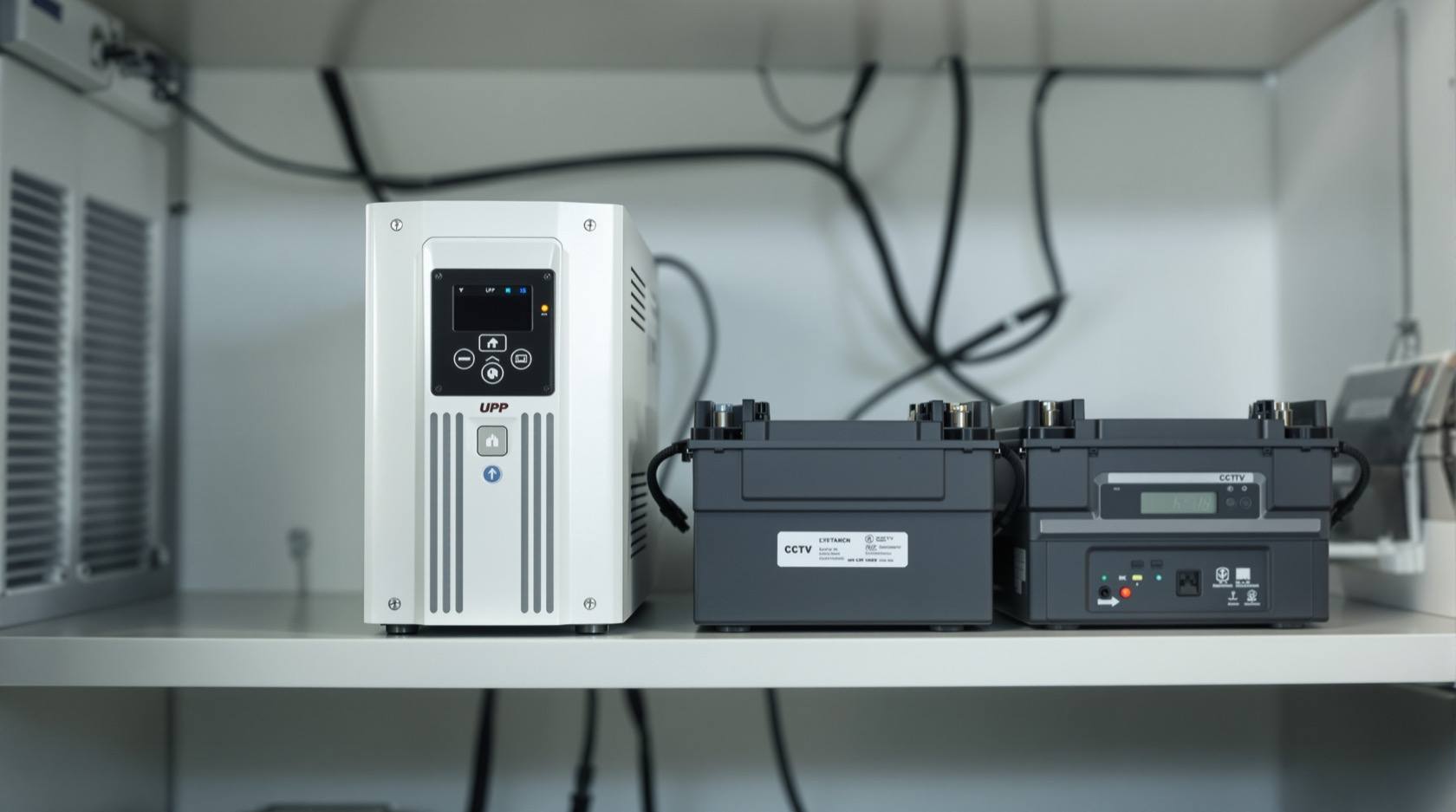
UPS and Battery Maintenance in India (2026): Keep Security Alive Through a Power Cut
How to look after the UPS units and backup batteries that keep your cameras, NVR, alarm panel and gate controller running when the mains fails — treating batteries as consumables you replace on schedule, and proving it with a regular pull-the-mains backup test.
A power cut is exactly when a burglar prefers to work, and exactly when a badly kept security system quietly stops watching. The mains drops, the lights go, and if the batteries behind your cameras and alarm are tired, the whole system goes dark with them. You will not notice on a calm evening. You will notice on the one night it mattered, when you check the recordings and find the last clip is from the moment the power failed.
The uncomfortable truth of backup power is that it fades in silence. A battery does not warn you before it dies; it simply delivers less and less runtime each year until, one cut, it delivers none. Nothing on the screen looks different the day before. That is why backup batteries are not a "fit and forget" part of a security system — they are consumables, like tyres or a water filter, that must be replaced on a schedule you decide in advance, not on the day they fail. The day of the cut is the worst possible day to discover a dead battery.
This guide is about keeping that backup alive. It covers the different kinds of UPS and battery in a typical Indian home security setup, the simple routine that keeps them healthy, the one test most people skip that actually catches a dying battery, and a clear line between what you can safely do yourself and what belongs to an electrician or your installer.
Scope & safety. This is an upkeep guide for homeowners, not an electrical manual. You can safely run a backup test, read indicator lights, keep equipment cool and ventilated, wipe accessible terminals and swap a plug-in battery. Anything hard-wired — the standby battery inside an alarm or fire panel, high-capacity UPS wiring, or mains work — is for a qualified electrician or your AMC provider. A fire alarm panel's standby battery is a statutory life-safety part governed by the National Building Code (NBC = SP 7:2026) and must be serviced on schedule by a competent person, never skipped. Old lead-acid and lithium batteries are hazardous e-waste and must be disposed of properly. This is not a price guide or a buying guide — budget for replacement, but choose products elsewhere.
Why backup power fails when you need it
Three things conspire against backup batteries in Indian homes, and understanding them makes the whole routine obvious.
First, use. Every power cut draws the battery down and every restoration charges it back up. In a city with frequent cuts, a battery cycles hard and ages faster than the calendar alone suggests. Backup that is exercised often wears out sooner, not later.
Second, heat. Battery chemistry hates warmth. A UPS tucked inside a closed cabinet, a hot meter room, or a sun-baked utility corner runs its battery at a temperature that shortens its life dramatically. In much of India, heat is the single biggest killer of backup batteries — a battery that might last four years in a cool cupboard can be finished in two if it is baked. Ventilation is not a nicety; it is life extension.
Third, silent decline. Unlike a bulb that flickers or a fan that rattles, a fading battery gives almost no visible warning. It holds its indicator light, it sits there looking healthy, and only a real load test — pulling the mains and watching how long things actually stay up — reveals that its true runtime has collapsed from an hour to ninety seconds.
Put those together and the maintenance logic writes itself: keep it cool, test it regularly so you catch the silent decline, and replace it on a planned cycle before it fails.
The kinds of backup in a home security system
A home security setup usually hides backup power in several places, each with its own battery and its own quirks. Knowing what you have is the first step to keeping it alive.
- The CCTV / NVR UPS. A small UPS or battery backup powering the network video recorder, and often the PoE switch or camera power supply. Lose this and your recordings stop the instant the mains drops. This is the backup most homes forget to test.
- The alarm panel's standby battery. Intrusion alarm and fire panels carry a sealed backup battery inside the enclosure so the alarm keeps working through a cut. It is usually hard-wired and not a homeowner swap. On a fire panel it is a statutory life-safety part.
- The gate or barrier controller battery. Automatic gates, boom barriers and some smart locks hold a backup so they still open, close and lock during a cut. A dead one can leave a gate stuck — open or shut — at the worst moment.
- The router / camera UPS. Your cameras and cloud alerts are useless if the internet dies with the power. A small UPS on the router and ONT keeps remote viewing and notifications alive through a cut.
Each of these depends on a battery, and every battery is a consumable on a clock.
The maintenance schedule
Backup power upkeep is not complicated, but it is a routine — a few small checks on a rhythm, and one honest test. Here is the schedule for a typical home.
| Task | Frequency | Who |
|---|---|---|
| Glance at UPS / panel indicator lights; listen for any beep | Weekly | Homeowner |
| Check equipment is cool and ventilated, not boxed in or in direct sun | Monthly | Homeowner |
| Run the backup test — pull the mains, confirm everything stays up for a useful time | Quarterly | Homeowner |
| Inspect batteries and terminals for corrosion, swelling, heat or leaking | Quarterly | Homeowner |
| Wipe accessible terminals; check plug-in battery seating | Every 6 months | Homeowner |
| Service hard-wired alarm / fire panel standby battery; load-test | Annually | Electrician / AMC |
| Replace batteries on their planned service-life cycle | Every few years | Electrician / homeowner (if accessible) |
| Note the install date on every battery and diarise the next replacement | At install and each replacement | Homeowner |
The two rows that do the real work are the quarterly backup test and the planned replacement cycle. The rest are the cheap early-warning checks that flag trouble between them.
The backup test — the one people skip
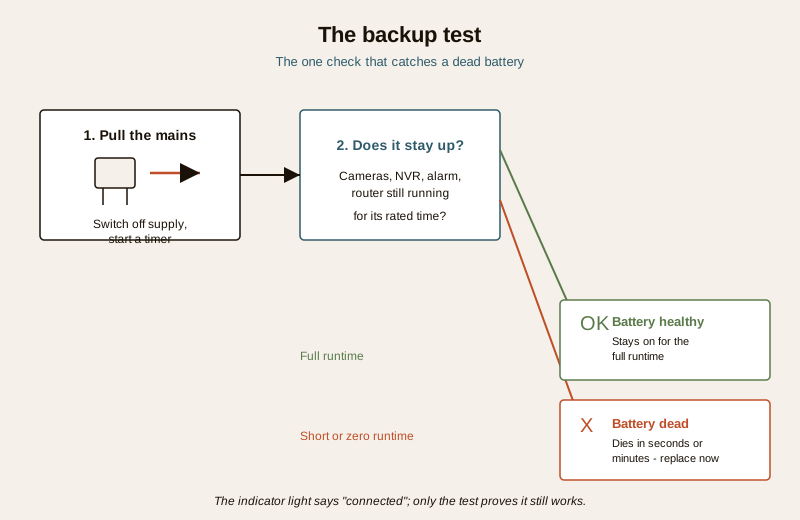
This is the check that catches a dead battery, and almost nobody does it. Once a quarter, with someone watching the cameras' live view or the recorder, safely switch off or unplug the mains to the security equipment and start a timer. Watch what actually happens.
- Does the NVR stay recording? Does the live view hold?
- Do the cameras stay up, or do some drop immediately?
- Does the alarm panel stay armed and report on battery, without a low-battery fault?
- Does the router stay on so remote alerts still work?
- How long does it all last before anything drops — and is that a useful time, or seconds?
Restore the mains and note the result with the date. A healthy system holds up for its rated runtime; a system that dies in seconds or a couple of minutes has a battery that is effectively gone, whatever its indicator light claims. The indicator light tells you the battery is connected; only the backup test tells you it still works. For the wider picture of keeping a system running through an outage, see the guide on security systems during a power failure.
Keeping it cool and ventilated
Because heat is the number-one killer, where you put the UPS and batteries matters as much as any check.
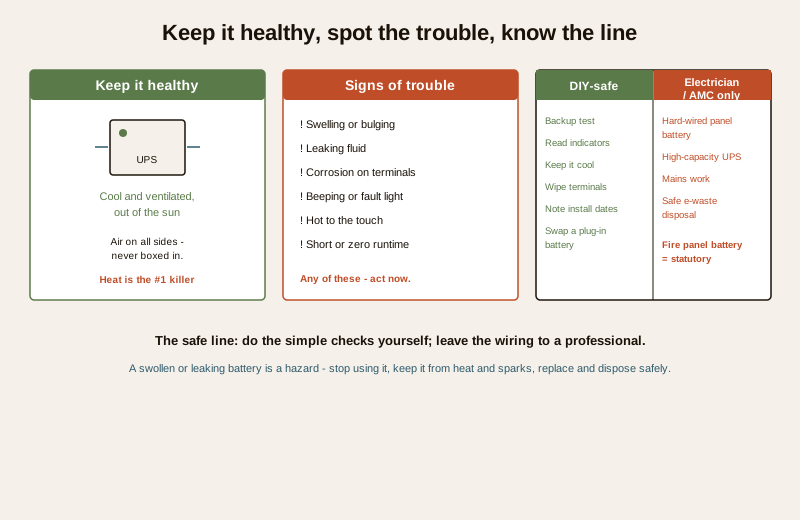
- Give the UPS air on all sides — do not seal it inside a closed cabinet, stack it under other gear, or bury it in a hot meter cupboard.
- Keep it out of direct sun and away from anything that radiates heat.
- Keep the vents and any fan free of dust so the equipment can shed its own heat.
- If the only available spot is genuinely hot, accept that the battery will need replacing sooner and shorten your replacement interval accordingly.
A cool, ventilated, dust-free spot can add years to a battery's life for free. Boxing it in for tidiness is the commonest self-inflicted failure.
Signs of trouble
Between tests, a few visible and audible signs warn you a battery is failing or dangerous. Learn to spot them.
- Short or zero runtime in a cut — the system that used to ride out a cut now dies quickly, or dies at once. The clearest sign, and the reason to test.
- A swollen, bulging or leaking battery — a battery that has ballooned or is weeping fluid is failed and unsafe. Stop using it, keep it away from heat and sparks, and have it replaced and disposed of safely. Never puncture or force a swollen battery.
- Persistent beeping or a fault light on the UPS or panel — often a low-battery, replace-battery or fault warning. Read the manual for what the pattern means; do not just silence it.
- Heat — a UPS or battery that is hot to the touch in normal standby is a warning sign, not normal.
- Corrosion or a powdery deposit on terminals — a poor connection that starves the system and can mean a leaking or ageing battery.
Any of these means act now, not later. A swollen battery in particular is a hazard, not merely a spent part.
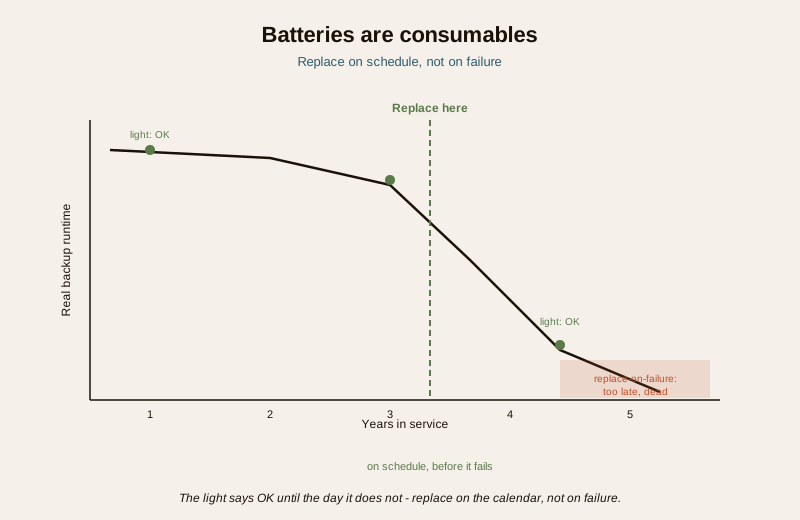
Batteries are consumables — replace on schedule, not on failure
This is the heart of the guide, and the habit that separates a system that works from one that only looks like it works.
A backup battery has a service life — a few years, depending on chemistry, heat and how hard it cycles — after which its real runtime has quietly collapsed even though nothing looks wrong. The right response is not to wait for it to fail. It is to decide the replacement interval in advance, write the install date on the battery, diarise the next change, and replace it on that date whether or not it has failed yet. A battery replaced a few months early costs a little money. A battery replaced the night after a break-in costs you the footage that would have mattered.
- Note install dates. The moment a battery goes in, mark it — a date on the battery, a line in your maintenance log, a reminder in your phone. Without a date you are guessing.
- Budget for it. Treat backup batteries as a recurring running cost of the system, like an AMC. Every battery in the house will need replacing within a few years; plan the money so it is never a surprise.
- Shorten the interval where it is hot. A battery in a hot location ages faster; replace it sooner than one in a cool cupboard.
- Right-size the backup. A UPS that is overloaded or undersized for its job gives poor runtime and stresses its battery. Enough capacity for a useful runtime, not so little that it dies in minutes, is part of getting the backup right. To gauge what runtime you actually need, see the electrical backup assessment for security and the guide to CCTV power supplies and UPS.
- Protect against surges. India's supply brings spikes and sags that damage electronics and batteries. Surge protection ahead of the UPS protects the whole chain and the battery's life.
Building this replacement rhythm into your calendar is the single highest-value thing you can do for backup reliability. The security maintenance calendar is a ready-made way to slot these dates in alongside your other checks.
DIY-safe versus call a professional
Backup power upkeep has a clear safe line. Stay on the right side of it.
You can safely do these yourself:
- Run the quarterly backup test and time the runtime.
- Read indicator lights and note what any beep or fault light means.
- Keep equipment cool, ventilated, dust-free and out of the sun.
- Visually inspect for swelling, leaking, corrosion or heat.
- Wipe an accessible external terminal that is dust-dirty (with the equipment safely off, never on a swollen or leaking battery).
- Swap a genuinely user-accessible, plug-in battery that the manual says is homeowner-replaceable.
- Keep the logbook — install dates, test results and next replacement dates.
Leave these to an electrician, installer or AMC provider:
- The hard-wired standby battery inside an alarm or fire panel — opening the panel and load-testing or changing that battery is skilled work, and on a fire panel it is statutory life-safety servicing.
- High-capacity UPS and inverter batteries, and anything involving mains wiring.
- Any electrical fault, tripping, or scorching around the supply.
- Safe disposal of old batteries. Lead-acid and lithium batteries are hazardous e-waste — they must go to a proper e-waste or battery collection channel, never the household bin. Ask your installer or a registered e-waste handler; disposing of them correctly is both the law and basic safety.
Life-safety — do not skip. A fire alarm panel's standby battery is not an optional convenience. It is a statutory part of a life-safety system, and it must be tested and serviced on schedule by a competent person under the National Building Code (NBC = SP 7:2026) and your fire safety obligations. If your building has a fire panel, its battery servicing belongs in your annual professional check, every year, without exception.
A short backup-power checklist
- Weekly: glance at the UPS and panel lights; listen for any beep.
- Monthly: confirm nothing is boxing in the UPS; it is cool and ventilated.
- Quarterly: run the backup test — pull the mains, time the runtime, note the result and date.
- Quarterly: inspect batteries and terminals for swelling, leaking, corrosion or heat.
- Every battery: write the install date on it and diarise the next replacement.
- Every few years: replace batteries on their planned cycle, before they fail.
- Annually: have an electrician or AMC service the hard-wired panel batteries — and never skip the fire panel's.
- Always: dispose of old batteries as e-waste, and act at once on a swollen, leaking or hot battery.
The bottom line
A security system is only as reliable as the weakest battery keeping it alive, and that battery fades in silence. The two habits that matter are the ones almost everyone neglects: run the backup test often enough to catch a dying battery before the burglar does, and replace batteries on a planned schedule rather than waiting for the day they fail. Keep the equipment cool, watch for the warning signs, keep the fire panel's statutory servicing sacred, and dispose of the old batteries safely. Do that, and the night the mains drops, your cameras, your alarm and your gate are all still doing their job — which is the entire point of having them.
This upkeep sits inside a larger routine. For the full picture of keeping a security system working, see the pillar guide on security system maintenance, the wider security maintenance sub-hub, and the main security hub.
Key takeaways
- Backup batteries are consumables, not fit-and-forget parts — they fade silently and must be replaced on a planned schedule, before they fail, not on the day of the cut.
- The backup test is the check that catches a dead battery — once a quarter, pull the mains and confirm everything stays up for a useful runtime; the indicator light alone never proves it.
- Heat is the number-one killer of batteries in India — keep the UPS cool, ventilated, dust-free and out of the sun; never box it in.
- Know your kinds of backup — the NVR UPS, the alarm panel's standby battery, the gate controller battery and the router UPS each have a battery on a clock.
- Watch for swelling, leaking, corrosion, beeping, heat and short runtime — any of these means act now, and a swollen battery is a hazard to replace and dispose of safely.
- Note install dates and budget for replacement — right-size the runtime and add surge protection so the backup is enough and stays healthy.
- Keep the safe line — DIY the test, the checks, cooling and an accessible plug-in swap; leave hard-wired panel batteries, high-capacity UPS, mains work and e-waste disposal to a professional. The fire panel's standby battery is statutory — never skip it.
Where to go next
- Security system maintenance — the pillar routine this backup upkeep sits inside.
- Security systems during a power failure — keeping the whole system running through an outage.
- CCTV power supply and UPS — sizing and powering the camera and recorder side.
- Electrical backup assessment for security — working out how much runtime you actually need.
- Security maintenance calendar — a ready-made schedule to diarise your tests and replacements.
- The security maintenance sub-hub and the main security hub.
References
- National Building Code of India (SP 7), Bureau of Indian Standards — fire alarm and life-safety system provisions, including standby power for fire detection and alarm systems, and periodic testing by competent persons. Verify the current edition (SP 7:2026) via the BIS catalogue: https://www.services.bis.gov.in/
- Digital Personal Data Protection Act, 2023 — CCTV footage and recorder data handled during maintenance or battery servicing remains personal data; ensure anyone servicing the equipment is bound to protect it.
- E-Waste (Management) Rules — used lead-acid and lithium backup batteries are hazardous waste and must be routed to authorised e-waste or battery collection channels, never the household bin.
This is an educational upkeep overview for homeowners, not electrical advice or an installation manual. Do the simple, safe checks yourself; leave hard-wired panel batteries, high-capacity UPS, mains work and battery disposal to a qualified electrician, installer or AMC provider. A fire alarm panel's standby battery is a statutory life-safety part and must be serviced on schedule by a competent person; verify any standard's current status via the BIS catalogue before relying on it.
Export this guide
Related Guides — Deep-dive reading
Emergency Lighting Testing in India (2026): The Function Test, the Duration Test and the Battery That Quietly Dies
Emergency lighting is what gets people out of a building in a power cut or a fire — and it is useless if its batteries have silently gone flat. This professional guide covers what emergency lighting is, the two tests that keep it honest (the short frequent function test and the longer periodic duration test that catches dying batteries), what to test across escape routes, stairs and exit signs, the statutory test log, and the safe split of who does what.
SecuritySecurity for People Living Alone in India (2026): Calm, Practical Habits When There Is No Second Person to Notice
Living alone is an ordinary and growing part of Indian life - the student in a new city, the working single, the elder whose children are abroad, the person after a separation. It does not call for fear. It calls for a few deliberate habits, because there is no second person in the home to notice trouble, raise the alarm, or catch an accident. This is calm self-reliance, layer by layer.
SecuritySecurity System Network Failure (2026): When Everything Goes Offline at Once, and How to Get It Back
When your whole security system drops offline together, the fault is almost never in the cameras. It is in the shared network they all lean on. This guide helps an Indian homeowner tell an internet outage from a router, switch or cabling fault, power-cycle things in the right order, and know when to call a professional.
SecurityRelated Tools — Try Free
Security Backup Power Calculator
Size a UPS/inverter and battery to keep CCTV, NVR, router and alarm running through a power cut — load, Ah, VA and cost.
Backup PowerAccess-Control Battery-Backup Calculator
Size the standby battery so an access system keeps running through a power cut, with an egress life-safety note.
Battery BackupSecurity System Cost Estimator
Estimate the all-in capex with GST, annual running cost and 5-year total cost of ownership of a home or building security system.
Cost Estimator