
Tile Adhesive Guide India: Types, IS 15477 Grades & How to Choose (2026)
A specifier's guide to tile adhesive (thin-set) for Indian homes - why it beats the traditional cement-sand mortar bed for vitrified, porcelain and large-format tiles, the IS 15477 types C1, C2 and C2-improved plus epoxy, and how to pick the right one for every substrate and location.
For decades in India, tiles went down on a thick, wet bed of cement and sand - the "mortar bed" or "thick-bed" method the local mason knew by heart. It worked for the small, porous ceramic tiles of the time. But today's homes are tiled in dense vitrified, porcelain and big 600 mm and 800 mm large-format tiles, and the old wet bed struggles to hold them. The modern answer is tile adhesive - a factory-made "thin-set" that you comb on in a 3 to 6 mm layer and that grips even glass-smooth tiles.
This guide helps you choose and specify the right tile adhesive: why thin-set beats the mortar bed, the IS 15477 types named simply, and how to match the adhesive to your substrate, tile and location - a dry bedroom floor, a wet bathroom, an exterior facade, a swimming pool or a tile-on-tile makeover. It sits inside our construction chemicals guide, the anchor that maps waterproofing, admixtures, adhesives and grouts together; read that for the big picture.
Scope and safety: This is a selection guide, not a laying manual. Prices, coverages, trowel sizes and open times here are indicative - they move with brand, tile, substrate and climate, so get local quotes and the manufacturer's data sheet. The actual surface preparation, priming, mixing, laying, movement joints and curing are skilled work; substrate soundness and waterproofing under wet-area tiling are decisions for a qualified applicator, tiler or waterproofing consultant. Specify the adhesive; leave the laying to a trained tiler.
Why tile adhesive beats the mortar bed
The traditional method sets a tile onto a fresh 20 to 40 mm bed of cement-sand mortar, sometimes with a slurry of neat cement (the "slush coat") for grip. Two problems dog it with modern tiles. First, dense low-absorption tiles do not bond well to wet mortar - vitrified and porcelain tiles barely soak up moisture, so the cement paste that would normally key into a porous ceramic has little to grab. Second, a thick hand-laid bed almost always traps air voids; you hear these as a hollow, drummy sound when you tap the finished floor, and they are the weak spots where tiles later crack, lift or "pop".
Tile adhesive fixes both. It is a polymer-modified thin-set - cement, graded fine sand and polymers - that you apply in a thin, even, combed bed. The polymers give it a chemical grip that holds smooth, non-absorbent tiles, and combing plus pressing gives near-full contact behind the tile, so there is little void to go hollow. The bed is thin (typically 3 to 6 mm, up to about 12 mm for large tiles), which means less dead load, less shrinkage and faster, cleaner work.
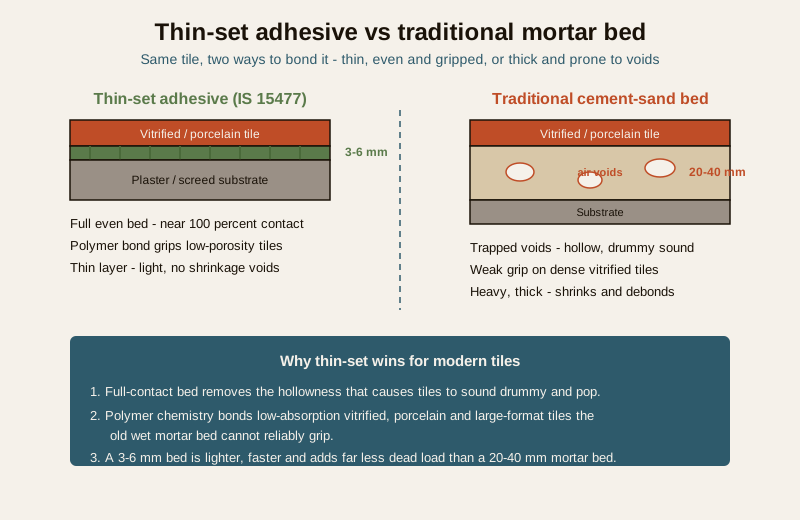
The thin-bed method also lets you tile tile-on-tile - straight over sound existing tiles without hacking them off - and it is the only reliable way to fix large-format and gauged porcelain slabs, whose weight and low porosity make a mortar bed a debonding risk. For the flooring choices that sit on top of all this, see our flooring hub.
The IS 15477 types - named simply
Indian tile adhesives are graded to IS 15477, the standard for cement-based tile adhesives, which sorts them broadly by bond strength. You will see them sold as "Type 1 / Type 2 / Type 3" and, in the international shorthand most bags also print, as C1, C2 and C2-improved. Higher classes mean stronger, more flexible bonds for harder jobs - not that a lower class is "bad". You simply step up the grade as the tile gets denser, bigger, or the location gets wetter or more exposed.
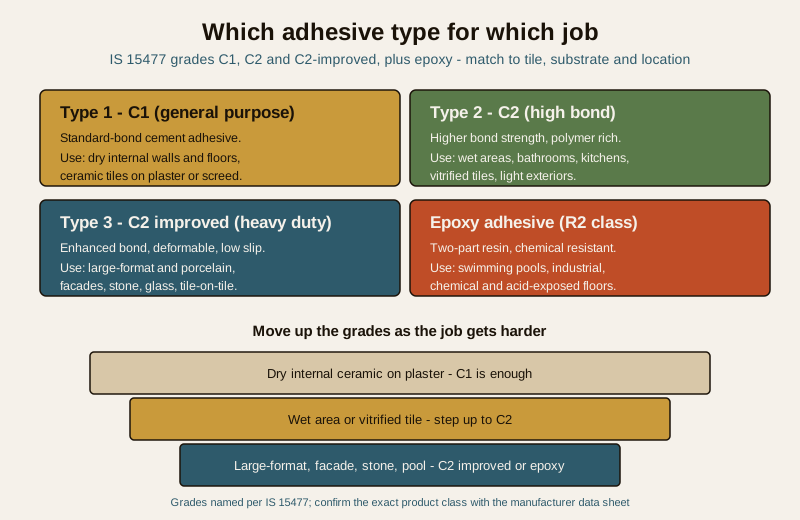
- Type 1 (C1) - general purpose. A standard-bond cement adhesive for dry internal walls and floors - ceramic tiles on plaster or a cement screed in bedrooms, living rooms and dry passages. The economical default where conditions are easy.
- Type 2 (C2) - high bond. A polymer-rich adhesive with markedly higher bond strength for wet areas and denser tiles - bathrooms, kitchens, balconies, and vitrified tiles where C1 would not hold. This is the workhorse grade for most Indian homes.
- Type 3 (C2-improved) - heavy duty. An enhanced, more deformable adhesive for the hardest jobs - large-format and porcelain tiles, exterior facades and cladding, natural stone, glass mosaic, and tile-on-tile - where extra bond and the ability to flex without cracking matter.
- Epoxy adhesive (R-type). A two-part resin adhesive, not cement-based, that is chemically resistant and waterproof for swimming pools, industrial and chemical-exposed floors, and acid or food-processing areas. It is costlier and needs skilled handling but is unmatched where cement adhesives would be attacked. Epoxy also crosses over into grouting - see our epoxy grouts and tile grouts guide.
| Location / tile | Recommended grade | Why |
|---|---|---|
| Dry internal floor / wall, ceramic tile | Type 1 (C1) | Easy, absorbent tile on sound plaster or screed |
| Bathroom, kitchen, balcony, wet areas | Type 2 (C2) | Higher bond, tolerates moisture and denser tiles |
| Vitrified tile, internal | Type 2 (C2) | Low-absorption tile needs polymer grip |
| Large-format / porcelain (600 mm plus) | Type 3 (C2-improved) | Weight and low porosity need top bond and flex |
| Exterior facade, cladding, stone | Type 3 (C2-improved) | Wind, thermal movement and exposure demand deformability |
| Tile-on-tile (over existing tiles) | Type 3 (C2-improved) | Bonds to glazed, non-porous existing surface |
| Swimming pool, chemical / industrial floor | Epoxy adhesive | Permanent water and chemical resistance |
Do not treat these as clause-exact rules; IS 15477 defines the classes and test methods, but the exact product for your tile and substrate is a call for the manufacturer's data sheet and a qualified applicator. When in doubt, go one grade higher rather than lower - the cost difference per bag is small against the cost of a floor that debonds.
How to choose - substrate, tile and location
Three questions settle the choice. First, what is the substrate? A sound cement plaster or screed takes any grade; a green (fresh) concrete, a smooth RCC surface, a gypsum plaster, a cement board or an existing tiled floor each need the right grade and often a primer so the adhesive keys properly. Cement boards and drywall backers are a common wet-area substrate - see our cement boards and fibre cement guide for what to tile onto in bathrooms.
Second, what is the tile? The lower a tile's water absorption, the more polymer grip it needs: highly absorbent ceramic is forgiving (C1 fine), while vitrified and porcelain are glassy and want C2 or C2-improved. Size compounds this - a heavy 800 mm slab needs a stronger, more deformable bed than a 300 mm tile, and often back-buttering as well.
Third, where is it and what will it face? Dry, indoor and lightly used means C1. Wet, heated, frozen, outdoors or chemically loaded means step up: C2 for wet areas, C2-improved for facades and exteriors that see sun-and-rain thermal cycling, epoxy for pools and chemical floors. Under any wet-area tiling, the tile adhesive does not replace waterproofing - the membrane goes first, then you tile over it; our waterproofing guide covers that layer, which is a separate and non-negotiable step.
Coverage and notched-trowel basics
Tile adhesive is combed onto the substrate with a notched (toothed) trowel whose notch size sets the bed thickness and therefore the coverage. Bigger tiles need bigger notches and use more adhesive. As a rough guide, small wall tiles use a 6 mm notch, 300 to 600 mm floor tiles a 10 to 12 mm notch, and large-format 600 mm-plus tiles a 12 to 20 mm notch - often with adhesive back-buttered onto the tile too for full contact.
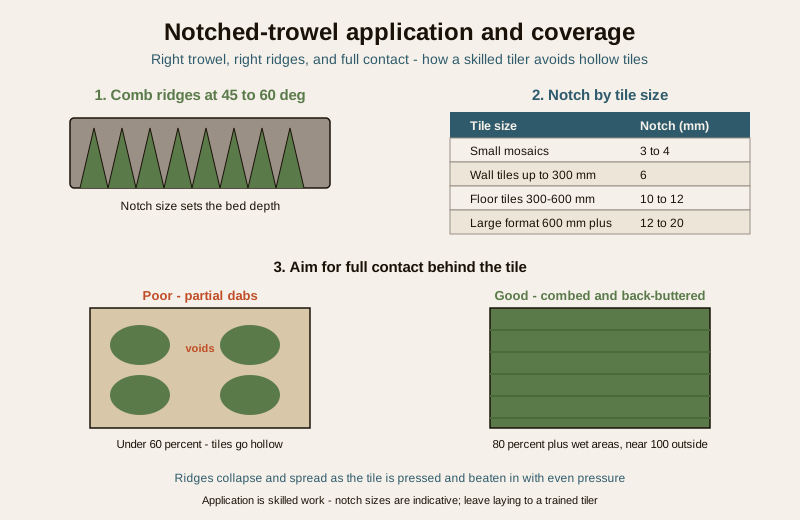
The single most important quality target is coverage - the percentage of the tile back actually stuck to adhesive. Aim for at least 80 percent contact in wet areas and near 100 percent outdoors and for heavy tiles; anything much under 60 percent leaves voids that will sound hollow and fail. Two things kill coverage: adhesive that has "skinned over" past its open time before the tile is set, and setting tiles into partial dabs instead of a properly combed and beaten-in bed. Both are why laying is skilled work.
To turn all this into a number of bags for your job, use our tile adhesive calculator - give it your area, tile size and notch, and it estimates the adhesive quantity so you specify rather than guess.
| Factor | Thin-set tile adhesive | Traditional cement-sand mortar bed |
|---|---|---|
| Bed thickness | 3 to 6 mm (up to ~12 mm large tiles) | 20 to 40 mm |
| Bond to vitrified / porcelain | Strong (polymer grip) | Weak and unreliable |
| Hollowness risk | Low - full combed contact | High - trapped voids common |
| Dead load on slab | Light | Heavy |
| Consistency | Factory-controlled mix | Varies with mason and site sand |
| Tile-on-tile / large format | Yes, purpose-made grades | Not reliable |
| Speed and mess | Fast, clean | Slow, wet, more waste |
| Upfront material cost | Higher per bag | Lower (cement and sand) |
| Whole-job cost and durability | Lower failure and rework | Higher risk of debonding |
Common failures and how the right adhesive prevents them
Two complaints dominate tiling: tiles that debond (lift, crack or pop) and hollowness (a drummy sound when tapped). Both trace back to bond and contact. Debonding happens when the adhesive cannot hold the tile - the wrong low grade under a dense or large tile, a dirty or unprimed substrate, tiling over green concrete that is still shrinking, or missing movement joints so thermal expansion tears the bond. Hollowness is the void problem - a thick uneven mortar bed, or thin-set set past its open time or into dabs.
The right adhesive, correctly specified, heads both off: a C2 or C2-improved grip on the tile, a combed full-contact bed, a primed and sound substrate, and movement/expansion joints in large or exterior areas. What the adhesive cannot fix is a bad substrate or a missing waterproofing layer - those are the applicator's and consultant's job. This is the same "specify the material, defer the execution" logic that runs through our whole materials library, from the complete building materials guide pillar to the family of construction adhesives used across a build.
Sustainability and cost notes
Tile adhesive is cement-based, so it carries cement's embodied-carbon footprint, but a thin 3 to 6 mm bed uses far less material than a thick mortar bed and produces less on-site waste and water use - a modest net saving. Low-dust and low-VOC formulations improve site air quality; epoxy adhesives are higher-impact to make but very long-lived. As a rough guide, cement tile adhesives run roughly Rs 12 to Rs 40 per kg (a 20 kg bag covers a modest area depending on notch and tile), with C2 and C2-improved dearer than C1, and epoxy adhesives several times higher. Treat these as ballpark material-only figures - add primer, waterproofing, grout, trowels and skilled labour, and confirm with local suppliers and current data sheets. For green-building context, low-emission adhesives and grouts contribute to GRIHA, IGBC and LEED indoor-environment credits.
Key takeaways
- Tile adhesive (thin-set) beats the cement-sand mortar bed for modern tiles - stronger bond, thin even bed, far less hollowness and debonding.
- IS 15477 sorts adhesives into Type 1 (C1) general, Type 2 (C2) high-bond, Type 3 (C2-improved) heavy-duty, plus epoxy for pools and chemical floors.
- Choose by substrate, tile and location: C1 for dry internal ceramic, C2 for wet areas and vitrified, C2-improved for large-format, facades, stone and tile-on-tile, epoxy for pools and industrial.
- Coverage is everything - comb with the right notched trowel, set within the open time, and target 80 to 100 percent contact to avoid hollow, drummy tiles.
- Tile adhesive does not replace waterproofing under wet areas, and laying is skilled work - specify the grade, and leave surface prep and installation to a trained tiler.
References
- Bureau of Indian Standards - IS 15477 covers cement-based tile adhesives and their classification and test methods; consult the current edition for grade definitions and marking.
- National Building Code of India (SP 7:2026) - general provisions for finishes, wet areas and building envelopes.
- GRIHA / IGBC / LEED - green-building rating references for low-emission adhesives, grouts and indoor environmental quality credits (general).
- Studio Matrx guides: construction chemicals guide, construction adhesives, epoxy grouts and tile grouts, waterproofing guide, cement boards and fibre cement, the flooring hub, the complete building materials guide and the tile adhesive calculator.
Export this guide
Related Guides — Deep-dive reading
Epoxy Grout vs Cement Grout for Tiles in India: Which to Specify (2026)
A plain-English guide to tile grouts for Indian homes: what grout does, how cementitious grout compares with epoxy grout on cost, stain and water resistance, hygiene and durability, and exactly where each one belongs - kitchens, bathrooms, pools, dry rooms and more.
Building MaterialsPorcelain, Ceramic & Sintered-Stone Facade Cladding in India: A Practical Guide
Thin large-format porcelain and sintered-stone slabs can clad a building with the look of marble, concrete or weathered steel at a fraction of stone's weight — but on a facade, the fixing system is a life-safety decision, not a finish choice.
Building FacadesBathroom Wall Tiles in India: The Complete Guide to Wall Finishes
Ceramic vs porcelain wall tiles, sizes and large-format, full-height vs dado, highlighter walls, layout and setting-out, adhesive vs cement, grout and epoxy grout — plus paint, panels, stone and glass alternatives. India-first, with ₹ costs and IS codes.
BathroomsRelated Tools — Try Free
Tile Adhesive Calculator
Estimate tile adhesive bags and cost by area and bed thickness, for floor or wall tiling jobs.
Flooring CalculatorGrout Quantity Calculator
Estimate grout in kg and cost by tile size, joint width and thickness — cement or epoxy grout.
Flooring CalculatorPool Tile Calculator
Floor, wall and waterline area and the total number of tiles for your pool, with a wastage allowance.
Pool Calculator