
How to Stop Door Draughts: DIY Sealing Guide India 2026
Seal the four sides of any door to block draughts, dust, insects, noise and AC loss — a step-by-step DIY guide with Indian prices.
If you can feel a breeze, see daylight, or watch dust and insects creep in around a shut door, you have an air-leak problem — and learning to stop door draughts is one of the cheapest, most satisfying weekend DIY jobs in any Indian home. The same gaps that let cold monsoon air or summer heat in are also where your air-conditioning quietly escapes, where street dust settles, and where mosquitoes and lizards sneak through. Sealing them properly can cut AC running cost, keep rooms cleaner, and dampen corridor noise — all for a few hundred rupees and an afternoon.
The trick is to think of a door as having four sides plus a keyhole, and to seal each one with the right product. Most people only fix the bottom and wonder why the draught remains. Below we go side by side. Difficulty: easy. Time: 1–3 hours. Cost: ₹150–1,200 DIY. No structural work, no carpenter needed for most homes.
Why doors leak, and why you should stop door draughts
Air always moves from higher pressure to lower — so when your AC cools a room or a ceiling fan and corridor create a pressure difference, air rushes through any gap it can find. A 5 mm gap running the full bottom of a standard 2,100 mm × 900 mm door is roughly the same open area as a 45 mm hole punched in the door. That is a lot of leaked cool air, and a clear runway for dust and insects.
In Indian homes the usual culprits are: oversized clearances left for monsoon swelling, doors that have shrunk in dry weather, worn-out original seals on uPVC/aluminium frames, and main doors that simply never had a bottom seal. Hard water and dust also clog any existing brush seals over time.
If the gap is there because the door itself is warped or the frame has dropped, sealing tape is only a patch — read warped door fix and fix sagging door first, because a seal cannot close a gap that keeps changing shape.
Find the leaks first (2-minute tests)
Before you buy anything, locate the actual leaks:
- Daylight test: stand inside a dark room in daytime with the door shut and look for light around the edges. Light = air gap.
- Paper test: close the door on a sheet of paper. If it slides out with no resistance at any point, that edge isn't sealing.
- Smoke/incense test: on a breezy day or with the AC on, run a lit agarbatti slowly around the door edge. Where the smoke streams sideways, air is moving — mark it with a pencil.
- Hand test: simply run a wet hand around the frame on a windy day; you'll feel the cold streams.
Tools & materials you'll need
- Tape measure and a pencil
- Scissors or a sharp utility knife
- A clean dry cloth and a little surface cleaner or spirit (adhesion fails on dusty surfaces)
- For the bottom: a door sweep / bottom seal (screw-on aluminium-and-brush or stick-on rubber) or a fabric draught excluder (the simplest, no-fix option)
- For sides & top: self-adhesive foam or rubber weatherstrip tape, or compression P/E-profile strips
- For the keyhole: an escutcheon with a cover, or a small foam plug
- Optional: screwdriver and short screws (for screw-on sweeps), hacksaw (to trim metal sweeps)
How to seal each side — step by step
1. Clean and dry every surface you'll stick to. Wipe the frame rebate, the door bottom and the strike side with cloth and a little spirit, then let it dry. Adhesive seals fail almost only because of dust or grease.
2. Measure each side. Note the bottom width, both side heights, and the top width. Buy a little extra — seals are sold by the metre or in 5–6 m rolls.
3. Seal the bottom (biggest win). Measure the gap. For a stick-on rubber/silicone sweep, peel and press it to the bottom edge so the fin just brushes the floor when shut. For a screw-on sweep, hold it in place, mark holes, drill pilot holes, screw loosely, test the swing (it must clear the floor and any threshold), then tighten. If the floor is uneven, an automatic drop-down seal or a simple fabric excluder works better. Aim for light contact — too tight and the door is hard to close.
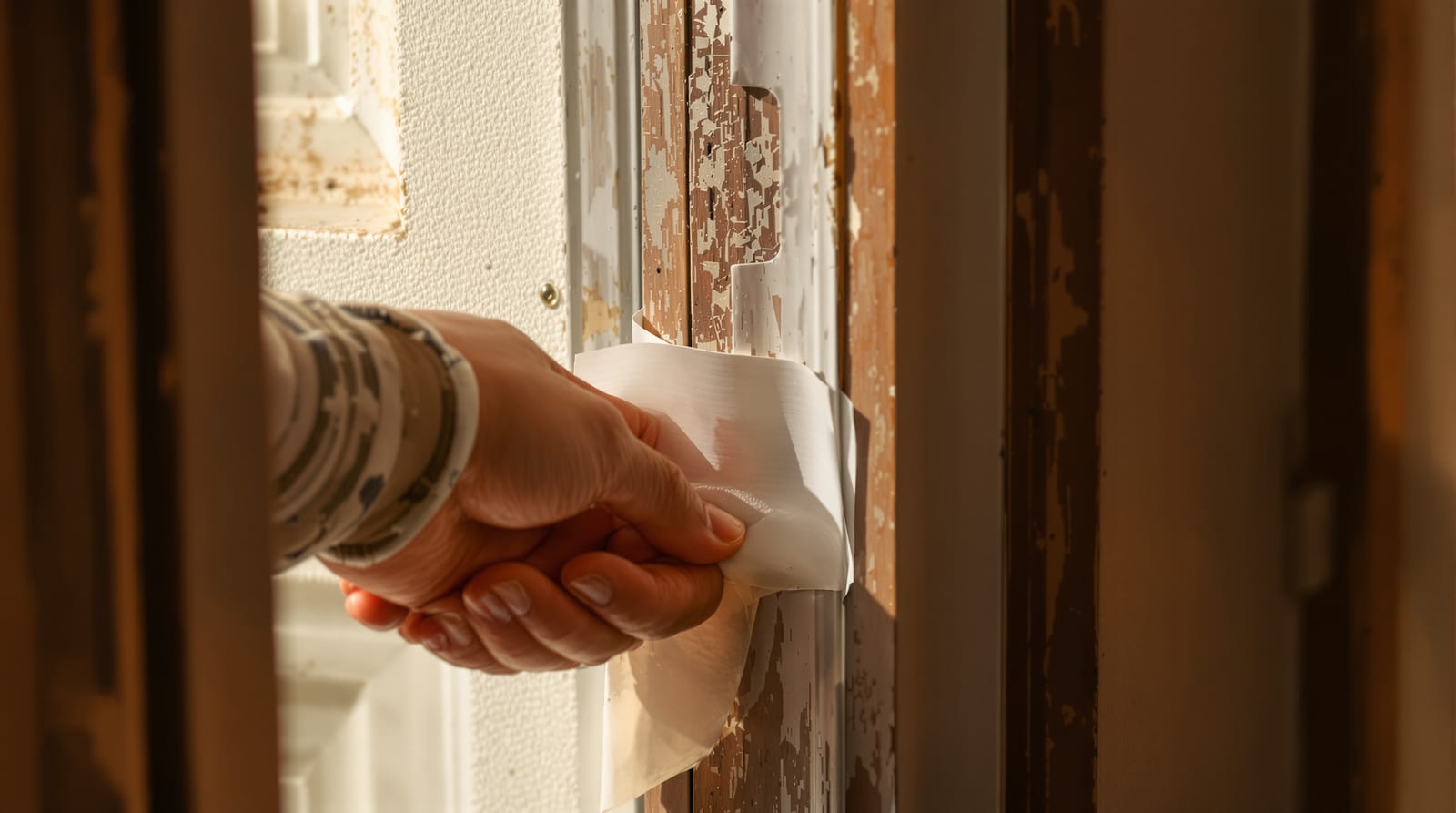
4. Seal the two sides and the top. Stick self-adhesive foam/rubber weatherstrip inside the frame rebate (the L-shaped recess the door closes against), so the door gently compresses it shut. Run it up one side, across the top, down the other side. Cut neat butt joints at the corners. Choose a thickness that fills your gap when compressed — too thick and the door won't latch.
5. Don't block the latch and hinges. Keep the strip just clear of the strike plate and hinge knuckles so the door still latches and swings.
6. Seal the keyhole and letterplate. Fit a keyhole escutcheon with a swivel cover, or push a small foam plug into an unused old-style keyhole. If you have a letterplate, add a brush flap behind it.
7. Test and adjust. Repeat the paper/smoke test. The paper should now grip lightly all around, and the door should still close with a normal push. If it slams hard or won't latch, switch to a thinner strip.
What seals which side
Which seal for which gap
| Gap location | Best product | Indian price (DIY) | Notes |
|---|---|---|---|
| Bottom (uneven floor) | Fabric draught excluder | ₹150–400 | No tools; slide it across when shut |
| Bottom (smooth floor) | Stick-on rubber/silicone sweep | ₹150–500 | Easiest fix; trims with scissors |
| Bottom (heavy/main door) | Screw-on aluminium + brush sweep | ₹300–1,000 | Most durable; needs drilling |
| Sides & top | Self-adhesive foam/rubber strip | ₹100–400/roll | Goes inside frame rebate |
| Sides & top (worn uPVC) | Replacement P/E-profile seal | ₹200–600 | Matches frame channel |
| Keyhole | Escutcheon with cover / foam plug | ₹50–300 | Small but real leak |
| Letterplate | Brush flap | ₹150–500 | Add behind the plate |
How much you'll save (and spend)
| Job | DIY cost | Carpenter / handyman | Difficulty | Time |
|---|---|---|---|---|
| Find leaks (tests only) | ₹0 | — | Easy | 10 min |
| Bottom sweep | ₹150–1,000 | ₹300–800 + part | Easy–moderate | 30–60 min |
| Sides + top weatherstrip | ₹100–600 | ₹300–700 | Easy | 30–45 min |
| Keyhole + letterplate | ₹50–800 | — | Easy | 15 min |
| Full door, all sides | ₹300–1,200 | ₹700–1,500 incl. parts | Easy | 1–3 hr |
Goods carry 18% GST; small repairs are mostly cheap parts. On an AC room, a well-sealed door noticeably reduces how long the compressor runs — try the door draught saving calculator to estimate your own gap and saving, and the door gap clearance checker to confirm your clearances are in a sealable range before you buy.
India realities to plan for
- Monsoon swelling: wooden doors swell in humidity, so don't seal so tightly that the door jams when wet. Leave a hair of play, or use a soft compressible foam. See fix swollen door monsoon.
- Dust: the same seals that stop draughts cut the fine street dust that coats floors near the main door — a big quality-of-life win in many cities.
- Insects: brush sweeps and tight side seals block mosquitoes, ants and the occasional lizard better than a loose curtain.
- Hard water & dust on tracks: for sliding and uPVC doors, clean the channel first or the seal won't seat. See sliding door track cleaning.
- Heat: stick-on adhesive can soften on a sun-baked main door; choose a heat-rated rubber strip or a screw-on sweep for exposed entrances.
When to stop and call a carpenter
Weatherstripping is genuinely DIY, but stop if: the gap is uneven because the door is warped or the frame has dropped (fix the cause first); the bottom rail is rotted or borer-eaten (a seal won't hold — see door bottom rot repair); or it's an automatic/sensor door — isolate power and call the installer rather than fitting seals near the operator. For a deeper run-through of edge and seal options, see door seals weatherstripping, and for a draughty bedroom that's also noisy, combine sealing with soundproof existing door DIY. For the full picture across every door topic, see the complete door guide and door troubleshooting.
Frequently asked questions
Will sealing my door really lower my electricity bill?
Yes, modestly but reliably for AC rooms. Sealed gaps mean less cooled air escapes, so the compressor cycles less. The bigger everyday wins are usually less dust and fewer insects — use the door draught saving calculator for a rough number on your own door.
My door is hard to close after I added weatherstrip. What went wrong?
The strip is too thick for the gap. Compression seals should let the door shut with a normal push. Peel it off and switch to a thinner foam, or move it slightly so it doesn't fight the latch and hinges.
What's the cheapest way to stop a draught under the door tonight?
A fabric draught excluder (the long stuffed tube) for ₹150–400. No tools, no sticking — just lay it against the bottom when the door is shut. A rolled towel works for one night in a pinch.
Can I seal a wooden door that swells in the monsoon?
Yes, but leave a little play and use soft compressible foam rather than a rigid strip, so the door still closes when humid. If it's already jamming when wet, fix the swelling first — see fix swollen door monsoon.
Do these seals also reduce noise?
They help — air gaps are also sound gaps, so sealing all four sides cuts corridor and street noise a little. For a real reduction you'll need mass on the leaf too; combine sealing with soundproof existing door DIY.
Export this guide
Related Guides — Deep-dive reading
Soundproof Doors in India: How Doors Leak Sound, STC Ratings, Seals & Real Costs
A door is the weakest acoustic link in any wall - and it usually leaks through the gaps, not the panel - so here is how to actually quieten a bedroom, home theatre or street-facing room, from a 1,500-rupee seal kit to a proper acoustic door.
Home Doors & EntrancesDoor Not Closing Properly? Fix It Step-by-Step (India 2026)
A clear decision tree for a door that won't shut — latch, hinge-bind, swelling, sag, warp or a moved frame — with DIY fixes and ₹ costs.
Home Doors & EntrancesDoor Repair Guide India: Fix Holes, Dents, Swelling, Hinges & Locks (2026)
A fix-it reference for Indian homes: every common door problem with a quick fix, a proper repair, a replace verdict, the materials needed, and indicative rupee costs.
Home Doors & EntrancesRelated Tools — Try Free
False Ceiling Cost Estimator
Live ₹/sqft across 8 ceiling types — POP, gypsum, designer, metal, PVC, wooden — with cove and spot lighting for 20 Indian cities.
Cost CalculatorCross-Ventilation Analyzer
Estimate airflow and air changes per hour (ACH) from room size, window areas, layout, and local wind — with NBC 2016 Part 8 compliance check.
Ventilation CalculatorDoor Draught Saving Calculator
See the AC energy and rupees you save by sealing the gaps around a door, plus the payback.
Savings Calculator