
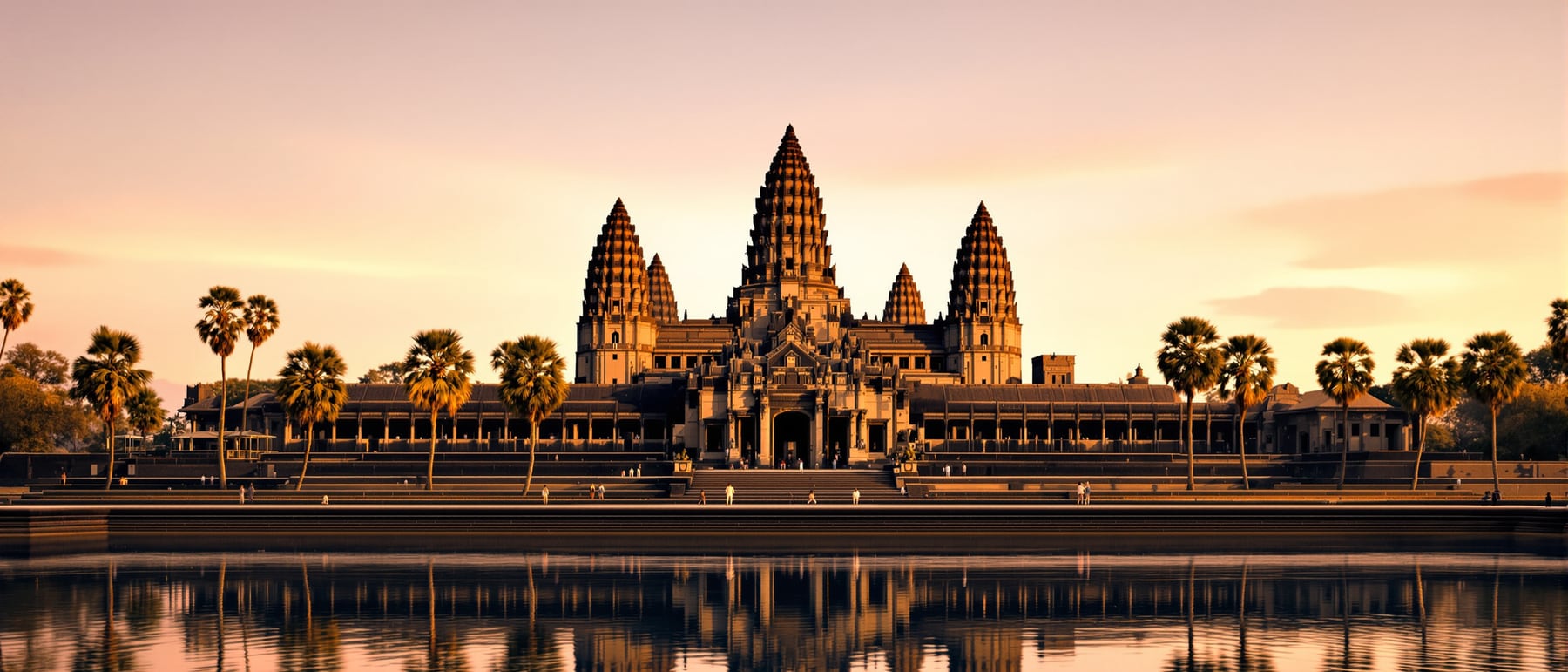
Angkor Wat: The Temple, the Tomb, and the Universe in One
How a Khmer god-king raised the largest religious monument on Earth — a mountain of sandstone that is at once a temple to Vishnu, a scale model of the cosmos, and his own mausoleum, turned uniquely to face the west and death, its walls carved with the gods churning the ocean for the elixir of immortality — the perfect close to a journey through the great tombs of the world.
We have come to the end of our journey through the great tombs of the world — from a Stone Age mound in Ireland to a pharaoh's painted underworld, a Maya king's hidden crypt, a keyhole of earth in Japan. And we close it in the jungles of Cambodia, before the largest religious monument ever built, with a temple that gathers up every theme of the whole series into a single, overwhelming whole.
Angkor Wat is, first, a temple — a mountain of sandstone raised to the god Vishnu by a Khmer king in the twelfth century. It is, second, a model of the entire universe, its towers the peaks of the cosmic mountain, its moat the ocean at the world's edge. And it is, third — most scholars agree — a tomb: the funerary temple of its builder, King Suryavarman II, who turned it, alone among all Khmer temples, to face the west and death, so that he might pass through it into the world of the gods and live forever. Temple, tomb, and cosmos, fused in one building. There is no more fitting place to end.
This is the forty-seventh article in our Architectural Wonders series, and the last of a chapter on great tombs.
1. The mountain that is a temple
Begin with the sheer, world-beating scale — because nothing prepares you for how big Angkor Wat is.
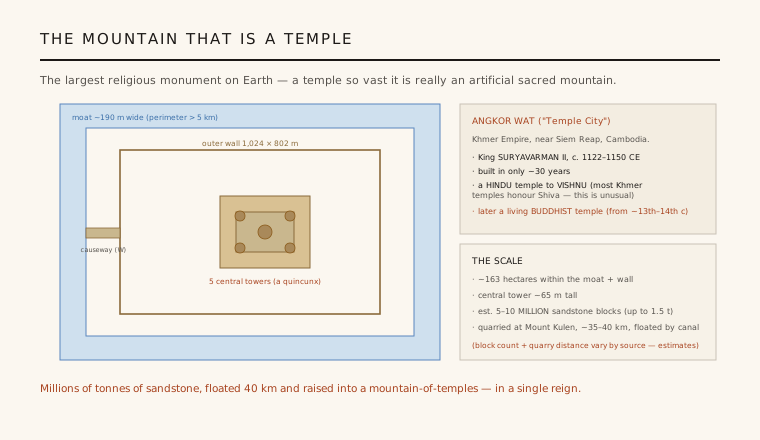
Angkor Wat — the name means "Temple City" — is the largest religious monument on Earth. A moat nearly two hundred metres wide and over five kilometres around encircles a rectangular wall more than a kilometre long; within it, a long raised causeway leads to a central temple-mountain crowned by its famous quincunx of five towers, the tallest rising some sixty-five metres. The whole enclosure covers about 163 hectares, built from an estimated five to ten million sandstone blocks — some weighing a tonne and a half — quarried at Mount Kulen, dozens of kilometres away, and floated to the site by canal. And it was raised by King Suryavarman II in only about thirty years, roughly 1122 to 1150 CE, as a Hindu temple to Vishnu — a genuinely unusual choice, since most Khmer state temples honoured Shiva. Later, gradually, it became a Buddhist temple, which it remains to this day: a living, worshipped place, never a mere ruin. It is, in raw ambition, the equal of anything in this series — the Pyramids of Giza laid down and spread across the jungle.
2. A model of the universe
But Angkor Wat is not merely big. Every stone of it means something — because the whole temple is a scale model of the cosmos itself.
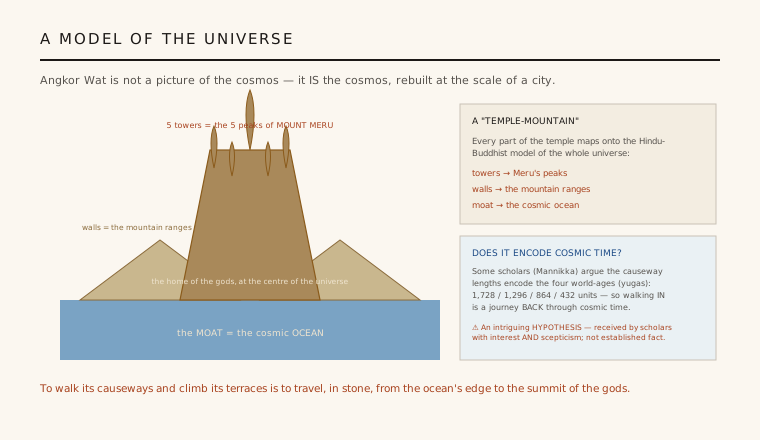
In the Hindu-Buddhist imagination, the universe is centred on Mount Meru, a cosmic mountain of five peaks that is the home of the gods, ringed by mountain ranges and a vast encircling ocean. And Angkor Wat is that universe, rebuilt in stone: its five towers are the five peaks of Meru; its concentric walls are the mountain ranges; its great moat is the cosmic ocean. It is a "temple-mountain" — to walk its causeways and climb its terraces is to journey, symbolically, from the edge of the world to the summit of the gods. It is the same profound idea we met at Kailasa, the Indian temple carved to be Shiva's holy mountain — the conviction that a building can be a working model of the whole of creation. Some scholars go further: the art historian Eleanor Mannikka has argued that the very lengths of the causeways encode the durations of the four world-ages (the yugas), so that to walk inward is to travel back through cosmic time. That last claim is an intriguing hypothesis, received by scholars with as much scepticism as interest — but the core idea, that Angkor Wat is a deliberate map of the universe, is not in doubt.
3. The temple that faces death
And now the theme that earns Angkor Wat its place in a series on tombs — because this cosmic temple to a living god was also, the evidence strongly suggests, built as a grave.
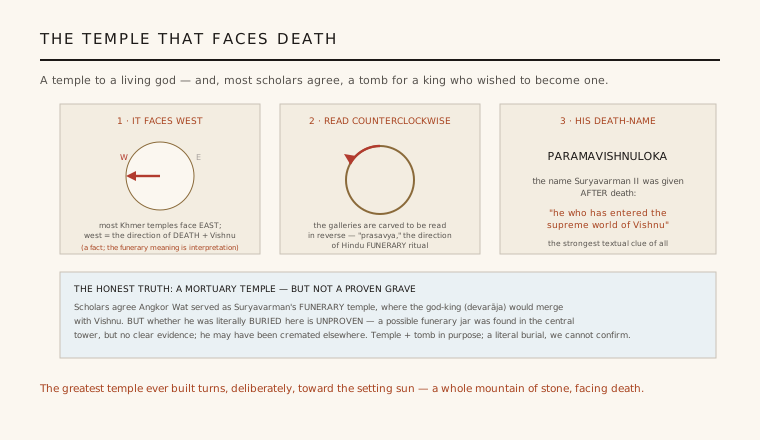
The Khmer believed their kings were god-kings (the devarāja), who at death would merge with the deity — and the scholarly consensus is that Angkor Wat served as Suryavarman II's funerary temple, the vehicle for his union with Vishnu. Three clues point that way. First, and most strikingly, the temple faces west — where nearly every other Khmer temple faces east toward the rising sun. West is the direction of the setting sun, of death, and of Vishnu. Second, its great bas-reliefs are carved to be read counterclockwise — the reverse of normal circumambulation, and precisely the direction used in Hindu funerary ritual. Third, and firmest, Suryavarman II was given a posthumous name — Paramavishnuloka — meaning "he who has entered the supreme world of Vishnu." And yet honesty requires a caveat, the same one that has haunted this whole series: whether the king was literally buried here is unproven. A vessel that may have been a funerary jar was recovered from the central tower, but there is no clear evidence; he may have been cremated elsewhere. So the truth is precise and moving: Angkor Wat was, in purpose, a temple and a tomb at once — the mortuary monument of a king who wished to become a god — even if his physical remains have never been found within it. Like Newgrange, where this journey began, it turns architecture itself toward the passage from death into something beyond.
4. The elixir of immortality
If any doubt remained that Angkor Wat belongs in a story about the human refusal of death, its walls settle it — for carved along them, at vast length, is the gods' own quest for eternal life.
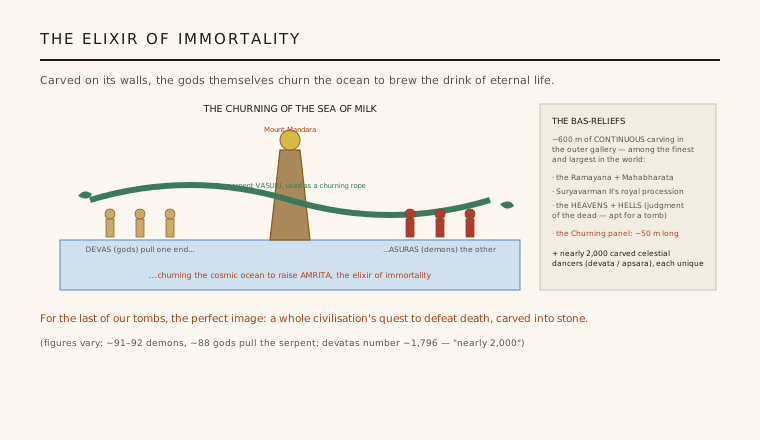
The outer gallery of Angkor Wat holds some six hundred metres of continuous bas-relief — among the largest and finest carved narratives in the world — unrolling the great Hindu epics, the Ramayana and Mahabharata, the historical procession of Suryavarman II himself, and the heavens and hells where the dead are judged. And its most celebrated panel, some fifty metres long, is the Churning of the Sea of Milk (Samudra Manthana): the gods and demons, in an uneasy alliance, wrap the great serpent Vasuki around the mountain Mandara and pull it back and forth like a rope, churning the cosmic ocean — in order to raise from its depths the amrita, the elixir of immortality. For the last of our tombs, there could be no more perfect image: an entire civilisation's yearning to defeat death, quite literally carved into the stone of a king's mortuary temple, watched over by nearly two thousand serene celestial dancers. Everything this whole series has been about — the human refusal to let death be the end — is written here, in a wall of gods reaching for the drink of eternal life.
5. A monument that never died
And here is the final wonder — the reason Angkor Wat is not just the grandest of the tombs but, in a sense, the only one that worked.
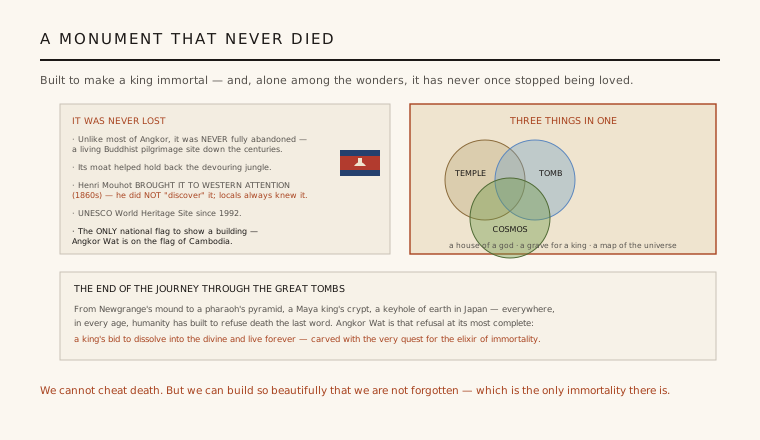
Almost every tomb in this series fell silent — sealed, robbed, ruined, forgotten. Angkor Wat never did. Unlike most of the great city of Angkor, which the jungle swallowed, Angkor Wat was never fully abandoned: it remained a living Buddhist pilgrimage site down the centuries, its wide moat helping to hold the devouring forest at bay. When the French naturalist Henri Mouhot wrote of it in the 1860s, he did not "discover" it — the Khmer had never lost it, and never stopped worshipping there. Today it stands on the flag of Cambodia — the only national flag on Earth to depict a building — and it has been a UNESCO World Heritage Site since 1992. Consider what that means: Suryavarman II built this mountain to carry him into the world of the gods and make him immortal. We cannot say whether his soul found Vishnu. But his monument achieved exactly what every builder in this series hoped for and almost none attained — it was never forgotten, never fell dark, and is loved and walked and prayed in still, nine centuries on. And that is the truth the whole journey through the great tombs has been circling toward, from the mound at Newgrange to a queen's marble Taj Mahal: we cannot cheat death — but we can build so beautifully, and mean it so deeply, that we are not forgotten. That is the only immortality architecture can honestly offer. And it is, in the end, the reason Studio Matrx exists at all — to build, in memory and love, things that reach across time to whoever comes after.
6. What a modern architect can learn from Angkor Wat
- A building can hold many truths at once. Angkor Wat is temple, tomb, and cosmos in a single structure, with no contradiction. The richest architecture is layered — it can serve function, faith, memory and meaning simultaneously, each deepening the others.
- Orientation is a statement. Turning the whole temple west, toward death, against all convention, was a deliberate, legible choice. The way a building faces — to the sun, the water, the city, the grave — is never neutral; it speaks before a single wall is read.
- Scale can be made meaningful, not just impressive. Angkor Wat's vastness means something: it is the universe at full size. Bigness for its own sake is empty; bigness in the service of an idea is sublime.
- Encode the message in the whole design. The towers, walls, moat, causeways and reliefs all say the same thing. When every element of a building reinforces one clear idea, the result reads with a power no amount of ornament can fake.
- The best monuments stay alive. Angkor Wat endured because it was never abandoned — it kept being used, worshipped, loved. Design for continued life, not just for the opening day; a building's deepest success is measured in centuries of use.
- And, across all the great tombs: every culture, in every age, has built to refuse death the last word — and what survives is not the body but the work, and the love and meaning poured into it. Build things worth remembering; it is the truest, and perhaps the only, way to reach across time.
References & further reading
1. UNESCO World Heritage Centre — Angkor (inscribed 1992). https://whc.unesco.org/en/list/668/
2. World History Encyclopedia — Angkor Wat. https://www.worldhistory.org/Angkor_Wat/
3. Encyclopaedia Britannica — Angkor Wat. https://www.britannica.com/topic/Angkor-Wat
4. Smarthistory (Khan Academy) — Angkor Wat. https://smarthistory.org/angkor-wat/
5. APSARA National Authority (official Angkor management body). https://www.angkor.gov.kh/
6. Eleanor Mannikka — Angkor Wat: Time, Space, and Kingship (University of Hawai'i Press) — for the cosmological-time interpretation (a scholarly hypothesis).
Last verified 2026-07-04. Figures follow UNESCO and standard scholarly sources and are given as widely cited approximations that vary by source. Angkor Wat, the largest religious monument in the world, was built under King Suryavarman II (r. 1113–c.1150) around 1122–1150 CE (build time ~28–40 years) as a Hindu temple to Vishnu, later gradually becoming Buddhist (from ~13th–14th c.); it remains a living place of worship. It covers ~162.6 ha; the outer wall is 1,024 × 802 m, the moat ~190 m wide, the central tower ~65 m high; an estimated 5–10 million sandstone blocks were quarried at Mount Kulen (~35–40 km, source-variable) and floated by canal. The Mount Meru cosmology (five towers = Meru's peaks, walls = ranges, moat = ocean) is the standard interpretation; the yuga/cosmic-time encoding (Mannikka) is an intriguing hypothesis received with scepticism, not established fact. The funerary/mortuary-temple function is scholarly consensus, supported by the unusual west orientation (a documented fact whose funerary meaning is interpretation, with some counter-argument), the counterclockwise (prasavya) bas-reliefs, and the king's posthumous name Paramavishnuloka; a literal burial/interment at the site is UNPROVEN and debated (a possible funerary jar was found in the central tower). The ~600 m of bas-reliefs include the ~50 m Churning of the Sea of Milk (Samudra Manthana; ~91–92 asuras / ~88 devas, minor source variance) and nearly 2,000 devata/apsara carvings. Angkor Wat was never fully abandoned (a continuous Buddhist pilgrimage site); Henri Mouhot brought it to Western attention (1860s) but did not "discover" it; it appears on Cambodia's national flag (the only flag depicting a building). Angkor is a UNESCO World Heritage Site (1992).
Export this guide
Related Guides — Deep-dive reading
Borobudur: The Mountain You Climb to Reach Enlightenment
In the volcano-ringed heart of Java, around 1,200 years ago, Buddhist kings built the largest Buddhist monument on Earth — not a temple you enter but a solid stone mountain you climb: a three-dimensional map of the universe, wrapped in 2,672 carved panels and 504 Buddhas, that turns the path to enlightenment into a walk you take with your feet. Then it was abandoned, buried under ash and jungle, and rebuilt, stone by million-stone, in our own age.
Architectural WondersThe Pyramid of the Sun: A Mountain Raised Over a Cave by a People With No Name
In the Valley of Mexico, a civilisation we cannot name built one of the largest pyramids on Earth — a man-made mountain of a million cubic metres — and set it precisely over a sacred cave they believed was the womb of the world. They left no writing we can read; even the words 'Pyramid of the Sun' were given, a thousand years later, by the Aztecs, who found the city in ruins and called it the birthplace of the gods.
Architectural WondersAbu Simbel: The Temple a Pharaoh Cut Into a Mountain — and the World Moved to Save It
How Ramesses the Great hollowed two temples out of a Nubian cliff, guarded them with four twenty-metre giants of himself, and aimed the whole mountain so precisely that twice a year the rising sun still races sixty metres into the dark to touch the gods at the very back — and how, three thousand years later, more than fifty nations sawed the temples into a thousand pieces and lifted them bodily up the cliff to escape a rising lake.
Architectural WondersRelated Tools — Try Free
Before & After Studio
Generate AI before-and-after renders to preview how your redesign could look.
DesignAICross-Ventilation Analyzer
Estimate airflow and air changes per hour (ACH) from room size, window areas, layout, and local wind — with NBC 2016 Part 8 compliance check.
Ventilation CalculatorWindow Orientation Planner
Pick the best window type, glass and shading by wall direction — north, east, south and west.
Window Tool