
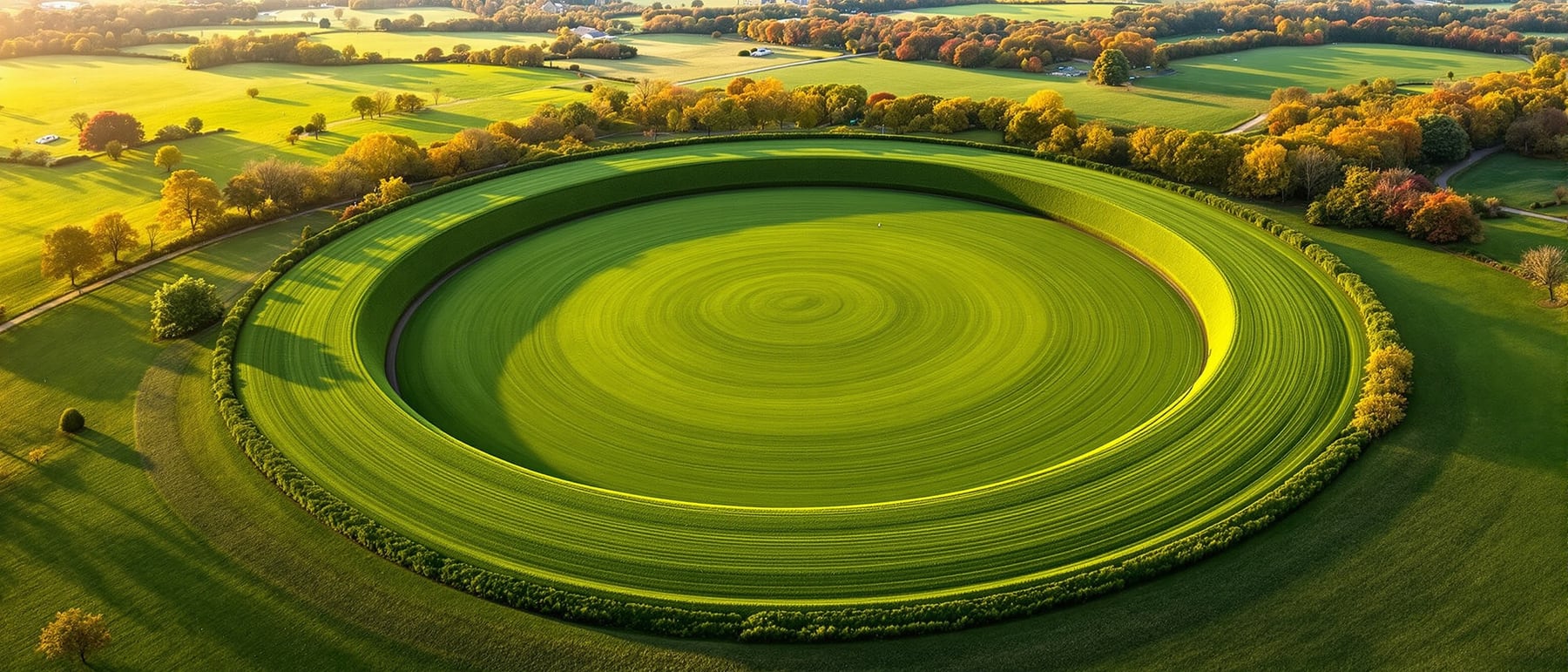
The Newark Earthworks: A Cathedral of Earth Aligned to the Moon
Two thousand years ago, in what is now Ohio, Native American people raised the largest set of geometric earthworks on Earth — mile-wide circles, a perfect octagon, squares and avenues, all shaped from piled soil without metal, wheels or writing. And they aligned one of them, with astonishing precision, to the full 18.6-year cycle of the moon. Much was bulldozed for a city; one great piece spent over a century as a golf course; in 2023 it finally became a UNESCO World Heritage Site.
From the Pantheon — the pinnacle of a literate, imperial, concrete-pouring civilisation, whose oculus catches the sun — we cross the Atlantic and go back a thousand years, to something that could hardly be more different, yet does something uncannily similar. In what is now Ohio, Native American people built the largest set of geometric earthworks on the planet — not in stone or concrete, but in piled earth — and tuned one of them, with breathtaking precision, to the moon. Where the Pantheon is a permanent building you step inside, the Newark Earthworks are a vast landscape you walk across. And where Rome had engineers, writing and iron, these builders had none of those things — and achieved geometry and astronomy to rival any of them.
This is the fifty-eighth article in our Architectural Wonders series, and the eleventh in our chapter on the great temples and sacred places of the world.
We must begin with an act of honesty and respect. We do not know what these builders called themselves; archaeologists label them the "Hopewell," after the nineteenth-century owner of a farm where their artefacts were found — a borrowed, accidental name, like so much in this chapter. They were ancestors of Native American nations living today, for whom this ground remains sacred. And their masterpiece was very nearly lost — first to a growing city, then, astonishingly, to a golf course. That it survives at all is part of its wonder.
1. Geometry drawn on the land
The first thing to grasp is the sheer, precise scale of what was shaped here — by hand, from soil.
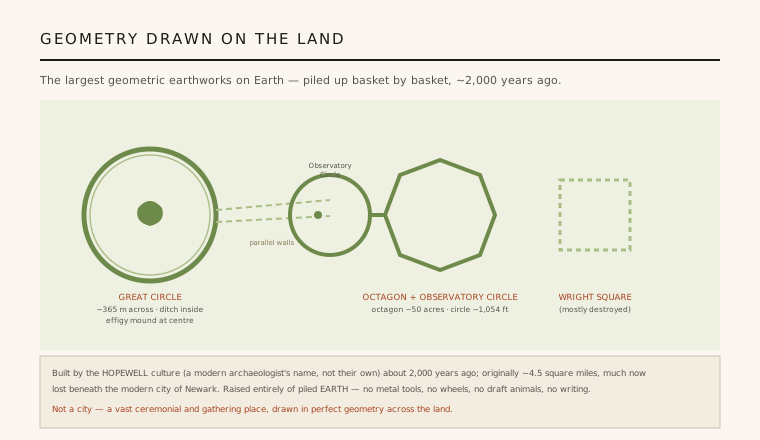
Around two thousand years ago (roughly the first four centuries CE), the Hopewell laid out, across what is now the city of Newark, Ohio, an interconnected complex of geometric earthworks that originally sprawled over about four and a half square miles — the largest set of geometric earthen enclosures in the world. There was a Great Circle, a ring about 365 metres across, its embankment wall backed by a ditch on the inside (a sure sign it was for ceremony, not defence — you don't dig your moat inside your wall), with a low effigy mound at its heart. There was the Octagon — a precise eight-sided figure of eight long walls — joined to an equally precise circle, the Observatory Circle. There was a great square, the Wright Earthworks. And long parallel walls once ran between them, connecting the whole into a single ceremonial landscape (some believe an avenue may even have run some 90 kilometres south to another earthwork centre, though that "Great Hopewell Road" is debated). All of it was raised basket-load by basket-load of earth, by people with no metal tools, no wheels, no draft animals, and no writing — the same constraints under which the builders of the Pyramid of the Sun raised their mountain in Mexico. And it was not a city — almost no one lived here. It was a place people came to: a vast cathedral of soil for ceremony, gathering, and watching the sky.
2. A network, not a nation
To understand who could build this, you have to abandon the idea of an empire. The Hopewell were something stranger, and in a way more remarkable.
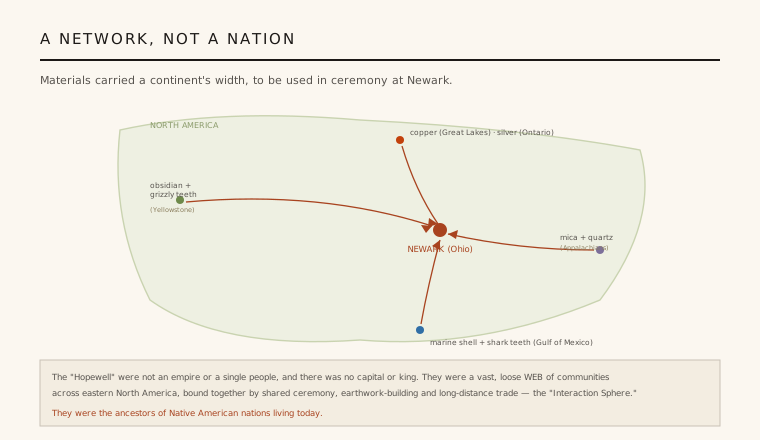
There was no Hopewell empire, no capital, no king — no single "Hopewell people" at all. What scholars call the Hopewell Interaction Sphere was a vast, loose web of communities spread across eastern North America, bound together not by conquest but by shared ceremony, shared geometry, and long-distance trade — the same power of pilgrimage over conquest that built Chavín de Huántar in the Andes. And the reach of that trade is staggering. Into ceremonial centres like Newark flowed precious materials carried thousands of kilometres across the continent: obsidian (volcanic glass) and grizzly-bear teeth from the Yellowstone region in the far west; copper from the Great Lakes and silver from Ontario; mica and clear quartz crystals from the Appalachians; marine shell and shark teeth from the Gulf of Mexico. These were not everyday goods; they were brought here to be worked into sacred objects and offered up in ceremony. Picture it: a continent-wide network of independent communities, with no writing to coordinate them, nonetheless sharing a common sacred geometry and a supply chain reaching from Wyoming to the Gulf. The Newark Earthworks are the cathedral of that network — and their builders were the ancestors of Native nations who are still here.
3. A moon machine of earth
Now the astonishment. The Octagon and its circle are not just beautiful geometry — they are a precision instrument, aimed at the most difficult target in the sky.
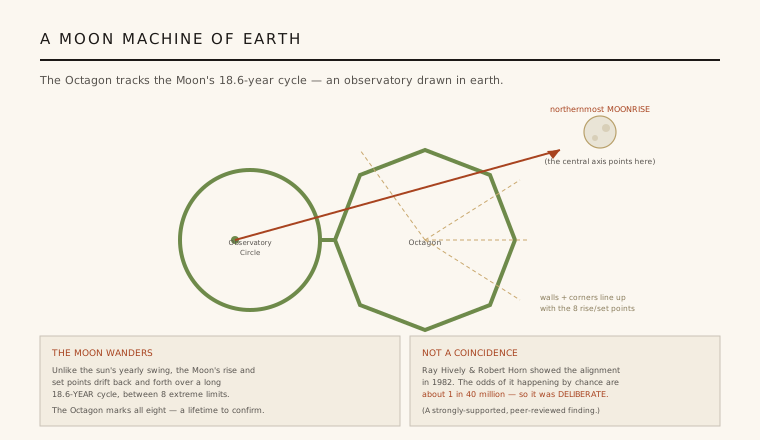
The sun is easy, relatively speaking: its rising and setting points swing between two limits and back over a single year. The moon is fiendishly harder. Its rising and setting points wander through a far more complex pattern that takes a full 18.6 years to complete — drifting out to extreme limits and back, eight key points in all. To detect that pattern, you must watch the horizon carefully for nearly two decades, across a span longer than a childhood, and remember. And the Hopewell did exactly that — then built the answer into the ground. In 1982, the researchers Ray Hively and Robert Horn demonstrated that the walls and corners of the Octagon, and its long central axis running out from the Observatory Circle, are aligned to the eight extreme rising and setting points of the moon across its 18.6-year cycle. The main axis points to the northernmost moonrise, the "maximum northern standstill." The odds of such a match occurring by chance are estimated at about one in forty million — this was deliberate. The Newark Octagon is, in effect, a lunar Stonehenge built of earth — a machine for tracking the moon, laid out by people who had watched the sky with a patience that spanned generations. (This is a strongly-supported, peer-reviewed finding, and one echoed in the same instinct we saw at Stonehenge.)
4. Surveying a perfect circle by hand
Set the astronomy aside for a moment and consider only the geometry. It should not have been possible.
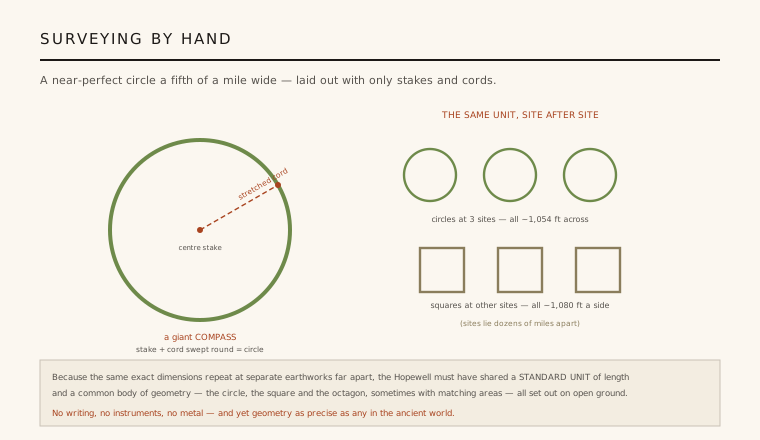
The Observatory Circle is very nearly a perfect circle, about 1,054 feet (321 metres) across; the Octagon beside it is a true, regular eight-sided figure. Laying out shapes that large and that accurate, on open ground, is hard even with modern instruments. The Hopewell had none. And here is the detail that turns skill into genius: the same measurements repeat. Separate circle earthworks scattered dozens of miles apart are all almost exactly 1,054 feet in diameter; several square earthworks are all about 1,080 feet on a side. That can only mean the Hopewell shared a standard unit of length and a common body of geometric knowledge — a circle, a square and an octagon that they could reproduce, precisely, across a whole region. They almost certainly did it the way you would draw a circle with a compass, only at giant scale: a stake at the centre and a stretched cord swung round to trace the ring; cords and stakes to strike the straight lines and equal angles. No writing, no instruments, no metal — and yet geometry as exact as anything in the ancient world, worked out and remembered and taught, entirely by mind, hand and cord.
5. Lost, golfed, and reclaimed
The last part of the story is the hardest, and the most modern — and it is only just now turning toward hope.
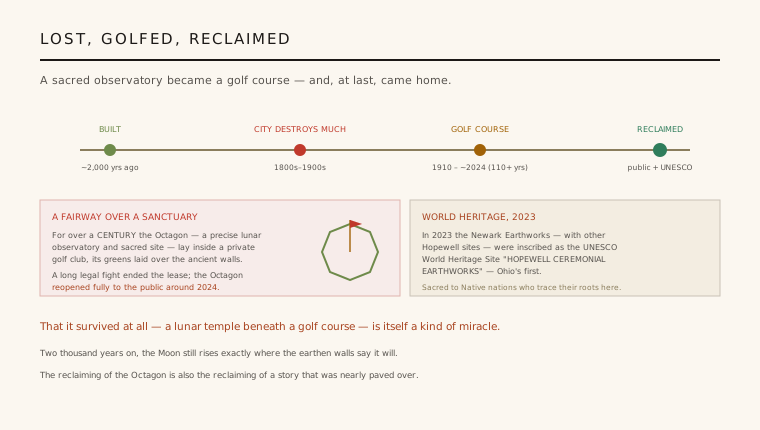
As the American city of Newark grew through the 1800s and 1900s, most of the earthworks were flattened — levelled for streets, houses and factories. Two great pieces survived: the Great Circle, and the Octagon. But the Octagon's fate is one of the strangest in this whole series. In 1910 the land was leased to a private country club, and for more than a hundred and ten years the Octagon Earthworks — a sacred lunar observatory two thousand years old — sat inside a golf course, its ancient walls mown into fairways and greens, its interior open only to club members. It took a long and painful legal battle for the Ohio History Connection to end the lease and return the Octagon to the public, which finally happened around 2024. And in 2023, the Newark Earthworks, together with other Hopewell sites in Ohio, were inscribed as a UNESCO World Heritage Site — the "Hopewell Ceremonial Earthworks," Ohio's first. There is something almost unbearably moving in that arc: a temple to the moon, nearly paved over, then quietly kept alive under a golf course, and at last recognised as one of humanity's great works — and returned to the descendants of the people who built it. Two thousand years on, the moon still rises exactly where the earthen walls say it will.
6. What a modern architect can learn from the Newark Earthworks
- Architecture does not require stone. The Hopewell made monumental, precise, enduring works out of the humblest material there is — earth. It is a lesson in seeing the possibilities in ordinary material, and in the fact that ambition and intelligence, not luxury, make great building.
- Great design can be a landscape, not an object. Newark is not a building but a shaped piece of ground you move through. Some of the most powerful architecture is horizontal and immersive — experienced by walking, at the scale of the land itself.
- Patience is a design tool. To align earthworks to the moon, the builders had to observe for nearly twenty years before they could even build. Some things worth making require a timescale longer than a career — and a willingness to build for people you will never meet.
- A shared standard lets many hands make one thing. A common unit of measure and a common geometry let a decentralised network raise consistent, precise works across a region. Standards are what let a community, rather than a single master, build greatness.
- What we inherit, we can neglect — or honour. The same earthworks were a sacred observatory, then a bulldozed inconvenience, then a golf course, then a World Heritage Site. A culture reveals itself in what it chooses to protect — and it is never too late to give something back its dignity. (A world away, the great Buddhist university of Somapura Mahavihara met a gentler version of the same fate — forgotten for centuries as a mere hill, then dug up and honoured.)
- Respect whose story you are telling. These are the works of living peoples' ancestors, on sacred ground. The first duty of anyone who builds on, studies, or writes about such a place is humility — to listen, to credit, and to return what was taken.
References & further reading
1. UNESCO World Heritage Centre — Hopewell Ceremonial Earthworks (inscribed 2023; includes Newark). https://whc.unesco.org/en/list/1689/
2. Ohio History Connection — Newark Earthworks and The Newark Earthworks and the Moon. https://www.ohiohistory.org/visit/browse-historical-sites/newark-earthworks/
3. The Ohio State University — Newark Earthworks Center / Hopewell Ceremonial Earthworks research. https://earthworks.osu.edu/
4. Hively, R. & Horn, R. — "Geometry and Astronomy in Prehistoric Ohio," Journal for the History of Astronomy (1982). https://articles.adsabs.harvard.edu/pdf/1982JHAS...13S...1H
5. Smithsonian Magazine — An Ohio Earthwork… Open to the Public (the golf-course reclamation, 2024). https://www.smithsonianmag.com/travel/
6. Encyclopaedia Britannica — Hopewell culture. https://www.britannica.com/topic/Hopewell-culture
*Last verified 2026-07-04. Figures follow UNESCO, the Ohio History Connection, the Ohio State University Newark Earthworks Center, and the research of Hively & Horn, and are given as widely cited approximations that vary by source. The Newark Earthworks (Newark, Licking County, Ohio, USA) are the largest set of geometric earthen enclosures in the world, built by the Hopewell culture c. 1–400 CE (broader Hopewell era c. 200 BCE–500 CE); "Hopewell" is a modern archaeological name (after a 19th-c. landowner), not the builders', who were ancestors of living Native American nations. The complex originally covered ~4.5 sq mi (much destroyed by the modern city). Surviving elements: the Great Circle (~365 m/1,200 ft diameter; embankment with an INTERNAL ditch; central "Eagle" effigy mound) and the Octagon Earthworks (an octagon of eight ~170 m walls, ~50 acres, joined to the Observatory Circle, ~1,054 ft/321 m diameter, with an Observatory Mound); plus the Wright Earthworks (square, mostly gone) and former connecting parallel walls (the ~90 km "Great Hopewell Road" to Chillicothe is hypothesised/debated). Built of piled earth (baskets) with no metal, wheels, draft animals or writing; ceremonial/gathering centres, not settlements. LUNAR ALIGNMENT: Hively & Horn (1982) showed the Octagon–Observatory Circle aligns to the eight extreme moonrise/moonset points of the 18.6-year lunar standstill cycle (central axis → maximum northern moonrise); odds of chance alignment ~1 in 40 million — a strongly-supported, peer-reviewed finding. GEOMETRY: a shared standard unit — separate circles across the region ~1,054 ft, squares ~1,080 ft — laid out precisely (probably by stake-and-cord) without instruments. TRADE: the Hopewell Interaction Sphere moved obsidian and grizzly teeth (Yellowstone), copper (Great Lakes), silver (Ontario), mica/quartz (Appalachians), and marine shell/shark teeth (Gulf) across the continent — a network, not a state. SURVIVAL: much leveled by the city; the Octagon was a private golf course (Moundbuilders Country Club) from 1910 for 110+ years; the Ohio History Connection ended the lease and reopened it to the public c. 2024. Inscribed as the UNESCO World Heritage Site "Hopewell Ceremonial Earthworks" in 2023 (Ohio's first).
Export this guide
Related Guides — Deep-dive reading
Cahokia and Monks Mound: The Great City America Forgot
A thousand years ago, across the river from where St Louis now stands, Native Americans built a city of perhaps twenty thousand people — larger than London at the time — with a hundred and twenty earthen mounds, a plaza the size of dozens of football fields, and a solar calendar of cedar posts. At its heart rose Monks Mound, the largest earthwork in the Americas, with a footprint to rival the Great Pyramid. Then, before Europeans ever arrived, it vanished — and almost no one remembers it.
Architectural WondersSomapura Mahavihara: The Buddhist University Hidden Inside a Hill
Twelve hundred years ago in Bengal, a Pala emperor built one of the largest monasteries the Buddhist world had ever seen — a walled quadrangle a fifth of a mile across, ringed by 177 monks' cells, with a great cross-shaped, terraced temple rising from its courtyard. For four centuries scholars came from as far as Tibet to study here; then it was abandoned, and slowly buried, until villagers knew it only as Paharpur — 'the hill-town.'
Architectural WondersThe Pantheon: The Dome That Has Never Been Beaten
Nearly nineteen centuries ago the Romans poured a hemisphere of concrete 43 metres across, left a single round hole open to the sky at its summit, and walked away — and it is still, today, the largest unreinforced concrete dome on Earth. A temple to all the gods that became a church, the best-preserved building of ancient Rome, and the ancestor of every great dome from Florence to the United States Capitol.
Architectural WondersRelated Tools — Try Free
Before & After Studio
Generate AI before-and-after renders to preview how your redesign could look.
DesignAICircadian Light Meter
Patient-centric circadian lighting visualizer for Indian healthcare design — time-of-day × intensity → CCT, melanopic lux (EML / mEDI), melatonin suppression, and an alertness curve. Calibrated against WELL v2 L03 Circadian Lighting Design, CIE S 026:2018, Brainard 2001, and Lucas et al. 2014.
Circadian ToolHealing View Impact Calculator
Evidence-Based Design dashboard quantifying the recovery impact of nature view + daylight factor on analgesic use, length of stay, and HCAHPS patient-experience uplift. Calibrated against Ulrich 1984 (Science), Park & Mattson 2008, and the CHD EBD evidence base.
EBD Calculator