
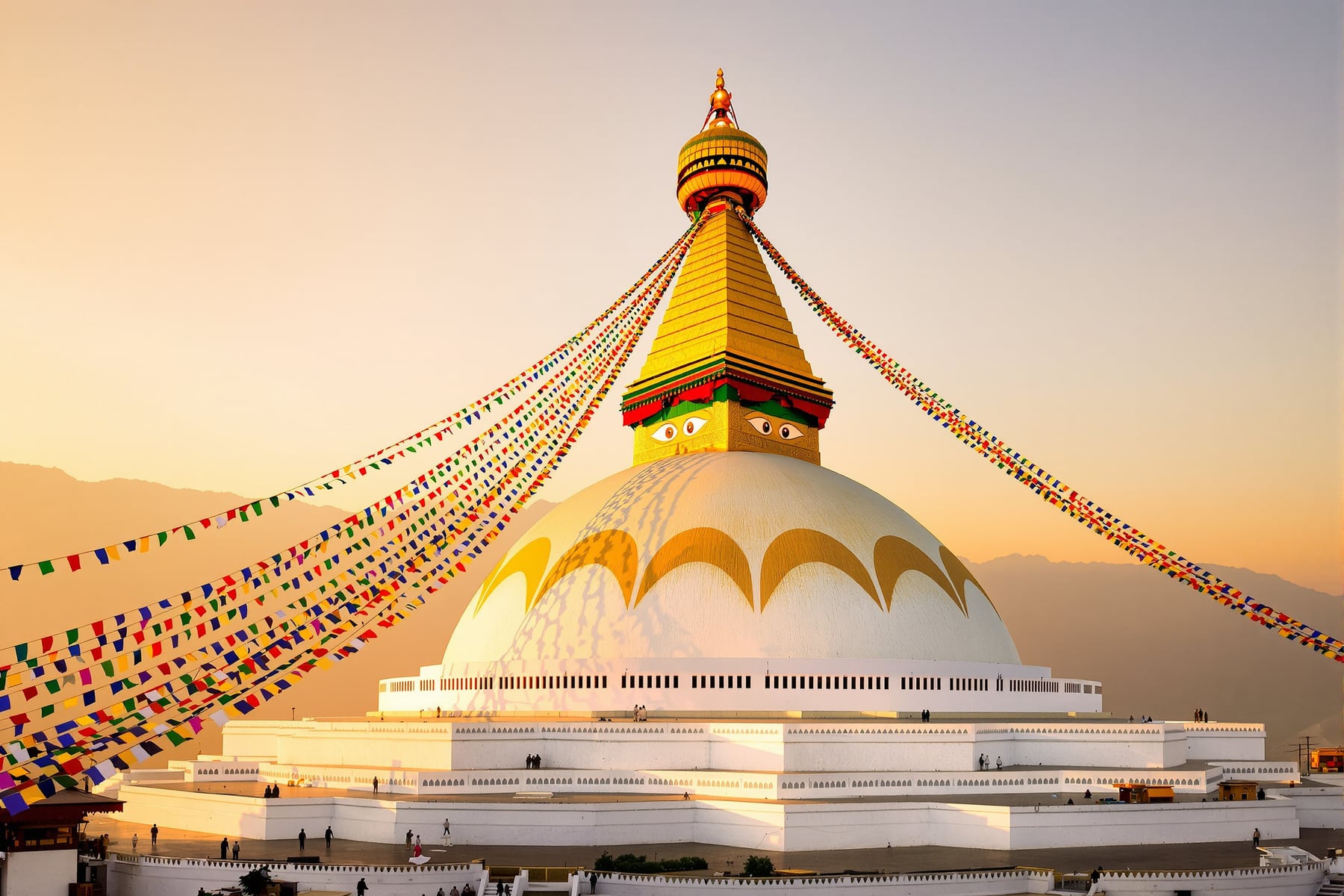
Boudhanath: The Great Mandala of Kathmandu
How Tibetan Buddhism built a diagram of the whole cosmos out of brick and whitewash — a colossal stupa whose plan is a mandala, whose golden tower watches all four directions at once, and which its own community dismantled and raised again after the 2015 earthquake.
Stay a little longer in the green Kathmandu Valley. A few kilometres from the golden pagoda of Pashupatinath, on the old caravan road that once carried salt and wool over the Himalaya to Tibet, stands a wholly different kind of sacred building. It is not a temple you enter. It is a mountain of whitewash you walk around. From a distance Boudhanath reads as the simplest thing imaginable — a smooth white dome under a golden tower, with two calm eyes painted near the top. It is one of the largest stupas on earth, and it is anything but simple. It is a diagram of the entire universe, built at the scale of a hill.
Where Pashupatinath is Hindu — timber, brick and beaten gold — Boudhanath is Buddhist, and made of the humblest materials of all: brick, mud and lime-whitewash. It is the holiest site of Tibetan Buddhism outside Tibet, ringed today by more than fifty monasteries, its dome circled from before dawn by a slow river of pilgrims turning prayer wheels. And like its Hindu neighbour, it was struck by the 2015 earthquake — but its story of survival is a different one, and in some ways the more moving of the two.
This is the twentieth article in our Architectural Wonders series.
1. A mandala you can walk
Most great buildings are meant to be looked at, or entered. Boudhanath is meant to be read from above and walked around. Its whole form is a mandala — the geometric diagram of the cosmos that sits at the heart of Tibetan Buddhist art — lifted off the page and built solid.
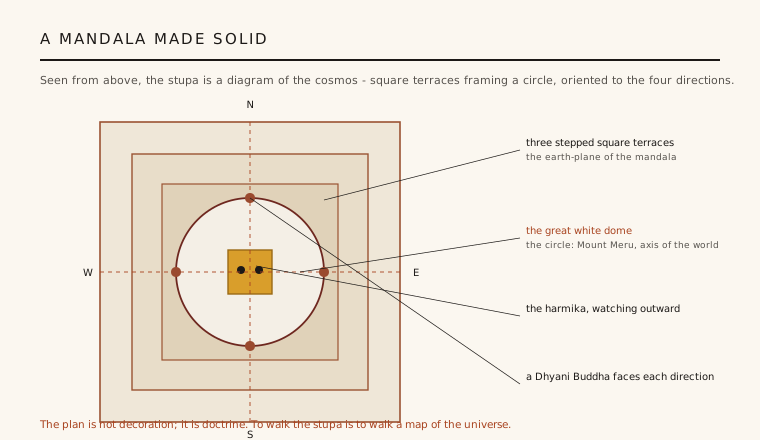
Look at the plan and you see the mandala's signature rhythm: square, then circle, then square again. Three stepped terraces, set square to the four directions, make the base — the plane of the earth. On them sits the great circular dome — the cosmos itself, and the world-mountain, Meru, at its axis. On the dome sits a small square tower. A Dhyani Buddha presides over each of the four cardinal points, with a fifth, Vairocana, understood to dwell in the white dome at the centre — the classic five-fold scheme of every Tibetan mandala. At Konark the whole temple was built as a literal model of the cosmos — the sun-god's chariot in stone. Here the same ambition is abstracted to pure geometry: not a picture of the universe, but its diagram. To walk the terraces is to walk a map of everything.
2. From earth to sky
If the plan is a map, the section is a ladder. Read the stupa from the ground up and every band you climb is a rung of doctrine — and, in the old Buddhist reading, one of the five elements, stacked from solid earth at the bottom to pure space at the summit.
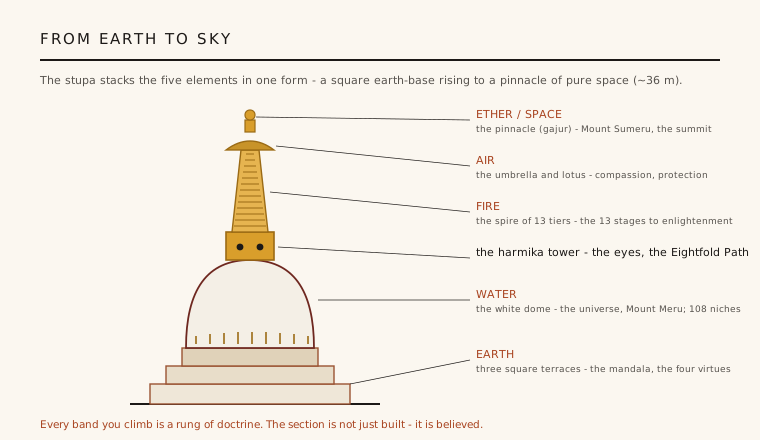
The square base — the "Lion's Seat" — carries on its four sides the four boundless virtues: love, compassion, joy and equanimity. Above it the three terraces are the earth. The great whitewashed dome (the _anda_, or "vessel") is water — the boundless womb of the universe — and around its foot run 108 niches, that most sacred of Buddhist numbers, each holding an image of the Buddha Amitabha. The square harmika tower above stands for the Noble Eightfold Path. From it rises a tapering spire of thirteen tiers — the element of fire, and the thirteen stages a soul must climb to full enlightenment. An umbrella and lotus near the top are air; the gilded pinnacle (the _gajur_) is ether, pure space, the summit of Mount Sumeru.
It is enormous — most often quoted at about 36 metres high (some sources say more), on a mandala base roughly 100 to 120 metres across, which makes it the largest stupa in Nepal and one of the largest anywhere. But the size is not really the point. At Brihadeeswara we learned that proportion is structure; here proportion is scripture. The counts are not chosen by the eye — they are fixed by faith: thirteen tiers, one hundred and eight niches, four virtues, five elements. The section is not just built. It is believed.
3. The eyes that watch every way
The one feature everyone remembers is the eyes. On each of the four faces of the golden tower, a pair of huge, calm, half-closed eyes of the Buddha looks out over the valley — the same serene gaze in every direction.
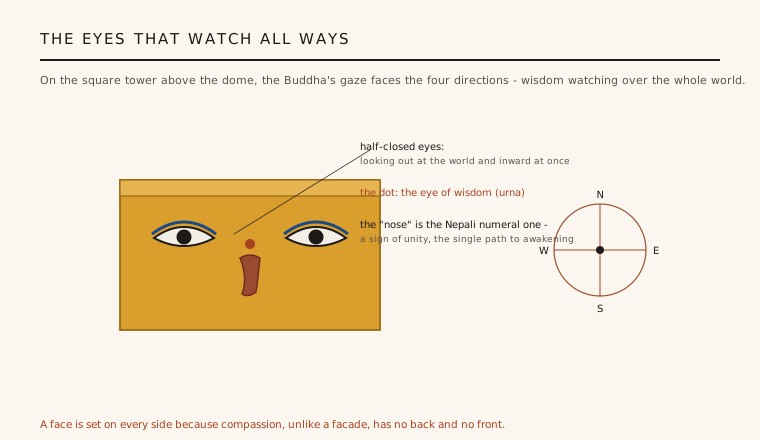
Those eyes are half-closed on purpose — looking outward at the suffering of the world and inward in meditation, both at once. They are read as method and wisdom, the two wings of the awakened mind. The dot between the brows is the eye of insight. And what looks like a nose is not a nose at all: it is the Nepali numeral one — a sign that there is a single path to liberation. This is the deepest architectural lesson of the stupa, and the reason it works on a pilgrim who cannot read a word of scripture. The building is a legible diagram: eyes for awareness, a numeral for the one path, thirteen steps for thirteen stages, one hundred and eight for the whole. As the painted caves of Ajanta preached to those who could not read, Boudhanath preaches in pure sign. And note the humane geometry of it — there is a face on every side, because compassion, unlike a façade, has no back and no front.
4. A building you walk, not a building you enter
Here is the strangest and most instructive fact about the stupa: it is completely solid. There is no door, and no inside. You cannot go in, because there is no in. A stupa is a reliquary — a sealed mound raised over sacred relics (Boudhanath is said to enshrine relics of a past Buddha) — and its architecture is organised entirely around movement on the outside.
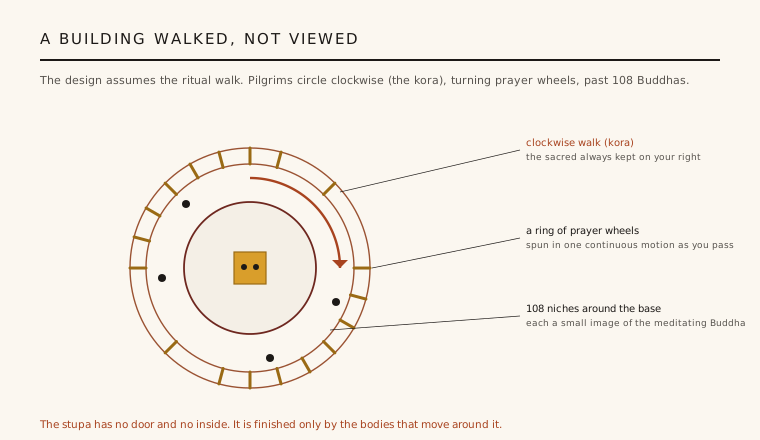
The ritual is the kora: you walk clockwise, keeping the sacred always on your right, and as you go you spin the continuous ring of prayer wheels set into the base, each turn releasing a printed prayer. The design assumes this walk completely. Its scale, its circular terraces, its ring of wheels, its 108 niches — none of it is composed for a frontal view, the way a temple façade or a palace elevation is. It is composed for a body in motion around it. This is a profound idea for any architect: the building here is not the object, it is the choreography. Boudhanath is finished only by the pilgrims moving around it — a piece of architecture whose most important material is human ritual.
5. Broken, and remade by hand
Nepal sits on one of the most violent fault lines on earth, and Boudhanath has been broken before — it was reconstructed after the great 1934 earthquake, and the Kathmandu Valley, with the stupa among its treasures, was listed by UNESCO in 1979 (the same inscription that protects Pashupatinath). Then, on 25 April 2015, the Gorkha earthquake cracked the tall spire so badly that it had to be taken down to the dome.
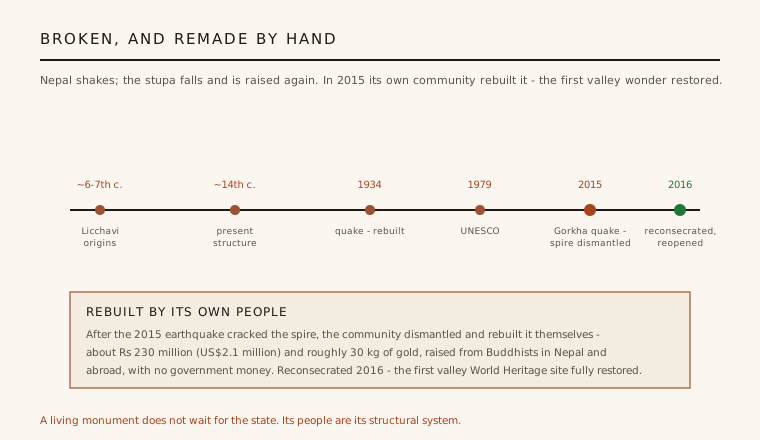
What happened next is the real lesson. Its neighbour Pashupatinath rode the quake out on its swaying timber frame — it survived by being cleverly built. Boudhanath took the blow, lost its crown, and was raised again by the hands of the faithful. The reconstruction — about Rs 230 million (US$2.1 million) and roughly 30 kilograms of gold for the pinnacle — was funded entirely by Buddhists in Nepal and around the world, with no government money at all; the community did the work, and over six hundred monks and nuns gathered to reconsecrate it. The stupa reopened, made whole, in November 2016 — the first of the valley's earthquake-damaged World Heritage sites to be fully restored. Two kinds of survival stand a few kilometres apart in one valley: one structural, one social. A living monument, it turns out, does not wait for the state to save it. Its people are its structural system. For a series that began as a quiet map of one young architect's travels, there is something fitting in ending among these calm eyes — a building whose whole purpose is to keep watch, with tenderness, over everyone who passes beneath it.
6. What a modern architect can learn from Boudhanath
- Geometry can carry meaning. The shift from square base to round dome to square tower is not a styling choice; each change of shape is a change of idea. Plan and section can be a language, not just a grid — form can mean.
- A building can be a legible diagram. The eyes, the numeral-one nose, the thirteen tiers, the hundred-and-eight niches: Boudhanath teaches its whole doctrine to someone who cannot read. Legibility — a building that explains itself — is a design deliverable worth chasing.
- Let ritual and use set the scale and the path. The stupa is solid and doorless, composed entirely around the clockwise walk. Choreograph how people move, and let that movement — not a frontal façade — generate the form.
- Additive massing can be structural and narrative at once. Terraces, dome, tower, spire, umbrella, pinnacle: a disciplined vertical stack where every added mass has both a job to do and a story to tell.
- A shared, rule-bound grammar travels and endures. Because the stupa's counts and proportions are a fixed, reproducible system, the form spread across the whole Himalayan and Mongolian world. A strong, constrained grammar outlives and out-travels a one-off invention.
- Resilience is social, not only structural. Boudhanath came back in eighteen months because its community paid for it, rebuilt it, and reconsecrated it themselves. The most earthquake-proof thing about a building may be the people who refuse to let it stay broken.
References & further reading
1. UNESCO World Heritage Centre — Kathmandu Valley (inscribed 1979; Boudhanath is one of its seven Monument Zones). https://whc.unesco.org/en/list/121/
2. Wikipedia — Boudha Stupa. https://en.wikipedia.org/wiki/Boudha_Stupa
3. South China Morning Post — Kathmandu believers restore quake-damaged Boudhanath stupa (2016). https://www.scmp.com/news/asia/south-asia/article/2046655/kathmandu-believers-restore-quake-damaged-boudhanath-stupa
4. myRepublica (Nagarik Network) — 30 kg gold used for Boudhanath Stupa reconstruction (2016). https://myrepublica.nagariknetwork.com/
5. Lion's Roar — The Story Behind the Stupa (the Jarung Khashor legend). https://www.lionsroar.com/the-story-behind-the-stupa/
6. The Longest Way Home — All the parts of Boudhanath Stupa, named. https://www.thelongestwayhome.com/blog/nepal/all-the-parts-sections-of-boudhanath-stupa-named/
Last verified 2026-07-03. Dimensions and dates vary between sources and are given as widely cited approximations — the height is most often quoted at about 36 m (some sources give more), and the mandala base at roughly 100–120 m across; the founding is traditionally credited to the Licchavi period, with the standing structure dated to about the 14th century. The 2015 earthquake damage, the community-funded restoration (about Rs 230 million / US$2.1 million and roughly 30 kg of gold, raised without government funding) and the 2016 reconsecration follow the established record. Boudhanath's religious significance is described with respect for living Buddhist tradition.
Export this guide
Related Guides — Deep-dive reading
Borobudur: The Mountain You Climb to Reach Enlightenment
In the volcano-ringed heart of Java, around 1,200 years ago, Buddhist kings built the largest Buddhist monument on Earth — not a temple you enter but a solid stone mountain you climb: a three-dimensional map of the universe, wrapped in 2,672 carved panels and 504 Buddhas, that turns the path to enlightenment into a walk you take with your feet. Then it was abandoned, buried under ash and jungle, and rebuilt, stone by million-stone, in our own age.
Architectural WondersSanchi: The Dome That Began Indian Architecture
How a solid brick-and-stone hemisphere raised over the Buddha's relics — a building with no inside — became India's first great monument, and fixed the form of the stupa for the whole of Asia.
Architectural WondersPashupatinath: The Golden Pagoda on the Sacred River
How the master builders of the Kathmandu Valley made a temple of timber, brick and beaten gold — a tiered Nepalese pagoda whose form travelled across Asia, whose shape lets it sway through earthquakes, and which stands at the very threshold of life and death on the holy Bagmati.
Architectural WondersRelated Tools — Try Free
Before & After Studio
Generate AI before-and-after renders to preview how your redesign could look.
DesignAIScale & Proportion Calculator
Check whether a room's shape or a window's proportion feels right, using the golden mean (1:1.618).
Design ToolCross-Ventilation Analyzer
Estimate airflow and air changes per hour (ACH) from room size, window areas, layout, and local wind — with NBC 2016 Part 8 compliance check.
Ventilation Calculator