
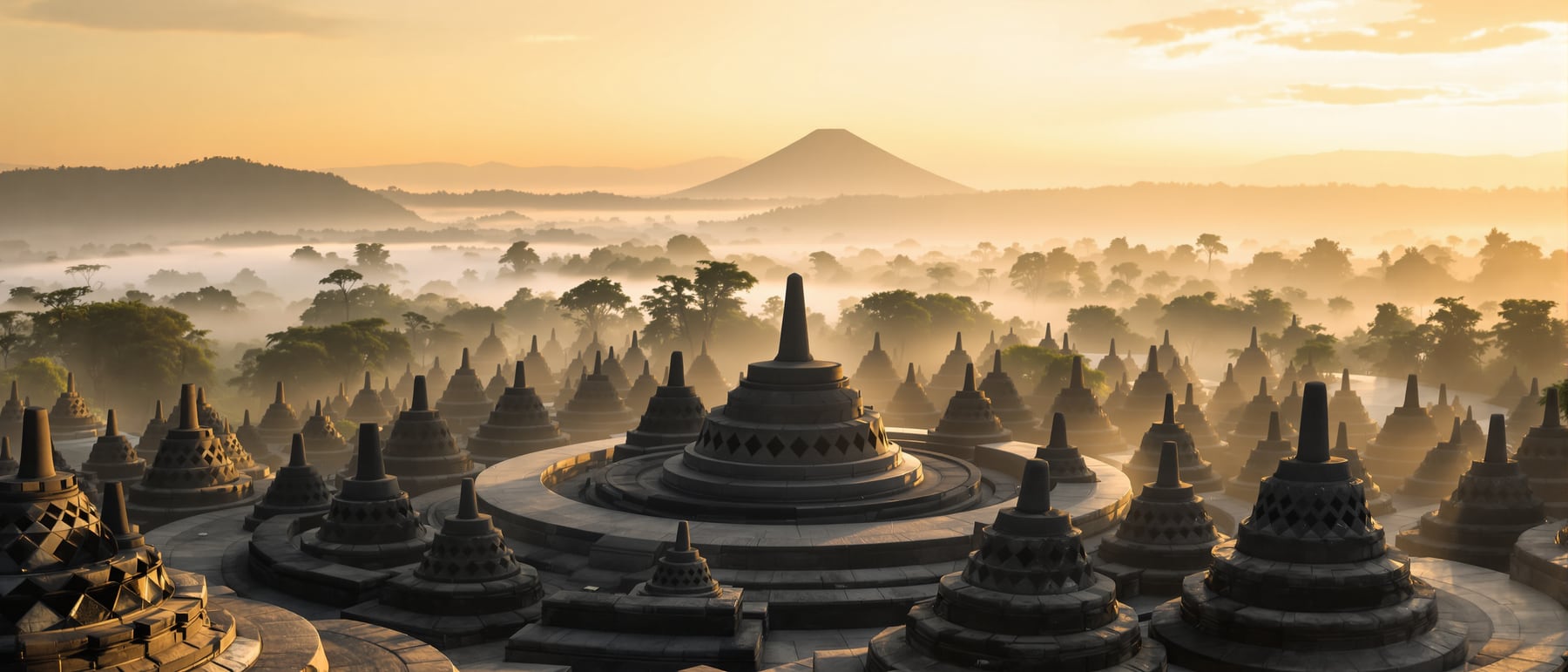
Borobudur: The Mountain You Climb to Reach Enlightenment
In the volcano-ringed heart of Java, around 1,200 years ago, Buddhist kings built the largest Buddhist monument on Earth — not a temple you enter but a solid stone mountain you climb: a three-dimensional map of the universe, wrapped in 2,672 carved panels and 504 Buddhas, that turns the path to enlightenment into a walk you take with your feet. Then it was abandoned, buried under ash and jungle, and rebuilt, stone by million-stone, in our own age.
We ended the last article at Somapura Mahavihara in Bengal — a Buddhist university with a great cross-shaped, terraced temple, built around 800 CE, whose form, some believe, travelled east. Now we follow that thread across the sea to Central Java, to a monument raised at almost exactly the same moment, by a Buddhist dynasty who took the terraced-mountain idea and built it on a scale the world had never seen. This is Borobudur — the largest Buddhist monument on Earth, and one of the most extraordinary ideas ever turned into stone.
This is the sixtieth article in our Architectural Wonders series, and the thirteenth in our chapter on the great temples and sacred places of the world.
For Borobudur is not a temple you go into. It has no rooms, no doorways, no inner sanctuary — it is solid, all the way through. It is a monument you go up: a man-made stone mountain that you climb, terrace by terrace, following carved walls and passing hundreds of Buddhas, until you reach the silent summit. And the climb is not a means to a view. The climb is the point. The whole building is a diagram of the path to enlightenment, and to walk up it is to walk that path with your own feet.
1. A mountain that is a mandala
Start with what it is, because Borobudur is unlike almost anything else in this series.
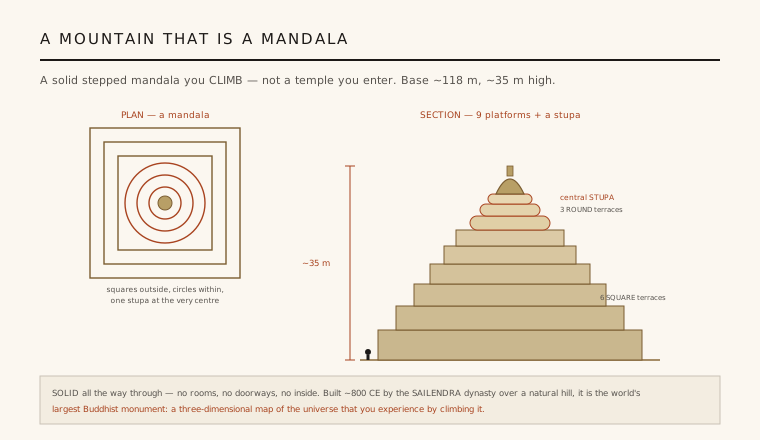
Borobudur was built around 800 CE by the Sailendra dynasty, the Mahayana Buddhist rulers of Central Java — making it a near-exact contemporary of Somapura, at the far end of the same Buddhist world. Seen from above, its plan is a giant mandala — a sacred diagram of the cosmos — with concentric squares on the outside enclosing concentric circles within. Seen from the side, it is a stepped stone pyramid, built over and around a natural hill, about 118 metres on each side at the base and rising some 35 metres. It climbs in nine stacked platforms: six square terraces below, then three round terraces above, crowned by a single great central stupa (a bell-shaped dome). And the crucial thing, again: it is solid — no interior, no chambers. Where the Roman Pantheon hollowed out a vast interior void, Borobudur does the opposite: it is a mountain of stone whose entire meaning is on its surface, to be read by walking — a cosmic temple-mountain, kin to Cambodia's Angkor Wat. It is, quite literally, the Buddhist universe rebuilt as a hill you can climb.
2. The three worlds
Why nine terraces, in that particular order? Because the shape is a cosmology — and the climb is a spiritual journey through it.
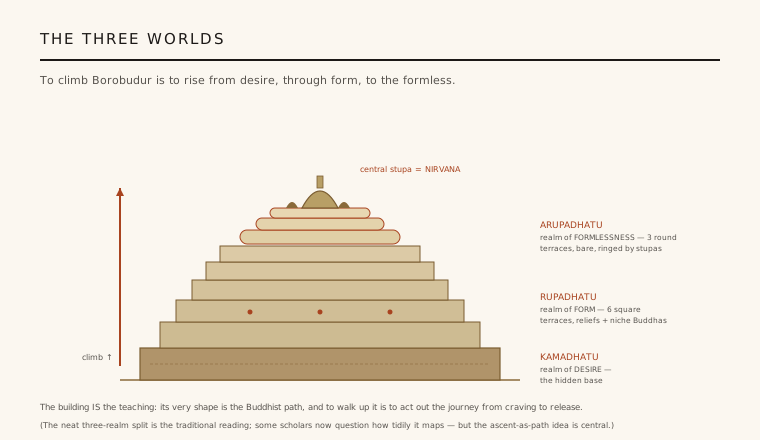
The monument is built as the three realms of Buddhist cosmology, stacked from bottom to top. At the base is Kamadhatu, the realm of desire — our ordinary world of craving and consequence (and, as we will see, it is hidden). Above it rise the six square terraces of Rupadhatu, the realm of form — lined with carved stories and with Buddha statues seated in open niches, the world of shapes and images. Higher still come the three round, bare, open terraces of Arupadhatu, the realm of formlessness — stripped of narrative and decoration, ringed only by stupas. And at the very summit stands the great sealed central stupa, standing for nirvana, enlightenment beyond all form. So a pilgrim climbing Borobudur physically ascends from desire, through form, to the formless — re-enacting, step by step and terrace by terrace, the Buddhist path from the world's cravings to release. The building doesn't describe the journey to enlightenment; it makes you perform it. (One honest note: this neat three-realm mapping is the traditional, widely-taught reading, and some scholars now debate how tidily the terraces really correspond — but the core idea of an ascent-as-spiritual-path is not in doubt.)
3. A scripture in stone
Along the walls of that climb runs the greatest single collection of Buddhist storytelling anywhere in the world.
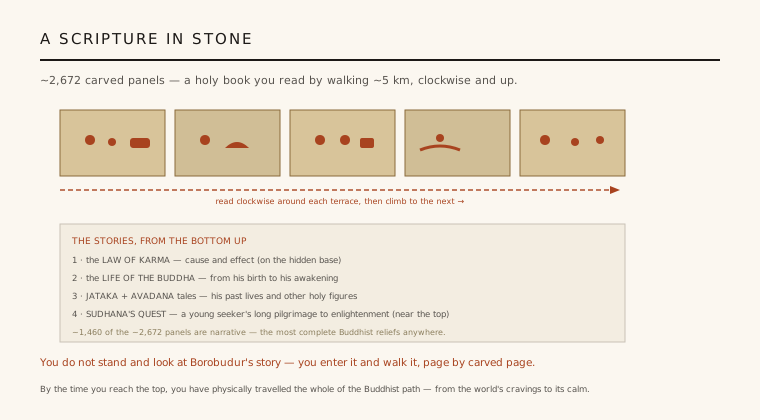
The walls of the square terraces are covered with about 2,672 carved relief panels, of which some 1,460 tell stories — the most complete ensemble of Buddhist narrative reliefs on Earth. And they are meant to be read in sequence, by walking clockwise around each terrace and then climbing to the next — a route of roughly five kilometres in all. The stories unfold in order as you rise: the law of karma on the hidden base; then the life of the Buddha, from his birth to his awakening; then Jataka and Avadana tales of his past lives and of other holy beings; and finally, near the top, the Gandavyuha — the long, searching pilgrimage of a young seeker named Sudhana, wandering from teacher to teacher toward enlightenment. It is no accident that the highest, hardest story is a pilgrimage: as you climb, you are Sudhana. The walls are a scripture you do not read sitting down — you read it by walking and climbing, page by carved page, until the stories and the ascent become the same act.
4. The hidden foot, and the Buddhas in cages
Two of Borobudur's most haunting features are, fittingly, about things half-seen and things concealed.
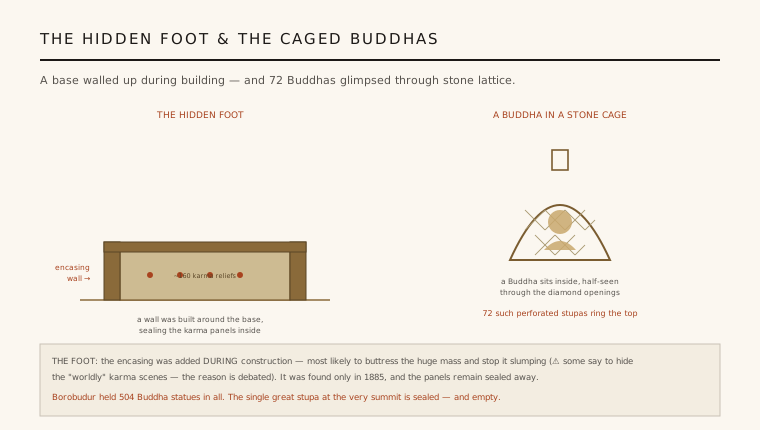
First, the hidden foot. The lowest level — the Kamadhatu base — once carried about 160 relief panels depicting the law of karma, sin and reward. But at some point during construction, an extra encasing wall was built around the base, sealing those panels away inside the monument's own foot. Why? The leading explanation is structural — the huge, heavy mass was beginning to slump, and the encasement acted as a buttress to hold it together; though some have suggested the "worldly" karma scenes were deliberately hidden from view. (The truth is genuinely debated.) The sealed reliefs were only discovered in 1885, and most remain walled up to this day. Second, the Buddhas in cages. On the three round upper terraces stand 72 bell-shaped stupas built as delicate stone latticework — the same reliquary-dome form as the great stupa of Boudhanath in the Himalayas, here multiplied and made translucent — and inside each one sits a Buddha statue, half-glimpsed through the diamond-shaped openings, present but not quite reachable, a beautiful image of a truth sensed but not yet fully seen. In all, Borobudur held 504 Buddha statues. And the great stupa at the very summit, the goal of the whole climb? It is sealed, and empty — the perfect, wordless symbol of a formlessness beyond all images.
5. Buried, found, and raised again
Like Somapura, Borobudur's story runs through abandonment and near-oblivion — but, unlike the great earthen mountain of Cahokia whose city vanished for good, its rescue is one of the great feats of modern conservation.
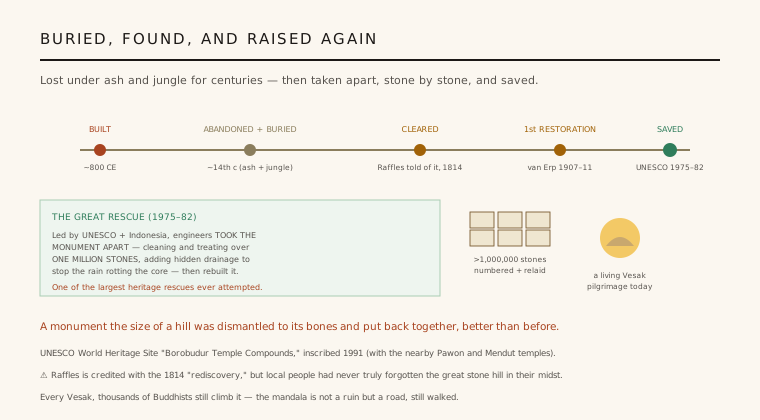
Borobudur was abandoned around the fourteenth century, as Java gradually turned to Islam, political power shifted to the east of the island, and the surrounding volcanoes (this is one of the most volcanically active places on Earth) made the region perilous. Over the centuries the monument disappeared beneath layers of volcanic ash and jungle — a whole mountain of carved stone swallowed by the forest. In 1814, the British lieutenant-governor of Java, Sir Stamford Raffles, was told of the buried monument by locals and had it cleared (though it is worth saying plainly: the people who lived beside it had never really forgotten the great stone hill in their midst). A first restoration was led by the Dutchman Theodoor van Erp from 1907 to 1911. But water was slowly destroying it from within — so between 1975 and 1982, a vast international rescue, led by UNESCO and Indonesia, took the entire monument apart, cleaned and treated over a million stones, built hidden drainage into the core to stop the tropical rain rotting it, and rebuilt the whole thing — one of the largest and most ambitious heritage rescues ever attempted. In 1991 it became a UNESCO World Heritage Site ("Borobudur Temple Compounds"). And it is not a ruin: every year at Vesak, thousands of Buddhists still climb it in candle-lit procession. The mandala is not a relic. It is a road, still walked.
6. What a modern architect can learn from Borobudur
- A building can be a verb, not a noun. Borobudur is not something you look at; it is something you do — a journey you perform with your body. The most profound architecture can choreograph an experience, turning a visitor into a participant.
- Meaning can live in the plan itself. The shape is the message: a mandala, a set of stacked worlds, a path. When form and idea are this fused, a building can teach a whole philosophy without a single word.
- Sequence and ascent are powerful tools. By making you climb, circle and rise in a fixed order, Borobudur controls not just what you see but when, and in what state of mind. Designing the route can matter as much as designing the rooms.
- Reveal slowly; conceal on purpose. The half-seen Buddhas in their lattice cages, the sealed and empty summit, the hidden karma foot — Borobudur understands that what is glimpsed or withheld can move us more than what is fully shown.
- Great works can be un-built and re-built. A monument the size of a hill was dismantled to its bones and reassembled, better than before. Conservation is itself a creative act — and proof that heritage, like a building, must be actively saved, not merely inherited.
- Design for the humblest material and the highest idea at once. Borobudur is grey volcanic rock, the commonest stone of a volcanic island — shaped into the most sublime idea a culture possessed. The nobility is never in the material; it is in the intention.
References & further reading
1. UNESCO World Heritage Centre — Borobudur Temple Compounds (inscribed 1991). https://whc.unesco.org/en/list/592/
2. World History Encyclopedia — Borobudur. https://www.worldhistory.org/Borobudur/
3. Encyclopaedia Britannica — Borobudur. https://www.britannica.com/topic/Borobudur
4. Smarthistory — Borobudur. https://smarthistory.org/borobudur/
5. Miksic, John — Borobudur: Golden Tales of the Buddhas (standard scholarly work). https://www.worldcat.org/title/borobudur-golden-tales-of-the-buddhas/oclc/22984936
6. UNESCO — The Restoration of Borobudur (the 1975–1982 campaign). https://whc.unesco.org/en/activities/
*Last verified 2026-07-04. Figures follow UNESCO, the World History Encyclopedia, Britannica, Smarthistory and Miksic, and are given as widely cited approximations that vary by source. Borobudur is in Magelang Regency, Central Java, Indonesia (Kedu Plain, near Yogyakarta), amid active volcanoes. It is the largest Buddhist monument in the world, built c. 778–850 CE (commonly "~800 CE") under the Mahayana Sailendra dynasty; near-contemporary with the Pala-era Somapura Mahavihara. It is a solid stepped stone monument (no interior) built over a natural hill: base ~118 m per side (~14,000 m²), height ~35 m; nine platforms (SIX square + THREE circular) topped by a central stupa; the plan is a mandala. Cosmology: three realms — Kamadhatu (desire; the hidden base), Rupadhatu (form; the square terraces with reliefs and niche Buddhas), Arupadhatu (formlessness; the circular terraces with stupas), rising to the summit stupa (nirvana); the traditional three-realm mapping is widely taught but debated in detail. Reliefs: ~2,672 panels (~1,460 narrative + ~1,212 decorative) — the most complete Buddhist relief ensemble — read clockwise while ascending (~5 km), covering karma (Karmavibhangga), the Buddha's life (Lalitavistara), Jataka/Avadana tales, and Sudhana's quest (Gandavyuha). Statues: originally 504 Buddhas; the three round terraces carry 72 perforated (latticed) stupas, each enclosing a Buddha; the summit stupa is sealed and empty. HIDDEN FOOT: ~160 karma reliefs on the Kamadhatu base were covered by an encasing wall added during construction — most likely a structural buttress against slumping (some argue to conceal "worldly" imagery; debated); discovered 1885, mostly still sealed. Abandoned c. 14th c. (spread of Islam, eastward power shift, volcanic activity) and buried under ash/jungle; brought to Western attention when Raffles was informed of it in 1814 (locals had not forgotten it); restored by Th. van Erp (1907–11) and then in a major UNESCO/Indonesia campaign (1975–82) that dismantled and rebuilt it with >1 million stones and new drainage. UNESCO World Heritage Site "Borobudur Temple Compounds" (with Pawon and Mendut), inscribed 1991; a living Vesak pilgrimage site.
Export this guide
Related Guides — Deep-dive reading
Somapura Mahavihara: The Buddhist University Hidden Inside a Hill
Twelve hundred years ago in Bengal, a Pala emperor built one of the largest monasteries the Buddhist world had ever seen — a walled quadrangle a fifth of a mile across, ringed by 177 monks' cells, with a great cross-shaped, terraced temple rising from its courtyard. For four centuries scholars came from as far as Tibet to study here; then it was abandoned, and slowly buried, until villagers knew it only as Paharpur — 'the hill-town.'
Architectural WondersBoudhanath: The Great Mandala of Kathmandu
How Tibetan Buddhism built a diagram of the whole cosmos out of brick and whitewash — a colossal stupa whose plan is a mandala, whose golden tower watches all four directions at once, and which its own community dismantled and raised again after the 2015 earthquake.
Architectural WondersThe Pantheon: The Dome That Has Never Been Beaten
Nearly nineteen centuries ago the Romans poured a hemisphere of concrete 43 metres across, left a single round hole open to the sky at its summit, and walked away — and it is still, today, the largest unreinforced concrete dome on Earth. A temple to all the gods that became a church, the best-preserved building of ancient Rome, and the ancestor of every great dome from Florence to the United States Capitol.
Architectural WondersRelated Tools — Try Free
Home Building & Interior Cost Calculator — 20 Cities
Construction + interior costs for 20 Indian cities across kitchen, wardrobes, flooring, painting, ceiling.
Cost CalculatorCircadian Light Meter
Patient-centric circadian lighting visualizer for Indian healthcare design — time-of-day × intensity → CCT, melanopic lux (EML / mEDI), melatonin suppression, and an alertness curve. Calibrated against WELL v2 L03 Circadian Lighting Design, CIE S 026:2018, Brainard 2001, and Lucas et al. 2014.
Circadian ToolCross-Ventilation Analyzer
Estimate airflow and air changes per hour (ACH) from room size, window areas, layout, and local wind — with NBC 2016 Part 8 compliance check.
Ventilation Calculator