
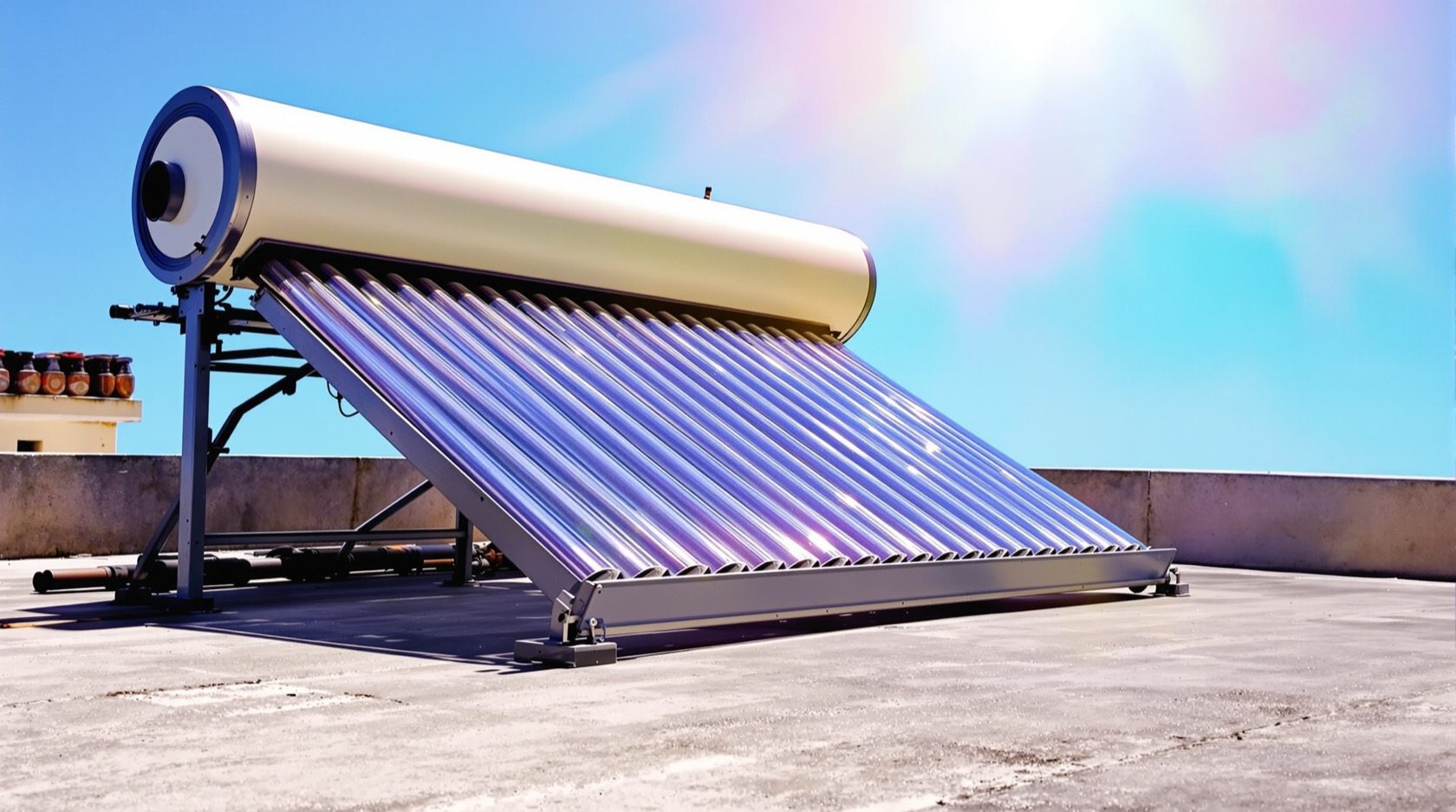
Solar Water Heating: Near-Free Hot Water from the Indian Sun
India's most cost-effective renewable heating — how a solar water heater works, evacuated-tube vs flat-plate collectors, sizing and economics, the role of the electric backup, and why it pays back faster than almost any home upgrade in a sun-rich country.
In a country with sun almost year-round, heating water with electricity is, for much of the year, paying for something the sky gives away. A solar water heater captures that free heat — and because hot water is the biggest heating load in most homes, it's arguably the highest-return renewable-energy upgrade an Indian household can make, paying for itself in just a few years and then running near-free for a decade or more. This guide explains how solar water heating works, the choices, and the economics.
It builds on the Water Heater Guide and Home Heating Guide, part of the HVAC Knowledge Hub. Deciding on and sizing a solar water heater is a homeowner decision — this is for you.
Scope. Choosing, sizing and understanding the economics is covered here. Rooftop mounting, plumbing and electrical backup wiring are qualified installer/plumber/electrician work.
How solar water heating works
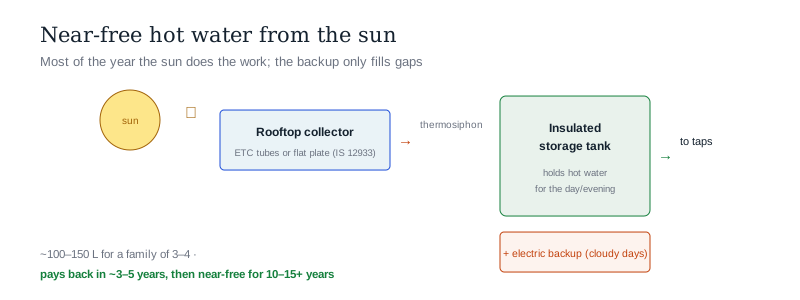
A solar water heater is elegantly simple:
- Collectors on the roof absorb the sun's heat and transfer it to water flowing through them.
- The warmed water rises (hot water is lighter) into an insulated storage tank by natural thermosiphon — often with no pump at all.
- The tank holds the hot water for use through the day and evening.
- An electric backup element in the tank tops up the temperature on cloudy days or heavy demand — so you're never without hot water.
Most of the year the sun does all the work; the backup only fills gaps. The result is hot water at a fraction of an electric geyser's running cost.
Evacuated-tube vs flat-plate collectors
The main choice is the collector type:
- Flat-plate collector (FPC) — an insulated glazed box with an absorber plate. Robust, long-lasting, and well-suited to warmer regions and hard water; the traditional workhorse. Made to standards like IS 12933.
- Evacuated-tube collector (ETC) — rows of double-walled glass tubes with a vacuum for insulation. More efficient in cold and cloudy conditions (better for hill/north climates), often cheaper, but the glass tubes are more fragile and can struggle with very hard water.
- Rule of thumb — ETC for colder/cheaper and where water is soft; FPC for hot regions, hard water and long-life robustness. Both work well across most of India.
Sizing and economics
- Sizing — roughly 100–150 L of solar capacity for a family of 3–4; scale up with occupants and bathrooms. Undersize and you lean on the backup; oversize and you pay for unused capacity.
- Cost & payback — a domestic system is a few tens of thousands of rupees installed, and by replacing most of your geyser's electricity it typically pays back in ~3–5 years, then delivers near-free hot water for its 10–15+ year life. Few home upgrades beat that return.
- Incentives — solar water heating is promoted by MNRE and some states/utilities (and municipal rules increasingly require it for larger buildings); check current state incentives.
- Running cost — near zero for the solar share; only the backup uses electricity. See how it compares in the geyser running cost calculator.
Getting the most from it
- Match collector to climate & water — ETC for cold/soft-water, FPC for hot/hard-water regions.
- Insulate the pipes and tank — heat lost between roof and tap is heat wasted; good insulation keeps water hot into the evening.
- Use hot water in the evening — draw on the day's stored heat before the backup kicks in overnight.
- Maintain it — periodic cleaning of collectors and, in hard-water areas, descaling; a well-kept system holds its efficiency for years.
- Consider a heat-pump alternative — where roof space or sun is limited, a heat-pump water heater is the next-best low-running-cost option.
The one-line answer
A solar water heater captures the sun's free heat for the biggest heating load in the home, making it arguably India's highest-return renewable upgrade: rooftop collectors warm water that rises by thermosiphon into an insulated tank, with an electric backup filling in on cloudy days — so most of the year the sun does the work and running cost is near zero. The main choice is the collector: evacuated-tube (ETC) for colder, cloudier or hill climates and softer water; flat-plate (FPC), built to standards like IS 12933, for hot regions, hard water and long-life robustness. Size roughly 100–150 L for a family of 3–4, and the economics are compelling — a system typically pays back in ~3–5 years and then delivers near-free hot water for 10–15+ years, helped by MNRE and state incentives. Insulate the pipes, use the stored hot water in the evening, and maintain the collectors, and it quietly replaces most of your geyser's electricity for the life of the system.
Where to go next
- Compare the numbers: Geyser Running Cost Calculator.
- The appliance context: Water Heater Guide.
- The electric alternative: Heat Pump Guide.
- The heating overview: Home Heating Guide.
References
- IS 12933 (Parts 1, 2 & 5 : 2025) Solar Flat Plate Collector — Specification, Bureau of Indian Standards (MED 4).
- Ministry of New & Renewable Energy (MNRE) — solar water heating systems & incentives: https://mnre.gov.in/
- Bureau of Energy Efficiency (BEE) — efficient water heating guidance: https://beeindia.gov.in/
Choosing and sizing is covered here; mounting, plumbing and electrical backup wiring are qualified installer work. Verify any standard's current status via the BIS catalogue before relying on it.
Export this guide
Related Guides — Deep-dive reading
Solar Water Heaters in India: ETC vs FPC, Sizing, Backup, Subsidy and Cost
The rooftop heater that gives an Indian home free hot water from the sun — how the collector and tank work, evacuated-tube versus flat-plate, passive thermosiphon versus forced circulation, honest LPD sizing, the electric backup for cloudy days, roof and freeze concerns, the MNRE and state subsidy context, and where the upfront cost pays back.
PlumbingHot Water Systems Guide (India): How to Choose the Right Water Heater
Electric, gas, solar or heat-pump? Central or point-of-use? A homeowner's how-to-choose overview that compares every water-heating option on upfront cost, running cost and where each one actually suits an Indian home.
PlumbingHow to Choose a Geyser in India: Buyer's Guide to Size, Type, Star Rating & Price (2026)
A buyer's decision guide to picking a bathroom geyser in India — sizing instant vs storage by family and use, storage vs instant vs gas vs solar, BEE star rating and running-cost maths, glass-lined vs stainless tank for hard water, pressure rating, warranty, good-better-best price tiers, the IS 302 safety mark, and how to spot a refurbished unit.
BathroomsRelated Tools — Try Free
Geyser Running Cost Calculator
Work out a water heater's electricity use and running cost per day, month and year — and compare electric, gas, heat-pump and solar.
Bathroom CalculatorRainwater Tank Sizer
How big should your rainwater tank be? Computes annual harvest, recommended tank capacity in litres, water-bill savings, and payback — for 10 Indian cities.
RWH CalculatorGeyser Size Calculator
Find the right water-heater capacity (litres) or instant kW for your bathroom and household, with an indicative running-cost note.
Bathroom Calculator