
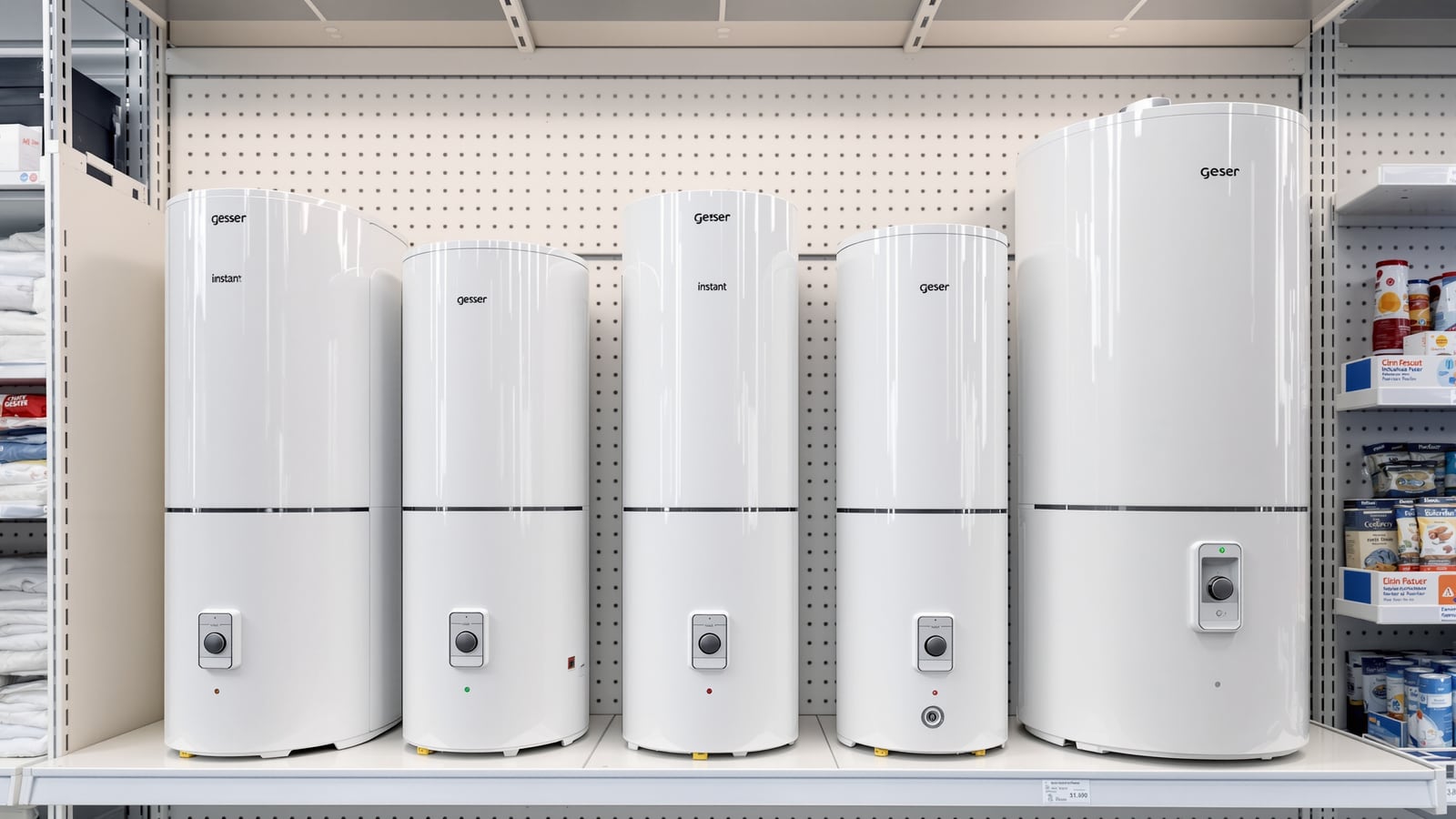
How to Choose a Geyser in India: Buyer's Guide to Size, Type, Star Rating & Price (2026)
A buyer's decision guide to picking a bathroom geyser in India — sizing instant vs storage by family and use, storage vs instant vs gas vs solar, BEE star rating and running-cost maths, glass-lined vs stainless tank for hard water, pressure rating, warranty, good-better-best price tiers, the IS 302 safety mark, and how to spot a refurbished unit.
A geyser is one of those purchases where the showroom will happily sell you the wrong thing. Push for the biggest tank, the shiniest chrome body, the "lifetime" sticker — and you walk out with an oversized unit that costs more to buy, more to run, and still trips your breaker on a wet wall. The right geyser is a boring, deliberate decision: the correct litres for the bath your family actually takes, a type that matches your fuel and roof, a star rating that pays for itself, a tank that survives your water, and a genuine IS 302 safety mark.
This is a buying guide, not a physics lesson. It walks through the five things that actually decide the purchase — size, type, star rating, tank material and safety — then gives you a good-better-best price table, a what-to-check-before-you-pay checklist, and the red flags that separate a fresh unit from a repainted refurbished one. For the deeper technical detail on wiring, anode rods and descaling, read it alongside the bathroom water heater guide for India, and treat the bathroom shopping guide for India as the pillar it hangs off.
Buy the geyser for the bath you take, not the tank that looks impressive. A right-sized 15 L heater on 5 stars beats a 25 L unit on 3 stars on price, bill and heat-up time — every single month.
Step 1: Size it — litres by use and family
Sizing is where most money is wasted. An instant geyser holds 1–3 L and heats water as it flows; a storage geyser holds a tankful (6–50 L) warm and ready. The rule of thumb: instants for a handwash or a single quick bucket, storage for showers and full bucket baths.
| Use case | Family / demand | Recommended capacity |
|---|---|---|
| Handwash point, kitchen, maid's toilet | 1 person, no bath | Instant 1–3 L |
| One quick bucket bath | 1 person | Instant 3 L or storage 6 L |
| Bucket baths, small bathroom | 1–2 people | Storage 6–10 L |
| Bucket baths or short shower | 3–4 people (family) | Storage 15 L |
| Showers, larger bathroom | 4–5 people | Storage 15–25 L |
| Overhead shower + longer use | 5+ / villa | Storage 25 L+ or solar with backup |
A single warm bucket needs roughly 15 litres of bath-temperature water, which a 15 L storage tank delivers by mixing its hot output with cold. A shower draws continuously, so it needs a larger reserve. The classic mistake is fitting a 3 kW instant to a shower: in a Delhi or Pune winter, when the incoming water is coldest, it delivers either warm water at a trickle or a cold shower at full flow. For any shower, choose storage.
Step 2: Pick the type — storage, instant, gas or solar
Four families, four honest use-cases. Size and star rating only matter once you have picked the right one.
- Storage electric — the default. Wall tank, thermostat, holds a tankful warm. Best for showers and reliable bucket baths across the country.
- Instant electric — small, cheap, wall-hugging. Perfect for handwash points and single buckets; wrong for showers.
- Gas (LPG / piped) — heats on demand, cheap to run where gas is available, no electricity load. Needs proper flue and ventilation; never install in a sealed bathroom.
- Solar — rooftop collector plus storage tank and an electric backup element. Highest upfront cost, near-zero running cost, only sensible for independent houses with roof access.
Step 3: Star rating and the running-cost maths
Every electric storage geyser sold in India carries a BEE star rating (Bureau of Energy Efficiency), 1 to 5 stars. More stars means better tank insulation, so the water stays hot longer and the element switches on less often. The rating is measured as "standing loss" — how many units the geyser leaks per day just holding water warm.
The heating energy is roughly the same whatever the star rating: raising the temperature of the water you actually use costs what it costs. The saving is in standby. A 5-star 15 L unit might lose about 0.4 fewer units a day than a 1-star model — call it 12 units a month, or roughly ₹90–₹100 on a ₹8/unit tariff. Over a 7-year life that is ₹7,000–₹8,000, far more than the price gap between a 3-star and 5-star model. On any geyser you leave switched on, buy 5 stars.
| Rating | Typical standby loss | Extra vs 5-star (per month) | Worth it if... |
|---|---|---|---|
| 3-star | Higher | ~₹60-80 more | You rarely use it, tight budget |
| 4-star | Moderate | ~₹30-40 more | Occasional / guest bathroom |
| 5-star | Lowest | Baseline | Daily-use family bathroom |
One habit beats any star rating: switch the geyser off after your bath. A timer or a simple indicator switch pays back faster than an extra star.
Step 4: Tank material — glass-lined vs stainless for hard water
The tank is what fails first, and India's hard water decides how fast. The two common linings:
- Glass-lined (vitreous enamel) tank — a glass coating fused onto steel. Excellent corrosion resistance and the industry default, but it relies on a sacrificial anode rod that dissolves to protect the tank. In hard water the anode wears out in 1.5–3 years and must be replaced, or the tank starts to rust.
- Stainless steel tank — resists corrosion without an anode and tolerates scale better, so it is the safer pick for very hard borewell water. It can be marginally more expensive and, if a cheap grade of steel is used, pinhole leaks at welds are the failure mode.
If you are on hard municipal or borewell water — most of peninsular and western India — favour a stainless tank, or commit to replacing the anode rod on a glass-lined unit every couple of years. Either way, annual descaling extends element life. The bathroom water heater guide covers anode and descaling detail.
Step 5: Pressure rating, warranty and the IS 302 mark
Pressure rating. A geyser's tank has a maximum working pressure, usually printed as bar. A standard overhead-tank gravity feed is low pressure and any geyser copes. But if you have installed a shower pump or a pressure-booster pump to drive an overhead or rain shower, you need a geyser rated for it — typically 8 bar — or the tank and safety valve will be overworked. Check this before you buy if a pressure-booster pump is in your bathroom.
Warranty — read the three numbers. Geyser warranties are split, and the headline number is the least important. Look for: (1) tank/inner-vessel warranty, often 5–7 years, the one that matters most; (2) heating element and thermostat, usually 2–3 years; (3) overall/product, often 2 years. A "7 year warranty" splashed on the box usually means the tank only — the element that actually fails is covered for far less.
IS 302 safety mark. Electric water heaters in India must carry the BIS certification mark under IS 302-2-21 (the safety standard for water heaters), shown as the ISI mark with a licence number. This is the non-negotiable one: it certifies earthing, insulation and thermal cut-out. No ISI mark, no purchase — a geyser is a high-wattage appliance bolted to a wet wall, and this is exactly where counterfeits cut corners. Pair it with a proper dedicated point and RCBO, covered in bathroom electrical safety for India.
Good, better, best — price tiers
Indicative 2026 street prices for a 15 L storage geyser, the family default. Brands are neutral examples, not endorsements.
| Tier | Price range (15 L) | What you get | Typical picks |
|---|---|---|---|
| Good | ₹7,000-10,000 | 4-5 star, glass-lined tank, 5-yr tank warranty, basic IS 302 | Bajaj, Havells entry, V-Guard |
| Better | ₹10,000-15,000 | 5 star, better anode / stainless option, 7-yr tank, 8-bar rating | Havells, AO Smith, Racold |
| Best | ₹15,000-25,000+ | Premium stainless / blue-diamond tank, digital display, 8-bar, 7-10 yr tank | AO Smith premium, Racold, Crompton high-end |
Instant 3 L units run ₹2,500–₹5,000; gas heaters ₹4,000–₹9,000; a solar system with tank and backup starts around ₹18,000–₹35,000 for a 100–200 L household unit before installation. Spend the middle tier on the tank and star rating; the display and chrome trim are the parts you pay a premium for and never notice again.
What to check before you pay
- The IS 302 / ISI mark and a real licence number — verify it, do not just glance at a printed logo.
- The BEE star label — a physical yellow label, not a claim in the listing.
- Tank warranty in years, in writing — get the split (tank vs element) stated on the invoice or card.
- Pressure rating if you run a shower or booster pump — 8 bar.
- What is in the box — safety valve, mounting bracket, manual, warranty card. A missing safety valve is a common cost-cut.
- Installation — is it included, and does self-installation void the warranty? Many brands require authorised fitting for the tank warranty to hold.
Red flags and refurbished units
Refurbished geysers repainted and sold as new are a real problem online and in grey-market shops. Spot them by looking past the price:
- A price well below the street rate for a "sealed" premium unit is the loudest signal.
- Physical use marks — scale inside the inlet/outlet, water stains on the element, scuffs on a "new" body.
- A tampered carton — re-taped seals, mismatched serial numbers between unit and box, a reprinted or peeled BEE label.
- Warranty that starts "from today" rather than from your dated invoice — genuine warranty runs from purchase and needs the card and bill.
- No GST invoice — without it you have no warranty claim and no proof of a genuine unit.
Distrust the two classic showroom pitches: "bigger tank is safer, take the 25 L" (it just costs more) and "the star rating doesn't matter, it's the same heating" (the standby saving is real and adds up). Ask the vendor three questions: what is the tank warranty in years, is it glass-lined or stainless, and is installation included? A straight answer to all three usually means a straight seller.
References
- Bureau of Energy Efficiency (BEE) — Standards & Labelling programme for electric storage water heaters (star rating).
- IS 302-2-21 — Safety of household electrical appliances: particular requirements for water heaters (BIS).
- Bureau of Indian Standards (BIS) — ISI certification mark and licence verification.
- National Building Code of India (NBC) 2016 — electrical installation and appliance safety provisions.
Export this guide
Related Guides — Deep-dive reading
Geyser for Bathroom India: Water Heater Types, Sizing, Star Rating & Safe Wiring (2026)
How to choose a bathroom water heater in India — storage vs instant vs gas vs solar, the right litres for a bucket bath or shower, BEE star rating and running cost, why hard water needs an anode and descaling, pressure rating for showers, and the dedicated electrical point and safety it must have.
BathroomsHow to Choose a Shower System in India: A Buyer's Guide by Water Pressure, Type & Budget
A buyer's decision guide to picking a shower system for an Indian bathroom — start by measuring your water pressure, then choose overhead, hand, combo or jets, pick concealed versus exposed, and buy the right finish, warranty and ₹ tier without getting sold a fake.
BathroomsHow to Choose a Bathroom Faucet in India: A Buyer's Guide to Cartridges, Brass & Fakes (2026)
A buyer's decision guide to CP fittings — the ceramic-disc cartridge that decides life in hard water, the brass-vs-zinc weight test, finish durability, warranty, honest good/better/best rupee tiers, and how to spot the huge fake-faucet problem in the Indian market.
BathroomsRelated Tools — Try Free
Electrical Safety & Load Audit
Home electrical audit — 10 categories, 65+ checkpoints across earthing, RCCB, MCB, wiring, switchboards, appliance circuits, DG/inverter backup.
Safety AuditDoor Paint Calculator
Estimate paint and primer litres and cost to paint your doors by size, number of doors, coats and paint type.
Door CalculatorGeyser Size Calculator
Find the right water-heater capacity (litres) or instant kW for your bathroom and household, with an indicative running-cost note.
Bathroom Calculator