
Solar Water Heaters in India: ETC vs FPC, Sizing, Backup, Subsidy and Cost
The rooftop heater that gives an Indian home free hot water from the sun — how the collector and tank work, evacuated-tube versus flat-plate, passive thermosiphon versus forced circulation, honest LPD sizing, the electric backup for cloudy days, roof and freeze concerns, the MNRE and state subsidy context, and where the upfront cost pays back.
A solar water heater turns your roof into a boiler that runs on sunlight. In a country with 250-plus clear-sky days across most of the plains, it is one of the few home appliances that genuinely earns free fuel: once installed, the sun heats your bathing and kitchen water at zero running cost. This guide explains how it works, the two collector types you will be quoted, how to size one honestly, the electric backup that makes it practical, and where the upfront outlay pays back.
This is a heater-type guide inside the Studio Matrx Plumbing Knowledge Hub. For the full family of water-heating options and how to choose between them, start at the pillar hot water systems guide. The closest rival for a whole-house upgrade is the heat pump water heater, which works day and night. And however you heat water, the pipes that carry it are covered in hot water distribution.
A solar water heater is not a solar pump. A solar pump uses PV panels to make electricity that drives a motor to move water — see the solar pumps guide. A solar water heater has no panels and no electricity in its core job: it uses the sun's heat directly to warm the water itself. Same roof, completely different product.
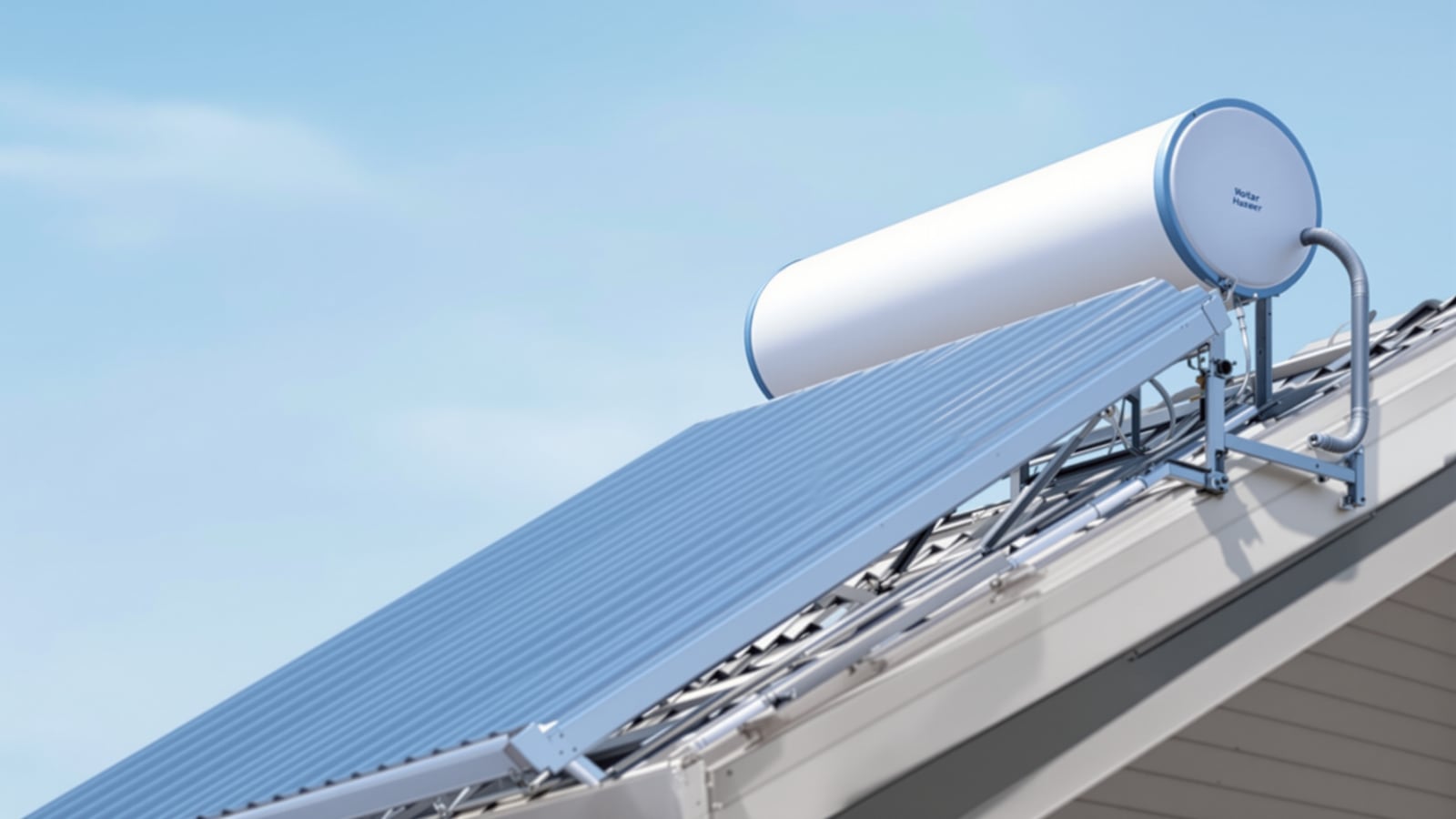
How a solar water heater works
Every domestic system is a simple loop of three parts, from sunlight to your tap:
- The collector — the part that faces the sun and absorbs its heat. It is either a bank of evacuated glass tubes or a flat plate panel (more on the choice below). Either way, a dark absorber surface soaks up sunlight and passes that heat into water.
- The insulated storage tank — a horizontal, well-lagged tank, usually mounted just above the collector. Hot water is lighter than cold, so it rises and collects here, staying warm overnight in good insulation.
- The plumbing — a cold feed from your overhead tank into the bottom of the collector, and a hot draw from the top of the storage tank into the house.
The mental model: cold water enters the collector, the sun heats it, warm water rises into the tank, and you draw it off through the day and evening. By mid-morning on a clear day the tank is hot; a well-insulated 200 LPD system still delivers a warm bath the next morning.
ETC versus FPC: the collector choice
Almost every quote you get will be for one of two collector technologies. This is the single biggest decision.
- ETC (Evacuated Tube Collector) — rows of double-walled glass tubes with a vacuum between the layers, like a Thermos flask. The vacuum kills heat loss, so ETC performs better in cold weather, on hazy winter mornings and in the hills. It is also cheaper per litre, which is why most Indian residential systems sold today are ETC. The catch: the water often flows inside the glass tubes, so in hard water areas the tubes scale up and lose efficiency, and glass tubes can crack (hail, a stray cricket ball, thermal shock).
- FPC (Flat Plate Collector) — a flat insulated box with a copper absorber sheet and copper riser tubes under toughened glass. It is more rugged and hail-tolerant, and because the water runs through sealed copper it copes far better with hard water and high-pressure supply. It costs more and loses a little more efficiency on cold cloudy days than ETC.
| Feature | ETC (evacuated tube) | FPC (flat plate) |
|---|---|---|
| Cold / cloudy performance | Better (vacuum insulation) | Slightly lower |
| Upfront cost | Lower | Higher |
| Hard-water tolerance | Poor — tubes scale up | Good — sealed copper |
| Durability | Glass tubes can crack | Rugged, hail-tolerant |
| Pressure handling | Better on pressurised systems (FPC) | Good |
| Best for | Budget, cold climates, soft water | Hard water, hail zones, long life |
Rule of thumb: hard water or a hail-prone hill town, choose FPC. Soft water and a tight budget, ETC is the value pick. If you must run ETC on hard water, ask for a system with a heat-exchange (indirect) loop so scale-prone water never enters the tubes.
Passive versus forced circulation
Separately from the collector, systems differ in how water moves through them:
- Thermosiphon (passive) — no pump. The tank sits above the collector, and natural convection does the work: heated water rises, cold sinks. Simple, silent, nothing to fail, no electricity for circulation. This is the default for homes and what the diagram above shows. It needs the tank mounted higher than the collector, so it wants roof headroom.
- Forced circulation (active) — a small pump pushes water between a collector on the roof and a tank that can sit lower, even at ground level. Used for large systems, hotels, hostels and where the tank cannot be mounted above the collector. It adds a pump, a controller and a small parasitic electricity draw.
For a normal house, thermosiphon is almost always the right answer: less to break, nothing to run.
Sizing: how many LPD do you need?
Solar systems are rated in LPD — litres per day of hot water the tank holds and reheats. Size by how many people bathe with hot water, not by house size. As an indicative planning figure, budget roughly 40 to 50 litres per person per day for comfortable bathing, then round to the nearest standard tank.
| Household | Indicative sizing | Common tank |
|---|---|---|
| 1-2 people | ~80-100 LPD | 100 LPD |
| 3-4 people (typical family) | ~150-200 LPD | 200 LPD |
| 5-6 people | ~250-300 LPD | 300 LPD |
| Joint family / large home | 400 LPD and up | 500 LPD or multiple units |
A 200 LPD ETC system is the workhorse of the Indian residential market. When in doubt, size up one step: a slightly oversized tank stays hotter longer and copes better with cloudy days. To sanity-check demand against your existing geyser, run the geyser running cost calculator — the kWh it burns is roughly what solar replaces.
The electric backup — why every good system has one
The sun does not shine on demand. A run of cloudy monsoon days, or a foggy North Indian December week, and a pure solar tank runs lukewarm. The fix is a backup electric heating element (typically 1.5 to 3 kW) fitted inside the storage tank, exactly like a geyser element. On a dull day you flip it on for 20-30 minutes and get hot water anyway.
- Keep the backup on a separate switch, not always-on, or you quietly pay for electric heating on sunny days too.
- Some homes skip the built-in element and instead route solar hot water into the inlet of an existing electric geyser, which then tops up the last few degrees — an efficient hybrid.
- The solar system does the bulk of the heating; the electric element is an occasional helper, not the main event.
Roof, orientation and freeze protection
Installation is where a good system is won or lost:
- Orientation and tilt — the collector faces true south (in the northern hemisphere) at a tilt roughly equal to your latitude, so it catches the winter sun. A shaded roof kills output; even a water-tank shadow at 3 p.m. matters.
- Structure — a filled 200 LPD tank plus frame is a real rooftop load. Mount it on a proper MS frame over a beam or load-bearing wall, not loose on the waterproofing membrane.
- Freeze protection (hills) — in Shimla, Manali, Leh and other sub-zero belts, water left in the tubes or exposed pipes can freeze and burst them. Use systems rated for freezing with an antifreeze (glycol) heat-exchange loop, or drain-back designs, and lag every exposed pipe.
- Hard-water scaling — as noted, ETC tubes scale in hard water; plan periodic descaling, or choose FPC or an indirect system.
Running cost, subsidy and payback
The headline is simple: running cost is effectively zero, offset by occasional backup-element use and small maintenance. The economics are all about upfront cost versus the electricity bill it kills.
| System (indicative) | Typical capacity | Indicative cost | Running cost |
|---|---|---|---|
| ETC 100 LPD | 1-2 persons | ₹15,000-₹25,000 | Near zero (backup only) |
| ETC 200 LPD | 3-4 persons | ₹22,000-₹35,000 | Near zero (backup only) |
| FPC 200 LPD | 3-4 persons, hard water | ₹35,000-₹55,000 | Near zero (backup only) |
| FPC 300 LPD | 5-6 persons | ₹50,000-₹75,000 | Near zero (backup only) |
Figures are indicative and vary by brand, city, roof work and BIS certification; get local quotes.
A 200 LPD system replacing a geyser used by a family of four can save a meaningful slice of the monthly electricity bill; against that saving, most homeowners see payback in roughly 3 to 5 years, after which the hot water is free for the rest of a well-maintained system's 10-15 year life.
Subsidy and policy context (by name, verify current figures locally): the Ministry of New and Renewable Energy (MNRE) has historically supported solar thermal, and several state nodal agencies and DISCOMs run their own incentives; prefer BIS-certified systems. Note that net metering applies to solar PV export, not to a purely thermal heater — do not confuse the two. Rules and amounts change often, so confirm the current scheme with your state agency. This guide deliberately quotes no subsidy number, because a stale one is worse than none.
Pros and cons
- Pros: free fuel from the sun; near-zero running cost; large electricity-bill saving; long life; no gas, no flue, no combustion risk; well suited to Indian sun.
- Cons: high upfront cost; needs clear, strong, south-facing roof space; underperforms in extended cloud/fog without backup; ETC vulnerable to hard water and hail; heavy filled tank needs structural care.
Solar is the standout choice for a home with roof space, sunshine and a plan to stay put long enough to bank the payback. If your roof is shaded or space-starved, compare the always-on heat pump water heater via the broader hot water systems guide before deciding.
References
- Ministry of New and Renewable Energy (MNRE) — solar thermal programme and empanelled systems (verify current scheme and figures).
- Bureau of Indian Standards (BIS) — certification for solar water heating systems (confirm the current standard number locally before quoting it).
- Your state renewable-energy development agency / DISCOM — for current subsidy and incentive details.
Export this guide
Related Guides — Deep-dive reading
Solar vs Electric Water Heater: Which to Choose for Your Home in India
The energy-source decision for whole-home hot water — a solar water heater's high upfront cost and near-free running against an electric geyser's cheap install and steep monthly bill. Upfront vs running cost, payback, roof needs, seasonal reliability, and a clear verdict by household.
PlumbingSolar Water Heating: Near-Free Hot Water from the Indian Sun
India's most cost-effective renewable heating — how a solar water heater works, evacuated-tube vs flat-plate collectors, sizing and economics, the role of the electric backup, and why it pays back faster than almost any home upgrade in a sun-rich country.
HVAC & CoolingWater Supply Systems in India: How Water Reaches Every Tap in Your Home
The complete map of how water gets into an Indian home and out to every fixture — the sources it comes from, the sump-pump-overhead-tank storage model that buffers intermittent supply, how gravity and pressurised distribution differ, and the demand figures that size the whole thing.
PlumbingRelated Tools — Try Free
Geyser Running Cost Calculator
Work out a water heater's electricity use and running cost per day, month and year — and compare electric, gas, heat-pump and solar.
Bathroom CalculatorRainwater Tank Sizer
How big should your rainwater tank be? Computes annual harvest, recommended tank capacity in litres, water-bill savings, and payback — for 10 Indian cities.
RWH CalculatorSolar Water Heater Size Calculator
Size a solar water heater — storage LPD and collector area — from occupants, per-person hot water and system yield.
Plumbing Calculator