
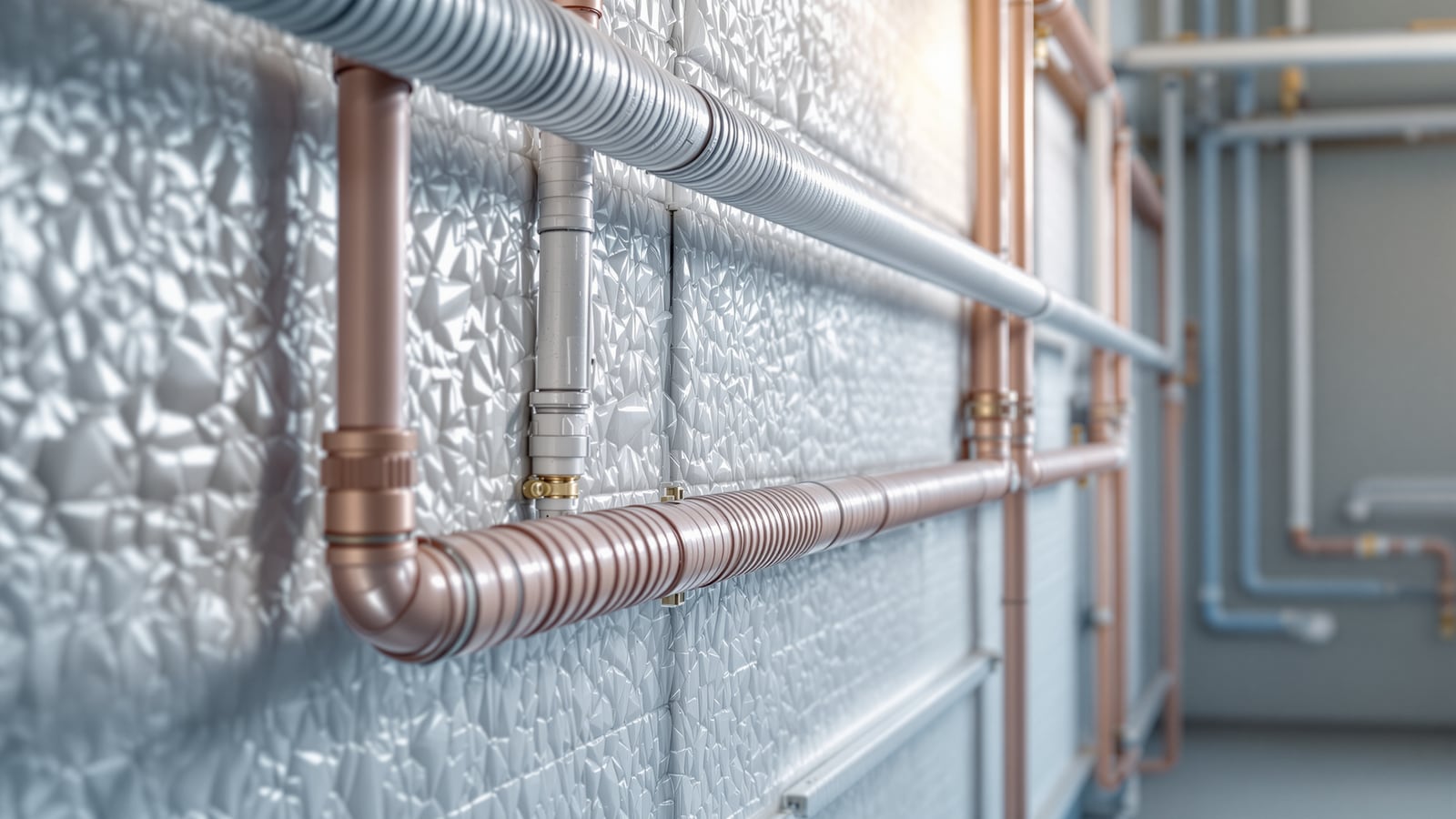
Hot Water Distribution in India: Getting Hot Water to the Tap Fast
The piping side of hot water — why you wait so long for it, how to kill dead legs, insulate the runs, add a recirculation loop, choose CPVC or PPR within their temperature limits, and stop scalding at the outlet.
Everyone thinks about the geyser. Almost nobody thinks about the pipe between the geyser and the tap — and yet that pipe is why you stand shivering, running litres of cold water down the drain, waiting for warmth that takes fifteen seconds too long to arrive. Hot water distribution is the quiet half of a comfortable bathroom: not the appliance that heats the water, but the piping that delivers it, hot and fast, where you actually want it.
This is a supply-side guide within the Studio Matrx Water Supply hub and the broader Plumbing Systems hub. It deliberately stays on the pipe side of the story. For the heater itself — sizing and running cost — use the Bathrooms hub's geyser size calculator and geyser running-cost calculator. Whether you heat centrally or at each point of use is a system-architecture choice, covered in the centralized and decentralized guides — here we assume the heater is chosen and ask only: how does its hot water reach the outlet well?
Hot water you paid to heat, sitting cold in a long pipe, is money and comfort thrown away twice — once when it cooled, and again when you flush it down the drain to reach the warm water behind it.
Why you wait for hot water: the dead leg
When you close a hot tap, the water in the pipe between the geyser and that tap stops moving. Within minutes it gives up its heat to the surrounding pipe, wall and air, and by morning it is at room temperature. Open the tap again and that cold slug has to be pushed out before hot water arrives. Plumbers call a long, stagnant, un-circulated hot branch a dead leg.
The length of the dead leg decides your wait. A rough rule: every metre of 15 mm CPVC pipe holds roughly 0.13 litres of water, so a geyser mounted 8 metres of pipe-run away means you flush about a litre of cold water — and wait the seconds it takes to flow — every single time.
- Long dead leg = long wait + wasted water + wasted energy reheating the slug that cooled.
- Short dead leg = near-instant hot water with almost nothing flushed away.
- The distance that matters is pipe length, not straight-line distance — every bend, riser and detour adds to it.
The single most effective, and cheapest, fix is design, not gadgetry: keep the heater close to the fixtures it serves.
Keep the heater close — the first and best fix
The decentralized, point-of-use pattern most Indian homes already use exists largely to solve this: put a small geyser directly above or beside each bathroom, and the hot run shrinks to a metre or two. A single central geyser feeding bathrooms at opposite ends of a large house creates two long dead legs and two long waits.
| Layout | Typical hot-pipe run to farthest tap | Rough wait at 15 mm | Water flushed each time |
|---|---|---|---|
| Geyser inside/above the bathroom | 1-2 m | 1-3 sec | Under 0.3 litre |
| Geyser in adjacent utility wall | 3-5 m | 4-8 sec | 0.4-0.7 litre |
| One central geyser, far bathroom | 10-15 m | 15-30 sec | 1.3-2.0 litre |
| Central geyser + recirculation loop | Any | 1-3 sec | Under 0.3 litre |
Figures indicative for 15 mm CPVC and normal flow; confirm against your actual layout.
If the run has to be long, two tools recover most of the loss: insulation to slow the cooling, and a recirculation loop to keep hot water always waiting at the tap.
Insulate the hot lines: stop losing the heat you paid for
A bare hot-water pipe is a radiator. It sheds heat continuously into the wall and the air, so the water cools faster between uses and the geyser works harder to make it up. Pipe insulation — also called lagging — is a foam sleeve slipped over the hot pipe before it is buried, boxed or clipped to a wall.
- Insulate all hot-water pipe, including the short nipple out of the geyser and any pipe in unheated shafts, ducts or terrace runs where cooling is fastest.
- Closed-cell elastomeric foam (nitrile rubber) sleeves are the common choice — sold to fit 15 mm and 20 mm pipe, typically 6-13 mm wall thickness.
- Insulation earns its keep most on long runs and recirculation loops, where hot water sits or circulates for long periods. On a 1 m point-of-use nipple the payback is smaller but still real.
- Concealed pipe is buried once and forever — insulate before the wall closes, because you will not get a second chance without breaking tiles.
Insulation does not make hot water arrive faster on the first draw; it slows how quickly the standing water cools between draws, so a pipe used every few minutes stays warm. Combined with a short run, it is often all a home needs.
Recirculation loops: hot water always at the tap
For a large house, a villa, or a genuinely central heating system, the answer to long runs is a recirculation loop. Instead of a hot branch that dead-ends at the far tap, you run a continuous loop: hot water goes out on the supply line, past the fixtures, and a return line brings the un-drawn water back to the geyser or tank to be reheated. A small recirculation pump keeps this water gently moving, so hot water is always parked right at every outlet. Open the tap and it is there — no slug, almost no wait.
- Return line. A dedicated pipe (often 15 mm) from the last fixture back to the heater completes the loop. This is much easier to install during construction than to retrofit.
- The pump. A small circulator — a few tens of watts — drives the flow. Some homes run it on a timer (mornings and evenings only) or a thermostat/aquastat so it works only when needed, saving energy.
- Comfort valve alternative. Where a full return line cannot be run, a thermostatic recirculation valve at the farthest fixture can bleed cooled water back into the cold line, using the existing cold pipe as the return — a simpler retrofit, though it slightly warms the cold supply.
A loop costs energy to run and heat to feed — the whole loop never fully cools — which is exactly why insulation is non-negotiable on a recirculation system. For a typical Indian flat with a geyser above each bathroom, you almost never need this; it is a tool for large or central layouts, decided alongside the centralized plumbing system choice.
Pipe material for hot lines: CPVC and PPR, and their limits
Not every pipe can carry hot water. Ordinary rigid PVC and galvanised iron are wrong choices for hot lines — PVC softens and deforms with heat, and GI corrodes and scales. The two right answers in India are CPVC and PPR.
| Property | CPVC | PPR |
|---|---|---|
| Full name | Chlorinated PVC | Polypropylene random copolymer |
| Joining | Solvent-cement (glued) | Heat fusion (welded) |
| Continuous hot service | Around 70-80 degC typical | Around 70 degC typical, higher for short peaks |
| Feel | Rigid, cream/tan | Rigid, usually green/grey |
| Common home use | Very common for hot + cold | Common, often in larger/newer builds |
Always match the pipe's pressure-temperature rating to your geyser's set temperature. Manufacturer rating tables and the printed pipe class govern — treat the above as indicative and confirm before buying.
The rule that catches people out: a pipe's pressure rating falls as temperature rises. A domestic geyser thermostat set around 55-60 degC sits comfortably inside both materials' envelope; problems appear only when someone runs an oversized heater or a solar system that stagnates far hotter than expected. When in doubt, size the pipe class for the highest temperature the water can reach, not the average.
Thermal expansion — give the hot pipe room to move
Plastic pipe expands noticeably when it heats. A long CPVC or PPR hot run, rigidly clamped at both ends, will bow, creak or stress its joints as it warms and cools each day. Good practice leaves it room to move:
- Space the clips a little wider on hot lines than cold, and avoid pinning long runs dead-tight between two fixed points.
- Use an expansion loop or offset — a deliberate bend — on long straight hot runs so the movement is absorbed by flexing, not by joint stress.
- Where a hot pipe passes through a wall or slab, sleeve it so it can slide rather than grind against masonry.
These are small details, but a hot line installed with no allowance for expansion is a slow leak waiting to appear at a stressed joint years later.
Anti-scald: safe temperature at the outlet
Distributing hot water well includes distributing it safely. Water hot enough to be stored safely — geysers are often set around 55-60 degC partly to suppress bacteria — is hot enough to scald a child in seconds. The fix belongs at the outlet, not at the tank: a thermostatic mixing valve (TMV) blends hot and cold to a safe, steady delivery temperature (commonly targeted around 43-45 degC at a shower or child-safe basin), and holds it even if pressure fluctuates.
- Point-of-use TMVs sit at a specific shower or basin — the usual retrofit for a child's or elder's bathroom.
- A single mixer tap blends manually but does not hold temperature if the cold supply pressure drops — a TMV does, preventing the sudden scald when someone flushes elsewhere.
- Keep the tank hot for safety and hygiene; make the outlet safe with mixing. Never solve scald risk by turning the geyser thermostat dangerously low.
Getting it right — a short checklist
- Measure the pipe length from geyser to the farthest tap; if it is long, either move the heater closer or plan a recirculation loop.
- Insulate every hot run, especially in shafts, ducts and terrace exposure — and always insulate before concealed pipe is buried.
- On big or central layouts, run a proper return line + pump, with a timer or thermostat, and insulate the whole loop.
- Use CPVC or PPR for hot lines, class-rated for the hottest the water can get — never plain PVC or GI.
- Allow for thermal expansion: wider clip spacing, an expansion offset on long runs, sleeves through walls.
- Fit a thermostatic mixing valve wherever children or elders bathe; keep the tank hot, make the outlet safe.
- Size and cost the heater itself with the geyser size and running-cost calculators, and treat every figure here as indicative — confirm ratings and layout with a licensed plumber.
Great hot-water distribution is mostly invisible: a heater kept close, short insulated runs, a loop only where the house truly needs one, the right pipe within its temperature limits, and a mixing valve at the tap. Get the pipe right and the geyser you already chose finally delivers on its promise — hot water, quickly, safely, without the wasteful morning wait.
References
- National Building Code of India (NBC) 2016, Part 9 — Plumbing Services — the governing framework for water supply and hot-water distribution in Indian buildings.
- Central Public Health and Environmental Engineering Organisation (CPHEEO) — Manual on Water Supply and Treatment, for supply and demand context (indicative domestic demand around 135 lpcd).
- Bureau of Indian Standards — the IS codes covering CPVC and PPR piping systems, electric storage water heaters and plumbing fittings; confirm the current code, edition and pressure-temperature class applicable to your installation with a licensed professional.
- Manufacturer pressure-temperature rating tables for the specific CPVC/PPR pipe class, geyser and mixing valve chosen. Verify all temperature limits, sizing and safety details locally.
Export this guide
Related Guides — Deep-dive reading
Centralized Plumbing System in India: Central Plant Design Guide
How a centralized plumbing system works — one central plant (hot-water calorifier, softening, boosted supply) serving a whole hotel, hospital or large home through circulation loops and return lines — with its efficiency case, its heat, pressure and Legionella risks, and when it beats going decentralized.
PlumbingPipe Expansion Joints & Thermal Expansion in India: Stopping Buckled, Sagging, Stressed Pipe Runs
Why CPVC, PPR and PVC pipes move so much when they heat and cool, how that movement buckles pipe and cracks joints on long or sun-exposed runs, and how to absorb it with expansion loops, offsets, bellows, and supports that let the pipe slide.
PlumbingThermostatic Mixer India: Anti-Scald Showers, Set-Temperature Valves & What They Really Cost (2026)
How a thermostatic mixer holds one safe temperature no matter what happens to the pressure — the wax cartridge explained, why it needs balanced hot and cold supply, geyser vs instant-heater realities, exposed vs concealed, rupee ranges, and exactly who should pay the premium.
BathroomsRelated Tools — Try Free
Geyser Size Calculator
Find the right water-heater capacity (litres) or instant kW for your bathroom and household, with an indicative running-cost note.
Bathroom CalculatorPlumbing Pressure-Test & Leak Checklist
Pre-closure pressure and leak test — 9 categories, 60+ checkpoints across water supply, drainage, fixtures, waterproofing, hot water, tanks.
Pre-Closure TestChild & Elder Home-Safety Audit
Room-by-room safety audit for households with children or seniors — 10 categories, 70+ checkpoints tagged by audience.
Safety Audit