
Solar vs Electric Water Heater: Which to Choose for Your Home in India
The energy-source decision for whole-home hot water — a solar water heater's high upfront cost and near-free running against an electric geyser's cheap install and steep monthly bill. Upfront vs running cost, payback, roof needs, seasonal reliability, and a clear verdict by household.
Every Indian home that wants reliable hot water eventually faces the same fork: heat the water with the sun or with the grid. A solar water heater costs a lot to install but then runs on free sunlight; an electric geyser costs very little to fit but quietly bills you every time you switch it on. This is the energy-source decision, and the honest short answer is that solar wins on lifetime cost for a house that draws plenty of hot water, while a geyser wins on simplicity, low outlay, and any spot the sun can't reach.
Each product has its own full guide already — this article is only the head-to-head. For how a solar water heater actually works, its ETC-versus-FPC collectors and LPD sizing, read the solar water heaters guide. For the electric geyser as an appliance — and the separate storage-vs-instant form-factor question that is often confused with this one — see the Bathrooms cluster's storage vs instant geyser and the Bathrooms hub. Both sit under the Studio Matrx hot water systems pillar.
Keep two decisions apart. This page is what heats the water — sun or electricity. Storage vs instant is what shape the box is — a tank you fill and reheat, or a small on-demand unit. You can pair either energy source with either form; muddling them is the commonest mistake buyers make.
The two contenders in one line each
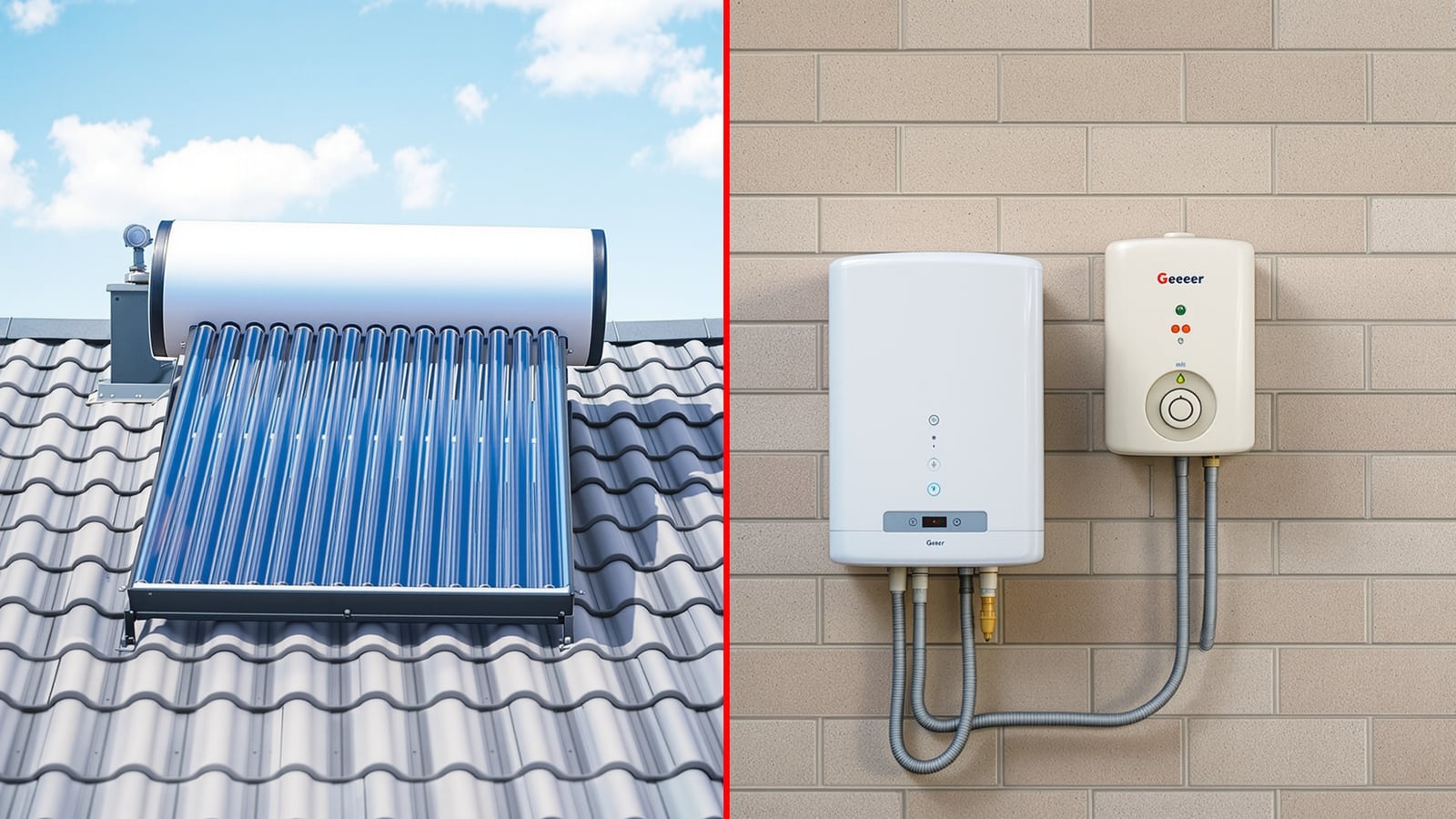
- Solar water heater — a rooftop collector that turns sunlight directly into heat, feeding an insulated storage tank, with a small electric backup element for cloudy days. High upfront cost, near-zero running cost, needs roof and sun, best for high daily hot-water demand.
- Electric geyser — a wall-mounted tank (or compact instant unit) with a resistance element that turns grid electricity straight into heat. Cheap and quick to install anywhere, works on demand in any weather, but every litre of hot water costs you electricity.
Upfront cost vs running cost — the whole argument
Almost everything else follows from a single trade. A solar water heater asks for a large cheque on day one and then barely touches your electricity bill. An electric geyser is the reverse: a small cheque today, then a running cost that never stops. Over a decade the two lines cross, and where they cross is the payback period.
- Solar upfront is high because you are buying a collector, an insulated tank, roof mounting, and installation labour all at once — often several times the price of a geyser. Subsidies may be available for domestic solar water heating; check current MNRE and your state's schemes, as terms change.
- Solar running cost is near zero on sunny days — the sun is free. The only electricity is the backup element on cloudy or monsoon days, and standby losses.
- Geyser upfront is low — a storage geyser is one of the cheapest ways to get hot water, fitted in an hour.
- Geyser running cost is high and permanent — a resistance element converts one unit of electricity into one unit of heat (no more), and a family that bathes with hot water daily feels this every month.
For indicative rupee figures and how they move by capacity and city tariff, lean on the Studio Matrx cost guidance rather than any single number here — this article is about the shape of the decision, not a quote.
Solar vs electric water heater: side by side
| Factor | Solar water heater | Electric geyser |
|---|---|---|
| Fuel / energy source | Sunlight (free), electric backup | Grid electricity only |
| Upfront cost | High — collector, tank, mounting, labour | Low — cheap appliance, quick fit |
| Running cost | Near zero on sunny days | High, every use, forever |
| Payback period | Years, then it earns money | None — it only ever costs |
| Space needed | Sunny, unshaded roof area | A wall and a power point |
| Weather reliability | Weak in monsoon/winter without backup | Full, on demand, any season |
| Hot water on demand | Stored; instant heat only via backup | Yes (storage) / instant units heat as you draw |
| Coverage | Whole home from one rooftop system | Usually one per bathroom |
| Typical lifespan | Long — roughly 15-20 years for the system | Shorter — roughly 8-12 years |
| Best for | High daily demand, long-term savings | Low use, rentals, shaded/cold sites |
Payback: when the crossover happens
The maths is a race between the geyser's saved electricity and the solar system's higher price. The more hot water you draw each day, the faster solar's near-zero running cost claws back its upfront premium — a large family bathing morning and evening reaches payback far sooner than a single professional who showers cold half the year. After payback, the solar system keeps delivering essentially free hot water for the rest of its long life, which is where the lifetime saving comes from.
| Household / usage | Daily hot-water demand | Which pays over the lifetime | Why |
|---|---|---|---|
| Large family, big house | High, twice-daily | Solar water heater | Fast payback, then years of near-free water |
| Mid-size family | Moderate, daily | Solar (if roof suits) | Payback is slower but still reached |
| Small household / couple | Low, seasonal | Electric geyser | Solar's outlay rarely justified |
| Single person / rental | Occasional | Electric geyser | Cheap to fit, little electricity spent anyway |
| No usable / shaded roof | Any | Electric geyser or heat pump | Solar simply isn't an option |
- High, daily demand — payback is quickest; solar is clearly the better lifetime buy.
- Modest, seasonal demand — payback stretches out; the case weakens.
- Occasional or single-person use — a geyser you switch on for ten minutes may never be beaten on lifetime cost, because you were never going to spend enough on electricity to justify solar's outlay.
Two things stretch a solar payback and must be honest in your sums: the backup element's winter/monsoon electricity, and any finance or maintenance over the years. Even so, for a hot-water-hungry household the direction is not in doubt.
Roof, space and reliability across seasons
Solar's superpower and its constraint are the same thing: it needs the sun. That means a genuinely unshaded roof angled to catch daylight, plus room for the tank — no roof, or a shaded, cramped, or heavily built-up one, rules it out. It also means performance dips exactly when you might want hot water most: cloudy monsoon weeks and cold northern winters. This is why a real solar system always ships with an electric backup element — on a grey day it quietly behaves like a geyser so you are never left with cold water. Sizing that backup and the tank correctly is covered in the solar water heaters guide.
An electric geyser has none of these worries. It sits on a wall, needs only a power point, and heats to the same temperature in a July downpour or a January dawn. Its weakness is the mirror image: it will only ever cost you money to run, and because it heats point-by-point you usually need one per bathroom, multiplying both the appliances and the standby losses.
It's not always either/or
The two are not rivals in every home — the smartest whole-house setups often use both. A solar water heater carries the bulk of the year's demand for free, and its built-in electric backup steps in on the handful of grey days. Some homes keep a small instant geyser at a distant or occasionally used bathroom while solar serves the main bathrooms. And if a low electricity bill is the whole goal but the roof or budget rules out solar, the heat pump water heater is the third option — it runs day and night at roughly a third of a geyser's electricity. Once you have picked the energy source, get the hot water to the tap efficiently with hot water distribution.
For a wider map of every plumbing "this vs that" call — pipes, tanks, pumps and more — see the plumbing comparisons guide.
The verdict
- For a large family or a big house with high daily hot-water demand and a sunny roof — choose a solar water heater. The high upfront cost is recovered by near-free running, and after payback you get years of essentially free hot water. This is the lowest lifetime-cost option and the right long-term call.
- For a small household, a rental, a flat with no usable roof, a shaded or cold site, or genuinely occasional use — choose an electric geyser. It is cheap to fit, works instantly in any weather, and you will never spend enough on electricity to justify solar's outlay.
- For a home that wants both low bills and full reliability — pair solar with its electric backup, or consider a heat pump where the roof or budget doesn't suit solar.
Bottom line: if you use a lot of hot water every day and have sun on your roof, solar pays; if you use little, rent, or lack the roof, the humble electric geyser is still the sensible buy.
Export this guide
Related Guides — Deep-dive reading
Solar Water Heaters in India: ETC vs FPC, Sizing, Backup, Subsidy and Cost
The rooftop heater that gives an Indian home free hot water from the sun — how the collector and tank work, evacuated-tube versus flat-plate, passive thermosiphon versus forced circulation, honest LPD sizing, the electric backup for cloudy days, roof and freeze concerns, the MNRE and state subsidy context, and where the upfront cost pays back.
PlumbingHeat Pump Water Heaters in India: The Most Efficient Way to Heat Water
How a heat pump water heater moves heat out of the air to warm your water at roughly a third of a geyser's electricity bill — integrated vs split units, tank sizing, where it suits, install needs, and the real payback.
PlumbingHot Water Systems Guide (India): How to Choose the Right Water Heater
Electric, gas, solar or heat-pump? Central or point-of-use? A homeowner's how-to-choose overview that compares every water-heating option on upfront cost, running cost and where each one actually suits an Indian home.
PlumbingRelated Tools — Try Free
Rainwater Tank Sizer
How big should your rainwater tank be? Computes annual harvest, recommended tank capacity in litres, water-bill savings, and payback — for 10 Indian cities.
RWH CalculatorGeyser Running Cost Calculator
Work out a water heater's electricity use and running cost per day, month and year — and compare electric, gas, heat-pump and solar.
Bathroom CalculatorGeyser Size Calculator
Find the right water-heater capacity (litres) or instant kW for your bathroom and household, with an indicative running-cost note.
Bathroom Calculator