
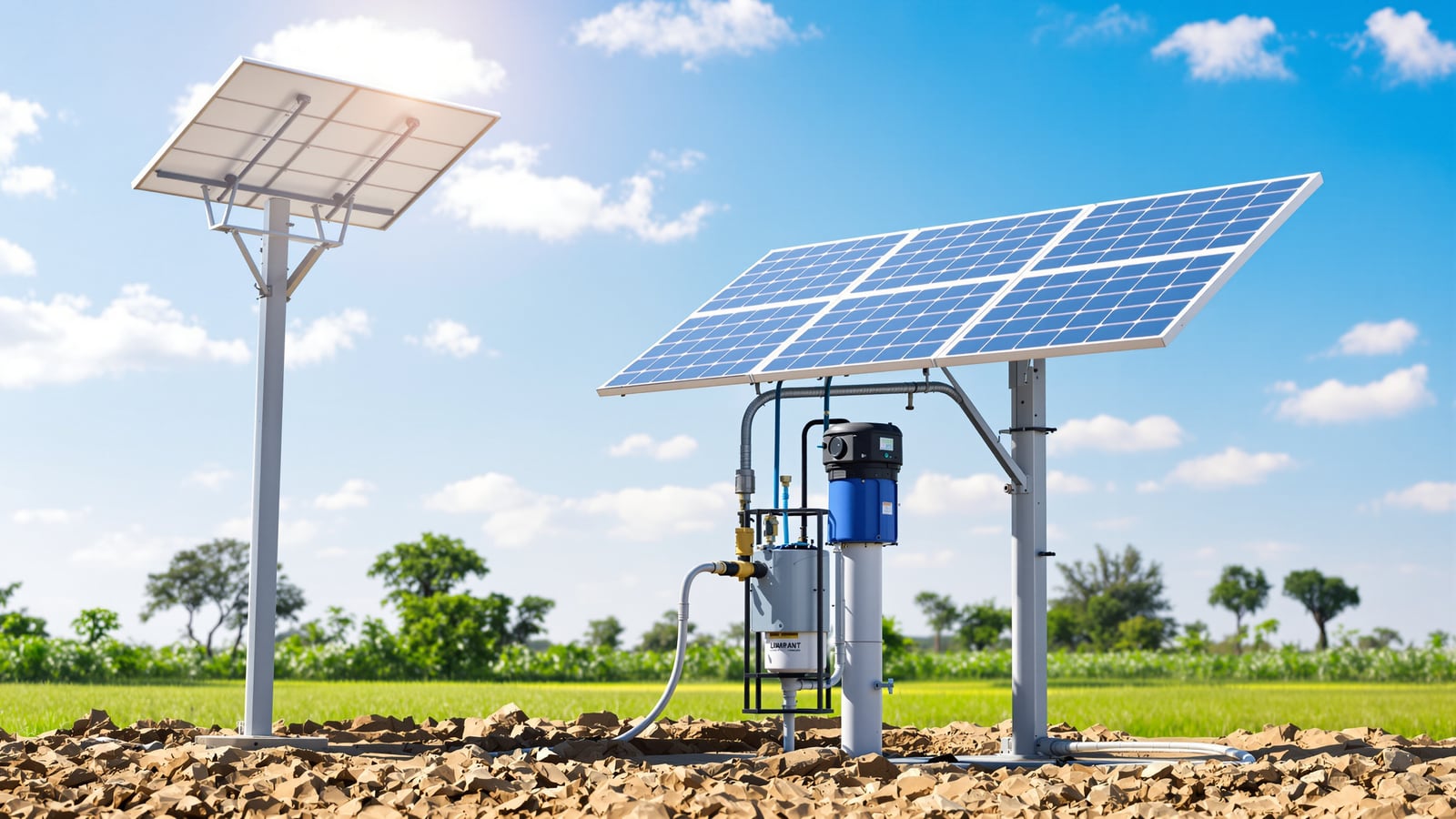
Solar Water Pumps in India: How They Work, Sizing, DC vs AC, Subsidy and Cost
The solar-PV-powered pump that lifts borewell and open-well water with zero running cost — how the panel array, controller and submersible or surface pump work together, how to size one against your daily water need, head and sun-hours, DC versus AC options, the PM-KUSUM subsidy landscape, and where the upfront cost pays back.
A solar water pump lifts water using nothing but sunlight — no grid connection, no diesel, no monthly electricity bill. For Indian farms, farmhouses, off-grid homes and anyone tired of load-shedding stopping the water, it is one of the few appliances that genuinely runs on free fuel once installed. This guide explains how a solar pump actually works, how to size one honestly, the DC-versus-AC choice, the PM-KUSUM subsidy context, and where the big upfront outlay pays for itself.
This is a pump-type guide inside the Studio Matrx Plumbing Knowledge Hub. For the full family of pumps and how to choose between them, start at the pillar water pumps guide. If your water comes from the ground, read the sibling borewell pumps guide and the borewell water system guide alongside this one. And before you buy anything, run the numbers on the pump size calculator.
A solar pump is not a normal pump with a panel bolted on. It is sized around energy harvested per day, not just pressure and flow. Its single defining trait is that it works hardest at noon and does nothing at night — so you pump into storage when the sun shines and draw from the tank the rest of the time.
How a solar pump works
Every solar pump is a short chain of four parts, from sunlight to water:
- The PV array — a set of solar panels (typically 300 to 550 watt-peak each) wired in series and parallel to produce a target DC voltage and wattage. This is the fuel tank; more panels means more water per day.
- The controller or VFD — the brain. A DC pump uses an MPPT controller that squeezes maximum power from the panels; an AC pump uses a solar variable-frequency drive (VFD) that inverts the panel's DC into three-phase AC and varies its frequency so the motor tracks whatever the sun is giving. Both include dry-run and over/under-voltage protection.
- The pump and motor — either a submersible unit sitting deep in a borewell casing, or a surface / monoblock pump beside an open well, sump or tank. The motor is matched to the controller output.
- The delivery side — a non-return valve (NRV) at the pump so lifted water does not fall back, the riser pipe, and almost always a storage tank, because the water arrives on the sun's schedule, not yours.
The mental model: the panels harvest energy through the day, the controller keeps the pump running at whatever speed that energy allows, and the tank buffers the mismatch between a pump that works only in daylight and a household that wants water at 6 a.m. and 9 p.m.
Sizing: daily water, head and sun-hours
A solar pump is sized around three numbers, and getting them right matters more here than for a grid pump because you cannot just run it longer at night to catch up.
- Daily water need — total litres you must move per day. A family of four with a garden might need 1,500 to 3,000 litres; a small farm plot, far more.
- Total head — the vertical lift from the water level to the tank inlet, plus friction losses in the pipe, in metres. Borewell dynamic water levels of 30 to 90 m are common in India, and head is what dictates pump power.
- Peak sun-hours — the number of hours per day your panels get near-full sun. Most of India averages roughly 5 to 6 peak sun-hours across the year, but a cloudy monsoon day may give only 2 to 3.
The honest rule: your pump must deliver the whole day's water within those peak sun-hours, not a 24-hour spread. If you need 3,000 litres and have 5 usable sun-hours, the pump must average 600 litres per hour at your head — and the panel array must be big enough to drive it. Rather than reproduce the full formula here, feed your head, flow and household size into the pump size calculator; for pressurised bathroom supply, the shower pump calculator covers that separately. As a habit, oversize the array by 20 to 30 percent so early-morning and cloudy-hour output still lifts useful water.
DC vs AC solar pumps
The controller type splits the market into two families, and the choice shapes cost, efficiency and serviceability.
| Feature | DC solar pump | AC solar pump (with VFD) |
|---|---|---|
| Controller | MPPT charge controller | Solar variable-frequency drive |
| Efficiency | Higher (no DC-AC conversion loss) | Slightly lower, drive losses |
| Typical range | Small to medium, up to ~3 HP | Small to large, 1 HP to 10 HP+ |
| Motor cost | Higher (specialised BLDC/DC motor) | Lower (standard AC induction motor) |
| Local serviceability | Fewer technicians, brand-specific spares | Any pump mechanic can service the motor |
| Best for | Small off-grid homes, low-head lifts | Farms, deep borewells, larger flows |
DC systems win on raw efficiency and simplicity for small loads; AC-with-VFD systems win on power, on using a conventional pump you can get repaired anywhere, and on the option to also run the same pump off the grid when the sun fails.
Battery or no battery
Most Indian solar pumps are battery-less — this is the default and the reason they are affordable. The panels drive the pump directly, and the overhead tank is your battery, storing water instead of electricity. You add batteries only when you genuinely need pumping after dark or steady output through cloud, because a battery bank large enough to run a pump is expensive, needs replacing every few years, and erodes the "zero running cost" advantage. For almost every home and farm, a bigger tank beats a battery.
PM-KUSUM and subsidy context
The Government of India's flagship scheme for solar pumping is PM-KUSUM (Pradhan Mantri Kisan Urja Suraksha evam Utthaan Mahabhiyan), which supports standalone solar pumps and the solarisation of existing grid pumps, primarily for agricultural users. States implement it through their nodal agencies (DISCOMs, agriculture or renewable-energy departments), and eligibility, the exact subsidy share and the approved-vendor list vary by state and change year to year.
- Subsidy support is typically split between central and state governments, with the farmer paying a balance share — but the percentages and caps differ by state and by scheme phase, so treat any figure you hear second-hand as unverified.
- Confirm current rates, eligibility and empanelled suppliers with your state nodal agency or DISCOM before budgeting.
- Domestic and farmhouse (non-agricultural) users may not qualify for KUSUM at all in some states, and buy at full commercial price.
We deliberately do not quote a subsidy percentage here, because a stale number is worse than none — check the official source for your state.
Cost, running cost and payback
The headline trade is stark: high upfront cost, near-zero running cost. A solar pump has no electricity bill and no diesel, so once installed it lifts water essentially for free; the only recurring spend is occasional maintenance and eventual panel or controller replacement over a long life. Figures below are indicative and swing with head, HP, panel brand and location — get a local quote.
| Pump size | Typical head | Approx. array | Indicative system cost (before subsidy) | Best suited to |
|---|---|---|---|---|
| 1 HP DC/AC | up to ~30 m | ~1.2 to 1.5 kWp | ₹1,20,000 to ₹1,80,000 | Small home, open well, garden |
| 2 HP AC | 30 to 60 m | ~2 to 3 kWp | ₹1,80,000 to ₹3,00,000 | Farmhouse, medium borewell |
| 3 HP AC | 50 to 80 m | ~3 to 4 kWp | ₹2,80,000 to ₹4,50,000 | Deep borewell, small farm |
| 5 HP AC | 60 to 100 m | ~5 to 6 kWp | ₹4,50,000 to ₹7,00,000 | Larger farm, high daily volume |
Against a grid or diesel pump running for hours every day, the fuel and bill savings often recover the upfront cost in roughly 4 to 7 years (much faster where you were burning diesel, and faster still with subsidy), after which the water is free for the rest of the panels' life. The economics improve the more hours a day you currently pump.
Monsoon, cloudy days and other limits
Solar pumping has real weaknesses, and pretending otherwise leads to dry taps:
- No sun, no water. On overcast monsoon days output can fall by half or more, exactly when you may least expect a water shortage. Size storage for two to three days of buffer, or keep a grid/diesel backup.
- Daylight-only. A battery-less system does nothing at night — you rely on the tank filled during the day.
- Panel maintenance. Dust, bird droppings and shading cut output sharply; panels need periodic cleaning to keep delivering.
- Deep, high-yield borewells may exceed what an affordable array can drive within sun-hours, so the pump under-delivers on the darkest weeks.
- Theft and security. Panels in remote fields are a target and may need fencing or anti-theft mounting.
Common problems and fixes
- Low flow at midday — usually dirty panels, shading, or an undersized array; clean, de-shade, or add panels.
- Pump stops and restarts — passing clouds dropping power below the start threshold; normal on patchy days, but persistent tripping points to a controller fault or a borewell whose water level is drawing down.
- No output in clear sun — check controller error codes, DC connections and dry-run lockout before suspecting the pump.
- Tank never fills — the daily energy simply is not meeting the daily need; recheck sizing against real sun-hours.
References
- PM-KUSUM (Pradhan Mantri Kisan Urja Suraksha evam Utthaan Mahabhiyan) — the national scheme for solar pump support; verify current terms with your state nodal agency or DISCOM.
- Ministry of New and Renewable Energy (MNRE) — policy and empanelment framework for solar pumping.
- Bureau of Energy Efficiency (BEE) — efficiency context for pumps and motors.
Treat all prices, HP ranges, heads and payback periods above as indicative. Confirm sizing with a pump dealer against your actual borewell water level and daily demand, and confirm subsidy terms with the official state source before you commit.
Export this guide
Related Guides — Deep-dive reading
Water Pumps Guide for India: Types, How to Choose & Size (Head, Flow, Phase)
The master overview of domestic and building water pumps — what a pump actually does (lift plus pressure), the two numbers that decide everything (HEAD in metres and FLOW in LPM), a pump-type-to-use table, single vs three phase, priming, foot valve and NRV needs, dry-run protection, and BEE star rating with running cost at a glance for an Indian home.
PlumbingBorewell Pumps in India: How to Size HP by Depth, V3/V4/V6 Types, Stages and Running Cost
The deep-well submersible pump is the heart of a private borewell — a slim multi-stage unit that sits underwater and pushes your supply up to the tank. This guide explains how to pick horsepower by borewell depth, water level and yield, which body diameter (V3/V4/V6) fits your bore, why more stages mean more head, and how oversizing wastes electricity and can dewater the bore.
PlumbingWater Supply Systems in India: How Water Reaches Every Tap in Your Home
The complete map of how water gets into an Indian home and out to every fixture — the sources it comes from, the sump-pump-overhead-tank storage model that buffers intermittent supply, how gravity and pressurised distribution differ, and the demand figures that size the whole thing.
PlumbingRelated Tools — Try Free
Rainwater Tank Sizer
How big should your rainwater tank be? Computes annual harvest, recommended tank capacity in litres, water-bill savings, and payback — for 10 Indian cities.
RWH CalculatorSolar CCTV Sizing Calculator
Enter cameras, sun-hours and backup days to get the solar panel wattage, battery Ah and an indicative kit cost for an off-grid camera.
Solar SizingShower Pump Calculator
Check whether your shower needs a pressure-boost pump and what size — available vs required pressure from your tank height or supply.
Bathroom Calculator