
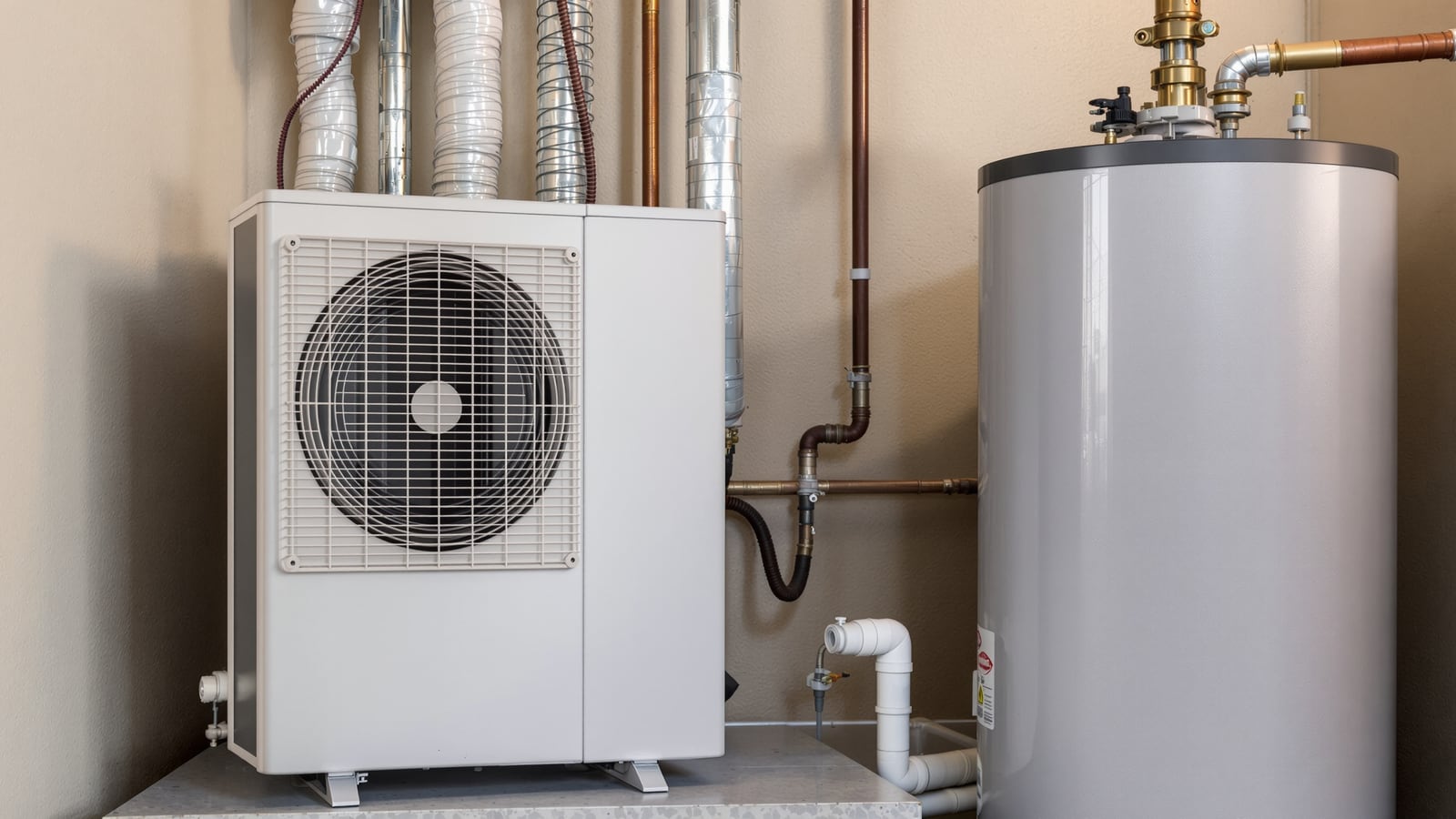
Heat Pump Water Heaters in India: The Most Efficient Way to Heat Water
How a heat pump water heater moves heat out of the air to warm your water at roughly a third of a geyser's electricity bill — integrated vs split units, tank sizing, where it suits, install needs, and the real payback.
Of every way to heat water with electricity, the heat pump water heater is the cheapest to run — often by a wide margin. Instead of turning electricity directly into heat like a geyser's element, it uses a little electricity to move heat that already exists in the surrounding air into your water. For a home, hostel, or small hotel that draws a lot of hot water every day, that difference shows up as a dramatically smaller electricity bill.
This guide sits within the Studio Matrx hot water systems guide and the broader Plumbing Systems hub. It is about the heating technology — how a heat pump makes hot water and whether it suits you. For the ordinary electric geyser most homes already own, and for sizing and running-cost sums, lean on the Bathrooms hub's geyser size calculator and geyser running-cost calculator. For getting that hot water to the tap quickly, see hot water distribution.
A resistance geyser converts one unit of electricity into one unit of heat. A heat pump uses one unit of electricity to deliver three or four units of heat — because most of the heat is scavenged from the air, not made from scratch.
How a heat pump heats water
A heat pump water heater (HPWH) works exactly like an air-conditioner or refrigerator run in reverse. A fan pulls in room or outdoor air; a refrigerant absorbs heat from that air, is compressed so it gets much hotter, and then gives that heat up to the water in the storage tank through a coil. The now-cooled, dried air is blown back out. Nothing is burned and no element glows red — the electricity only runs the compressor and fan.
The number that matters is the Coefficient of Performance (COP): heat delivered divided by electricity consumed. A resistance geyser is fixed at a COP of 1. A domestic HPWH typically runs at a COP of around 3 to 4 in warm conditions — meaning it needs only about a quarter to a third of the electricity a geyser uses for the same hot water. COP falls as the air gets colder, so the same unit is more efficient on a warm Chennai afternoon than a cold Shimla dawn.
- Warm, humid climates suit it best — plenty of ambient heat to harvest, so COP stays high year-round. Coastal and southern India are ideal.
- Slower recovery. A heat pump heats gently, over an hour or more, not in the fierce minutes an element takes. This is why it lives with a well-sized storage tank.
- It makes cool, dry air and some noise — the fan and compressor hum like a small AC, and the exhaust is a few degrees cooler than the room.
Integrated vs split units
HPWHs come in two physical layouts, and the right one depends on your space and airflow.
- Integrated (monobloc / all-in-one). The heat pump sits directly on top of a storage tank as a single tall appliance — like a fridge-sized geyser. Simplest to install; needs a room with plenty of air and ventilation, because it cools the space it stands in. A garage, utility room, or open terrace enclosure suits it. In a small sealed cupboard it starves for air and its COP collapses.
- Split. The heat pump (outdoor unit) sits outside like an AC condenser, connected by refrigerant lines to an indoor storage tank. It draws on outdoor air, so it never chills a living space and the compressor noise stays outside. More flexible for flats and multi-storey homes, but a more involved installation with refrigerant piping.
| Integrated (all-in-one) | Split | |
|---|---|---|
| Layout | Heat pump on top of tank, one unit | Outdoor heat pump + indoor tank |
| Best for | Garage, utility, open terrace | Flats, homes wanting quiet indoors |
| Air source | Cools the room it stands in | Uses outdoor air only |
| Install | Simplest, plug-and-play-ish | Needs refrigerant lines, more skilled |
| Noise indoors | Fan/compressor hum in the room | Quiet inside; noise stays outdoors |
Layouts and suitability are indicative — confirm airflow, drainage and electrical needs against the specific model and your site.
Sizing the storage tank
Because a heat pump heats slowly, the tank is your buffer — it must hold enough hot water for a peak draw while the pump quietly catches up. Undersize it and the family runs cold during the morning rush; oversize it and you pay to keep more water hot than you use.
Match the tank to how much hot water you draw at peak, not to the whole day's total. As a rough starting point:
| Household / use | Typical HPWH tank size | Notes |
|---|---|---|
| Small family, 2-3 people | 100-150 litre | One or two bathrooms |
| Larger family, 4-6 people | 200-300 litre | Staggered bathing helps recovery |
| Hostel / PG / small guesthouse | 300-500 litre+ | High daily volume is where HPWH shines |
| Hotel / commercial | Multiple / large-tank systems | Size to peak demand profiles with a designer |
Indicative sizes only. Do the arithmetic for your household with the Studio Matrx geyser size calculator — the litres-per-person logic is the same — then add margin for the heat pump's slower recovery.
The bigger the daily hot-water volume, the better a heat pump pays off, which is exactly why hostels, PGs, and hotels are its strongest home in India — a single well-sized system can serve many bathrooms far cheaper than a bank of resistance geysers.
Install requirements and what to watch
A heat pump water heater asks for a few things a plain geyser does not. Plan these before you buy.
- Airflow. The unit must breathe. An integrated model needs a well-ventilated room or an outdoor spot; a split model needs clear space around the outdoor unit. Cramped, sealed placement is the single most common cause of disappointing performance.
- The cool-air by-product. The exhaust air is a few degrees cooler and drier. A nuisance in a cold hill-station winter; a mild bonus in a hot store-room you would like slightly cooler anyway.
- Noise. Expect a low hum like a fridge or small AC. Keep an integrated unit out of bedrooms; put a split unit's compressor where its noise will not annoy.
- Condensate drain. Like an AC, it produces water droplets from the air it dries. It needs a drain or a tray routed to one, or it will puddle.
- Electrical and space. A dedicated circuit and earthing as the manufacturer specifies, and floor space for a tall, heavier appliance — plan for it in new builds rather than squeezing it in later.
Airflow is not optional. A heat pump denied fresh air is just an expensive, slow geyser — it falls back on a small backup element and loses the very efficiency you paid for.
Running cost, efficiency, and payback
This is where a heat pump earns its keep. Because it delivers three to four units of heat per unit of electricity, its running cost is roughly one-third that of a resistance geyser for the same hot water. The trade is a much higher purchase price, so the sums are about payback — how quickly the monthly saving repays the extra cost.
| Water heating method | Indicative electricity to run | Indicative purchase cost | Best where |
|---|---|---|---|
| Electric storage geyser | Baseline (COP 1) | Low (a few thousand ₹) | Low daily use, low upfront budget |
| Heat pump water heater | ~1/3 of geyser (COP ~3-4) | High (₹40,000 to ₹1,20,000+ by size) | High daily hot-water use, warm climate |
| Solar water heater | Very low; free sun, needs backup | High upfront, roof-dependent | Sunny site, good roof, daytime demand |
Prices and consumption are indicative and vary widely by brand, capacity and tariff. Work out your own running cost with the geyser running-cost calculator as the COP-1 baseline, then divide by your model's rated COP for the heat-pump figure.
The more hot water you use, the faster it pays back — which is why a heavy-use home, hostel, or hotel recovers the extra cost in a few years, while a light-use flat may find a simple geyser cheaper overall for a long time. Against a solar water heater, the picture is nuanced: solar's running cost is lower still (the sun is free) and both carry a high upfront cost, but a heat pump works at night, in monsoon, and without a large clear roof, whereas solar delivers its best when the sun shines and usually needs an electric backup for cloudy days. Many efficient systems pair the two — solar for the daytime bulk, a heat pump or small geyser for backup.
On efficiency ratings, India's Bureau of Energy Efficiency (BEE) runs the star-rating programme for electric water heaters; ask specifically about the star rating and rated COP of the model you are considering, and about any prevailing efficiency or renewable-heating incentives — but confirm current figures and eligibility from the official source rather than a salesperson's claim.
Pros and cons at a glance
- Pros: lowest running cost of any electric water heating; scales beautifully for high-volume use; no combustion, flue or gas connection; the cool exhaust air is welcome in hot store-rooms.
- Cons: high upfront cost; slower recovery, so needs a well-sized tank; needs airflow and space; makes noise and cool air; efficiency drops in cold climates; more involved (and pricier) to service than a plain geyser.
A heat pump water heater is not for everyone — a light-use flat in a cold hill town is better served by a simple geyser. But for a warm-climate home, a hostel, PG, or small hotel that pours out hot water every day, it is the most efficient electric heater you can buy, and the electricity bill tells the story within a few years.
References
- Bureau of Energy Efficiency (BEE) — the Standards and Labelling (star-rating) programme covering electric water heaters; consult it by name for current ratings and any efficiency incentives rather than relying on advertised figures.
- National Building Code of India (NBC) 2016, Part 9 — Plumbing Services — the governing framework for water supply and hot-water installations in Indian buildings.
- Bureau of Indian Standards — IS codes covering electric and heat-pump water heaters and their safety and performance; confirm the current code, edition and rating class with a licensed professional.
- Manufacturer datasheets for the specific model — rated COP, tank capacity, ambient-temperature performance, electrical, airflow and condensate-drain requirements. Verify all sizing, cost and safety details locally with a licensed electrician and plumber.
Export this guide
Related Guides — Deep-dive reading
Solar vs Electric Water Heater: Which to Choose for Your Home in India
The energy-source decision for whole-home hot water — a solar water heater's high upfront cost and near-free running against an electric geyser's cheap install and steep monthly bill. Upfront vs running cost, payback, roof needs, seasonal reliability, and a clear verdict by household.
PlumbingHot Water Systems Guide (India): How to Choose the Right Water Heater
Electric, gas, solar or heat-pump? Central or point-of-use? A homeowner's how-to-choose overview that compares every water-heating option on upfront cost, running cost and where each one actually suits an Indian home.
PlumbingSolar Water Heaters in India: ETC vs FPC, Sizing, Backup, Subsidy and Cost
The rooftop heater that gives an Indian home free hot water from the sun — how the collector and tank work, evacuated-tube versus flat-plate, passive thermosiphon versus forced circulation, honest LPD sizing, the electric backup for cloudy days, roof and freeze concerns, the MNRE and state subsidy context, and where the upfront cost pays back.
PlumbingRelated Tools — Try Free
Geyser Running Cost Calculator
Work out a water heater's electricity use and running cost per day, month and year — and compare electric, gas, heat-pump and solar.
Bathroom CalculatorGeyser Size Calculator
Find the right water-heater capacity (litres) or instant kW for your bathroom and household, with an indicative running-cost note.
Bathroom CalculatorRainwater Tank Sizer
How big should your rainwater tank be? Computes annual harvest, recommended tank capacity in litres, water-bill savings, and payback — for 10 Indian cities.
RWH Calculator