
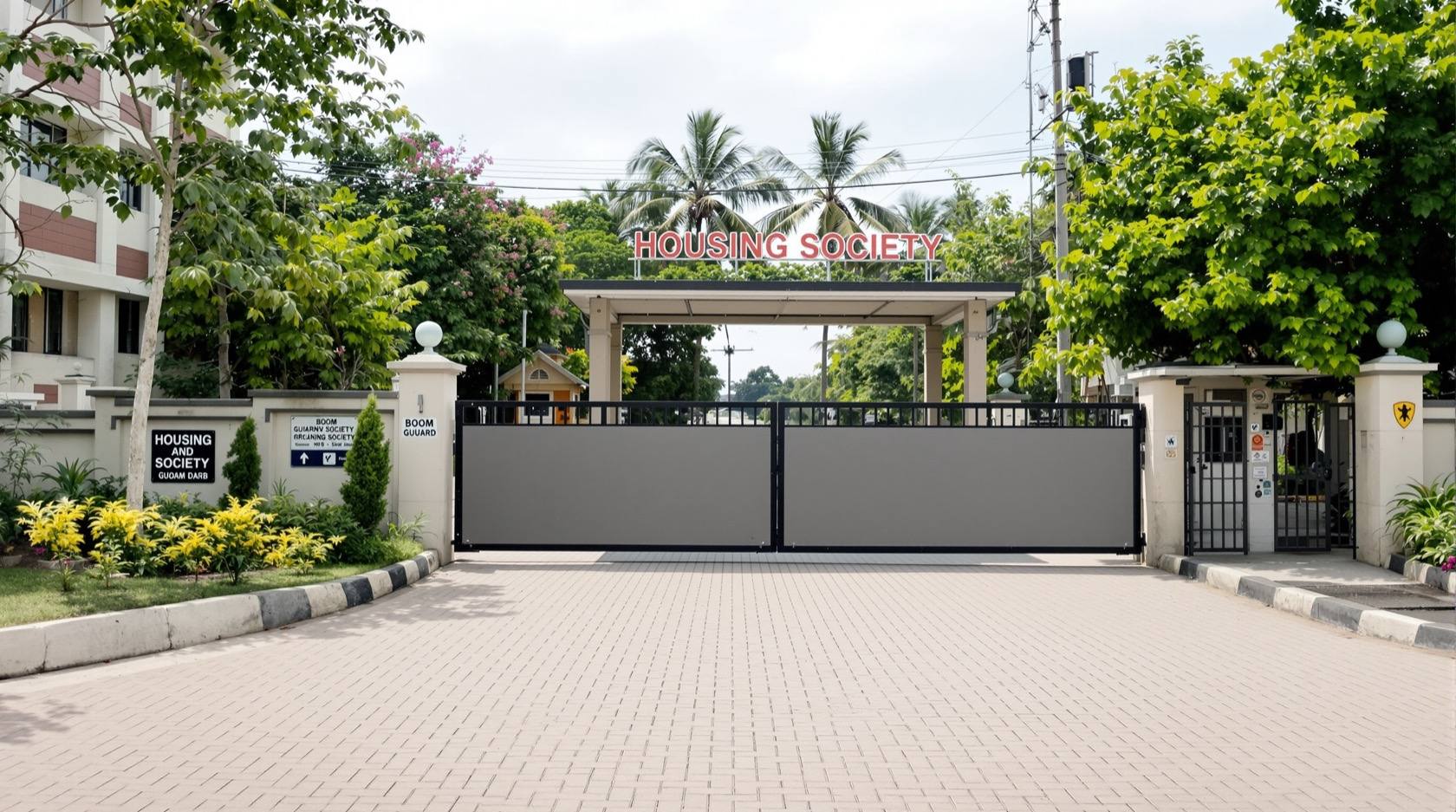
Society Entry and Gate Management in India (2026): Smooth, Secure and Fair
How a housing society runs its gates and entries well — clear SOPs for residents, visitors, deliveries and domestic staff; the right gate hardware; anti-tailgating discipline; and doing all of it fairly and within DPDP.
The gate is where a society's security is felt every single day — by residents in a hurry, by a delivery rider standing in the sun, by a domestic worker who comes at the same time each morning, and by the guard trying to keep the whole thing moving. Done well, the gate is quiet, quick and fair: residents flow through without a daily hassle, guests are expected before they arrive, workers are treated with dignity, and nothing genuine gets stuck. Done badly, it becomes a humiliating checkpoint, a traffic jam onto the public road, and a pile of personal data nobody is protecting. This guide is about getting society entry and gate management right on all three counts at once — smooth, secure and fair.
Entry is one part of the wider picture covered in the guide to gated communities; it works hand in hand with visitor access management and the guard-to-resident intercom that lets a guard confirm a visitor with a resident in seconds. The people who run it are the guards — hire and manage them fairly, as set out in hiring and managing society guards. This page pulls the gate together: the flows, the SOPs, the hardware and the rules.
Scope & how to read this. This helps residents and the managing committee (RWA / AOA) plan, decide and coordinate a fair, workable gate — it is not legal advice, and it does not tell anyone how to defeat security. Fairness and the DPDP Act, 2023 are not optional extras here; they are part of the design. Figures are indicative — get local quotes and confirm rules with your society's legal advisor.
Start from the flows, not the gadgets
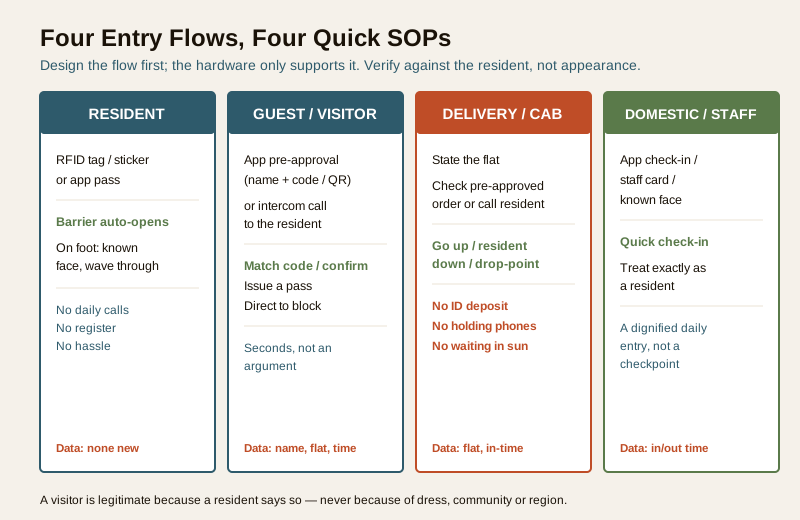
A gate serves four different kinds of people, and each needs a different, quick path. The commonest mistake is running everyone through one slow lane with the same interrogation — the resident is annoyed, the worker is humiliated, and the queue spills onto the road. Design a distinct SOP for each flow first; the hardware then simply supports it.
The four flows
- Residents should barely notice the gate. An RFID tag on the windscreen, a sticker, or an app-based pass opens the barrier automatically. No daily phone calls, no writing in a register, no asking "which flat". If a resident is on foot, a face they and the guard both know is enough.
- Guests and visitors should be expected before they arrive. The resident pre-approves them in the society app (a name and a one-time code or QR), or the guard makes a quick intercom call to the resident to confirm. On confirmation, a pass is issued and the visitor goes to the right block — no confirmation, no entry, but the wait is measured in seconds, not an argument.
- Deliveries and cabs need a respectful, quick process. A rider or driver states the flat, the guard checks against a pre-approved order or calls the resident on the intercom, and either the rider goes up or the resident comes down or a drop-point is used. Do not make a delivery or gig worker wait in the sun for twenty minutes, and do not take their phone or hold their ID as a deposit — it is unnecessary and demeaning.
- Domestic workers and regular staff come daily. Give them a dignified daily entry, not a checkpoint: a simple app check-in or a card, a known face, a nod. They are people who work here, not suspects — the tone at the gate is exactly the same as it is for a resident.
A clear SOP for each flow
| Flow | How they are verified | What the guard does | Data collected (keep minimal) |
|---|---|---|---|
| Resident | RFID tag / sticker / app pass | Barrier auto-opens; wave through if on foot | Already on society roll; nothing new at the gate |
| Guest / visitor | App pre-approval (name + code/QR) or intercom confirm to resident | Match the code or call the flat; issue a pass; direct to block | Name, flat visited, in-time; photo only if the society has resolved to and it is proportionate |
| Delivery / cab | Pre-approved order or a quick intercom call to the resident | Confirm the flat; send up, call resident down, or use drop-point | Flat and in-time; no ID deposit, no holding the phone |
| Domestic worker / regular staff | App check-in / staff card / known face | Quick check-in; treat exactly as a resident | One-time enrolment held by the society; daily in/out time only |
The rule behind the table: verify against the resident, not against the person's appearance. A visitor is legitimate because a resident says so, not because of how they are dressed or where they seem to be from.
The gate hardware, sized to the traffic
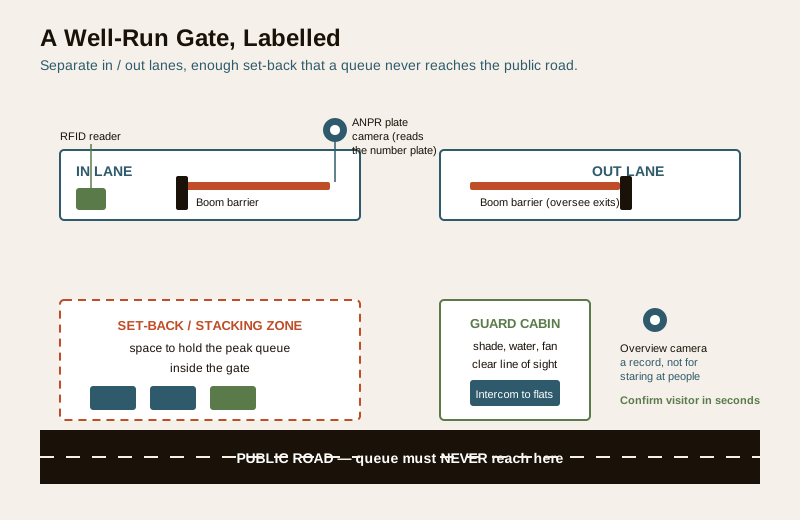
Hardware exists to make the SOPs fast and to stop the queue backing onto the public road. Specify it to your actual peak-hour traffic, not to a brochure.
What sits at a well-run gate
- A boom barrier per lane — ideally separate in and out lanes so an exiting car never blocks an entering one. On a busy gate, two in-lanes at peak.
- RFID / ANPR to auto-open for enrolled residents. RFID reads a windscreen tag; ANPR (a plate camera) reads the number plate and opens for a known vehicle — quietly logging the plate.
- An intercom from the cabin to every flat, so the guard can confirm a visitor with the resident in seconds without anyone shouting or waiting. This is the backbone of the whole visitor flow.
- A camera reading plates at the entry, plus a clear overview camera — for a record, not for staring at people.
- A guard cabin with shade, water, a fan and a clear line of sight, positioned so the guard can work without standing in traffic.
- Queue-management space — enough set-back inside the gate that vehicles waiting to be cleared never tail back onto the public road. If your peak queue reaches the road, you need more lanes, faster clearance, or a redesign — not a faster-shouting guard.
What to specify when you buy
| Item | Specify | Why it matters |
|---|---|---|
| Boom barrier | Lanes (separate in/out), opening speed, safety loop / anti-crush | A slow or single barrier is what makes queues reach the road |
| RFID / ANPR | Read range, accuracy in rain/dust, how a failed read is handled | Residents must not be stranded by a mis-read; have a manual fallback |
| Intercom | Cabin-to-every-flat coverage, backup if a line is down | The visitor SOP collapses without a working intercom |
| Plate camera | Placement, night legibility, where footage is stored and for how long | It is a record, so retention and access must be defined up front |
| Guard cabin | Shade, water, fan, seating, sight-lines, power backup | Guard welfare is both right and required, and a comfortable guard works better |
| Queue set-back | Metres of stacking space inside the gate at peak | Protects the public road and prevents road-rage at your own entrance |
A queue is a design problem, not a discipline problem. If cars back onto the road, the fix is lanes, faster clearance or pre-approval — never blaming the guard or waving genuine people through unchecked.
Anti-tailgating and gate discipline
The weakest point of any gate is a barrier that opens for one vehicle and lets a second slip through behind it — tailgating for vehicles, piggybacking for people on foot. Managing this is about a calm, consistent routine, not aggression.
- One authorisation, one entry. The barrier closes behind each vehicle before the next is cleared; a safety loop that senses the vehicle helps prevent both crushing and tailgating.
- On foot, one person one check. A group entering together is confirmed together — politely, not by singling out whoever "looks like" they do not belong.
- A known face is a valid check. Recognising regular residents, staff and workers is the point of continuity, not a lapse.
- The exit matters too. Do not let the out-lane become an unmanaged hole; log or at least oversee exits, especially for vehicles.
- Escalation, not confrontation. If something is genuinely wrong, the guard follows a defined escalation — call the supervisor or the committee's point person — rather than physically blocking or detaining anyone.
Fairness is a rule, not a courtesy
A gate handles hundreds of people who are not residents — workers, drivers, delivery staff, tenants, guests. How the society treats them is the clearest signal of what kind of community it is, and several common practices are simply unfair and can be unlawful.
Apply the rules equally — and lawfully
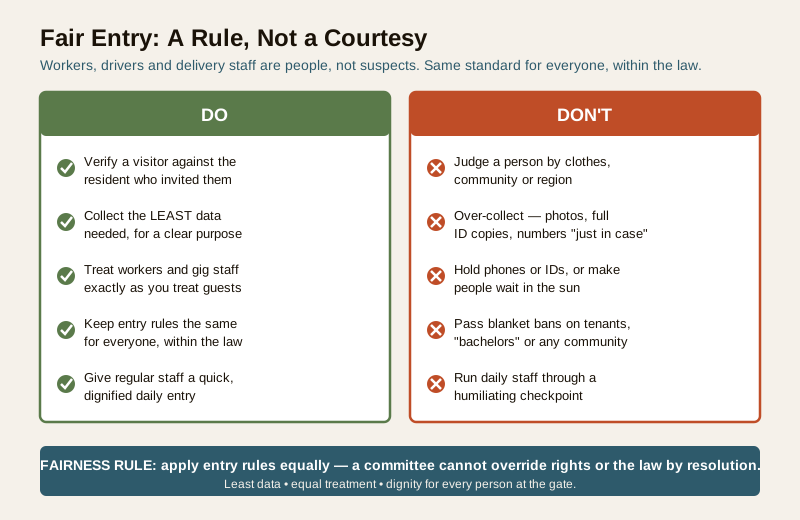
- Same rule for everyone. The verification standard is the same whether the person arriving is in a suit or in work clothes. Profiling by dress, community, region, language or religion is wrong and has no place in an entry policy.
- No humiliating checks. No holding a worker's phone or ID as a "deposit", no making people wait in the sun as a matter of routine, no separate, degrading treatment for staff.
- No unlawful blanket bans. A managing committee acts within its bye-laws and the law — the relevant state Apartment Ownership / Cooperative Societies Act, the Model Bye-laws and residents' fundamental rights. It cannot, by resolution, impose blanket bans on tenants, on "bachelors", or on people of a particular background; such rules are frequently challenged and struck down. A flat owner's right to let their home, and a worker's right to earn, are not the committee's to cancel.
- Dignity for daily workers. The person who has come to the same block every morning for five years deserves a nod, not a fresh interrogation.
The fair-entry test
| Do | Don't |
|---|---|
| Verify a visitor against the resident who invited them | Judge a person by their clothes, community or region |
| Collect the least data needed, for a clear purpose | Over-collect — photos, full ID copies, or numbers "just in case" |
| Treat workers and gig staff exactly as you treat guests | Hold phones or IDs, or make people wait in the sun |
| Keep entry rules the same for everyone, within the law | Pass blanket bans on tenants, "bachelors" or any community |
| Give regular staff a quick, dignified daily entry | Run daily staff through a humiliating checkpoint |
The visitor data the gate collects — a DPDP duty
Every gate now collects personal data: names, phone numbers, photos, vehicle numbers, sometimes biometrics or app data. Under the Digital Personal Data Protection Act, 2023, a society doing this is a data fiduciary with real duties — this is not a form-filling formality.
Handle it like a custodian
- Collect the least. Ask only for what the flow genuinely needs. A delivery to a known order needs a flat number, not a copy of the rider's licence. Question every field on the visitor form.
- A clear purpose. Data is for verifying entry and for a security record — not for marketing, not for sharing, not for a committee member's private use.
- Secure it. Whether it is a paper register or an app, the visitor log identifies people and must be access-controlled, not left open on the cabin desk or exported freely.
- Limit retention. Keep entry logs and footage for a sensible, defined cycle and then delete them; indefinite hoarding is a liability, not an asset.
- Extra care with biometrics and workers' data. Fingerprint or face data and workers' phone numbers deserve the highest care. Never let a worker's number be misused — for personal calls, for pestering, or shared with anyone. If the society uses an app vendor, that vendor processes residents' and visitors' data on the society's behalf, so the contract must bind them to the same limits.
| DPDP principle at the gate | What it looks like in practice |
|---|---|
| Data minimisation | Flat + in-time for a delivery; no ID copy, no photo unless truly needed |
| Purpose limitation | Logs used for security only — never marketing, sharing or personal use |
| Security safeguards | Register or app access-controlled; not left open or exported freely |
| Storage limitation | Defined retention for logs and footage, then deletion |
| Care with sensitive data | Biometrics and workers' numbers protected; app vendor bound by contract |
DPDP note. Making the guard collect more "to be safe" is the opposite of safe under the DPDP Act — every extra field is more personal data the society must now protect and could be answerable for. Least data is both the fair choice and the compliant one.
How it connects
Society entry and gate management is one system within a community's shared security. It sits inside the guide to gated communities, runs on the visitor access management process and the guard-to-resident intercom, and depends on guards who are hired and treated well as covered in hiring and managing society guards. All of these live in the Community & RWA Security library.
Key takeaways
- Design the four flows first — resident, visitor, delivery/cab, domestic worker — each with a short, respectful SOP; the hardware only supports them.
- Verify a visitor against the resident, through app pre-approval or an intercom confirm — never against how the person looks.
- Give deliveries and daily staff a quick, dignified entry — no ID deposits, no holding phones, no waiting in the sun.
- Size the hardware to peak traffic and keep enough set-back that a queue never reaches the public road; a queue is a design problem, not the guard's fault.
- Run anti-tailgating as a calm routine — one authorisation, one entry — with escalation, not confrontation.
- Fairness is a rule: same standard for everyone, no profiling, no humiliating checks, and no unlawful blanket bans, which committees cannot impose by resolution.
- Treat visitor data as a DPDP duty: least data, a clear purpose, secured, retained briefly, and workers' numbers and biometrics never misused.
References
- Digital Personal Data Protection Act, 2023 — the society is a data fiduciary for visitor, worker and resident data; collect the least, secure it, limit retention and confirm current obligations with the society's legal advisor.
- The relevant state Apartment Ownership / Cooperative Societies Act and the Model Bye-laws — the framework within which a managing committee may set entry rules; blanket bans and rules that override residents' rights are commonly challenged. Verify with the registrar or the society's legal advisor.
- Private Security Agencies (Regulation) Act, 2005 (PSARA) — engage a licensed agency for gate guards, with fair wages and welfare; see the guide on hiring and managing society guards.
- Society app / gate-management vendor documentation — for how visitor pre-approval, passes and logs actually work in your system, and for the data-processing terms binding the vendor.
- Your society's own bye-laws, AGM resolutions and legal advisor — the authoritative source for what your community may and may not do at its gate.
This is educational guidance for planning a fair, secure gate, not legal advice. Entry rules must stay within your bye-laws and the law, treat every person equally and with dignity, and handle personal data under the DPDP Act; verify specifics with your society's legal advisor or the authority, and use licensed professionals for installation and life-safety work.
Export this guide
Related Guides — Deep-dive reading
Visitor Vehicle Management in India: A Professional Guide
The everyday weak point of every society and office gate is not the resident's car — it is the visitor, the cab, the delivery rider and the contractor who must be let in without opening the whole park to anyone. This is the process, not just the hardware: verify at the gate before the boom lifts, park visitors away from resident bays, and never jam the gate a fire tender needs.
SecurityFair and Lawful Community Security in India (2026): Dignity, Data and Governance Done Right
How a housing society can run security that is fair, dignified and within the law — rejecting discriminatory practices, respecting domestic, delivery and gig workers, honouring the DPDP Act as a data fiduciary, and governing within its bye-laws and residents' rights — and why that makes it better security, not weaker.
SecurityVisitor Screening Areas in India (2026): Verifying People at the Gate, With Dignity
How to design the space and procedure where visitors are identified, verified and admitted or turned away — a controlled airlock that verifies before the gate opens, respects DPDP privacy, and never humiliates the people it screens.
SecurityRelated Tools — Try Free
Gate Access Planner
Size a vehicle gate or boom barrier — lanes needed at peak and the right credential speed (RFID, ANPR, manual).
Gate FlowVisitor Access Planner
Size visitor handling at a gate or reception — lanes needed at peak and the temporary-pass pool.
Visitor FlowCCTV Camera Coverage & Count Calculator
Estimate how many CCTV cameras you need, the NVR channels, storage in TB for your retention period, and an indicative all-in cost with GST.
CCTV Calculator