
Hiring and Managing Society Guards in India (2026)
How a housing society engages security guards through a licensed agency, deploys enough of them to cover a 24x7 rota without burning anyone out, supervises them properly, and treats them with fair wages, rest and dignity.
Most housing societies want "good security" and reach for the cheapest guard quote they can find. That is exactly how you end up with under-paid, over-worked, poorly supervised people at your gate — which is not security at all. Guards are one layer of a society's protection: they deter, they observe and they report, backed by gates and access control and CCTV. Getting the human layer right means engaging them the lawful way, staffing enough of them, supervising them well, and treating them as the working professionals they are.
This guide is for a managing committee or an RWA sub-committee deciding how to engage and run society guards. The single most important decision is to use a PSARA-licensed private security agency and never to hire unverified individuals off the books — that choice sits inside your wider security guard licensing and compliance obligations and your overall gated-community security plan. The second most important is to budget honestly: a real 24x7 gate needs more guards than most committees assume, and squeezing the rate down simply transfers the pain onto the people at your gate. Plan the money alongside your security budget.
Give guard welfare and dignity equal weight with deployment and supervision throughout. Fair wages paid in full and on time, sane shifts, and a decent cabin are not charity — they are what produce an alert, stable, low-turnover guard force, and much of it is your legal responsibility too.
Scope & how to read this. This is planning and governance guidance for a society, not legal advice or a contract; engage a PSARA-licensed agency and take your society's legal advisor's view on wages, statutory dues and contract terms, which vary by state and change over time.
Step one: engage a licensed agency, not an individual
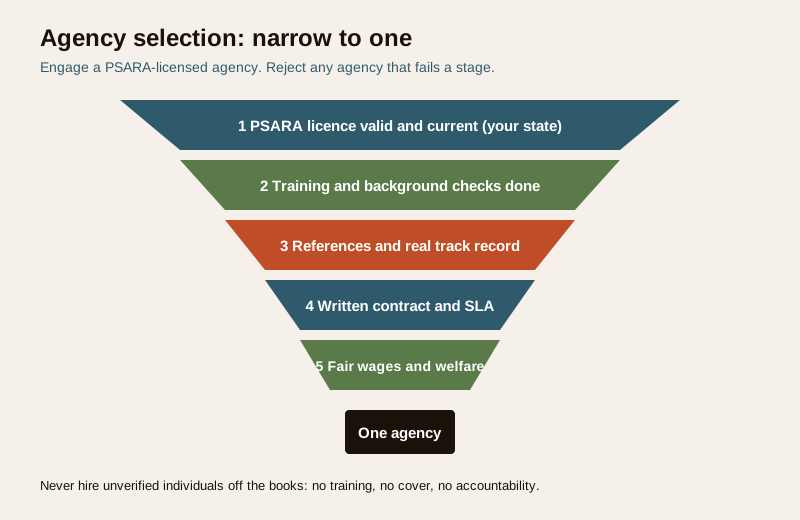
The lawful way to put guards at your gate is through a private security agency that holds a valid licence under the Private Security Agencies (Regulation) Act, 2005 (PSARA) and the rules of your state. The agency employs, trains, pays and insures the guards; your society contracts the service, not the individuals. Hiring people directly "off the books" to save money exposes the society and its office-bearers to legal and liability risk, leaves guards with no training or cover, and usually means no accountability when something goes wrong.
What to verify before you sign
Do not take a brochure at face value. Verify the agency the way you would any vendor holding a safety-critical role.
- PSARA licence — valid, current, and covering your state. Ask for the licence and check it is not expired or suspended.
- Guard training — the agency trains guards per the PSARA requirement; ask what the induction and refresher training actually covers.
- Background checks — the agency verifies each guard's identity, address and antecedents before deployment; ask how, and for what documents.
- Insurance and liability — the agency carries its own liability cover and meets statutory dues (see below); ask for proof, not promises.
- A proper written contract / SLA — scope, number of guards, posts, shift pattern, supervision, wage transparency, replacement time, notice, and how disputes are handled.
Statutory dues are non-negotiable
A genuine agency deducts and deposits the guards' statutory dues — provident fund, ESI and the like — and pays at least the applicable minimum wage for the state and skill category. A quote that is far below others is usually cheating either the guards or the exchequer, and the society can be drawn into that. Ask the agency to show wage transparency: what the guard is actually paid out of what you pay the agency.
Step two: deployment — how many guards you actually need
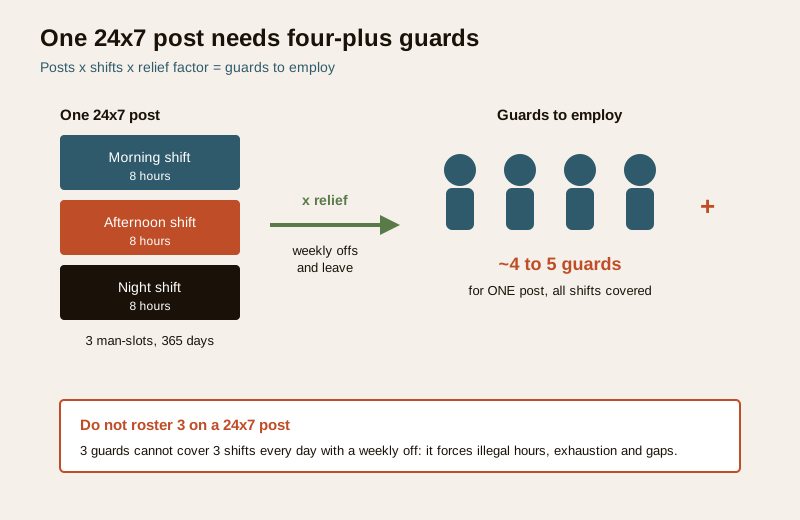
This is where most societies get the maths wrong. You do not staff a gate with "three guards for three shifts". A post that must be manned around the clock, every day of the year, needs more than one guard per shift slot once you account for weekly offs, leave, sickness and training. The multiplier that turns "posts on duty" into "guards to employ" is the relief factor.
Posts, shifts and the relief factor
Work it out in three moves:
1. Count your posts. A post is a position that must be staffed — the main gate, a second gate, a perimeter patrol beat, the lobby of a tower. Decide which are 24x7 and which are part-time (for example a day-only visitor desk).
2. Multiply by shifts. A 24x7 post over three eight-hour shifts is three "man-slots" a day; every one of those slots must be filled 365 days a year.
3. Apply the relief factor. Because each guard has weekly offs and takes leave, you need roughly four-plus guards to keep one 24x7 post covered across all shifts without anyone working seven days a week. Rostering only three guards on a round-the-clock post guarantees illegal hours, exhaustion and gaps in cover.
Worked example: staffing a mid-size society
Illustrative only — get your own numbers and quotes; the exact relief factor depends on weekly offs, leave policy and local practice.
| Post | Coverage | Man-slots per day | Guards to employ (with relief) | Notes |
|---|---|---|---|---|
| Main gate | 24x7 | 3 (three shifts) | ~4 to 5 | Boom barrier, visitor log, deliveries |
| Service / second gate | 24x7 | 3 | ~4 to 5 | Workers, vehicles, waste |
| Perimeter patrol | 24x7 | 3 | ~4 to 5 | Roving beat, checkpoints |
| Lobby / tower desk | Day only (2 shifts) | 2 | ~3 | Visitor assist, parcel desk |
| Supervisor | Day, overlaps shifts | 1 | 1 to 2 | Supervises, audits registers |
| Indicative total | ~16 to 20 | Confirm with agency for your layout |
If a committee is told it can run three 24x7 posts on nine or ten guards, someone is being over-worked — the guards, not the residents, pay for that "saving". Right-size the posts to your real risk and budget instead: fewer, well-run posts beat many under-staffed ones.
Step three: supervision and standard operating procedures
Guards perform to the level they are supervised to. A society that hands over the gate and never looks again gets drift — logbooks unfilled, patrols skipped, gates propped open. Supervision is light-touch but constant.
What good supervision looks like
- A named supervisor — either from the agency or a designated committee member as the single point of contact, responsible for the guard force and reachable in an incident.
- Clear SOPs — written, simple, in a language the guards read: how to handle a visitor, a delivery, a domestic worker, an emergency, a fire, a medical call, and who to escalate to. Keep gate and entry procedures consistent with these.
- A duty register and shift handover — every shift signs on and off, logs the round times and notes incidents; the handover passes on anything open.
- Periodic review — the supervisor and committee review the registers, spot patterns, and give feedback and refresher training rather than only reacting to failures.
SOPs must be fair, not a licence to profile
An SOP tells a guard what to do — verify a visitor, log a vehicle, call the resident — it does not authorise them to judge people by how they look, dress, or where they seem to be from. Deliveries, domestic workers, drivers and gig workers are doing their jobs; they are verified and logged the same courteous way, not treated as suspects. Blanket bans, humiliating searches, or profiling by caste, religion or region are wrong and can be unlawful. Fair, consistent procedure applied to everyone is both more decent and more effective — it keeps the register honest and the goodwill of the very workers who notice when something is off.
Data the guards collect is the society's responsibility
The moment your gate logs visitor names, phone numbers, photos, vehicle numbers, or worker details — on paper or an app — the society is handling personal data and is a data fiduciary under the Digital Personal Data Protection Act, 2023 (DPDP). Collect the least needed for a clear purpose, secure the registers and any app, keep data only as long as useful, and never misuse it — no sharing worker or resident details around, and extra care with anything biometric. Brief the guards that the logbook is confidential.
Step four: guard welfare and dignity — equal weight
Welfare is not the soft afterthought at the end of a security plan; it is what makes the plan work. Alert, rested, fairly-paid, respected guards protect a society well. Tired, cheated, humiliated ones do not — and they leave, so you are forever training strangers at your gate.
The welfare basics a society must ensure
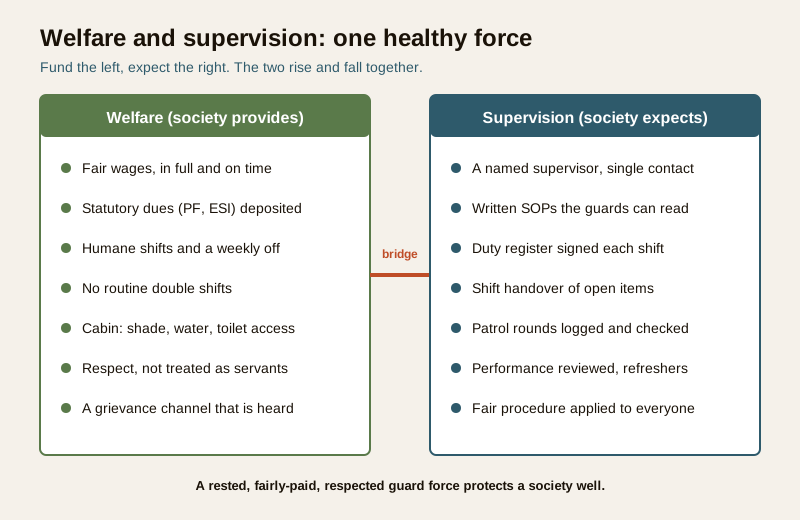
- Fair wages, in full and on time — at least the applicable minimum wage, with statutory dues paid. Do not negotiate the agency down to a rate that can only be met by short-changing the guard. If you cut cost, cut posts, not the per-guard wage.
- Rest and shift limits — humane shift lengths, a proper weekly off, and no routine double shifts. A guard forced to stay awake 16 hours is neither safe nor lawful.
- A proper cabin — shelter from sun, rain and cold, a fan or basic ventilation, clean drinking water, and access to a toilet. A plastic stool in the open is not acceptable for a person on a 12-hour post.
- Dignity and respect — guards are working professionals, not the society's servants. They should not be sent on residents' personal errands, addressed rudely, or blamed collectively for one household's complaint. A grievance channel and basic courtesy go a long way.
Welfare and supervision, side by side
Two halves of the same job — what you owe the guards, and what you expect of the deployment.
| Guard welfare (what the society provides) | Supervision (what the society expects) |
|---|---|
| Wages at or above minimum, paid on time | Named supervisor and single point of contact |
| Statutory dues (PF, ESI) deposited by agency | Written SOPs the guards can actually read |
| Humane shifts, weekly off, no forced doubles | Duty register signed each shift, with handover |
| Cabin with shade, water, toilet access | Patrol rounds logged, checked periodically |
| Respect — not treated as personal servants | Performance reviewed; feedback and refreshers |
| A grievance channel that is heard | Fair procedure applied equally to all visitors |
A committee that funds the left column has every right to expect the right column. The two rise and fall together.
Where guards fit in the bigger picture
Guards are a layer, not the whole wall. Their strength is human judgement — noticing the car that circles twice, the visitor whose story does not add up, the propped-open gate — and their job is to deter and to report, then let the response happen. That works only when they are backed by the physical layers: sound gates and access control, CCTV that a supervisor actually reviews, decent lighting, and a clear escalation path to residents and the police. Expecting three tired guards to substitute for all of that is how societies end up disappointed in "security" that was never resourced to succeed.
Equally, no amount of technology replaces a good guard force. The two are complementary, and both belong in an honest budget rather than one being starved to pay for the other.
How it connects
The guard force is the human layer of a society's protection, and it works best inside a joined-up plan. Read this alongside the gated-community security guide for the whole picture, security guard licensing and compliance for the PSARA and statutory detail, society entry and gate management for the procedures the guards run, and society security budget planning to fund it fairly. All of these live in the Community & RWA Security library.
Key takeaways
- Engage guards only through a PSARA-licensed agency — verify the licence, training, background checks, insurance and a written contract; never hire unverified individuals off the books.
- A round-the-clock post needs four-plus guards, not three, once weekly offs and leave are counted. Right-size posts to your budget rather than under-staffing them.
- Supervise with a named supervisor, clear SOPs, a signed duty register and periodic review — guards perform to the level they are supervised to.
- Give welfare and dignity equal weight: fair wages paid in full and on time, humane shifts and rest, a cabin with water and toilet access, and respect — guards are professionals, not servants.
- Apply security fairly — verify and log every visitor and worker courteously; SOPs must never license profiling, humiliating checks or blanket bans.
- The society is a data fiduciary under DPDP for gate logs and apps — collect the least needed, secure it, retain it briefly, and never misuse it.
- Guards deter and report as one layer, backed by gates and CCTV — do not expect them to replace the physical and technical layers.
References
- Private Security Agencies (Regulation) Act, 2005 (PSARA) and your state's rules — the licensing regime for private security agencies; verify the agency's current licence and your state's specific requirements.
- Digital Personal Data Protection Act, 2023 — governs the visitor, worker and resident data a society's gate collects; the society is a data fiduciary and must minimise, secure and limit retention.
- Applicable Minimum Wages notifications and labour-welfare statutes (PF, ESI) for your state and skill category — the source for fair wages and statutory dues; confirm current rates with your legal advisor.
- Your state Apartment Ownership / Cooperative Societies Act and the society's registered bye-laws — the framework within which the managing committee takes and records security decisions.
- Your society's legal advisor and the security agency's contract / SLA — the authoritative source for wages, dues, liability and terms; follow them over any generic guidance.
This is educational planning guidance for a housing society, not legal advice or a contract. Engage a PSARA-licensed agency, verify wages and statutory dues with your legal advisor, treat guards fairly and lawfully, meet your DPDP duties for the data your gate collects, and take security decisions properly through the committee. Figures are indicative — get local quotes and current rules for your state.
Export this guide
Related Guides — Deep-dive reading
Visitor Vehicle Management in India: A Professional Guide
The everyday weak point of every society and office gate is not the resident's car — it is the visitor, the cab, the delivery rider and the contractor who must be let in without opening the whole park to anyone. This is the process, not just the hardware: verify at the gate before the boom lifts, park visitors away from resident bays, and never jam the gate a fire tender needs.
SecurityFair and Lawful Community Security in India (2026): Dignity, Data and Governance Done Right
How a housing society can run security that is fair, dignified and within the law — rejecting discriminatory practices, respecting domestic, delivery and gig workers, honouring the DPDP Act as a data fiduciary, and governing within its bye-laws and residents' rights — and why that makes it better security, not weaker.
SecurityGuardhouse Design in India (2026): A Post That Sees Everything and Treats the Guard as Human
How to design the guard cabin so the guard can actually do the job — commanding sightlines to gate, approach and pedestrian entry, the controls within reach, and the shelter, water, toilet and shift that keep the post alert and manned rather than empty.
SecurityRelated Tools — Try Free
CCTV Camera Overlap Calculator
The overlap or blind gap between two adjacent cameras, from coverage width and spacing, plus the spacing for a target overlap.
OverlapCCTV Camera Coverage & Count Calculator
Estimate how many CCTV cameras you need, the NVR channels, storage in TB for your retention period, and an indicative all-in cost with GST.
CCTV CalculatorCCTV Camera Quantity Calculator
How many cameras a site needs from boundary length, coverage width per lens and key points — plus the recorder channel count.
Camera Count