
Fair and Lawful Community Security in India (2026): Dignity, Data and Governance Done Right
How a housing society can run security that is fair, dignified and within the law — rejecting discriminatory practices, respecting domestic, delivery and gig workers, honouring the DPDP Act as a data fiduciary, and governing within its bye-laws and residents' rights — and why that makes it better security, not weaker.
Good community security keeps people safe. It does not require humiliating anyone to do it. Yet in many Indian housing societies the daily practice drifts into something else — blanket bans on tenants or "bachelors", people turned away over religion, region, caste or food habits, domestic workers made to wait in the sun or use a separate "servants" lift, a delivery rider's phone or ID held at the gate as a deposit. None of this makes the community safer. It creates resentment, invites legal trouble, and quietly tells a large part of the people who keep the society running that they are suspects rather than neighbours and workers. This guide makes the honest case that fair and lawful community security is not the soft option — it is the stronger one.
Fairness sits alongside the practical machinery of a well-run gate. It is the companion to gate and entry management, to visitor access management, and to the security committee that sets the rules in the first place. Read this next to the broad gated-community security guide: every control it describes should pass the same test — is it applied equally, does it respect the person in front of it, and does it stay inside the law.
Scope & how to read this. This is educational guidance for residents and committees, not legal advice; it names Acts generally and you should verify the current rules and your specific situation with the society's legal advisor, the registrar or the relevant authority. The society and state Act, Model Bye-laws and residents' fundamental rights govern, and a resolution cannot override them.
Why fairness is better security, not weaker
Security is a human system before it is a technical one. A gate depends on guards who stay alert, workers who cooperate, residents who report what they see, and a domestic-worker and delivery ecosystem that treats the register and the ID check as normal rather than as an insult. Every one of those depends on trust.
Treat people fairly and they cooperate: a maid who is greeted by name tells the guard when a stranger followed her in; a regular delivery rider flags a fake order; a tenant who feels welcome joins the residents' group and reports the broken gate motor. Treat people as suspects and the opposite happens — workers evade the checks they resent, cooperation dries up, guards spend their energy policing dignity rather than watching the perimeter, and the society earns a reputation that makes good staff and good tenants go elsewhere. Discrimination also carries real legal and reputational risk that can land on the committee personally. Resentment is a security liability. Dignity buys cooperation, and cooperation is what actually keeps a community safe.
Unlawful and unfair practices to reject
Some common society practices are not just unkind — they are outside the law or the society's powers, and a committee that enforces them exposes itself. Name them plainly and stop them.
Blanket bans and profiling
- Blanket bans on tenants or "bachelors" — refusing to let owners rent, or barring single working people as a class, is a restraint that courts and authorities have repeatedly viewed unfavourably; an owner's right to let their flat is not the committee's to cancel by resolution.
- Refusing people by religion, region, caste, marital status or food habits — deciding who may buy, rent, visit or work based on identity is discrimination, contrary to residents' fundamental rights, and has no place in a security policy.
- "Vegetarian-only" or community-only rules aimed at excluding groups — a food or identity filter dressed up as a house rule is still exclusion.
Humiliating and coercive treatment
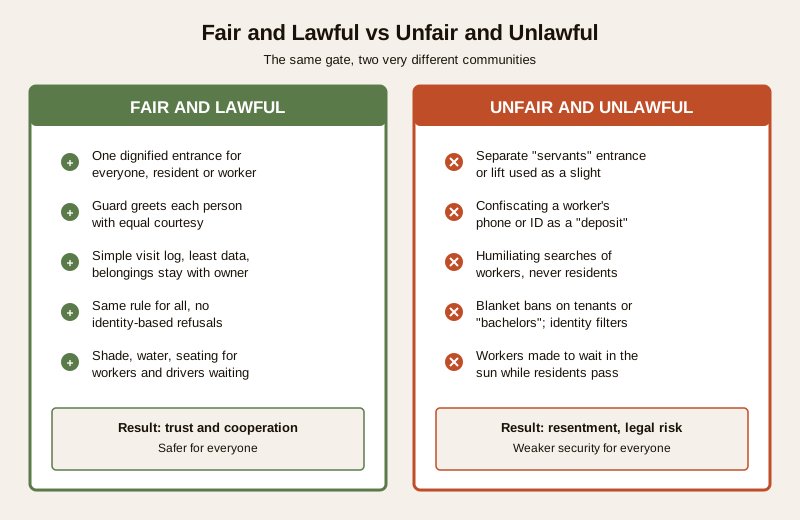
- Humiliating searches — pat-downs, bag-emptying or interrogation applied to workers and not to residents; searches, if any, must be lawful, proportionate, applied to everyone by the same rule, and never a daily ritual of suspicion.
- Confiscating a delivery or gig worker's phone or ID as a "deposit" at the gate — holding someone's property or identity document is not the society's right; log the visit instead and return nothing because nothing was taken.
- The separate "servants" entrance or lift used as a slight, and making workers wait in the sun while residents pass freely — a service lift for goods is a practical choice; forcing people into it to mark them as lesser is a humiliation, not a security measure.
The test to apply
For any rule, ask three questions: Is it applied equally to everyone, residents included? Is it the least intrusive way to meet a genuine safety need? Does it stay within our bye-laws, the state Act and residents' rights? If a rule fails any one of them, it is not security — it is discrimination wearing a lanyard, and the committee should drop it.
| Reject this | Because | Do this instead |
|---|---|---|
| Blanket ban on tenants or "bachelors" | Restrains an owner's lawful right to let; class-based exclusion | Same verification and house rules for every resident, owner or tenant |
| Refusing by religion, region, caste or food | Discrimination; against fundamental rights | Decide access on verified identity and genuine need, never identity group |
| Confiscating a worker's phone or ID | No legal right to hold property or documents | Log the visit in the register or app; let the person keep their belongings |
| Humiliating searches of workers only | Unequal, disproportionate, degrading | Proportionate, equal checks by one written rule, or none |
| Workers forced to wait in the sun / "servants" lift as a slight | Humiliation, not a safety control | Shade, water, seating; a service lift for goods, not for marking people |
Dignity for the people who keep the society running
Domestic workers, delivery and gig workers, drivers, gardeners, plumbers and tenants are residents and workers of the community — not a threat to be managed. Fair security treats them as such.
Domestic and gig workers
- They are workers, not suspects. A verification and a visit log are reasonable; suspicion as a daily posture is not. The same courtesy a guard shows a resident, a worker earns too.
- Equal, respectful treatment — greeted properly, allowed to sit in shade, given access to water and a toilet where facilities exist, and not made to prove their innocence every single day.
- Fair rules applied to everyone — if residents are not searched, workers are not searched; if residents show a pass, so do visitors and workers, by the same rule and the same tone.
Tenants and drivers
- Tenants are residents. Once a flat is let lawfully, the tenant has the same right to use the entrance, the lift, the amenities and the parking that comes with the flat, subject only to the same house rules as everyone. Verification for records is fine; second-class status is not.
- Drivers waiting for residents deserve shade, seating and a toilet, not a bench in the sun and a rule that they may not use any facility.
The single strongest signal a society sends is its entrance. One dignified entrance used by everyone, with a service lift reserved for goods rather than for people, tells every worker and tenant that they belong to the community they serve. Build the gate and entry system and the visitor process around that principle from the start.
The society as a data fiduciary — the DPDP Act 2023
The moment a gate writes down a visitor's name and phone number, photographs a worker, records a vehicle number, captures a delivery rider in an app or takes anyone's biometric, the society is collecting personal data. Under the Digital Personal Data Protection Act, 2023, that makes the society a data fiduciary — responsible for how it collects, uses, secures and retains the personal data of visitors, workers and residents. This is a legal duty, not a courtesy.
The principles to live by
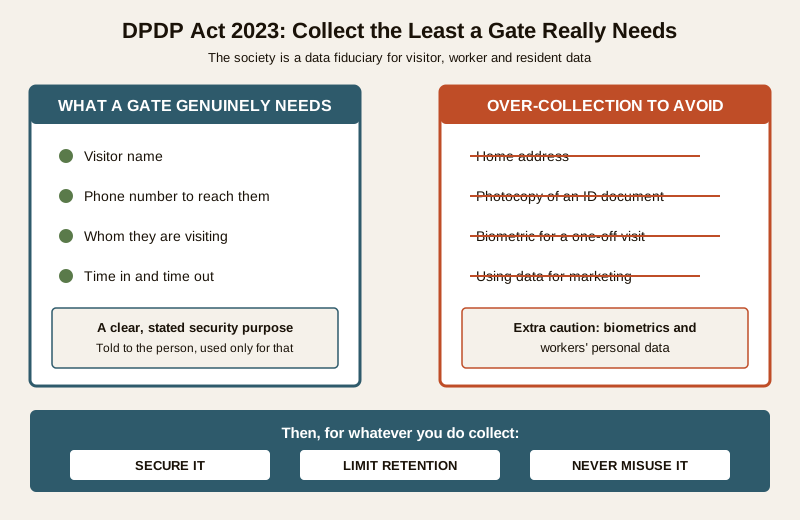
- Collect the least needed. A visitor log needs enough to identify and reach a visitor — usually a name, phone, whom they are visiting and the time. It does not need a home address, a photograph of an ID document, or a biometric for a one-off visit. Ask why each field exists.
- A clear, stated purpose. Collect data for a specific security purpose the person is told about — not to build a marketing list, share with vendors, or post in a residents' group.
- Secure it. Registers and app databases hold hundreds of people's contact details and movements; store them so they cannot be casually read, copied or leaked. A photographed register lying open on a desk is a breach waiting to happen.
- Limit retention. Keep visitor and worker records only as long as there is a security reason, then dispose of them on a set cycle. Footage and logs are not kept forever "just in case".
- Never misuse it. Do not use a worker's phone number to pressure them, a tenant's details to harass them, or footage to police residents' private lives. Data collected for safety is used only for safety.
- Extra caution with biometrics and workers' data. Fingerprint or face data and the personal data of low-wage workers are especially sensitive; collect them only with a genuine need, real security, and a way to opt for a non-biometric alternative wherever possible.
| Data the gate collects | Least-data question | Fair, DPDP-aligned practice |
|---|---|---|
| Visitor name and phone | Enough to identify and reach them? | Collect; do not demand home address or ID photo for a routine visit |
| Worker photo or biometric | Is a face or fingerprint truly needed here? | Prefer a simple pass or logged entry; offer a non-biometric option |
| Vehicle number | Needed for parking or access control? | Collect for that purpose only; do not publish or share |
| Delivery-app data | Whose purpose does it serve? | Use the minimum for entry; do not retain riders' data beyond the visit |
| CCTV footage | How long is there a real reason to keep it? | Signage in place, access limited, retention on a set cycle, then deleted |
Lawful governance — what an RWA can and cannot do
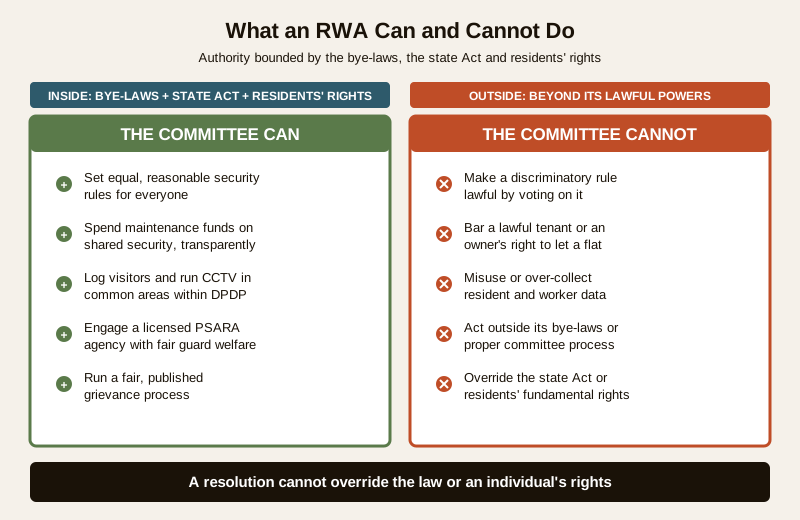
A managing committee or RWA has real authority to run shared security — but it is bounded authority. It acts within three things at once: the society's own registered bye-laws, the applicable state Apartment Ownership or Cooperative Societies Act and Model Bye-laws, and residents' fundamental rights. Where these conflict, the law and rights sit above the bye-laws, and the bye-laws sit above an ordinary resolution.
What a committee can do
- Set reasonable, equal security rules — gate hours, visitor logging, guard deployment, CCTV in common areas, parking control.
- Levy and spend maintenance funds on shared security, decided transparently in committee or the AGM with the books open to members.
- Engage a licensed PSARA agency for guards, with fair wages and welfare, and manage that contract.
What a committee cannot do
- Override the law or a resident's rights by resolution. A vote does not make a discriminatory ban lawful; a majority cannot strip a minority of rights the Constitution and the Act protect.
- Cancel an owner's right to let their flat, decide who may buy or rent on identity grounds, or bar a lawful tenant from amenities that come with the flat.
- Act outside its bye-laws or without proper process — security decisions with money or rights attached belong in a properly convened committee meeting or AGM, minuted, not in a WhatsApp decree by one office-bearer.
A fair grievance process
Fairness needs a route to raise a complaint and get an answer. A workable process: a written complaint to the committee or a named grievance point; an acknowledgement within a stated time; a fair hearing where the person can put their side; a reasoned, minuted decision; and an escalation path to the AGM, the registrar or the relevant authority if the matter is unresolved. Publish it so every resident, tenant and worker knows how to be heard. Get the wording and the escalation ladder checked by the society's legal advisor.
| The committee CAN | The committee CANNOT |
|---|---|
| Set equal, reasonable security rules for all | Make a discriminatory rule lawful by voting on it |
| Spend maintenance funds on shared security, transparently | Spend or decide outside its bye-laws and proper process |
| Log visitors and run CCTV in common areas within DPDP | Misuse resident, worker or visitor data, or over-collect it |
| Engage a licensed PSARA agency with fair guard welfare | Bar a lawful tenant or owner's letting by resolution |
| Run a fair, published grievance process | Override the state Act or residents' fundamental rights |
Putting it together
Fair and lawful security is not a separate programme bolted onto the gate — it is the standard every part of the system is held to. When the committee reviews the security setup, the entry process and the visitor system, each control should pass the three-question test, sit inside the DPDP duties, and be governed properly. The security committee is the body that keeps it that way — writing the rules down, applying them equally, and correcting the practices that drift into unfairness.
How it connects
Fairness and lawfulness run through every community-security decision. Read this alongside the gated-community security guide for the full picture, society entry and gate management and visitor access management for the daily practice where dignity is won or lost, and the housing society security committee for the governance that sets and enforces fair rules. All of these live in the Community & RWA Security library.
Key takeaways
- Fair, dignified security is stronger security — it buys the cooperation of workers, tenants and residents that actually keeps a community safe; resentment is a liability.
- Reject unlawful practices: blanket bans on tenants or "bachelors", identity-based refusals, humiliating searches, confiscating a worker's phone or ID, and the "servants" entrance used as a slight.
- Treat domestic, delivery, gig workers, drivers and tenants as people and residents, not suspects — equal, respectful treatment and one dignified entrance for everyone.
- Under the DPDP Act 2023 the society is a data fiduciary: collect the least data needed, for a clear purpose, secure it, limit retention, never misuse it, with extra care for biometrics and workers' data.
- An RWA acts within its bye-laws, the state Act and residents' rights — a resolution cannot override the law or an individual's rights.
- Run a fair, published grievance process so residents, tenants and workers can be heard and matters escalated properly.
- Name Acts generally and verify the specifics with the society's legal advisor, the registrar or the relevant authority; rules and rights depend on the society and the state.
References
- Digital Personal Data Protection Act, 2023 — the basis for the society's duties as a data fiduciary over visitor, worker and resident personal data; verify current rules and obligations with a legal advisor.
- The applicable state Apartment Ownership Act, Cooperative Societies Act and Model Bye-laws — the framework for what a managing committee or RWA may and may not do; confirm the version and provisions in your state with the registrar or society's advisor.
- Constitution of India and equality and anti-discrimination principles — the reason identity-based exclusion and discriminatory bans have no place in a society's rules.
- Private Security Agencies (Regulation) Act, 2005 (PSARA) — engage a licensed agency for guards, with fair wages and welfare; verify licensing and terms.
- Your society's registered bye-laws and AGM resolutions — the authoritative source for your own society's powers and process; read them with your legal advisor before acting.
This is educational guidance, not legal advice; figures and rules are indicative and depend on your society and state. Verify the current law and your specific situation with the society's legal advisor, the registrar or the relevant authority, keep security fair and DPDP-compliant, and let qualified professionals handle licensed and life-safety work.
Export this guide
Related Guides — Deep-dive reading
Visitor Vehicle Management in India: A Professional Guide
The everyday weak point of every society and office gate is not the resident's car — it is the visitor, the cab, the delivery rider and the contractor who must be let in without opening the whole park to anyone. This is the process, not just the hardware: verify at the gate before the boom lifts, park visitors away from resident bays, and never jam the gate a fire tender needs.
SecuritySecurity for Domestic Staff in Indian Homes (2026): Protecting the Home and the Worker's Dignity Together
Millions of Indian homes employ a maid, cook, driver, nanny, caretaker or gardener. Good practice keeps the home secure AND treats the worker as a trusted, verified human being with rights - never a suspect to be spied on. Lawful verification, dignified access control, the DPDP line on cameras, trust over surveillance, and a fair exit process.
SecurityVisitor Screening Areas in India (2026): Verifying People at the Gate, With Dignity
How to design the space and procedure where visitors are identified, verified and admitted or turned away — a controlled airlock that verifies before the gate opens, respects DPDP privacy, and never humiliates the people it screens.
SecurityRelated Tools — Try Free
Visitor Access Planner
Size visitor handling at a gate or reception — lanes needed at peak and the temporary-pass pool.
Visitor FlowAccess-Control Power Calculator
Total current and power an access system draws, to size the power supply — locks, readers and controllers.
AC PowerContract Studio
AI generates professional architecture service agreements with milestones and scope.
ArchitectAI