
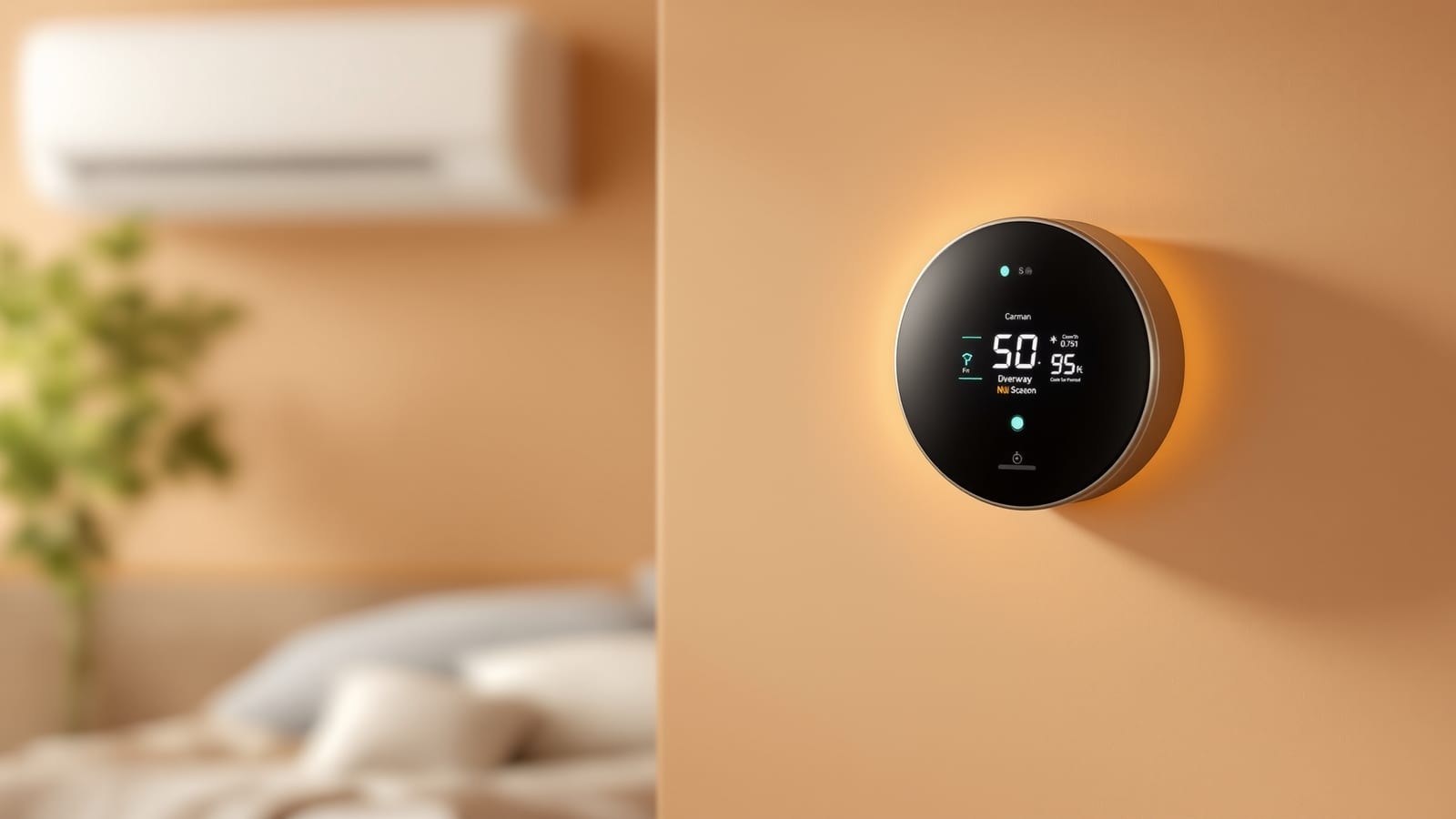
Smart Thermostats in India: Do You Actually Need One?
The smart thermostat is the crown jewel of the Western smart home — and in most Indian homes it controls nothing at all. An honest deep-dive into where thermostats fit in a split-AC country, why an IR controller is usually the right answer, and the handful of homes where a real thermostat earns its price.
Walk into any American smart-home store and the thermostat is on the front wall — the Nest, the ecobee, the glowing dial that has become the symbol of the whole category. Import that instinct into an Indian home and you hit a wall almost immediately: there is nothing for the thermostat to control. This guide exists to answer, honestly, the question a lot of buyers ask after watching one too many foreign YouTube reviews: do I actually need a smart thermostat in India?
The short answer, for most readers, is no — but for the right reasons, and with a much better thing to buy instead. If you have not yet framed the wider climate picture, read the smart HVAC and climate guide alongside this; and for the whole smart-home architecture, the ultimate guide to smart homes in India. Here we deal specifically and unsentimentally with the thermostat.
A thermostat is a controller for central heating and cooling. India cools room by room with split ACs. Before you buy the famous dial, ask what it would even be wired to.
What a smart thermostat actually does
A thermostat is not a temperature sensor — a common confusion. It is a controller that sits between your central heating-and-cooling plant and the wall, reading the room temperature and switching the plant on and off to hold a setpoint. A smart thermostat adds a phone app, scheduling, geofencing, learning algorithms and voice control on top of that switching job. Nest, ecobee, tado and Honeywell Home are the famous names.
The crucial phrase is "central plant." A thermostat presumes there is a single furnace, boiler, heat pump or ducted air handler serving the whole home through vents, and one wall control governing it. That architecture is nearly universal in North America and much of Europe. It is rare in India.
The India reality: a country of split ACs
Look at how Indian homes are actually cooled. The overwhelming majority use split air conditioners — one indoor unit per room, each with its own compressor and its own infrared remote. There is no central duct, no single plant, no wall thermostat, and therefore nothing for a Nest to control. Buying a wall thermostat for a split-AC flat is like buying a steering wheel for a house.
What Indian split-AC homes actually need is a device that speaks the language the AC already understands: infrared. An IR controller (also called an IR blaster or smart AC controller) learns your remote's codes and then impersonates the remote — from a phone, a schedule, a geofence or a voice command. The two names to know are Sensibo (Sky and Air) and Cielo Breez, both sold in India and both brand-agnostic: one unit will drive a decade-old Blue Star and a new Daikin equally well.
An IR controller effectively turns each split AC into a per-room smart thermostat living inside the appliance — the temperature reading, the setpoint, the scheduling and the geofencing all arrive without a single wire in the wall. That is why, for split-AC India, it is not merely an acceptable substitute; it is the correct device.
| Home type | Cooling / heating architecture | Right device | Why |
|---|---|---|---|
| Typical apartment or house | Split ACs, IR remotes | IR controller (Sensibo, Cielo) | Nothing central to wire a thermostat to |
| Large villa, premium tower | VRF / VRV, ducted central AC | True smart thermostat / VRF controller | One plant, zoned setpoints, real control |
| Cold-region home (hills, north) | Gas boiler, radiators, heat pump | True smart thermostat (Nest, tado) | Central heating is exactly its job |
| Mixed home | Some splits, one ducted zone | Both — IR per room, thermostat on the duct | Match each device to what it controls |
When a real thermostat does make sense
None of this means smart thermostats are useless in India — only that they belong to specific homes. There are three genuine cases.
First, central and VRF/VRV systems. Larger villas and premium apartments increasingly use ducted central AC or Daikin, Mitsubishi and Blue Star VRF systems, where a single plant serves many rooms. Here a wall thermostat or the manufacturer's smart controller is exactly right, and zoning — different setpoints in different rooms from one system — becomes a real, valuable feature rather than a marketing word.
Second, ducted heating in cold regions. Homes in Himachal, Uttarakhand, Kashmir and other cold belts that run gas boilers, radiators or reverse-cycle heat pumps have precisely the central architecture a Nest or tado was designed for. In these homes a learning thermostat that pre-warms the house before you wake genuinely earns its keep.
Third, new construction with central HVAC by design. If you are building and specifying ducted air from the start, plan the thermostat in — do not bolt IR controllers onto a system that was meant to have a proper wall control.
The smart features, and whether they matter
Strip away the brand mystique and a smart thermostat sells four features. It is worth judging each honestly, because an IR controller delivers all four just as well.
| Feature | What it does | Delivered by IR controller too? | Real value in India |
|---|---|---|---|
| Scheduling | Setpoints by time of day | Yes | High — night setback saves real money |
| Geofencing | Off when you leave, pre-cool on return | Yes | High — kills forgotten-AC waste |
| Learning | Infers your routine automatically | Partially | Modest — a good schedule beats it |
| Voice and app | Control from phone or speaker | Yes | Convenience, not savings |
The honest takeaway: the features that save money are scheduling and geofencing, and an IR controller does both. The feature unique to premium thermostats — self-learning — is the one that matters least once you have set a sensible schedule. Do not pay a premium for the dial's brain when the rules do the real work, a point the scenes and automations guide makes across the whole home.
The energy-savings math, honestly
Numbers keep everyone honest. The savings come not from the device but from the rules it enables — never cooling an empty room, and easing the setpoint overnight. The figure below shows where a scheduled setback quietly recovers rupees across a night.
For a bedroom 1.5-ton inverter AC on an ₹8/unit tariff, a 2 C night setback plus an empty-room cutoff realistically saves ₹200 to ₹350 a month across the cooling season — call it ₹1,000 to ₹1,750 over five months, per AC. An IR controller costing ₹7,500 to ₹13,000 therefore pays back inside two seasons on a single well-used unit, and faster across several. A true thermostat delivers the same saving on a central system but does nothing extra for a split. You can sanity-check your own figures against the smart HVAC guide and budget the whole build with the smart home cost calculator.
| Scenario | Device | Hardware cost | Season saving (per AC) | Payback |
|---|---|---|---|---|
| Split-AC apartment | Sensibo Sky IR controller | ₹9,000 to ₹13,000 | ₹1,000 to ₹1,750 | 2 seasons |
| Split-AC budget | Cielo Breez Plus | ₹7,500 to ₹11,000 | ₹1,000 to ₹1,750 | 1.5 seasons |
| Central AC villa | Nest / VRF controller | ₹18,000 to ₹35,000 | ₹2,500 to ₹5,000 (whole plant) | 2 to 3 seasons |
| Cold-region heating | tado / Honeywell | ₹15,000 to ₹30,000 | Winter heating gas saving | Region-dependent |
Compatibility and honest caveats
If you have decided you are in the genuine-thermostat camp, check compatibility before buying. A thermostat must match your plant's control wiring and voltage — Indian VRF systems often expect the manufacturer's own controller, and generic Nest-style units designed for 24 V North American HVAC may not map cleanly. For central ducted AC, confirm the thermostat supports your air handler's staging. For heating, confirm boiler or heat-pump compatibility. This is a job to confirm with your HVAC installer, not to guess at.
For the far more common split-AC buyer, the caveats are gentler: the IR controller needs line of sight to the indoor unit, cloud reliability varies by brand, and — as always — prefer a device that speaks Matter or has local control so you are not married to one app forever, the same lock-in warning the home automation guide raises. Pairing the controller with a separate temperature sensor and occupancy data, as covered in the smart home sensors guide, is what unlocks the smartest, most predictive climate behaviour.
The verdict
Do you actually need a smart thermostat in India? For the roughly nine in ten homes cooled by split ACs, no — and buying one would be a category error, because it controls nothing. Buy an IR controller instead; it is cheaper, brand-agnostic, and gives you every money-saving feature a thermostat would. Reserve the real thermostat for the homes it was built for: central ducted AC, VRF/VRV systems, and heated houses in India's cold regions. Match the device to what it actually controls, and the climate layer of your smart home will earn its keep either way.
For the full picture of cooling, fans and air quality, continue to the smart HVAC and climate guide; to understand the temperature sensors that feed any of these controllers, see the smart home sensors guide.
References
- Bureau of Energy Efficiency (BEE) — Star Labelling for Air Conditioners — official ISEER ratings that determine how efficient your AC is before any smart control is added.
- BEE — Standards and Labelling programme — India's appliance efficiency standards, including room air conditioners.
- IEC 60730 — Automatic electrical controls for household use — the international standard covering thermostats and temperature controllers.
- Sensibo — how infrared AC control works — manufacturer documentation for IR-bridge scheduling, geofencing and climate-react logic.
- Cielo — smart AC controllers — manufacturer specifications for IR control of split and window air conditioners.
- Google Nest — thermostat compatibility — manufacturer documentation on the HVAC wiring a true thermostat requires.
Export this guide
Related Guides — Deep-dive reading
Smart HVAC & Climate Control for Indian Homes: Thermostats, AC, Fans & Air Quality
In a country where cooling is the biggest slice of a home's electricity bill, climate control is where a smart home earns its keep. A hot-climate, honest playbook for smart ACs, BLDC fans, ventilation and air quality — with real brands and rupee costs.
Smart HomeHow to Choose a Security System (2026): The Master Buying Guide for Indian Homes and Buildings
The mental model that ties the whole buying decision together: start from your own risk, not a product; build the layers your situation actually needs; make the big architecture choices (wired vs wireless, local vs cloud, DIY vs professional); tell real product quality from marketing; and choose a vendor you can trust.
SecurityCCTV vs Video Door Phone: Which Does Your Home Need?
They look similar and get confused constantly, but a CCTV camera and a video door phone do different jobs — one watches the whole property and records, the other answers your door and controls who comes in. This guide settles CCTV vs video door phone for Indian homes: what each is for, where they overlap, real rupee costs, apartment versus villa relevance, and why most homes end up wanting both.
Smart HomeRelated Tools — Try Free
Window Hardware Cost Calculator
Estimate window hardware cost — hinges, handles, locks, rollers and multipoint gears.
Window CalculatorBefore vs After — Cost Reality Check
Compare what you expected to pay vs what you actually paid, category by category.
Reality CheckWindow Energy Savings Calculator
Compare standard glazing vs Low-E and DGU windows — annual cooling savings, 10-year savings and payback.
Window Calculator