
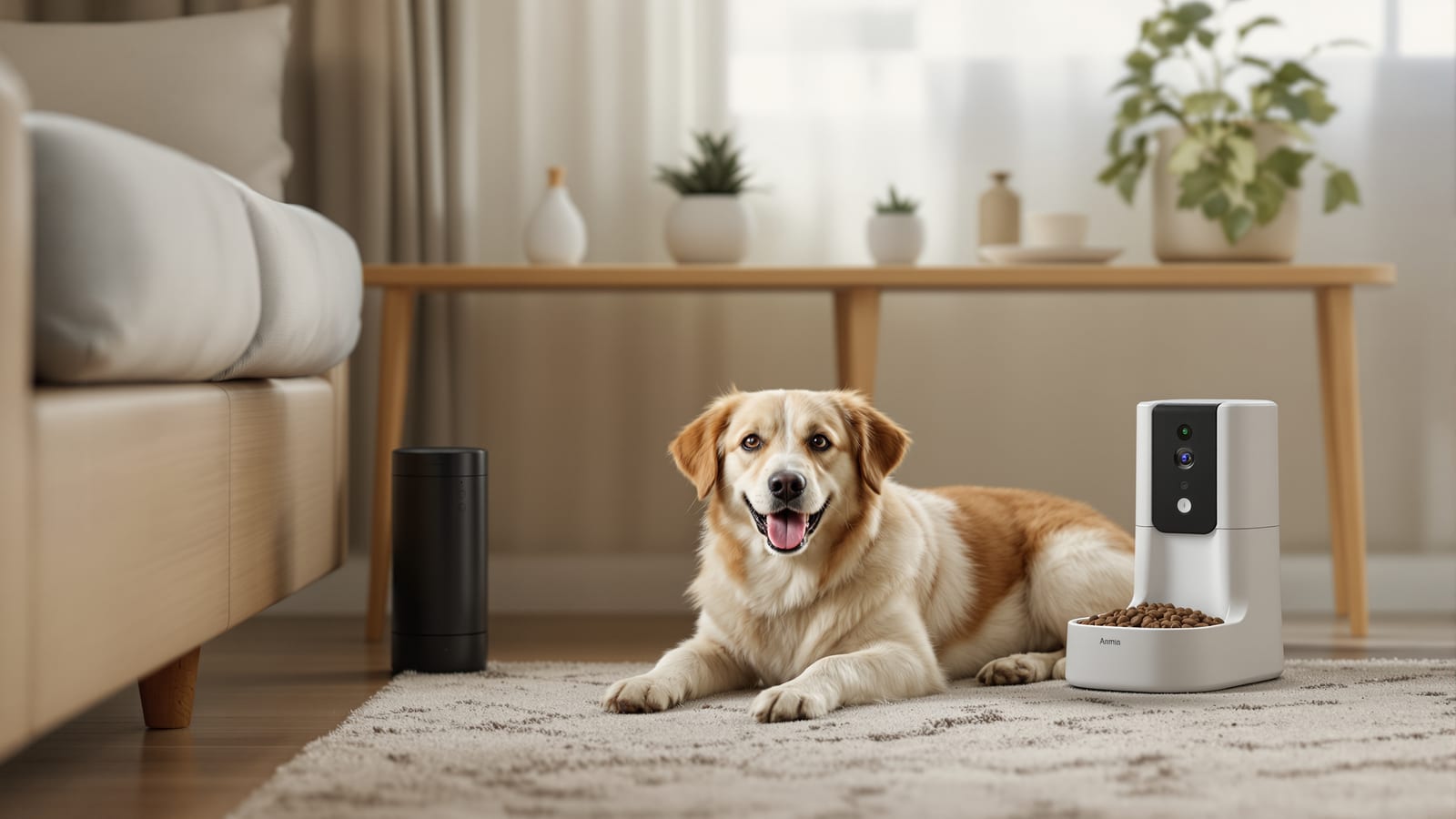
Smart Home for Pet Owners in India: Cameras, Feeders & Comfort
Pet cameras with two-way audio, automatic feeders, smart water fountains, summer AC automation to beat heatstroke, GPS collars and motion sensors that will not cry wolf every time your dog crosses the room — a full smart-home plan built around the animal at the centre of your home.
Anyone who has left for work while a dog watches from the window, or spent a Bengaluru summer afternoon worrying whether the cat is coping with the heat, already understands why a smart home matters more when there is an animal in it. Pets cannot text you, switch on a fan, refill a bowl or tell you they are frightened by the doorbell. A well-built smart home does all of that quietly on their behalf — and, just as importantly, lets you see and speak to them from anywhere.
This guide is written for Indian pet owners specifically: for the long working days, the brutal April-to-June heat that puts short-nosed breeds at real risk, the power cuts, the festival firecrackers that terrify dogs, and the reality that most of us leave pets alone at home far more than we would like. It maps the devices worth buying, with rupee prices and real brands, and shows how to wire them into gentle automations so your home looks after your pet even when you cannot. If you are new to home automation, keep the ultimate guide to smart homes in India open alongside this one, and if budget is your main worry, the smart home on a budget guide pairs naturally with everything here.
A smart home for a pet is not about gadgets for the animal. It is about turning your absence into presence — food that arrives on time, water that stays fresh, air that stays cool, and a voice that can say "good boy" from four hundred kilometres away.
Quick verdict: the four things that actually matter
Strip away the novelty and pet-owner smart home spending should concentrate on four outcomes, in this order of importance:
| Priority | What it solves | Core device | Typical spend |
|---|---|---|---|
| 1. Staying cool | Heatstroke risk in Indian summers | Smart AC / fan control + temperature sensor | ₹2,500–₹9,000 |
| 2. Eyes and voice | Anxiety, monitoring, reassurance | Pet camera with two-way audio | ₹2,500–₹9,000 |
| 3. Food and water | Missed meals, stale water on long days | Automatic feeder + smart fountain | ₹4,000–₹14,000 |
| 4. Safety and escape | Lost pets, door dashes | GPS smart collar + door sensor | ₹3,000–₹12,000 |
Everything else — automated pet doors, litter monitoring, calming playlists — is worthwhile but secondary. Get the cooling right first: in an Indian summer it is genuinely the difference between comfort and a veterinary emergency. Price your own combination with the smart home cost calculator before you commit.
The pet-care smart home, mapped
Before the detail, here is how the pieces sit around the animal at the centre of the home.
Notice that no single device is the smart home; the value comes from them working together. The temperature sensor tells the AC to cool the room, the feeder drops a meal, the camera lets you watch it happen, and the collar tells you where the animal is if a door is left open. Below, each part in turn.
Beating the Indian summer: temperature and AC automation
This is the one that saves lives. Brachycephalic (short-nosed) breeds like Pugs, Bulldogs and Persian cats, plus thick-coated dogs like Huskies and Golden Retrievers kept in Indian cities, are acutely vulnerable to heatstroke once room temperature climbs past the low thirties. A pet left in a closed flat during a May afternoon can reach dangerous core temperatures well before you get home.
The fix is a temperature sensor talking to a smart AC controller or smart fan. A device like the Sensibo Air or Cielo Breez clips onto any existing split AC and turns it into a smart, schedulable, remotely controlled unit — no new AC needed. Pair it with a temperature threshold and the room cools itself.
| Device | What it does | Price band |
|---|---|---|
| Smart IR AC controller (Sensibo, Cielo, Tata Play/Aqara IR) | Makes any split AC app- and rule-controlled | ₹2,500–₹9,000 |
| Standalone temperature/humidity sensor (Aqara, Tuya) | Triggers cooling above a threshold | ₹700–₹2,000 |
| Smart fan controller / smart ceiling fan (Atomberg, Havells) | Air movement when AC is overkill | ₹1,500–₹6,000 |
A sensible rule: if the pet room crosses 30°C, switch the AC on to 26°C; if it drops below 24°C, switch off. That keeps the animal in a safe band without running the compressor all day. Layer a fan for air movement and you cover the milder days cheaply. The smart ceiling fans guide and the broader remote monitoring guide both cover how these threshold automations are set up and, crucially, how to get an alert on your phone if the room is heating up faster than the AC can handle — a warning you want during a power cut, when the AC is dead and the room is warming fast.
Eyes and a voice: pet cameras with two-way audio
A pet camera is the emotional heart of the whole setup, for owner and animal alike. The good ones do three things: stream live video to your phone, let you talk and listen through two-way audio, and — the feature pet owners fall for — dispense a treat on command or fling one across the room with a button tap.
| Camera | Notable features | Price band |
|---|---|---|
| Furbo Dog Camera | Treat-tossing, barking alerts, two-way audio | ₹12,000–₹20,000 |
| Petcube Bites / Play | Treat dispenser, laser play, two-way | ₹10,000–₹18,000 |
| Generic pan-tilt cam (Mi 360, TP-Link Tapo, CP Plus) | Two-way audio, tracking, night vision | ₹1,800–₹4,500 |
You do not need a pet-specific camera to start. A ₹2,000 pan-tilt indoor camera with two-way audio — the same class covered in the smart home security systems guide — lets you check in and speak to a lonely dog, and many owners find that a familiar voice through the speaker settles an anxious animal instantly. Spend up to the Furbo or Petcube only if the treat-toss genuinely helps your pet; for many it is a joy, for some it just teaches them to hover by the machine. If you are renting, note the camera etiquette in the smart home for renters guide: keep it pointed inside your own home only.
Food and water on a schedule
An automatic feeder is what makes a long working day or a short trip humane. It holds dry food in a sealed hopper and dispenses measured portions on a schedule, so a pet eats at the same times whether you are home or not. The better models let you record a short call — the sound of your voice — that plays as the food drops, and let you trigger an extra portion from the app.
| Device | Feature | Price band |
|---|---|---|
| Smart automatic feeder (PetSafe, Petkit, Honeyguaridan, Tuya) | Scheduled portions, app control, voice record | ₹3,500–₹10,000 |
| Smart water fountain (Petkit Eversweet, Catit, Honeyguaridan) | Filtered, circulating fresh water; low-water alert | ₹2,500–₹7,000 |
| Simple gravity feeder + smart plug hack | Cheapest scheduled option (limited control) | ₹600–₹1,500 |
Two India-specific cautions. First, portion, do not free-feed — obesity is rampant in Indian pets and a scheduled feeder that drops fixed grams at fixed times is a quiet health intervention. Second, fresh circulating water matters more here than in cooler climates; a smart fountain keeps water moving and cool, encourages cats especially to drink enough in the heat, and warns you when the reservoir runs low. Keep a manual backup: feeders can jam and power can fail, so never let an automatic feeder be the only thing standing between your pet and a meal. A smart plug on a simple gravity dispenser or aquarium-style timer is a cheap redundancy layer.
The "away at work" automation, drawn
Here is how a normal working day is stitched together into one routine.
None of these steps needs you to remember anything. The feeder runs on a clock, the AC runs on a temperature rule, the camera is there when you want to look, and a geofence on your phone can pre-cool the house and switch on lights as you approach home. That is the whole promise of a pet smart home: the animal's day stays steady even though yours is chaotic.
Collars, doors and litter: safety and hygiene
GPS smart collars matter most for dogs that bolt — during firecrackers, thunderstorms or an open gate. A collar like the PetPace, or budget Tuya/GPS trackers around ₹3,000–₹8,000, shows the animal's location on your phone and alerts you if they leave a set boundary. Some also track activity and rest, useful for spotting early illness. Check the tracker uses a SIM or reliable network, since Bluetooth-only trackers have a range of a few metres and are near useless for a genuinely lost pet.
Automated pet doors (SureFlap, PetSafe microchip doors, ₹6,000–₹20,000) read a chip or collar tag and open only for your animal, keeping strays and monkeys out — a real concern in many Indian neighbourhoods. Smart litter monitoring for cats (Petkit Pura, Litter-Robot, ₹8,000 upward) tracks usage and weight, and a sudden change in litter-box habits is often the first sign of a urinary problem, so the data earns its keep medically, not just for convenience.
Keeping pets calm — and stopping false alarms
Two behavioural problems have smart-home answers. The first is anxiety. A routine is itself calming, so predictable feeding, lighting and even a scheduled calming playlist through a smart speaker or smart plug on a music system helps a nervous dog settle, especially during festival firecracker season. Dim, warm smart lighting on an evening schedule signals wind-down; avoid harsh cool-white light late at night.
The second problem is the opposite of calm: false-alarm chaos. If you run motion-sensing security cameras, a pet will trigger them constantly, burying real alerts under a hundred videos of the cat crossing the sofa. Fix it with three settings, and lean on the security systems guide for detail:
| Setting | What it does |
|---|---|
| Activity zones | Ignore motion in the pet's usual areas (floor, sofa) |
| Person detection | Alert only on human shapes, not animals |
| Sensitivity tuning | Lower trigger threshold so small movement is skipped |
Modern cameras with on-device person detection are the single biggest help — they simply do not alert for a four-legged shape. Set them up once and your security system stays trustworthy instead of becoming noise you learn to ignore.
Putting it together on a budget
You do not buy all of this at once. Start with the two life-and-connection essentials — an AC/temperature automation and a two-way camera — for under ₹6,000 combined using budget devices. Add a feeder and fountain next, then a GPS collar if your pet is a flight risk, and treat the pet door and litter monitor as later luxuries. Use the ecosystem selector to make sure your feeder, camera and sensors all live in one app rather than five, because juggling multiple apps is the fastest way to abandon a pet setup. A single well-chosen ecosystem, two or three core devices and a couple of gentle rules will look after the animal at the centre of your home better than a drawer full of gadgets ever could.
References
- PetSafe — Smart Feed automatic pet feeder (official product page)
- Sensibo — smart AC controllers and temperature automation
- Petkit — smart feeders, fountains and litter monitors
- Bureau of Indian Standards — home page and product safety standards
- The Ministry of Electronics and IT — Digital Personal Data Protection Act, 2023
- CERT-In — cyber security guidelines for IoT and connected devices
Export this guide
Related Guides — Deep-dive reading
Security for People Living Alone in India (2026): Calm, Practical Habits When There Is No Second Person to Notice
Living alone is an ordinary and growing part of Indian life - the student in a new city, the working single, the elder whose children are abroad, the person after a separation. It does not call for fear. It calls for a few deliberate habits, because there is no second person in the home to notice trouble, raise the alarm, or catch an accident. This is calm self-reliance, layer by layer.
SecurityGeofencing Home Security in India (2026): Convenience Without the Trap
A geofence is a virtual boundary around your home; your phone crossing it can arm the alarm as the last person leaves and light the place up as you arrive. This guide explains the genuinely useful security uses, and the honest caveats: never let a phone's location alone unlock your door, never make a geofence the only thing that arms your home, and treat continuous family tracking as sensitive data.
SecuritySecurity Fire Alarm Integration in India (2026): Smart Alerts, Certified Systems, Fail-Safe Egress
The most important sentence a smart-home designer can say about fire is also the least profitable: a smart-home smoke sensor or fire notification is a helpful add-on, not a substitute for a certified fire-alarm system. This guide draws the line hard — life-safety detection and alarm belongs to the NBC-governed certified system — and then covers the genuinely useful, correctly-scoped automations the smart layer can add on a verified fire signal: unlock for egress, open the gate for the fire tender, light the escape path, stop the away-scene, and notify everyone loudly. All of it fail-safe. None of it in the way of the system that actually saves lives.
SecurityRelated Tools — Try Free
Cross-Ventilation Analyzer
Estimate airflow and air changes per hour (ACH) from room size, window areas, layout, and local wind — with NBC 2016 Part 8 compliance check.
Ventilation CalculatorAcoustic Privacy (STC) Visualizer
Indian healthcare acoustic visualizer — compare wall assemblies and noise sources, see received SPL after STC attenuation, and check FGI 2018 / IS 1950 / NABH speech-privacy compliance with live dual-canvas waveform.
Acoustic ToolBefore vs After — Cost Reality Check
Compare what you expected to pay vs what you actually paid, category by category.
Reality Check