
Smart Home for Renters in India: Automate Without Losing Your Deposit
Damage-free, removable, take-it-with-you devices — smart plugs, bulbs, wireless cameras and reversible switch modules — that make a rented flat smart and leave the walls exactly as you found them.
Renting should not mean living in a dumb home. You can have voice-controlled lights, cameras that watch the door, a lock you open from your phone and a geyser that switches itself on before you wake — all in a flat that is not yours, with a landlord who must never see a single new hole in the wall. The trick is choosing devices by one ruthless rule: everything must come off cleanly, take nothing of the wall with it, and travel to your next home in a box.
This guide is built entirely around the Indian rental reality — a refundable security deposit worth one to several months' rent riding on you returning the flat exactly as you found it, and a landlord whose goodwill is worth keeping. It maps the renter-friendly devices you can install with total confidence, the ones to avoid, how to protect your deposit, the etiquette of cameras in a rented home, and how to lift the whole smart home out and reinstall it when you move. If you want the full device landscape first, keep the ultimate guide to smart homes in India and the retrofit smart home guide open alongside this one — retrofit thinking and renter thinking overlap heavily.
A renter's smart home is defined by subtraction, not addition. If a device cannot be removed in ten minutes leaving no trace, it does not belong in a rented flat — no matter how clever it is.
Quick verdict
Build your rental smart home almost entirely from plug-in and wireless devices: smart plugs, smart bulbs, a hub or smart speaker, wireless cameras, peel-and-stick sensors, battery-powered locks and portable curtain motors. Every one installs without tools deeper than a screwdriver and comes off without a mark.
Avoid anything permanent — hardwired switches that replace the wall plate, drilling for cameras or panels, in-wall cabling, plumbed-in devices. Not because they are bad, but because they damage a home you do not own and cannot be taken with you.
Do this and your deposit is safe, your landlord is untroubled, and your entire smart home fits in a carton on moving day. That is the whole strategy in three sentences.
Renter-friendly versus avoid, drawn
Hold the whole decision in one picture: green comes with you, red stays behind as damage.
Everything green shares one property: it interfaces with the flat through something already there — a socket, a lamp holder, a door — and detaches from it cleanly. Everything red bonds to the building itself. As a renter your job is to live entirely in the green column, and the good news is that the green column alone builds a genuinely capable smart home.
The renter's toolkit: devices that come off clean
These are the workhorses. Buy freely from this list; none of it will cost you a rupee of deposit.
| Device | How it installs | Leaves behind | Price band |
|---|---|---|---|
| Smart plug | Into an existing socket | Nothing | ₹600–₹1,500 |
| Smart power strip | Plugs in | Nothing | ₹1,500–₹3,000 |
| Smart bulb | Swaps into holder | Nothing | ₹500–₹1,800 |
| Smart hub / speaker | Plugs into socket | Nothing | ₹3,000–₹12,000 |
| Wireless / battery camera | Sits on a shelf; magnetic base | Nothing | ₹1,500–₹5,000 |
| Peel-and-stick sensor | Removable adhesive | Adhesive residue at most | ₹800–₹2,500 |
| Battery retrofit smart lock | Fits over existing latch | Original lock, unharmed | ₹8,000–₹25,000 |
| Portable curtain motor | Clips to existing rod / track | Nothing | ₹4,000–₹12,000 |
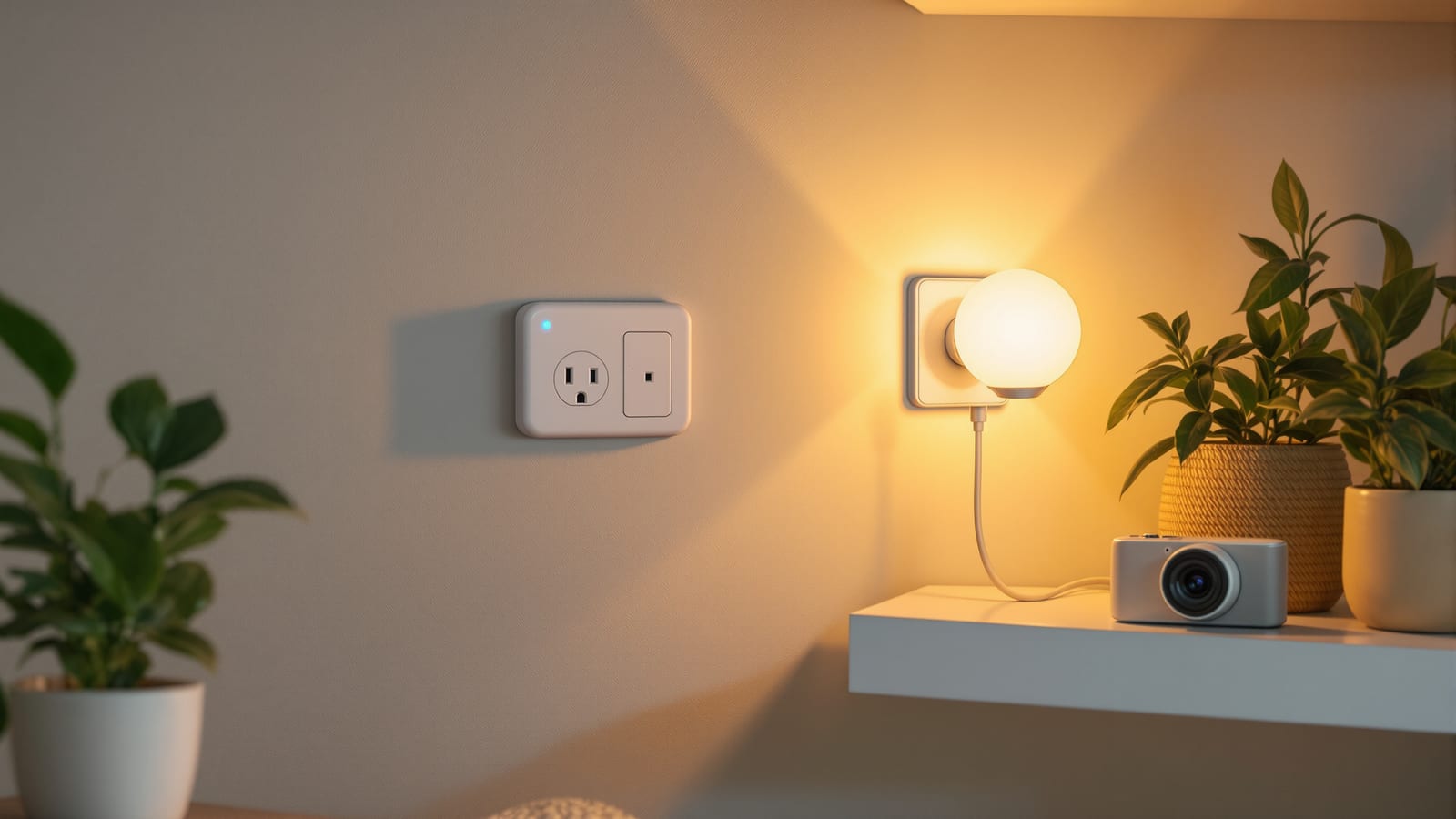
A smart plug is the single best renter device in India — it turns any dumb appliance (a geyser, a pump, a lamp, a fan on a socket) into an app- and voice-controlled one, and it simply unplugs when you leave. Smart bulbs give you colour, dimming and schedules with a bare swap of the existing bulb; keep the originals in a drawer to screw back on move-out. A wireless or battery camera that sits on a shelf or clips to a magnetic base watches your home without a single drilled hole. Peel-and-stick sensors — door, motion, leak — use removable adhesive; use a gentle command-strip type and even the residue lifts away. A battery retrofit smart lock fits over your existing latch on the inside, leaving the landlord's lock and the door untouched. For choosing among these devices, the choosing a home automation system guide and wired vs wireless home automation both land firmly on wireless for anyone who does not own their walls.
The one clever exception worth knowing: a reversible smart switch module. Some renters, with a landlord's blessing, tuck a small relay module behind an existing wall switch — the switch on the wall looks unchanged, and the module can be removed and the original wiring restored on move-out. It touches live mains, so it is a licensed-electrician job, not a peel-and-stick one, and only worth it in a longer tenancy. The mechanics are the same ones covered in the smart home installation guide.
What to avoid, and why
The avoid list is short but non-negotiable for a renter.
| Avoid | Why it is a problem for renters |
|---|---|
| Hardwired smart switches (replacing plate) | Alters permanent wiring; hard to revert; deposit risk |
| Drilling for cameras, panels, mounts | Holes are damage; patching is your cost |
| New wiring chased into walls | Permanent; needs restoration; landlord dispute |
| Plumbed-in smart taps, geysers, flush | Alters fixtures you do not own |
| Wired systems (KNX, Crestron, Control4) | Non-removable, non-portable, huge sunk cost |
| Anything you cannot undo in an afternoon | The universal renter test |
Every entry fails the same test: you cannot take it with you, and removing it leaves damage. A drilled hole must be filled and painted. A hardwired switch must be re-wired to original. A plumbed device must be re-plumbed. All of that is time, money and a nervous conversation with a landlord at exactly the moment you want your deposit back. The rule that never fails: if you cannot undo it in an afternoon and carry it out in a box, do not install it in a rented home.
Camera etiquette and privacy in a rented home
Cameras deserve their own note because they carry both a deposit dimension and a courtesy one. On the deposit side, stay wireless and shelf-mounted or magnetic — never drill a mount into a rented wall. On the courtesy side, keep every camera pointed strictly inside your own flat and at your own front door. Do not aim a camera at a shared corridor, a neighbour's entrance, a common stairwell or a shared terrace; in a housing society that invites a legitimate privacy complaint and can sour relations with both neighbours and landlord. Indoor cameras should be positioned so guests understand they are being recorded, and a landlord who visits should be told cameras are present. Treat the camera as watching your things, not the building's people, and you stay on the right side of both etiquette and good sense.
Protecting your deposit: the move-out playbook
The deposit is won or lost on move-out day, and a little discipline makes it automatic.
The playbook is short. Keep the originals. Every bulb you swapped, every switch plate, every fitting you removed — store it and restore it on the way out. Use gentle adhesive. For sensors and any stick-on mount, use removable command-style strips, not permanent glue, so nothing tears paint. Photograph the flat on day one. A dated set of move-in photos settles any dispute about what was already marked. Never drill. If you were tempted, the wireless alternative almost always exists. Do a reversal pass a week before moving. Unplug every device, un-stick every sensor, screw the original bulbs back, and walk the flat as a landlord would. Follow that and there is nothing for a deposit deduction to catch.
Taking your smart home to the next flat
This is the quiet superpower of the renter approach: because nothing is bonded to the building, moving is simply packing. On the last day you unplug the plugs, pop out the bulbs, lift the cameras off their shelves, peel the sensors, unscrew the battery lock and coil up the hub. It all fits in one carton. In the new flat you reverse the process in an evening — re-plug, re-pair, re-stick — and your smart home is back, no electrician, no landlord, no cost. Every rupee you spent as a renter followed you rather than enriching a flat you have left. That portability is precisely why the wireless, plug-in approach is not a compromise for renters but arguably the smarter long-game even for some owners, a point the home automation guide for India returns to. Price your own kit before you buy with the smart home cost calculator, and if you are weighing how much of it actually earns its keep, run the home automation ROI calculator.
The summary a renter needs is a single discipline: buy only what unplugs, unsticks or unscrews; keep every original; drill nothing. Do that and you get a fully modern smart home, a landlord who never has cause to complain, a deposit returned in full, and a kit that moves with you for years across every flat you rent.
References
- Bureau of Indian Standards — IS 732: Code of Practice for Electrical Wiring Installations
- Central Electricity Authority — Safety and Electric Supply Regulations
- Connectivity Standards Alliance — Matter for interoperable smart homes
- Connectivity Standards Alliance — Zigbee wireless standard
- Bureau of Indian Standards — home page and standards catalogue
- Ministry of Housing and Urban Affairs — Model Tenancy Act, 2021
Export this guide
Related Guides — Deep-dive reading
Security for Tenants in India (2026): Protect Your Rented Home and Your Privacy Without Losing the Deposit
Renting is home too. This guide covers a tenant's twin needs - securing a rented home with reversible, take-it-with-you measures the lease allows, and standing on your privacy rights so a landlord cannot surveil you inside your own walls. Practical, India-real, and firmly on the renter's side.
SecuritySecurity Systems in Rented Buildings in India (2026): Tenant, Landlord and the Fixtures
You want your rented home or shop to feel secure, but you do not own the walls. Here is how tenants and landlords in India can add cameras, locks and alarms fairly — reversibly, respectfully, and always in writing.
SecurityPoE vs Wi-Fi CCTV: Which Home Security Cameras Are Better?
One camera type runs power and video down a single Cat6 cable to an NVR and almost never drops out; the other clips to a wall in minutes and streams over your home Wi-Fi. This guide settles PoE vs Wi-Fi CCTV for Indian homes — reliability, video quality and bandwidth, cabling and power, retrofit versus new-build effort, NVR versus SD and cloud storage, hacking risk, real rupee costs, scalability and outdoor use — and gives a clear verdict for each kind of home.
Smart HomeRelated Tools — Try Free
Electrical Safety & Load Audit
Home electrical audit — 10 categories, 65+ checkpoints across earthing, RCCB, MCB, wiring, switchboards, appliance circuits, DG/inverter backup.
Safety AuditMotorized Curtain Cost Calculator
Estimate the all-in cost to motorise curtains — motors, tracks, hub and installation.
Cost CalculatorSmart Lock Cost Calculator
Estimate smart door lock cost by access type, tier and number of doors — and compare it to a mechanical lock.
Door Calculator