
How to Choose a Smart Speaker in India (Alexa, Google, Apple)
A smart speaker is the friendliest way into a connected home — but the choice is really three choices layered together: which assistant, speaker or display, and which model for which room. This buyer's guide walks an Indian household through all three, with real prices and honest trade-offs.
For most Indian households the smart speaker is the first smart-home device that ever crosses the threshold — often a small puck bought in a festival sale, sometimes a gift. It is the friendliest possible introduction: no wiring, no app-hopping, just a voice in the room that plays music, sets a timer for the pressure cooker, checks the weather and, later, turns off the lights. But "just buy a smart speaker" hides three separate decisions stacked on top of each other. Which assistant will run your home? Do you want a plain speaker or a display with a screen? And which specific model belongs in the kitchen versus the bedroom versus the hall? Get these three right and the device delights for years. Get them muddled and it ends up unplugged in a drawer.
A smart speaker is not really a speaker purchase — it is the front door to an ecosystem. The voice you choose today quietly decides which lights, locks and cameras will be easy to add tomorrow.
This guide is a companion to our ultimate guide to smart homes in India and pairs naturally with the voice assistants for the smart home guide. For the deep ecosystem comparison behind the choice of assistant, read Alexa vs Google vs Apple in India.
Decision one: the assistant comes first
Before you compare speakers, decide the voice — because the assistant, not the hardware, shapes daily life. In India the practical field is three:
- Amazon Alexa — the widest device range, the cheapest entry points, the largest catalogue of compatible Indian smart-home gadgets, and strong Hindi support. The default recommendation for most Indian homes.
- Google Assistant (Nest) — the best at understanding natural, messy questions and general knowledge, tightly tied to Android phones and YouTube Music, with excellent Hindi and improving support for other Indian languages.
- Apple Siri (HomePod) — the most private and the best-sounding, but the smallest smart-home device ecosystem in India and the highest price. Makes sense mainly for committed iPhone households.
Pick the assistant that matches the phones your family already uses and the wider home you intend to build. Switching later means re-linking every device, so this is the decision to get right. The full head-to-head lives in our Alexa vs Google vs Apple comparison; the summary below is enough to start.
| Alexa (Echo) | Google (Nest) | Apple (HomePod) | |
|---|---|---|---|
| Cheapest entry | ₹3,000–₹5,000 | ₹4,000–₹6,000 | ₹9,900+ |
| Device ecosystem in India | Widest | Wide | Narrow |
| Natural questions | Good | Best | Fair |
| Hindi / Indian languages | Strong | Strong | Limited |
| Best paired phone | Any | Android | iPhone |
| Privacy stance | Cloud-first | Cloud-first | Most private |
Decision two: speaker or display?
The second fork is whether you want a screen. A plain smart speaker hears you and answers with voice. A smart display adds a touchscreen, which changes what the device is good for.
A display earns its keep where you want to see something: a recipe step-by-step in the kitchen, a video call with grandparents, the camera feed at the gate, song lyrics, or a photo frame when idle. A plain speaker is better where a screen would be a distraction or a privacy worry — most obviously the bedroom, where a glowing screen and a camera are exactly what you do not want. Displays also cost roughly twice as much and, ironically, often have weaker sound than a similarly priced speaker because budget goes to the panel.
Decision three: sound quality vs assistant vs room
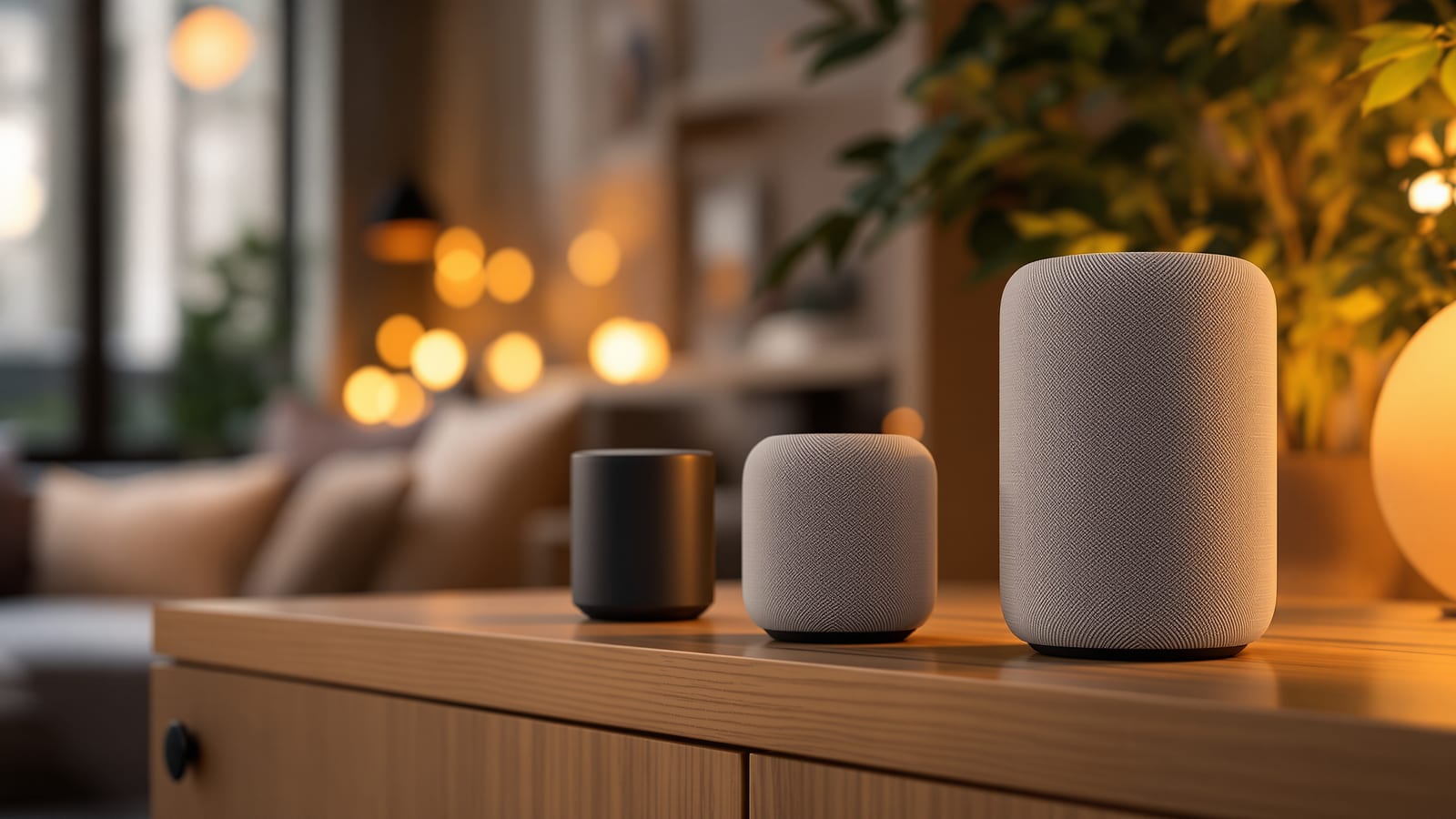
The smallest smart speakers — an Echo Dot or Nest Mini — are brilliant assistants but modest musical instruments. They fill a bedroom or a bathroom with clear enough sound, but they cannot carry a party in a large hall. If music matters, step up to a larger speaker (Echo, HomePod) or plan for a stereo pair. Match the device to the room:
| Room | What matters most | Suggested type |
|---|---|---|
| Bedroom | Quiet, no screen, gentle alarm | Small speaker (Dot / Mini) |
| Kitchen | See recipes, hands-free, wipe-clean | Small display (Show 5 / Hub) |
| Living hall | Sound quality, fills the room | Larger speaker or stereo pair |
| Study / desk | Answers, focus timers | Small speaker |
| Entrance | See who is at the gate | Display linked to door camera |
A common, sensible pattern for an Indian flat: a display in the kitchen, a mini speaker in each bedroom, and one larger speaker in the hall — all on the same assistant so they answer together and can play music in sync.
Indian-language support
This matters more in India than the international reviews admit. Alexa and Google both handle Hindi well, including a Hinglish mix, and both let you switch the assistant's language or run bilingually. Google's Assistant currently reaches a broader set of Indian languages and tends to parse casual, code-mixed speech more gracefully. Siri's Indian-language coverage is the weakest of the three. If elders at home speak mainly Hindi or a regional language, test the assistant in that language before you commit — set it up in a store or at a friend's home and ask it real questions the way your family actually speaks.
Budget bands
Smart speakers fall into clear price tiers in India, and festival sales (Great Indian Festival, Big Billion Days) routinely knock 30–50% off, so timing matters.
| Band | Price | Typical devices | For whom |
|---|---|---|---|
| Entry | ₹2,500–₹5,000 | Echo Dot, Nest Mini | First device, bedrooms, gifting |
| Mid | ₹5,000–₹10,000 | Echo Show 5, Nest Hub, HomePod mini | Kitchen display, better sound |
| Upper | ₹10,000–₹20,000 | Echo Show 8, larger Echo | Living-room hub, video calls |
| Premium | ₹20,000+ | HomePod, stereo pairs | Audiophiles, Apple homes |
The honest advice: buy one inexpensive device first, live with it for a month, and only then expand. You will learn which rooms you actually talk to and which assistant your family took to.
The model line-up
Here is where the abstract choices become specific boxes on a shelf. The chart positions the popular models by price and capability.
| Model | Type | Approx. price | Best for |
|---|---|---|---|
| Amazon Echo Dot | Speaker | ₹3,000–₹5,500 | First device, bedrooms |
| Amazon Echo Show 5 | Display | ₹8,000–₹11,000 | Kitchen, bedside |
| Amazon Echo Show 8 | Display | ₹13,000–₹18,000 | Living room hub, video calls |
| Google Nest Mini | Speaker | ₹4,000–₹6,000 | Android homes, bedrooms |
| Google Nest Hub | Display | ₹9,000–₹12,000 | Kitchen, Google Photos frame |
| Apple HomePod mini | Speaker | ₹9,900–₹12,000 | iPhone homes, better sound |
Prices swing widely in sales; the numbers above are typical street prices between events. Amazon devices dominate India on price and availability, Google's displays shine as photo frames and question-answerers, and the HomePod mini is the pick only if you are already inside Apple's world.
Multi-room audio
Once you have more than one speaker, they can play the same song across the house in sync, or you can call out to one and have the nearest respond. Alexa (Multi-Room Music) and Google (speaker groups) both do this well within their own ecosystem — which is another reason to standardise on a single assistant. Apple's AirPlay 2 does it beautifully but only across Apple devices. Mixing brands breaks the magic, so decide your ecosystem before you buy the second speaker.
Privacy and the mic-mute button
A smart speaker listens for its wake word all the time, and for many Indian buyers that is a genuine worry. Three honest points. First, every reputable device has a physical mic-mute button — press it and the microphone is electrically cut, not just software-disabled. Use it in the bedroom or during private conversations. Second, prefer a plain speaker over a camera-equipped display in private rooms. Third, you can review and delete your voice history in each app, and turn off the saving of recordings. Apple's HomePod is the most privacy-forward by design, processing more on-device; Alexa and Google are cloud-first but give you controls. For the fuller picture, our ultimate smart home guide covers home privacy in depth, and pairing a speaker with media is covered in the smart home entertainment guide.
Putting it together
A simple decision path for most Indian homes: choose Alexa if you want the widest, cheapest ecosystem; Google if the family is Android-first and asks the assistant lots of questions; Apple only if you live inside iPhones and value privacy above range. Then buy one small speaker for the room you talk to most, add a kitchen display next, and expand room by room on the same assistant. Estimate the cost of your planned rooms with our smart home cost calculator, and once the speakers are in, they become the natural voice for the lights, fans and locks you add later — a role explored in the voice assistants for the smart home guide.
References
- Amazon India — Echo & Alexa Devices — official Echo and Echo Show model range, specifications and Indian pricing.
- Google Store India — Nest Speakers & Displays — Nest Mini and Nest Hub specifications and availability in India.
- Apple India — HomePod mini — official HomePod mini specifications, pricing and HomeKit details.
- Amazon — Alexa Privacy & Voice History Controls — how to mute the mic, review and delete recordings.
- Google — Assistant Languages Supported — current list of languages, including Indian languages, supported by Google Assistant.
- TRAI — Telecom Regulatory Authority of India — background on data and consumer-protection context relevant to connected devices in India.
Export this guide
Related Guides — Deep-dive reading
Alexa vs Google Home vs Apple Home in India: Which Ecosystem?
An honest, India-first comparison of the three smart-home ecosystems — cost, Indian-language support, privacy, automation and lock-in — plus how Matter quietly changes the whole decision.
Smart HomeVoice Controlled Bathroom India: Waterproof Smart Speaker, Hands-Free Lights, Shower & Geyser, Privacy & Cost
A practical India-first guide to voice control in the bathroom — a splash-rated smart speaker or voice-enabled mirror that turns lights, music, exhaust fan, geyser and even the shower on and off hands-free — plus the microphone and privacy questions, the humidity and IP durability the device must survive, whether your Wi-Fi even reaches the wet corner of the house, which tasks genuinely benefit, the real accessibility win for elderly and disabled users, and what it all costs.
BathroomsVoice Assistants & Voice Control for Indian Homes: Alexa, Google & Siri
Which assistant understands Hinglish and Indian accents, which speaker or display to buy and where to place it, how voice helps elderly parents, and what mic-mute and DPDP mean for your family's privacy — with rupee costs throughout.
Smart HomeRelated Tools — Try Free
Full-Room BOQ — Living, Bedroom, Kitchen, Bath
Room-wise BOQ across living, bedrooms, kitchen, utility, and bathrooms with line-item pricing.
Full-Room BOQSmart Home Cost Calculator
13 device categories across 5 ecosystems (Apple HomeKit, Alexa, Google Home, Mi, Wipro). Live floor-plan that lights up as you add devices, per-room and per-category breakdown.
Smart Home CalculatorSmart Home Ecosystem Selector
Answer 5 questions and get a ranked recommendation for the smart-home ecosystem that fits your Indian household — Amazon Alexa, Google Home, Apple Home, Samsung SmartThings, or Home Assistant — with pros, caveats and a rough starter cost.
Selector