
Smart Kitchen Guide for Indian Homes: Appliances Worth It (and Not)
An honest, device-by-device walk through smart chimneys, refrigerators, ovens, dishwashers, purifiers, plugs, gas and leak sensors and voice control — with real Indian brands, rupee costs and a clear verdict on what is genuinely useful versus a marketing gimmick.
The kitchen is where "smart home" marketing gets loudest and least honest. Brochures promise a refrigerator that reminds you to buy milk and an oven you preheat from your car. In an Indian kitchen — where a pressure cooker, a gas hob and a dabba of leftover sabzi still do most of the real work — a lot of that is noise. But not all of it. A few smart devices here genuinely earn their place: they save power, they catch a gas leak before it becomes a tragedy, and they make a busy morning smoother. This guide separates the two, room-tested for Indian conditions, wiring and prices.
The test for any smart kitchen device is simple: does it change your behaviour for the better every week, or is it a feature you demonstrate once to guests and never touch again? Buy the first kind.
If you are planning a whole home rather than one room, read this alongside the ultimate guide to smart homes in India and the broader home automation guide for India. Lighting choices in the kitchen follow the same logic as the rest of the house, covered in the smart lighting guide for India, and running costs are handled in the smart home energy management guide.
How to think about a smart kitchen
An Indian kitchen has three kinds of load. There is safety (gas, fire, water leaks), energy (the fridge runs 24x7 and is often the single biggest appliance draw in the home), and convenience (everything else). The honest order of priority is exactly that: spend on safety first, on energy second, and treat convenience gadgets as optional treats bought only when they solve a real irritation.
Smart chimney and hob
A smart chimney (Faber, Elica, Hindware, Kaff, Glen) adds app control, auto-clean cycles, gesture or motion switching, and sometimes a heat sensor that ramps suction when it detects heavy tadka smoke. In an Indian kitchen that fries, tempers and roasts daily, the genuinely useful parts are the auto-heat sensing and the oil auto-clean — the app control itself you will rarely open. A filterless or auto-clean chimney is worth the premium purely for maintenance, smart or not. Treat the Wi-Fi as a bonus, not the reason to buy.
A smart hob or smart gas cooktop is mostly a gimmick today. Indian cooking is hands-on and improvised; a hob that pairs to an app adds little, and induction-based smart cooktops still struggle with heavy kadhai and pressure-cooker use. Skip the smart tag on the hob; spend that money on the chimney and a good gas sensor instead.
Smart refrigerator: the honest verdict
This is the big one people ask about, so here is the plain answer: a smart refrigerator is rarely worth the premium in India. The touchscreen, the internal cameras and the "view your fridge from the supermarket" feature sound magical and get used for about a week. Samsung Family Hub, LG InstaView ThinQ and Whirlpool connected models command a large premium for software you will forget.
What is worth paying for in a fridge has nothing to do with Wi-Fi: a higher BEE star rating, an inverter compressor (steadier cooling, quieter, far kinder to your bill), and good stabiliser-free operation for India's voltage swings. A 5-star inverter fridge saves real money every month; a smart screen saves nothing. Buy the efficient fridge, skip the screen.
| Fridge feature | Genuinely useful? | Notes |
|---|---|---|
| BEE 4-5 star rating | Yes, essential | The fridge runs 24x7; efficiency is the real saving |
| Inverter compressor | Yes | Quieter, steadier, handles Indian voltage better |
| Stabiliser-free / wide voltage | Yes | Fewer failures during brownouts |
| Wi-Fi app and remote view | Rarely | Novelty; abandoned within weeks |
| Internal cameras | No | Gimmick at this price |
| Touchscreen door hub | No | Costly software you will not use |
Smart oven and microwave
A smart microwave or convection oven (Samsung, LG, IFB) with app-driven auto-cook menus and voice preheat is a mild convenience for households that bake or grill often. Auto-cook Indian menus are genuinely handy for beginners. But if you mostly reheat and defrost, a good non-smart convection microwave does the same job for far less. Verdict: nice-to-have for keen bakers, skip for everyone else.
Smart dishwasher: does it fit Indian kitchens?
Dishwashers are finally catching on in India, and the smart features (delay start, cycle-done alerts, auto-detergent dosing) are actually pleasant here — you can run the machine on a delayed cycle during off-peak hours or overnight and get an alert when it is done. Bosch, IFB, LG and Faber sell connected models. The smartness is minor, but the dishwasher itself is worth serious consideration for Indian cooking (heavy masala-stained utensils need the intensive and pre-soak programmes; choose 13-14 place settings and Indian-specific wash cycles). Verdict: buy the dishwasher for the utility, not the app — and if a connected model costs little more, the delay-start and alerts are a genuine small plus.
Smart water purifier
A smart RO water purifier (Kent, Aquaguard, Pureit, Livpure) that reports filter life, TDS levels and service reminders through an app is one of the quietly sensible smart buys. Filter and membrane health is easy to forget, and drinking water quality is not something to guess at. The app nudges you to service on time and shows real-time TDS. Verdict: a modest but honest win, especially in hard-water and high-TDS cities. Do not overpay for it, but the connected reminder is more useful than most kitchen "smarts."
Smart coffee machine
A smart coffee or milk-frother machine you can start by voice or schedule is pure convenience and pure indulgence. For a serious coffee household it is a small daily delight; for everyone else it is a gimmick that gathers dust beside the filter-coffee kaapi setup. Verdict: buy only if you already drink machine coffee daily.
Smart plugs: the smartest small spend
Here is the best-value idea in the whole kitchen. A smart plug (Wipro, TP-Link Tapo, Amazon, Meross) turns any ordinary appliance smart for ₹500 to ₹1,200. Put one on the water purifier, the coffee maker, the microwave's standby, or an old geyser, and you get scheduling, voice control and — crucially — energy monitoring on models that measure watts. You can see exactly what an appliance costs to run, and switch off phantom standby loads. Verdict: the highest return per rupee in the kitchen. Buy a few before you buy any big "smart" appliance.
Gas and leak sensors: spend here first
If you buy one smart thing for your kitchen, make it a gas leak detector. An LPG or natural-gas sensor sounds a loud alarm and, on better models, sends a phone alert or even triggers a solenoid valve to cut the gas supply. In Indian kitchens with cylinder LPG this is not a luxury — it is a safety device. Brands: Honeywell, and several IoT sensors that pair with Alexa or a hub. A water leak sensor under the sink and behind the fridge catches slow leaks before they warp your modular carcass. Verdict: both are cheap, both are genuinely protective, both belong in every kitchen. This ties into whole-home safety covered in the smart home security systems guide for India.
Under-cabinet lighting and voice
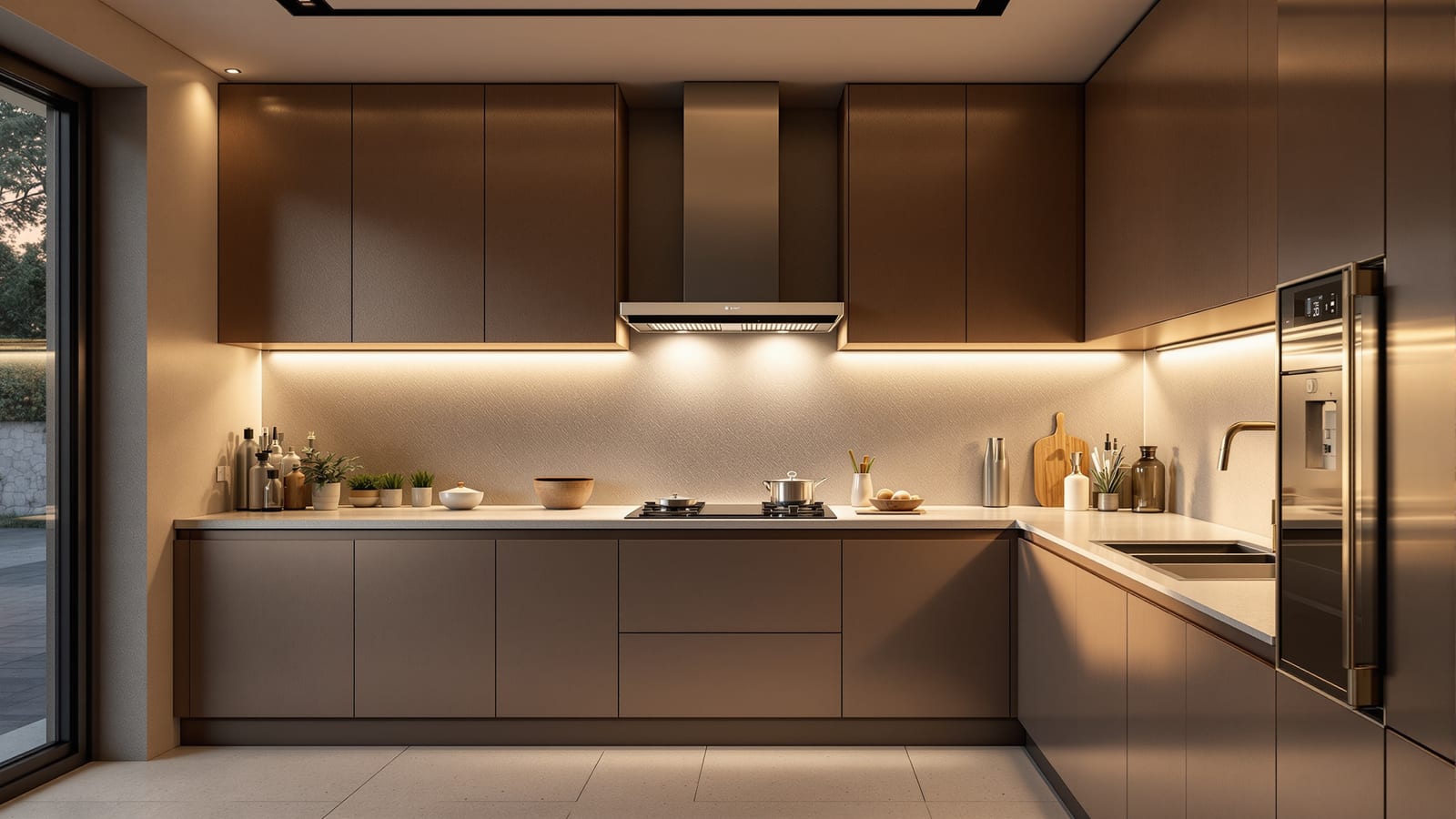
Motion-activated under-cabinet LED strips light the counter exactly where you chop and cook, and switch off on their own — a small, daily, genuinely useful upgrade. Follow the strip-and-driver advice in the smart lighting guide; insist on a decent driver, as the adapter is the usual failure point.
Voice control (Alexa or Google) is the one interface everyone in an Indian family will actually use in a kitchen, because your hands are wet or full of atta. "Set a 10-minute timer," "add dhania to the list," "turn on the chimney light" — hands-free, no app, no touching a screen with masala fingers. A small Echo or Nest speaker on the counter is one of the best-value additions to any kitchen.
What is worth it versus what to skip
Cost bands for planning
Prices move; treat these as 2026 planning bands, not quotes.
| Device | Typical India price (2026) | Honest verdict |
|---|---|---|
| Smart plug (Wipro, Tapo, Meross) | ₹500 - ₹1,200 | Best value; buy several |
| LPG gas leak sensor | ₹1,500 - ₹6,000 | Safety-critical; buy first |
| Water leak sensor | ₹800 - ₹2,500 | Cheap insurance |
| Auto-clean smart chimney (Faber, Elica, Kaff) | ₹18,000 - ₹45,000 | Worth it for auto-clean, not Wi-Fi |
| 5-star inverter refrigerator | ₹30,000 - ₹80,000 | Buy for stars, skip the screen |
| Smart RO water purifier | ₹12,000 - ₹22,000 | Modest but genuine win |
| Connected dishwasher (Bosch, IFB, Faber) | ₹35,000 - ₹65,000 | Buy for utility; app is a small plus |
| Smart microwave / convection oven | ₹12,000 - ₹35,000 | Only for keen bakers |
| Under-cabinet LED strip + sensor | ₹1,500 - ₹6,000 | Small daily upgrade |
| Voice speaker (Echo, Nest) | ₹3,000 - ₹8,000 | Everyone will use it |
For a whole-home estimate tuned to your rooms, use the smart home cost calculator, and see the full breakdown in the smart home cost guide for India.
Modular kitchen integration
If you are building a modular kitchen now, this is the moment to plan the smart layer into the civil and carpentry work — it costs little then and is painful to retrofit. Run a neutral wire and a spare conduit to the chimney and under-cabinet line, provision a switched socket behind the fridge and under the sink for sensors, and place a power point on the counter for a voice speaker. Standardise on one ecosystem so the chimney light, the plugs and the sensors all answer to the same app and the same voice assistant. Beyond that, resist the showroom's pressure to buy the most "connected" appliance in every category — the smart kitchen that lasts is a handful of well-chosen safety and energy devices, not a wall of screens.
The bottom line
Spend on safety (gas and leak sensors), then on energy (an efficient inverter fridge and smart plugs that show you where power goes), and only then on convenience. Skip the fridge touchscreen, the smart hob and the app-for-everything appliances that impress once and gather dust. A ₹1,000 smart plug and a ₹3,000 gas sensor will do more good in an Indian kitchen than a ₹1.5 lakh connected refrigerator ever will.
References
- Bureau of Energy Efficiency — Standards and Labelling (star ratings for refrigerators and appliances)
- BIS — Indian Standards search (appliance safety and performance standards)
- Petroleum and Explosives Safety Organisation (PESO) — LPG safety guidance
- Faber India — chimney range and smart features
- Kent RO Systems — water purifier product documentation
- Central Pollution Control Board — drinking water quality standards
Export this guide
Related Guides — Deep-dive reading
Smart Air Purifiers for Indian Homes: Beating PM2.5
Across Delhi-NCR winters and year-round urban haze, indoor air is often worse than the street. This guide explains what actually makes a purifier smart, how CADR and room sizing work, what HEPA and activated carbon really remove, honest running costs on filters and power, and which brands earn their price in Indian conditions.
Smart HomeSmart Plugs: The Cheapest Way Into a Smart Home (India Guide)
What a smart plug does, the best and worst things to plug into it, the load-rating warning that matters most, energy-monitoring models, Wi-Fi vs Zigbee, scheduling and automations, safety, and brands with real Indian prices.
Smart HomeHow to Choose a Smart Speaker in India (Alexa, Google, Apple)
A smart speaker is the friendliest way into a connected home — but the choice is really three choices layered together: which assistant, speaker or display, and which model for which room. This buyer's guide walks an Indian household through all three, with real prices and honest trade-offs.
Smart HomeRelated Tools — Try Free
Smart Home Cost Calculator
13 device categories across 5 ecosystems (Apple HomeKit, Alexa, Google Home, Mi, Wipro). Live floor-plan that lights up as you add devices, per-room and per-category breakdown.
Smart Home CalculatorSmart Lock Cost Calculator
Estimate smart door lock cost by access type, tier and number of doors — and compare it to a mechanical lock.
Door CalculatorCCTV Camera Coverage & Count Calculator
Estimate how many CCTV cameras you need, the NVR channels, storage in TB for your retention period, and an indicative all-in cost with GST.
CCTV Calculator