
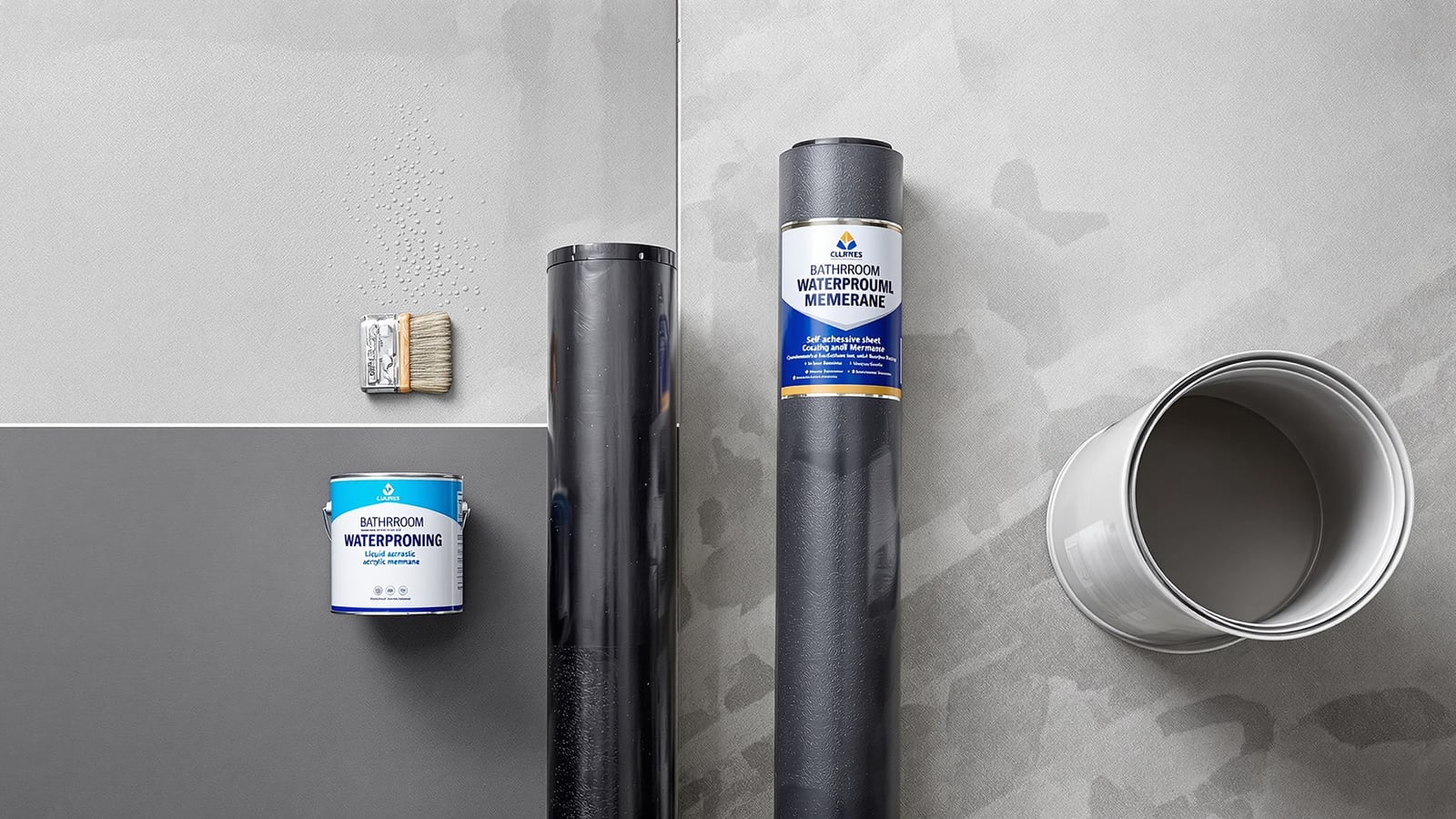
Waterproofing Membrane Types India: Cementitious vs Acrylic vs PU vs Sheet vs Crystalline
A practical comparison of the five waterproofing membrane families used in Indian bathrooms — cementitious, acrylic/liquid, polyurethane, sheet/pre-formed and crystalline/integral — with elongation, durability, ₹ per sq ft, and where each one actually belongs.
Ask three contractors how to waterproof an Indian bathroom and you will get three different answers — one swears by a grey cement slurry, another brushes on a rubbery paint, a third rolls out a black sheet with a blowtorch. They are all describing waterproofing membranes, and they are not interchangeable. A membrane is simply the continuous, water-blocking skin between your wet floor and the structural slab. The family it belongs to decides how much it can stretch over a crack, how long it lasts, whether UV will kill it, and what it costs per square foot.
This guide sits in the Studio Matrx bathroom hub. For the full method — surface prep, coving, ponding test and tile-over sequence — read the complete bathroom waterproofing guide for India. This page is the comparison you turn to when you have to choose which membrane, and it links out to the deep-dive on each type.
There is no single best membrane. There is the right membrane for a given surface, exposure and movement — and the wrong one is usually the one your contractor happens to have on the van.
The five membrane families
Every product on the Indian market is a variation of five chemistries. Understanding the family tells you 80% of what you need.
- Cementitious — cement + polymer, mixed on site and brushed on. Rigid, cheap, easy, breathable. The workhorse of internal wet areas. See the cementitious waterproofing guide.
- Acrylic / liquid-applied — water-based acrylic emulsion, single or two-component, rolled or brushed to form a seamless film. Flexible, UV-tolerant, forgiving. See the liquid waterproofing membrane guide.
- Polyurethane (PU) — a high-solids liquid that cures to a tough, highly elastic rubber. The premium liquid membrane for terraces, decks and demanding wet zones. See the polyurethane waterproofing guide.
- Sheet / pre-formed — factory-made rolls of bitumen (APP/SBS torch-on), HDPE or PVC, laid and lapped. Guaranteed thickness, excellent for large horizontal decks and basements. See the sheet membrane waterproofing guide.
- Crystalline / integral — chemicals that react with concrete to grow water-blocking crystals inside the pores, either dosed into the mix (integral) or slurried onto the surface (crystalline). Not a coating you can peel — it becomes part of the concrete.
The one table to choose from
This is the heart of the guide. Elongation is the single most useful number — it tells you how far the membrane can stretch as a hairline crack opens without tearing. Rigid cementitious sits near 0%; PU can exceed 400%.
| Membrane type | Typical elongation | Durability (design life) | UV / exposure | Where it belongs | ₹ / sq ft (material + labour) | Key pro | Key con |
|---|---|---|---|---|---|---|---|
| Cementitious (2-K polymer) | 5–15% | 8–12 yrs (under tile) | Poor — must stay covered | Internal bathroom floors & walls, sunken slabs, water tanks | 25–55 | Cheap, breathable, tile-friendly | Cracks if slab moves; no UV |
| Acrylic / liquid | 100–250% | 6–10 yrs | Fair–good | Balconies, chajjas, parapets, low-cost terraces, wall dampness | 35–70 | Seamless, flexible, easy DIY | Softens if permanently ponded |
| Polyurethane (PU) | 300–500% | 12–20 yrs | Excellent (aliphatic) | Terraces, roof decks, planters, high-movement wet zones | 80–160 | Bridges cracks, seamless, long life | Costly; needs dry, skilled prep |
| Sheet — bituminous (APP/SBS) | 30–50% | 10–15 yrs | Poor — needs screed/tiles over | Large flat roofs, podiums, basements, sunken slabs | 60–120 | Guaranteed thickness, robust | Laps/joints are weak points; torch skill |
| Sheet — HDPE / PVC | 200–400% | 15–25 yrs | Good (PVC) | Basements, retaining walls, tunnels, large decks | 90–180 | Very durable, chemical-resistant | Welded joints; specialist labour |
| Crystalline / integral | N/A (concrete-bound) | Life of structure | N/A (internal) | Water tanks, basements, lift pits, sunken slabs | 40–90 | Self-heals fine cracks; permanent | Only works in dense concrete; not for movement |
Rates are indicative 2026 metro pricing and swing with brand, number of coats and site access. Always price by system, not by litre.
How to read elongation vs your surface
A slab that barely moves — a ground-floor bathroom on a raft — is happy with a rigid, cheap cementitious coat. A cantilevered balcony or a terrace baking in 45°C summers and contracting on monsoon nights moves constantly; put a 10% membrane there and it will tear along every crack within two summers. Match the stretch to the movement.
Cementitious: the default indoor choice
Two-component polymer-modified cementitious membrane is what most well-built Indian bathrooms actually use, and rightly so. It bonds tenaciously to concrete and plaster, it lets residual construction moisture breathe out (important in freshly cast RCC), tiles stick straight to it with polymer adhesive, and it is cheap. Its weakness is rigidity — 5–15% elongation means it cracks if the substrate cracks. The fix is to add a reinforcing fibre mesh at coves, corners and pipe penetrations, and to keep it strictly for internal, tiled-over surfaces. For a standard 40–50 sq ft bathroom, expect two to three coats and a 48-hour ponding test before tiling.
Acrylic and PU: the flexible liquids
When the surface moves or sees sun, switch to a liquid-applied elastomeric membrane. Acrylic is the affordable step up — a rubbery, seamless film ideal for balconies, parapets and the underside of leaky terraces, with 100–250% stretch. Its limit is standing water: acrylics are not for permanently submerged tanks or deeply ponded decks, where they soften.
Polyurethane is the top of the liquid tier. High-solids PU cures into a seamless, joint-free rubber that stretches 300–500%, shrugs off UV (in its aliphatic form), and lasts 12–20 years. It is the correct answer for exposed terraces, roof decks and planter boxes. You pay for it — ₹80–160 per sq ft — and it demands a bone-dry, primed substrate, because PU and trapped moisture make blisters.
Sheet membranes: thickness you can count on
Liquid coats live and die by the applicator maintaining wet-film thickness. Sheet membranes remove that variable — the roll is a guaranteed 1.5–4 mm thick from the factory. Bituminous APP/SBS sheets are torch-fused and dominate large flat roofs, podiums and sunken slabs. HDPE and PVC sheets are welded, extremely durable, and the go-to for basements, lift pits and retaining walls under hydrostatic pressure. The trade-off is that every overlap and joint is a potential leak, so laps, primer and torching (or welding) must be done by trained crews — this is not a DIY family.
Crystalline and integral: waterproofing the concrete, not the surface
The odd family out. Crystalline systems do not form a peelable skin — they carry reactive chemicals into the concrete pores where, in the presence of moisture, they grow insoluble crystals that block capillaries and even self-seal hairline cracks that appear later. Integral admixtures do the same job, dosed into the concrete at the batching stage. Because the protection is inside the mass, it cannot be punctured, peeled or UV-degraded, and it lasts the life of the structure. Use it for water tanks, basements, lift pits and sunken slabs — ideally with a surface membrane, belt-and-braces. Its limit: it needs dense, well-compacted concrete and offers no crack-bridging across a moving joint.
Common mistakes when choosing
- Using cementitious on a terrace. It will craze under UV and thermal movement within two summers. Terraces want PU or a sheet.
- Skipping the primer under sheet or PU. Adhesion fails, blisters form, water tracks under the membrane.
- Trusting one thin coat. Every system is a multi-coat build to a specified total thickness — under-application is the No. 1 field failure.
- No ponding test. Always flood-test 48 hours before tiling, whatever the membrane.
- Ignoring the coving. 90% of leaks start at the floor-wall junction and around pipe penetrations, not in the open field.
Matching the membrane to Indian realities
Indian conditions punish the wrong choice faster than most. Monsoon humidity means substrates rarely dry fully — a bias toward moisture-tolerant cementitious indoors, and patience (or a moisture meter) before any PU or sheet job. 45°C-plus terrace temperatures and sharp day-night swings demand high elongation, so exposed decks belong to PU or PVC, never rigid slurry. Hard water and salts in ponded areas favour crystalline systems, which thrive in exactly those alkaline, wet conditions. And in apartments, society by-laws often forbid torch-on bitumen on shared terraces for fire reasons — check before you spec a sheet system, and keep a self-adhesive or liquid alternative in mind.
A sensible default stack for a typical Indian flat: cementitious in the internal bathrooms and utility, crystalline or integral in the overhead and underground water tanks, and PU on the exposed terrace above. Three families, each doing the job it is best at — which is the whole point of knowing the difference. When you are ready to execute, return to the bathroom waterproofing guide for the coat-by-coat method.
References
- NBC 2016 (National Building Code of India), Part 6 — Structural Design and dampproofing / waterproofing provisions.
- IS 2645 — Integral Cement Waterproofing Compounds — specification.
- IS 3067 — Code of Practice for General Design Details and Preparatory Work for Damp-Proofing and Waterproofing of Buildings.
- IS 13182 / IS 1322 — Bitumen and bituminous felt / sheet membrane specifications.
- CPWD Specifications and CPHEEO Manual — accepted waterproofing systems and testing practice for public works.
- IGBC / GRIHA — durability and water-leak-prevention credits guiding membrane selection in green buildings.
Export this guide
Related Guides — Deep-dive reading
Sheet Membrane Waterproofing India: Self-Adhesive, HDPE, PVC, TPO & Torch-Applied Bathroom Systems
How pre-formed sheet and membrane waterproofing works in an Indian bathroom — self-adhesive bituminous, HDPE, PVC and TPO sheets and torch-applied bitumen, with laps, primers, corner and penetration detailing, where sheets beat liquids, and ₹ costs.
BathroomsCementitious Waterproofing India: Coatings, Coats & Cost (2026)
How cement-based waterproofing coatings work in Indian bathrooms — one- vs two-component, polymer-modified slurries, surface prep, number of coats, curing, where they suit sunken slabs and wet areas, and where their low flexibility lets you down, with rupee costs.
BathroomsMembrane vs Liquid Waterproofing: Which Is Right for Your Roof?
Sheet membranes rolled and lapped over the slab, or a liquid coating brushed on as one seamless film? A balanced, India-grounded comparison for flat roofs and terraces across joints, thickness, complex shapes, UV, repair, skill, life and cost.
RoofingRelated Tools — Try Free
Apartment Video Door System Planner
Enter flats, entrances, floors and guard desk for a first-pass building intercom plan — door stations, indoor monitors, guard station, the right architecture and an indicative cost band.
Building PlannerBathroom Waterproofing Calculator
Work out waterproofing material (kg/L) and cost for a bathroom by area, wall band, system type and coats — cementitious, acrylic, PU or SBR.
Bathroom CalculatorMonsoon-Readiness Checklist
Pre-rain home audit across 9 categories — terrace, drains, waterproofing, electrical, HVAC, pest, vehicles, documents.
Seasonal Audit