
Retirement Home Landscape Design — Gardens for Later Life
Safe, accessible, therapeutic and low-maintenance gardens for older people — step-free paths, raised beds, sensory planting, shade and falls prevention
A garden designed for later life is not a smaller garden — it is a kinder one: level, firm, shaded and fragrant, so that an eighty-year-old can step out alone at dawn, walk safely, tend a tomato plant without bending, and sit in the sun with a cup of chai. As Indian families increasingly choose to keep ageing parents at home rather than send them away, the outdoor space becomes one of the most powerful — and most overlooked — tools for health, dignity and joy in the later decades. This guide shows you how to design a home garden that is safe, accessible, therapeutic and genuinely low-maintenance for older people in Indian conditions.
Why the garden matters more in later life
For a younger household the garden is a luxury — a place to entertain or to look at from indoors. For an older person it is closer to medicine. The benefits are not vague wellness claims; they are well documented and they compound.
- Gentle, weight-bearing exercise. A daily walk along a safe loop, or twenty minutes of light gardening, maintains balance, joint mobility and muscle — the single biggest protection against the falls that so often begin an irreversible decline.
- Sunlight and vitamin D. Vitamin D deficiency is widespread among older Indians, especially women who spend little time outdoors. Twenty to thirty minutes of morning sun on the arms and face, several times a week, supports bone strength and mood.
- Social contact. A shaded bench by the gate where a grandparent can watch the street, greet neighbours and wave to passing children is a defence against the isolation that quietly erodes health.
- Mental health and sleep. Time outdoors, daylight exposure and the rhythm of tending plants are linked to reduced anxiety and depression and to better night-time sleep — particularly valuable for those living with early dementia.
- Purpose. Caring for a living thing that needs you — watering the mogra, picking curry leaves for the kitchen — restores a sense of usefulness that retirement and dependency can take away.
A retirement garden, in short, is an interiors-style ageing-in-place strategy that happens to be outdoors. If you are also adapting the house itself — thresholds, bathrooms, lighting — pair this with our companion interiors guide on ageing in place so that the journey from bedroom to garden bench is seamless and step-free throughout.
Accessibility and safety: the non-negotiable foundation
Everything else fails if the garden is not safe to move through. Older bodies have narrower margins: slower reactions, weaker grip, poorer night vision, brittle bones. Design for the worst day — a monsoon morning, a slightly dizzy spell, a walking frame — not the best.
Step-free, level routes
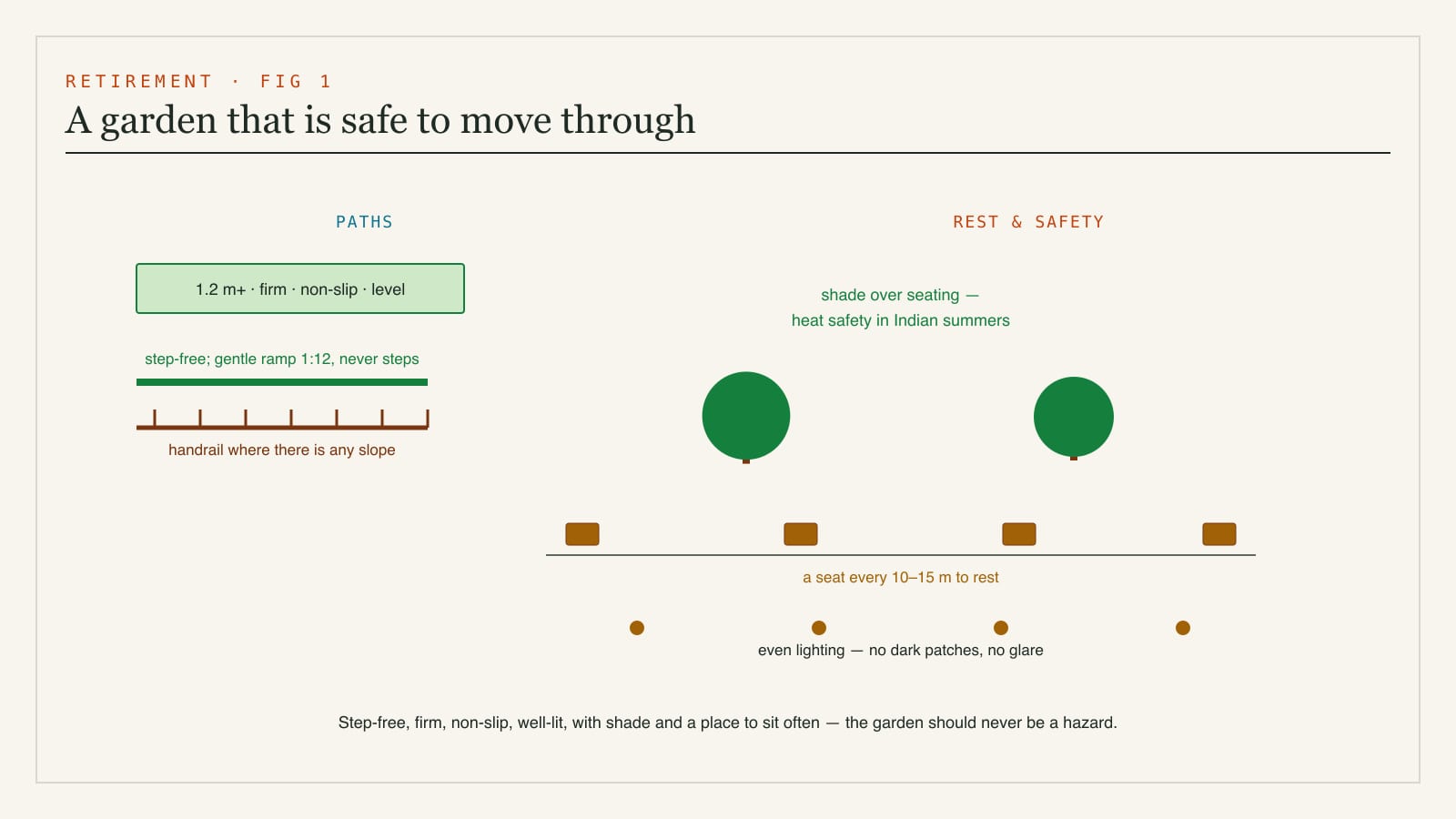
The ideal is a continuous level surface from the door to every part of the garden the older person will use. Where a change of level is unavoidable, replace steps with a gentle ramp. India's Harmonised Guidelines for accessibility recommend a ramp gradient no steeper than 1:12 (1:15 or 1:20 is kinder still), with a level landing every 9 metres and at the top and bottom. A 1:12 ramp climbing 300 mm needs 3.6 m of length — plan the space early, because retrofitting a compliant ramp into a finished garden is painful.
Firm, generous, non-slip paths
Paths are where most outdoor falls happen. Get them right:
| Element | Recommendation | Why |
|---|---|---|
| Clear width | 1200 mm minimum; 1500 mm where a walking frame or two people pass | Allows a carer alongside, room for a wheelchair turn |
| Surface | Firm, even, non-slip — brushed/textured concrete, exposed-aggregate, broom-finish, or stable compacted surfacing | Loose gravel, smooth polished stone and glazed tiles are dangerous when wet |
| Joints | Flush, tight joints; no raised edges or lipping | Toe-catch trips are the classic cause of falls |
| Cross-fall | Gentle (about 1:50) to shed monsoon water | Prevents standing water and algae |
| Edges | Slightly raised kerb or contrasting edge band | A visible, tappable edge guides a low-vision walker |
Avoid moss-prone shaded paving; in damp Indian conditions a north-facing path can turn lethally slippery. Slope it to drain, keep it swept, and choose a textured finish.
Handrails and frequent rest
Provide handrails on both sides of any ramp and along longer paths, set at about 850–900 mm, in a colour that contrasts with the background so it can be seen. A second, lower rail (around 760 mm) helps shorter and seated users.
Then scatter rest points everywhere. An older person who knows there is a bench within sight will walk far more — and far more confidently — than one who fears being stranded. A good rule is a seat every 9–10 metres. Choose benches with firm seats around 450–480 mm high (low sofas are very hard to rise from), with armrests to push up on and a back to lean against. A mix of sun and shade seats lets the user follow the season and the hour.
Lighting, sightlines and trip hazards
- Even, glare-free lighting along every route the person might use after dark, with no dark patches between pools of light — older eyes adapt slowly. Light the path surface and any level changes, not the walker's eyes. Motion-sensor lights near doors and steps are worth the modest cost.
- Clear sightlines. Keep planting low at junctions and gates so the person can see where they are going and others can see them. Avoid blind corners.
- Hunt down trip hazards: loose mats, trailing hose pipes, protruding tree roots, uneven settling slabs, garden-tool clutter. Recess or cover drainage channels. Run irrigation underground or along edges, never across a path.
Shade and heat safety — an Indian priority
In much of India the real danger half the year is not falling but heat. Older people regulate temperature poorly and dehydrate quickly. Design generous shade over the seating and the working areas — a flowering pergola, a shade sail, the canopy of a well-placed tree — and keep an accessible, shaded route so the garden is usable in the cool of early morning and evening. A drinking-water point or a covered spot for a water jug close to the bench is a small touch that prevents a serious problem. For deeper treatment of orienting paths and seating to sun and breeze, see Climate-Responsive Landscape Design and Outdoor Circulation Design.
Gardening without strain
Many older people want to keep gardening — it is often the whole point. The trick is to bring the garden up to them so the back, knees and hips are spared.
Raised beds and planters at the right height
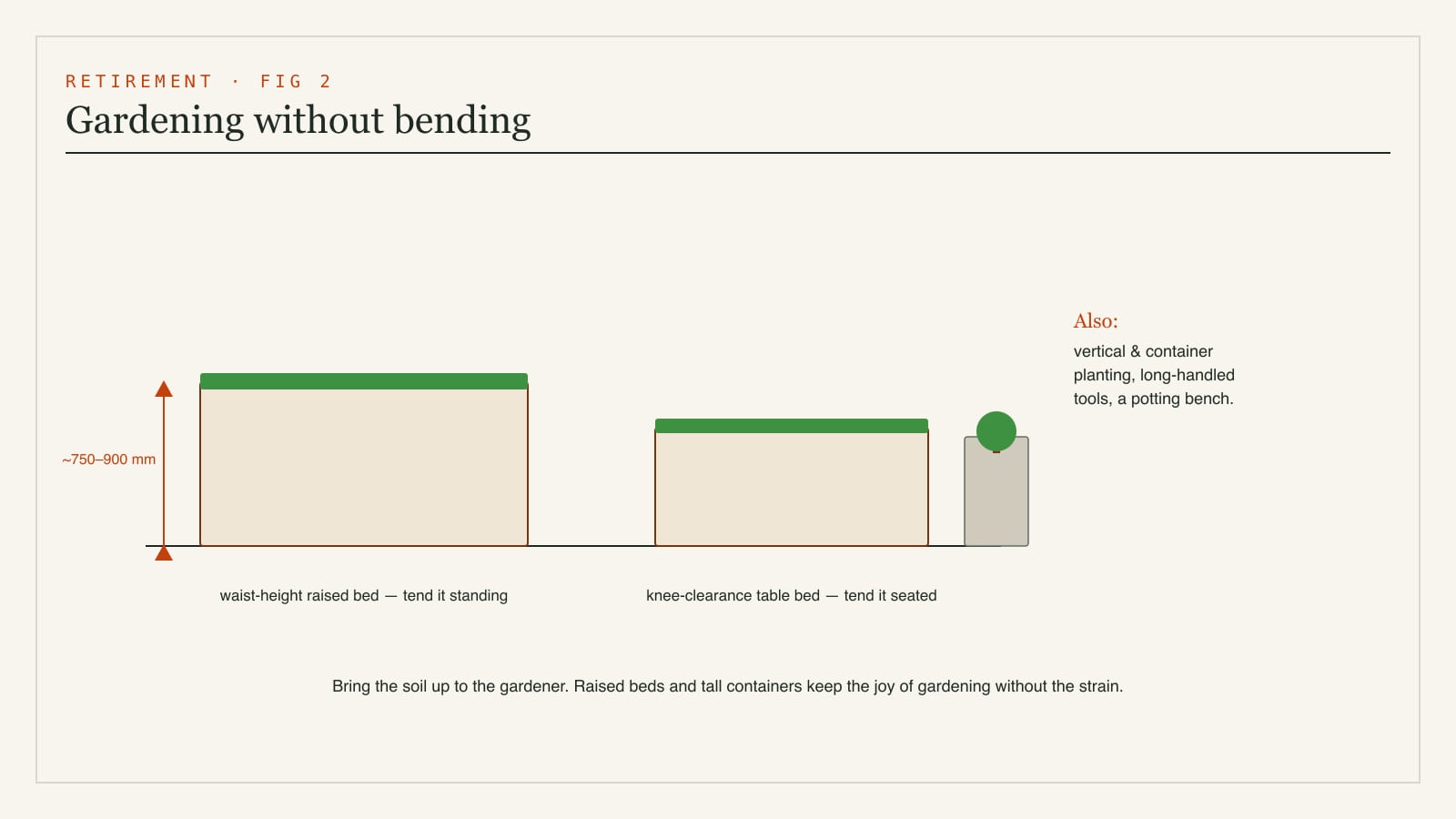
A raised bed lets a person tend plants while standing upright or seated, with no kneeling and no bending. Match the height to how they will work:
| Working position | Bed/planter top height | Notes |
|---|---|---|
| Standing | 750–900 mm | Most comfortable for general planting and weeding standing up |
| Seated (chair/wheelchair) | 600–700 mm, with knee clearance below | Leave a recess so the user can pull in close |
| Perched/short tasks | 450–500 mm | Easy to reach into from a garden stool |
Keep beds no more than about 600 mm deep from a one-sided approach (or roughly 1.2 m if reachable from both sides) so the centre is reachable without leaning in. Build them from brick, ferrocement, stone or sturdy timber; line and drain them well. Edge them with a wide flat capping the gardener can rest a forearm or a cup of tea on.
Vertical and container gardening
Where space or budget is tight, height does the work for you. Wall-mounted planters, trellises for climbers like the fragrant Madhumalti (Rangoon creeper) or money plant, tiered stands and grow-bags on a low table all bring plants within easy reach. Containers can be moved to chase the shade or shelter from a storm, and a tender plant can be brought near the bench to be enjoyed up close.
Lightweight, long-handled and well-organised
- Choose lightweight, long-handled, ergonomic tools with thick cushioned grips; long handles save bending and reaching. Keep a kneeler-seat with handrails for the few low tasks that remain.
- Provide a potting bench at a comfortable standing height — about 850–900 mm — with storage underneath and a hook rail for tools, so everything is to hand and nothing is left on the ground to trip over.
- Lay out beds so the gardener can reach every plant from a firm path; never make them step onto soft, uneven soil.
- Fit lever-type taps (easier than round knobs for arthritic hands), a lightweight hose on a reel, and ideally a self-coiling or short hose to avoid trailing lengths across paths.
Therapeutic and sensory planting
This is where a senior garden becomes a delight rather than merely safe. Older people may have dimmed eyesight and reduced appetite for novelty, but fragrance, texture, birdsong and the taste of a fresh herb reach straight past those limits. A sensory, therapeutic planting palette overlaps strongly with the principles in Healing Gardens and the nature-connection ideas in Biophilic Landscape Design — read those alongside this for the deeper "why".
Fragrance first
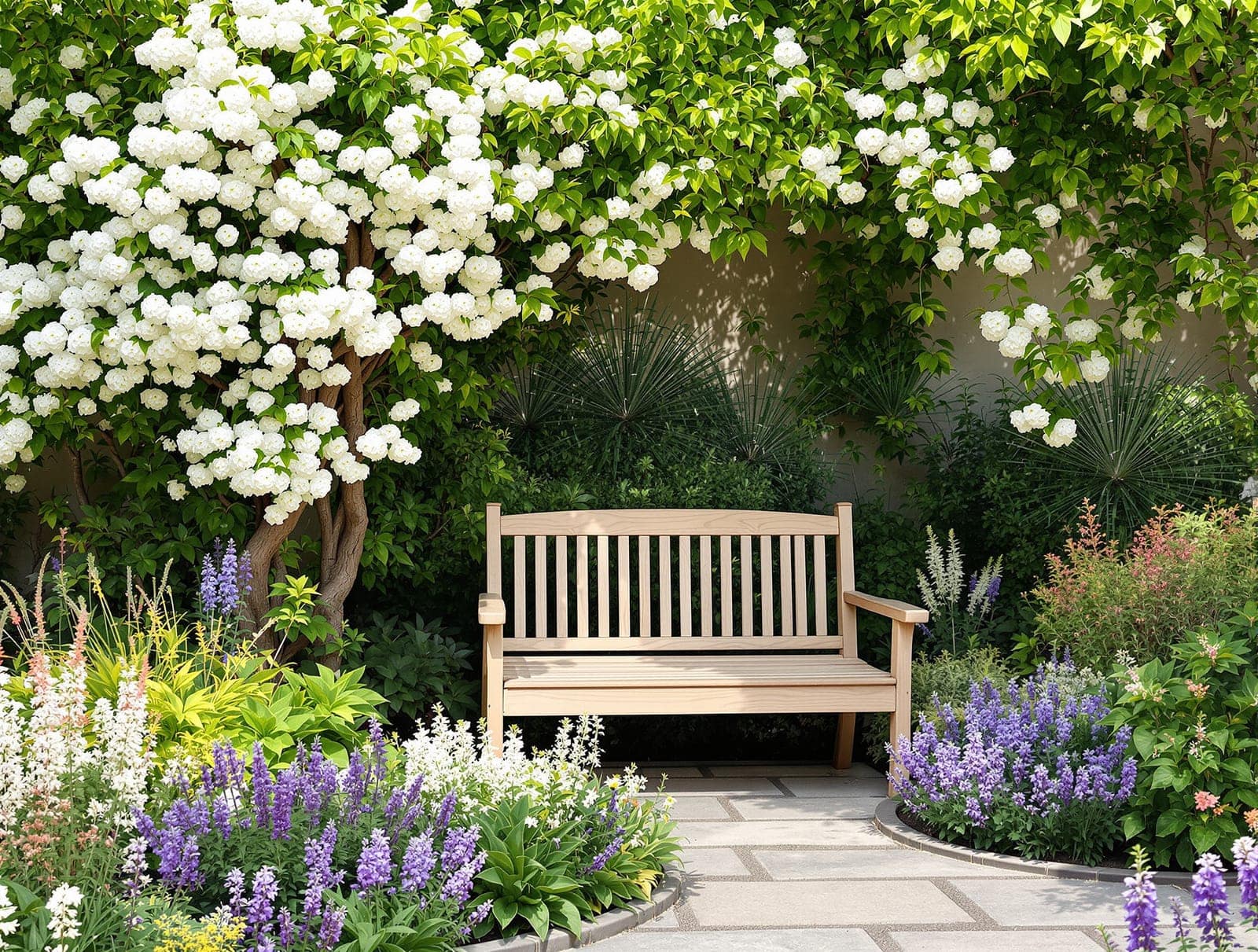
Scent is the sense most tightly bound to memory and emotion, and it works even for those who can no longer see or stoop to the flowers. Plant the evening- and morning-scented Indian classics close to seats, doors and windows:
- Mogra (Jasminum sambac) and other jasmines (Jasminum spp.) — pots near the bench, climbing the pergola.
- Parijat / Harsingar (Nyctanthes arbor-tristis) — drops fragrant flowers at dawn; deeply nostalgic for many older Indians.
- Raat ki Rani (Cestrum nocturnum) — intense night fragrance; place a little away from a bedroom window as it can be overpowering up close.
- Champa (Plumeria), Kamini / Murraya paniculata, and Tuberose (Rajnigandha) for layered, familiar scents.
Touch, colour and sound
- Tactile plants: soft lamb's-ear-like foliage, the feathery texture of ferns, the smooth leaves of money plant — things pleasant to brush past or stroke.
- High-contrast colour: older eyes lose contrast sensitivity, so favour bold, warm colours — marigold, hibiscus, bougainvillea, canna, ixora — against green, and avoid relying on subtle pastels alone.
- Birds and butterflies: a small birdbath kept clean, plus nectar plants like ixora, pentas, lantana (in a controlled spot), hibiscus and curry-leaf flowers, bring movement and sound — a living television that needs no remote.
Edible herbs and kitchen plants
Few things give an older person more quiet satisfaction than snipping their own tulsi, mint (pudina), coriander, curry leaves, lemongrass, chillies and cherry tomatoes for the kitchen. Grow these in the raised beds and containers nearest the door. For a fuller treatment see Edible Landscapes.
Safety in the planting — what to avoid
Therapeutic planting must also be safe planting:
- No thorny or spiny plants beside paths or seats — keep roses, bougainvillea spines, cactus and agave well back from where hands and arms travel. Thin skin tears and infects easily.
- Avoid toxic plants where there is any risk of confusion (relevant for dementia) or where grandchildren play: oleander (kaner), datura, dieffenbachia, and the seeds of castor and Madras-thorn are best kept out of a senior-and-child garden.
- Beware slip-litter: large smooth dropping leaves and squashy fallen fruit (e.g. ripe figs, some Ficus) on a path are a slip risk — site such trees off the route.
Low-maintenance by design
An older gardener's energy is precious; a family caring for ageing parents has little to spare. Design the garden so it largely looks after itself, leaving the pleasant tasks (picking herbs, deadheading near the bench) and shedding the heavy ones (mowing, constant watering).
- Hardy Indian natives and proven performers. Choose plants matched to your climate zone that thrive on neglect: ixora, hibiscus, allamanda, hardy palms, frangipani, oleander (sited safely), curry leaf, and tough groundcovers. They need less water, less feeding and less replacement. See Best Trees for Indian Homes for shade trees that earn their keep.
- Drip irrigation on a timer. Automated drip lines deliver water to the roots with no hose-dragging and no daily labour — the single highest-value upgrade for a low-maintenance senior garden. A simple battery timer costs little and removes a daily chore.
- Mulch generously. A 50–75 mm layer of bark, dried leaves or cocopeat over beds suppresses weeds, holds monsoon and irrigation moisture, and means far less weeding and watering.
- Minimal or no lawn. Lawn is the most labour-hungry element in any Indian garden — mowing, edging, watering, pest control. Shrink it to a small token patch (or replace it with hardy groundcover and paving), keeping just enough soft green for the eye and for a grandchild to sit on.
Indicative costs
Rough Indian ranges to budget against (materials and labour vary widely by city):
| Item | Indicative cost |
|---|---|
| Brick/ferrocement raised bed (per running metre, ~750 mm high) | ₹3,000–6,000 |
| Brushed-concrete / textured paving path (per sq m) | ₹400–900 (basic) to ₹1,500+ (stone) |
| Gentle ramp with handrails (per running metre) | ₹2,500–6,000 |
| Drip irrigation kit for a small garden | ₹3,000–10,000 |
| Quality bench with arms and back | ₹4,000–15,000 |
| Solar/LED path lighting (per fitting) | ₹500–2,500 |
A grandchildren-friendly note
A retirement garden is at its best when it is also a grandchildren's garden — the meeting ground of the generations. The good news is that the principles align: level, firm, non-slip surfaces are safe for toddling feet too; non-toxic, non-thorny planting protects small hands; soft groundcover gives a place to play within the grandparent's sightline. Add a low sandpit or a few pots a child can "own" and water, and the bench by the path becomes the happiest seat in the house. Where children's active play needs more room, our guide on Landscape Zoning for Family Activities shows how to keep boisterous zones separate from the calm, safe core the grandparents use.
Design it well and the same garden serves the four-year-old and the eighty-four-year-old at once — which is, after all, the whole point of ageing in place: not to shrink life, but to keep it whole.
References & further reading
- Harmonised Guidelines and Standards for Universal Accessibility in India (CPWD, Ministry of Housing & Urban Affairs) — authoritative Indian standards for ramps, gradients, handrails, path widths and step-free access.
- National Building Code of India 2016, Part 3 (Development Control & General Building Requirements) — provisions on accessibility and barrier-free design for the built environment.
- Indian Society of Landscape Architects (ISOLA) — professional guidance and resources on residential and therapeutic landscape design in Indian conditions.
- ICAR–Indian Institute of Horticultural Research (IIHR), Bengaluru — region-appropriate plant selection, kitchen-garden and container-growing guidance for Indian climates.
- Royal Horticultural Society (RHS) — "Gardening for older people" and raised-bed/accessible gardening advice — practical, well-tested guidance on tool ergonomics, bed heights and low-strain techniques.
- Marcus, C. C. & Sachs, N. — "Therapeutic Landscapes: An Evidence-Based Approach to Designing Healing Gardens and Restorative Outdoor Spaces" — the standard reference on the health evidence behind sensory and restorative garden design.
Export this guide
Related Guides — Deep-dive reading
Universal Design Doors for Indian Homes: Inclusive Doors That Work for Everyone (2026)
How to design and specify doors that serve children, the elderly, pregnant women, the injured and wheelchair users by default - generous width, lever handles, near-flush thresholds, low-force closing, contrast and good lighting - without your home ever looking medical.
Home Doors & EntrancesThe Accessible Home (India): Step-Free, Mobility-Friendly Design for Every Age
Practical, room-by-room accessibility that quietly works for ageing parents, recovery, pregnancy and kids alike.
Home Lifts & AccessibilityThe Best Trees for Indian Homes
A research-grade guide to choosing and placing trees around an Indian home — the real cooling and clean-air numbers, the right species for shade, flowers, fragrance and fruit, and the placement science that keeps roots out of your walls and drains.
LandscapeRelated Tools — Try Free
Cross-Ventilation Analyzer
Estimate airflow and air changes per hour (ACH) from room size, window areas, layout, and local wind — with NBC 2016 Part 8 compliance check.
Ventilation CalculatorCircadian Light Meter
Patient-centric circadian lighting visualizer for Indian healthcare design — time-of-day × intensity → CCT, melanopic lux (EML / mEDI), melatonin suppression, and an alertness curve. Calibrated against WELL v2 L03 Circadian Lighting Design, CIE S 026:2018, Brainard 2001, and Lucas et al. 2014.
Circadian ToolGarden Planning Toolkit
Get a tailored garden plan — planting layers, Indian species, features and a checklist — from your climate, space, sun and goals.
Planner