

Residential Window Standards in India
The map of every code that governs a home window — NBC, the IS codes, fire and egress, the green envelope code and accessibility — and which one to check for what.
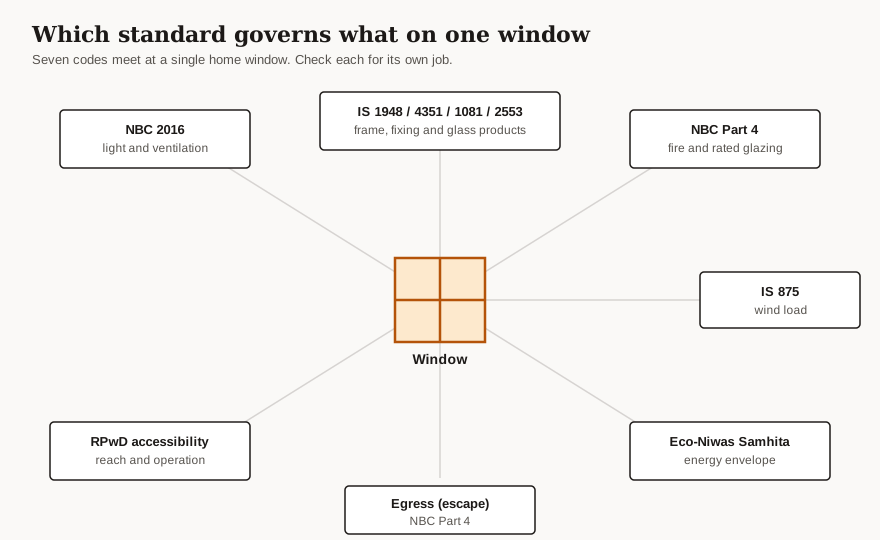
A single residential window in India is governed not by one rule but by a stack of them. The National Building Code sets how much light and air it must bring in. A clutch of Indian Standard (IS) codes govern the frame, the fixing and the glass. The Eco-Niwas Samhita decides how much heat it may let through. Fire and egress provisions decide whether you can climb out of it. And the accessibility guidelines decide whether everyone in the home can reach and operate it. This is the map of all of those standards — the umbrella that routes you to the right code for the right question.
If you want sizes, sills and proportions as a design decision, read Window Size Standards in India. This guide is the code and standards reference — what the law and the codes actually require, and where to look it up.
Which standard governs what
Start here. Each row points to the document that governs one aspect of a home window, and to the deeper spoke guide on this site.
| Question about the window | Governing standard | On this site |
|---|---|---|
| How much light and air must it give? | NBC 2016 (Part 8 Building Services) | NBC window requirements |
| What frame, fixing and glass are acceptable? | IS 1948, IS 4351, IS 1081, IS 2553 | this guide, below |
| Will it survive the wind? | IS 875 Part 3 (wind loads) | this guide, below |
| Is the glazing fire-rated, can fire spread through it? | NBC 2016 Part 4 (fire and life safety) | Fire safety and windows |
| Can you escape through it in a fire? | NBC Part 4 egress provisions | Emergency escape windows |
| How little heat may it transmit? | Eco-Niwas Samhita 2018, ECBC 2017 | Green building window standards |
| Can a wheelchair user reach and operate it? | RPwD Act 2016, Harmonised Guidelines 2021 | the accessibility spoke |
The honest caveat, said once and meant throughout: none of these national documents governs you directly. Your local municipal building bye-law adopts the NBC and then amends it — tightening some numbers, relaxing others. The bye-law is what the sanctioning authority checks against. Treat every figure below as indicative and verify it against your city's current bye-law before you build.
The code landscape, at a glance
The standards arrived in waves over seventy years, and they are still moving. This overview shows the layers a modern home window sits inside.
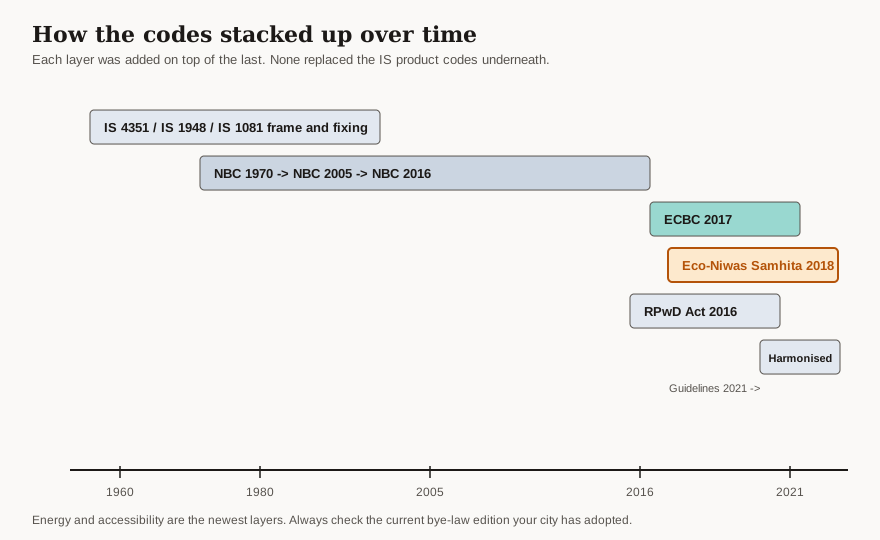
- Performance layer (NBC 2016): light, ventilation, fire, egress — what the window must do.
- Product layer (IS codes): the frame, the fixing, the glass — what the window is made of.
- Energy layer (ENS 2018, ECBC 2017): heat gain through the envelope — how little it may leak.
- Rights layer (RPwD Act 2016, Harmonised Guidelines 2021): access for all — who can use it.
Layer 1 — NBC 2016: light and ventilation
The National Building Code is the performance backbone. For a habitable room, its widely cited baselines are:
- Daylight: glazed window area of about 10 per cent of the floor area, with a minimum of roughly 1 sq m per room.
- Ventilation: an openable area for air — often cited as about half the glazed area, or greater than or equal to one-tenth of the floor area depending on the bye-law.
- Bathroom or WC: a window of at least 0.37 sq m.
- Ceiling height: 2.7 m for naturally ventilated rooms, 2.4 m where mechanically ventilated.
- The aperture must open to outside air or a verandah not more than 2.4 m deep.
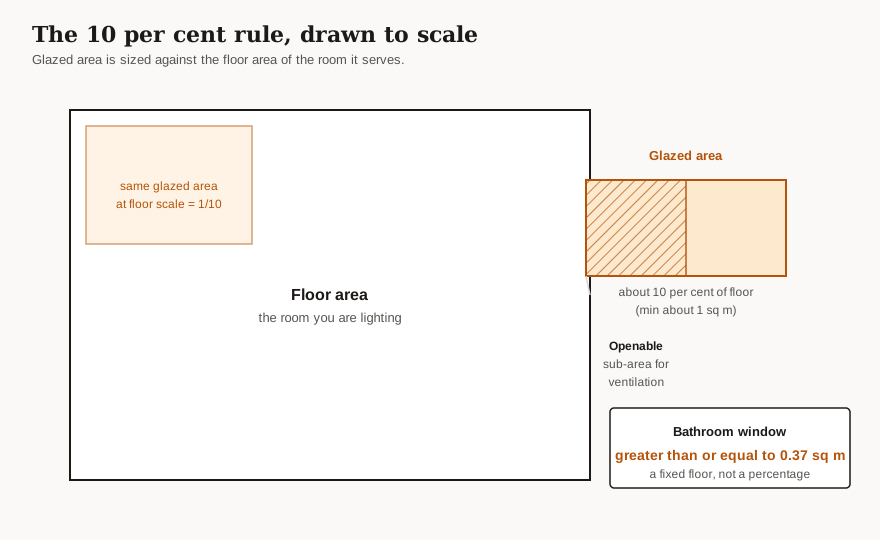
These percentages are exactly the kind of number a local bye-law re-writes. The full breakdown, with the right-to-light and shaft rules, is in NBC Window Requirements.
Layer 2 — the IS product and installation codes
A compliant window is also a manufactured object. The Indian Standards govern its physical reality.
| IS code | Governs | Why it matters at home |
|---|---|---|
| IS 1948 | Aluminium windows and doors | Section profiles, fabrication tolerances |
| IS 4351 | Steel windows | The classic mild-steel casement |
| IS 1081 | Code of practice for fixing and glazing | How the frame is set and the glass held |
| IS 875 Part 3 | Wind loads on structures | Whether the window resists design wind |
| IS 2553 Part 1:2018 | Safety glass (human impact) | ISI-mandatory toughened or laminated glass in risk zones |
IS 2553 in particular carries a mandatory ISI mark for safety glass — relevant for large panes, doors and low sills. Note the deliberate split: IS 2553 is about human impact safety, while fire-rated glazing is a different requirement handled under NBC Part 4 and covered in Fire Safety and Windows.
Layer 3 — fire, egress and accessibility
Three performance requirements deserve their own spokes because each can make a window non-compliant on its own:
- Fire: NBC Part 4 governs fire-rated glazing (integrity E and insulation I ratings such as EI60), spandrel fire-spread between floors, and the rule that escape routes must not be blocked by fixed grilles.
- Egress: at least one window per habitable room — especially bedrooms and basements — must be openable, low-silled and large enough to climb out of, with a quick-release grille, never a fully fixed bar.
- Accessibility: the RPwD Act 2016 and the statutory Harmonised Guidelines and Space Standards for Universal Accessibility 2021 (CPWD) require window controls a seated person can reach — a wheelchair footprint of about 1050 x 750 mm, lever hardware, and low sills where the view matters.
Layer 4 — the green envelope code
The Eco-Niwas Samhita 2018 (ENS) is the residential envelope code. Its headline metric is the Residential Envelope Transmittance Value (RETV), which must be less than or equal to 15 W/m2 in most climate zones, paired with a window-to-wall-ratio (WWR) linked VLT ladder and a U-value limit. ECBC 2017 is its commercial sibling. States are progressively adopting ENS as mandatory in their bye-laws.
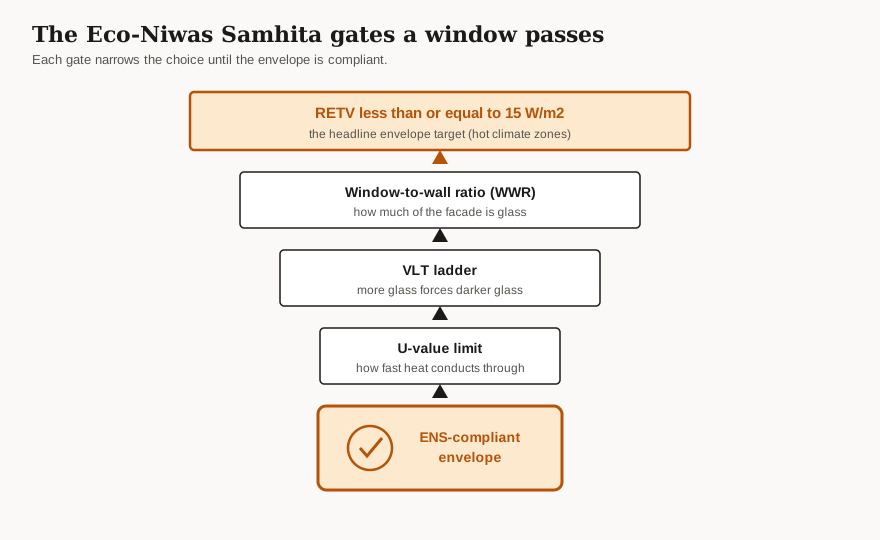
Do not confuse this mandatory envelope code with the voluntary IGBC, GRIHA or LEED credits — those are an optional scorecard, not the law. The mandatory-versus-voluntary split is set out in Green Building Window Standards.
A compliance checklist
Use this as a routing map, not a sanction. Each tick points back to the governing document.
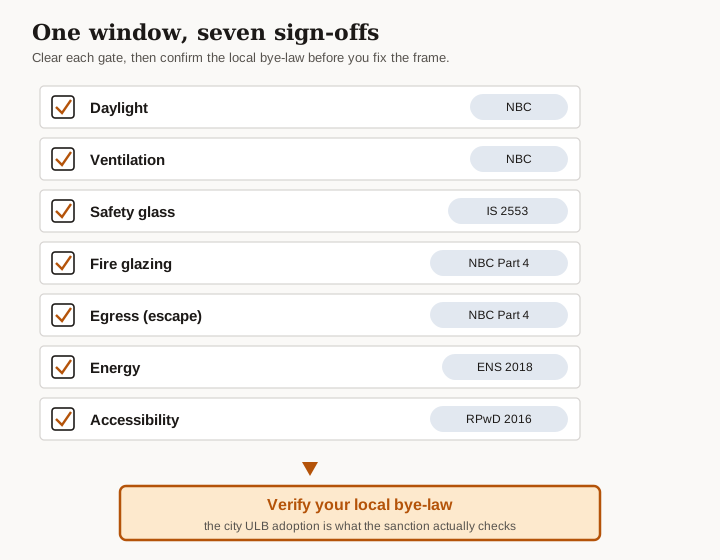
| Check | Standard | Pass condition (indicative) |
|---|---|---|
| Daylight area | NBC 2016 | Glazed area about 10 per cent of floor, min about 1 sq m |
| Openable ventilation | NBC 2016 | Openable area meets bye-law fraction |
| Bathroom window | NBC 2016 | Greater than or equal to 0.37 sq m |
| Frame and fixing | IS 1948 / 4351 / 1081 | Per the relevant material code |
| Wind resistance | IS 875 Part 3 | Designed for local wind zone |
| Safety glass | IS 2553 | ISI-marked where impact risk exists |
| Fire glazing | NBC Part 4 | Rated E / EI where required |
| Egress | NBC Part 4 | Quick-release grille, climb-out opening |
| Energy | ENS 2018 | RETV less than or equal to 15 W/m2 |
| Access | RPwD 2016 | Reachable controls, lever hardware |
Tick every row against your own city bye-law's current numbers, not the national defaults. The bye-law wins.
Where to go next
- The design counterpart: Window Size Standards in India — sizes and sills as a design choice.
- The five standards spokes: NBC requirements, fire safety, emergency escape, and green building standards.
- Choosing the unit itself: Types of Home Windows in India.
- The wider legal frame: Building Regulations and Compliance.
References
- National Building Code of India 2016, Bureau of Indian Standards: https://www.bis.gov.in/standards/technical-department/national-building-code/
- Eco-Niwas Samhita 2018 (Energy Conservation Building Code for Residential Buildings), Bureau of Energy Efficiency: https://beeindia.gov.in/en/programmes/eco-niwas-samhita
- Energy Conservation Building Code (ECBC) 2017, Bureau of Energy Efficiency: https://beeindia.gov.in/en/programmes/ecbc
- Harmonised Guidelines and Standards for Universal Accessibility in India 2021, CPWD: https://cpwd.gov.in/Publication/HarmonisedGuidelinesUniversalAccessiblity.pdf
- Bureau of Indian Standards (IS codes catalogue): https://www.services.bis.gov.in/php/BIS_2.0/bisconnect/standard_review
Export this guide
Related Guides — Deep-dive reading
National Building Code Window Requirements
What NBC 2016 requires of a home window in India: glazed area for light, openable area for ventilation, by-room minimums, ceiling heights and the bye-law that actually governs.
Windows & GlazingAccessibility Standards for Windows in India
The RPwD Act 2016 and the 2021 Harmonised Guidelines — what the law mandates for window reach, sills, hardware and contrast
Windows & GlazingBathroom Building Regulations in India: NBC 2016 & Municipal Bye-Law Requirements
What the National Building Code and your local building bye-laws actually require of a bathroom or toilet — minimum room sizes, ceiling height, mandatory ventilation and light, the WC-not-into-kitchen rule, and how plan approval works.
BathroomsRelated Tools — Try Free
Cross-Ventilation Analyzer
Estimate airflow and air changes per hour (ACH) from room size, window areas, layout, and local wind — with NBC 2016 Part 8 compliance check.
Ventilation CalculatorGreen Building Window Compliance Tool
Check your window design against Eco-Niwas Samhita — WWR, VLT, SHGC and U-value pass or fail.
ENS Pre-checkWindow-to-Wall Ratio Calculator
Compute WWR percent and check it against Eco-Niwas Samhita VLT and RETV limits and climate.
Window Tool