

Accessibility Standards for Windows in India
The RPwD Act 2016 and the 2021 Harmonised Guidelines — what the law mandates for window reach, sills, hardware and contrast
When a building must be accessible by law, the window stops being a design choice and becomes a compliance line item. A handle a wheelchair user cannot reach, a sill so high it blocks a seated sightline, or a stiff knob that needs two hands — each is not just bad design but a potential failure against a statutory standard. This guide is the standards and legal lens: what the law and the harmonised guidelines actually require of windows in India.
This is the compliance reference. For how to design a great accessible or senior-friendly window, read the design cousins linked below. This guide tells you what the rule book demands.
Which guide is this — and which is the design one
Studio Matrx covers window accessibility from two angles, and it helps to know which you need.
| You want to know... | Read this |
|---|---|
| What the LAW and harmonised guidelines mandate (the compliance reference) | This guide |
| HOW to design a window anyone can use, regardless of ability | Universal Design Windows |
| HOW to design windows for ageing-in-place and seniors | Senior-Friendly Window Design |
The two design guides are practical, room-by-room how-to. This guide is the rule book — the Acts, the dimensions, and the honest caveat about which buildings are actually bound by them.
The two instruments that govern accessibility
Two documents do almost all the work in India.
- The Rights of Persons with Disabilities (RPwD) Act, 2016. This is primary legislation. Sections 40 to 46 require that the built environment be made accessible per standards notified by the government, and they set timelines for public buildings to comply. The Act gives accessibility legal teeth.
- The Harmonised Guidelines and Space Standards for Universal Accessibility in India, 2021 (issued by CPWD under the Ministry of Housing and Urban Affairs). This is the technical standard notified under the Act — it contains the actual dimensions, reach ranges, and detailing that an accessible building must meet. A 2016 edition was superseded by this 2021 version.
Together they mean: for buildings the law covers, accessibility is not optional and the 2021 Harmonised Guidelines are the yardstick.
Honest scope — which buildings the law actually mandates
This is the most misunderstood point, so be clear-eyed about it.
- The RPwD Act and the Harmonised Guidelines bite hardest on government buildings, public buildings, and buildings used by the public — offices, hospitals, schools, transport terminals, and similar. The Accessible India Campaign (Sugamya Bharat Abhiyan) targets exactly these.
- For private homes, the mandate is generally weaker — accessibility there is usually best practice, a future-proofing decision, or driven by a specific occupant's need, rather than a hard legal requirement.
- What governs in practice is your local municipal building bye-law, which adopts and amends the National Building Code (NBC) and may incorporate accessibility provisions for certain occupancies. NBC 2016 Part 3 itself carries requirements for accessibility in specified buildings.
Always verify the local building bye-law and confirm whether your specific building type is one the law mandates. Treat the numbers below as indicative design targets unless a bye-law or sanction condition makes them binding for your project.
What the standards require of windows
The Harmonised Guidelines do not have a single "window chapter," but their reach, control, and clear-floor-space rules apply directly to windows and their hardware. The requirements distil to five things.
1. Controls reachable from a wheelchair (forward reach)
A seated user has a limited reach envelope. Window handles, latches, and any operating mechanism should fall within the forward and side reach range — generally taken as roughly 400 mm to 1200 mm above the floor, with a comfortable operating band around 900 mm to 1100 mm. Controls placed near 1500 mm or higher (a common builder default for top-hung sashes and locks) sit outside a seated user's reach.
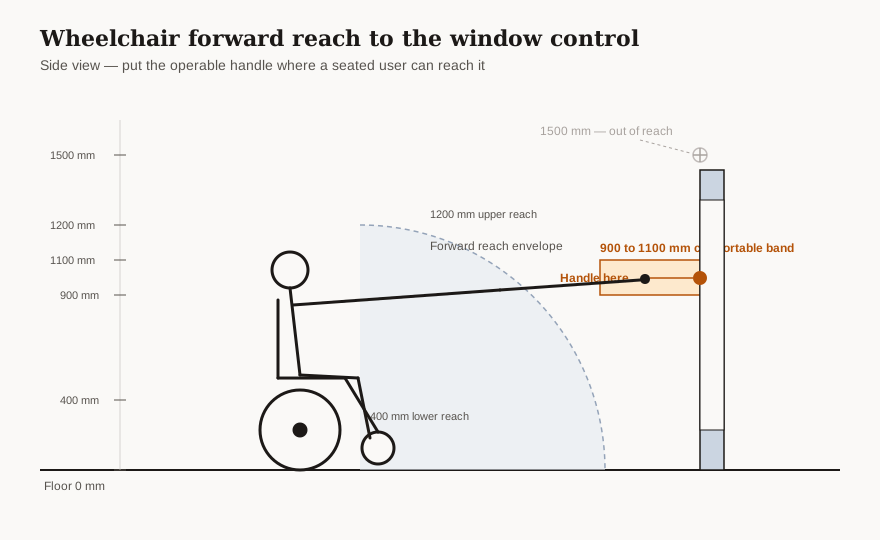
The reach also depends on how close the wheelchair can get. If a counter, sink, or deep sill forms an obstruction, the achievable forward reach drops, so over-reach distance matters. This is why clear floor space at the window is part of the standard, not just the handle height.
2. The wheelchair footprint and clear floor space
The Harmonised Guidelines size everything around a reference wheelchair footprint of about 1050 mm long by 750 mm wide. To approach and operate a window, you need clear floor space for that footprint — typically a clear approach of around 900 mm wide, and a 1500 mm diameter turning circle to manoeuvre in the room. Furniture or radiators jammed under a window quietly defeat compliance.
3. Low sills for a seated sightline (where the view matters)
A standing adult sees over a 900 mm sill; a seated user does not. Where the window exists to give a view (living rooms, day rooms, ward windows), the standard intent is a lower sill so the seated sightline clears it — commonly a sill around 600 mm or lower, giving an eye-level view from a wheelchair (seated eye height is roughly 1100 mm to 1250 mm).
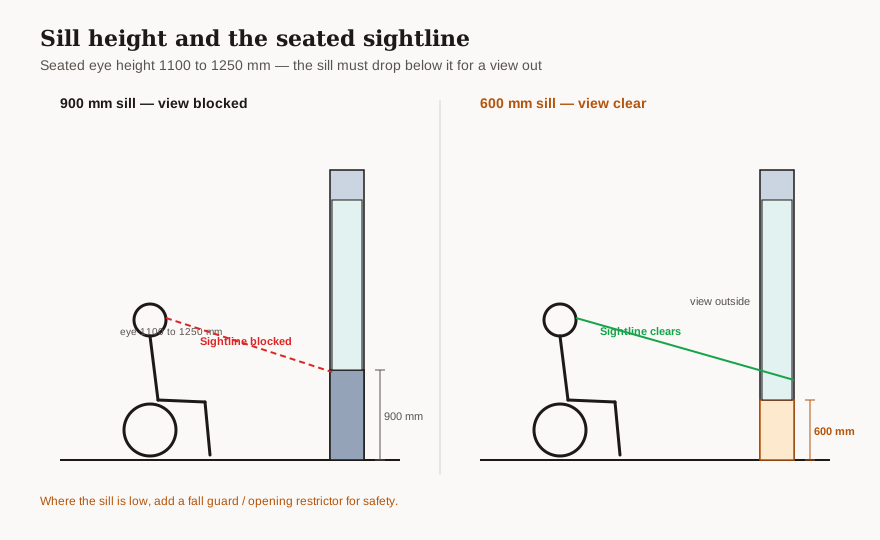
This must be balanced against fall safety: a low sill on an upper floor needs a guard or restrictor. The accessibility goal is the sightline, not an open drop.
4. Lever and easy-grip hardware (operable with one hand, no tight grasp)
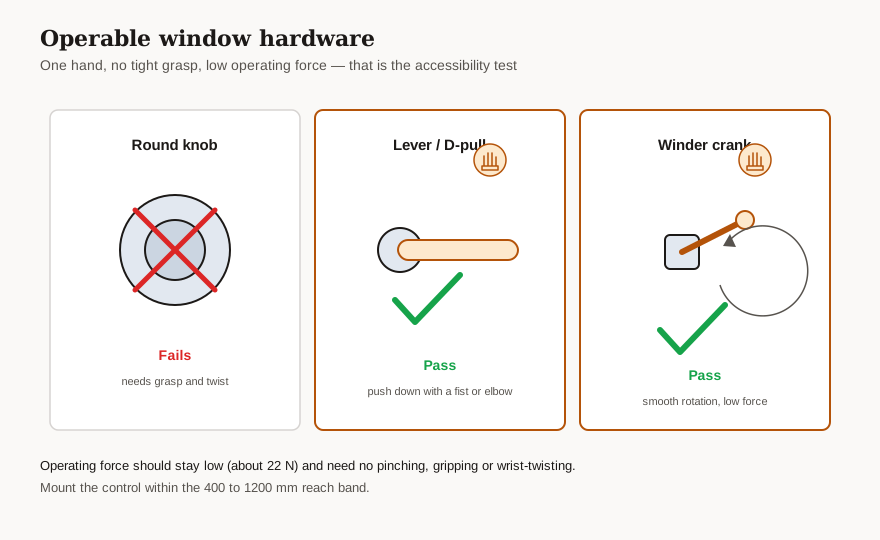
The single most quoted accessibility hardware principle is that controls must be operable with one hand, without tight grasping, pinching, or twisting of the wrist. In window terms that means:
- Lever or D-pull handles, not round knobs or small thumb-turns.
- Low operating force — a sash, crank, or restrictor that a weak or arthritic hand can move.
- Winders or motorised actuators where a heavy sash cannot otherwise be moved.
5. Visibility, contrast, and safe glazing
The guidelines stress colour and luminance contrast so that frames, handles, and the edges of glazing are visible to people with low vision — a clear frame against the wall, a contrasting handle, and manifestation (markings) on large glazed panels so they are not mistaken for an open path. Glazing within reach of a fall also brings in human-impact safety glass duties (IS 2553), which the pillar standards guide maps in full.
Compliance dimensions at a glance
| Parameter | Indicative requirement | Notes |
|---|---|---|
| Wheelchair footprint (reference) | 1050 mm long x 750 mm wide | Basis for clear-space sizing |
| Turning circle | 1500 mm diameter | To manoeuvre and approach |
| Clear approach width | about 900 mm | Unobstructed path to window |
| Control / handle height | 400 mm to 1200 mm (best 900 to 1100 mm) | Within seated forward reach |
| Sill for seated view | about 600 mm or lower | Where the view matters; add fall guard |
| Seated eye height | about 1100 mm to 1250 mm | Drives the sightline target |
| Hardware | lever / D-pull, low force | One hand, no tight grasp |
| Visual | contrast + glazing manifestation | For low-vision users |
All figures are indicative — verify the local building bye-law and the current 2021 Harmonised Guidelines for the binding numbers on your occupancy.
A window accessibility compliance checklist
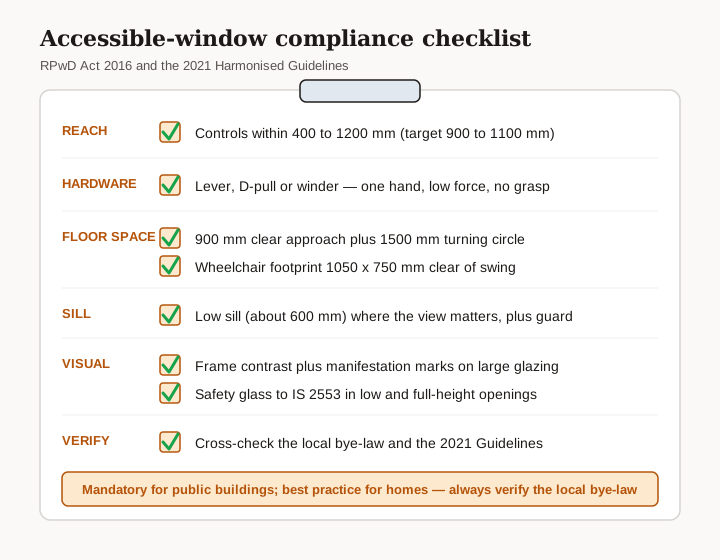
- [ ] Confirmed whether the building type is mandated by RPwD Act / bye-law, or best-practice only.
- [ ] Window controls fall within the 400 to 1200 mm seated reach band.
- [ ] Lever or easy-grip hardware, operable one-handed with low force.
- [ ] Clear floor space (about 900 mm approach, 1500 mm turning circle) at the window — no furniture trap.
- [ ] Low sill where the window's purpose is the view; fall guard or restrictor where needed.
- [ ] Frame, handle, and glazing have contrast and manifestation for low vision.
- [ ] Glazing within fall reach uses safety glass per IS 2553.
- [ ] Checked against the current 2021 Harmonised Guidelines and the local bye-law, not memory.
Where this sits in the standards map
Accessibility is one of several code lenses on a home window. For the full map of every standard — NBC light and ventilation, IS product codes, fire, egress, and the envelope code — start at the pillar, Residential Window Standards in India. For the broader legal frame of what a municipal sanction checks, see Building Regulations and Compliance. For an in-cluster sibling on the life-safety side, see Emergency Escape Window Requirements — an accessible low sill and an escapable low sill often pull in the same direction. To see the window forms these rules apply to, see Types of Home Windows.
And once you know what the law requires, turn to the design guides — Universal Design Windows and Senior-Friendly Window Design — to make it genuinely usable, not just compliant.
References
- The Rights of Persons with Disabilities Act, 2016 (Department of Empowerment of Persons with Disabilities)
- Harmonised Guidelines and Standards for Universal Accessibility in India 2021 (CPWD / MoHUA)
- Accessible India Campaign — Sugamya Bharat Abhiyan (DEPwD)
- National Building Code of India 2016 (Bureau of Indian Standards)
Export this guide
Related Guides — Deep-dive reading
Window Planning for Senior-Friendly Homes (India): Easy, Safe, Bright
Lower sills for a seated view, low-effort lever and motorised hardware, brighter glare-controlled daylight, and safe glass with fall restrictors for ageing residents.
Windows & GlazingUniversal Design and Windows (India): Openings That Work for Every Age and Ability
The seven Universal Design principles applied to windows — reach, sill height, operating force, glare and safe glazing — tied to the RPwD Act 2016 and CPWD Harmonised Guidelines.
Windows & GlazingDesigning Adaptable & Universal-Design Homes
Accessibility, Aging-in-Place, and the Multi-Stage Family — Code, Anthropometrics, and Plan-Stage Discipline for Indian Residential Architects
Room PlanningRelated Tools — Try Free
Cross-Ventilation Analyzer
Estimate airflow and air changes per hour (ACH) from room size, window areas, layout, and local wind — with NBC 2016 Part 8 compliance check.
Ventilation CalculatorWindow Size Calculator
Get the right window size, glazing area and openable area for any room using NBC daylight rules.
Window ToolAccessibility Compliance Calculator
Check a planned lift against the CPWD and RPwD accessible-lift benchmarks for a score.
Lift Checker